
What Camping Gear Do You Actually Need for a Kia Telluride?
The Kia Telluride is one of the better mainstream SUVs for car camping, and the reason is simple: when you fold the second and third rows flat, you open up roughly 87 cubic feet of cargo volume with a load floor about six feet long. That is enough for most adults to stretch out nearly straight, which is the single biggest thing that separates a comfortable platform from a cramped one. The right gear is whatever fits and works inside that space — not the longest packing list you can assemble.
Rather than hand you a pile of product names, this guide is organized by the categories that matter, each sized to the Telluride specifically. Get one good item in each category and you have a complete setup:
- Sleep system — a pad or SUV mattress sized to the ~6-foot folded floor, plus a bag and pillow.
- Power — a portable power station or 12V setup that keeps devices and a fan running without touching the starter battery.
- Privacy and light control — window covers for the Telluride's large glass area.
- Ventilation — a way to move air and manage condensation overnight.
- Roof and cargo expansion — a box or hitch carrier so gear lives outside and the cabin stays clear for sleeping.
- Organization — bins and a system so the bed stays clear and gear is findable in the dark.
- Kitchen — a cooking setup that always runs outside the vehicle.
- Safety — the small kit that turns a problem into a five-minute fix.
The sections below describe what to look for in each category and why it matters for the Telluride. Where a category has a lot of specific models worth comparing, we link to our dedicated buying guide rather than listing products here — this is a setup guide, and the goal is to help you choose well, not to sell you a rooftop tent. If you want the exact interior numbers to plan around, start with our Telluride cargo space and sleeping measurement guide, which lays out the folded dimensions in detail.
One framing helps before you spend a dollar: the Telluride gives you space, not a finished camper. Its advantage over a smaller SUV is that you rarely have to compromise on bed length, and its disadvantage over a van is that you have no plumbing, no standing room, and no built-in power. Good gear closes that gap thoughtfully rather than trying to turn the SUV into something it is not. Spend on the sleep system and power first — they decide whether you enjoy the trip — and treat the rest as upgrades you add as you learn how you actually camp.
Sleep System: Sizing a Bed to the Telluride's Cargo Floor
The sleep system is the foundation, because a comfortable night decides whether you keep camping in the Telluride or give up after one trip. The good news is that the folded floor is long enough — about six feet — that most people can lie close to straight, so you are not forced into the diagonal sleeping that smaller vehicles require. The challenge is leveling and insulating the surface, not finding room.
What to look for, sized to the Telluride:
- Measure first: the load floor is not perfectly flat — the folded seatbacks leave a slight slope and a small step. Measure the usable flat length and width in your own vehicle before buying anything.
- SUV-specific mattress or trimmed pad: a mattress cut for SUV cargo areas, or a sleeping pad trimmed to fit, beats a too-big air mattress that buckles against the wheel wells. Aim for a surface around six feet long.
- R-value matters more than thickness: R-value measures how well a pad resists heat loss into the cold metal floor. The ground under a parked car runs colder than the air, so a higher number keeps you warmer than extra cushion does.
- Bridge the gaps: a thin closed-cell foam layer or a folded blanket under the pad evens out the seatback step and adds insulation for almost no money.
Size the bed to the car, never the other way around. A pad cut to the Telluride's exact flat zone will always sleep better than the thickest mattress you can wrestle inside.
For a full breakdown of pads, bags, and how the layers work together, see our car camping sleeping system guide. The principles there apply directly to a Telluride-sized bed: a flat, insulated surface you can size and then forget about once you lie down. If two of you are sleeping, remember that the Telluride's width is generous for an SUV but still tighter than a queen — most couples run two narrow pads side by side rather than one wide mattress that fights the wheel wells.
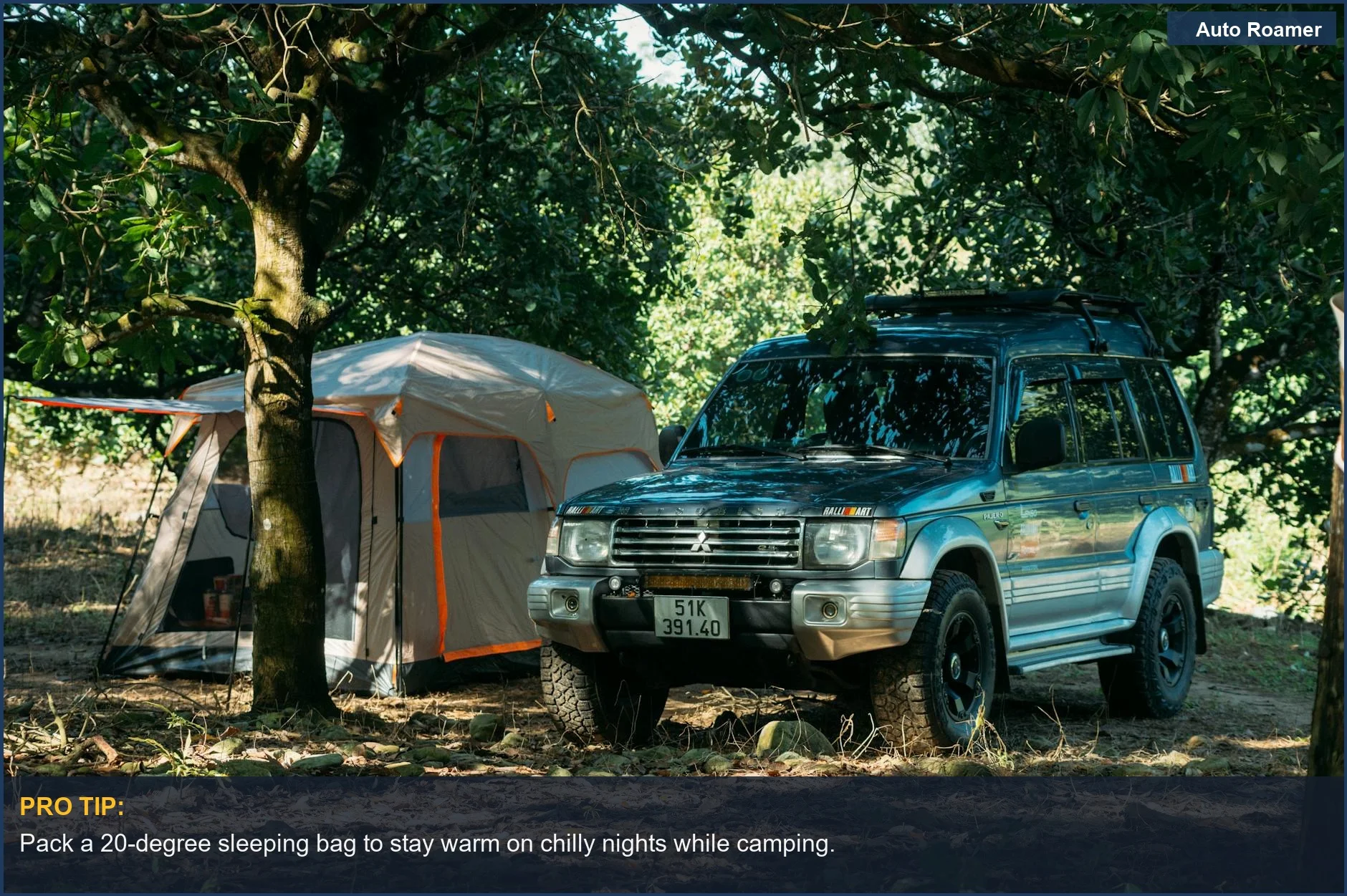
A word on the bag and pillow, because people obsess over the pad and forget the rest. Match the sleeping bag's temperature rating to the coldest night you realistically expect, then bring one warmer layer in reserve — it is far easier to vent a warm bag than to add heat to a cold one. A compressible camp pillow or even a stuff sack filled with clothing keeps your neck aligned and stops you from waking up sore. None of this is Telluride-specific, but the flat six-foot floor finally gives you room to use a full-size system instead of the abbreviated setups small cars force on you, so take advantage of it.
Power: Running Devices Without Killing the Starter Battery
This is where careless car campers get stranded. The Telluride's 12-volt system exists to start the engine and run accessories while it is on — not to power a fan, lights, and a cooler through the night with the engine off. Draw the starter battery down too far and you wake up to an SUV that will not start. Plan your power so that never happens.
The honest hierarchy of options:
- Built-in 12V and USB outlets: the Telluride has multiple outlets, including one in the cargo area on many trims, which is genuinely handy. Treat them as drive-time charging, though — running them for hours with the engine off can flatten the starter battery.
- Power bank: the simplest off-grid option for phones and headlamps. Rated in watt-hours; higher means more recharges before it is empty.
- Portable power station: the real answer for anything beyond phones — a fan, lights, a laptop, or a 12V cooler. It is an independent battery you charge at home or while driving, so it never touches the starter battery. Match its watt-hour rating to what you actually run overnight.
- Portable jump starter: cheap insurance. If you do drain the car battery, a compact jump pack gets you moving without flagging down a stranger.
For sizing a station against real camping loads, our portable power station guide walks through watt-hours versus what a fan, lights, and a cooler actually draw. The rule of thumb for a Telluride: anything more than topping up a phone belongs on a dedicated battery, not the car's. The Telluride's large cargo area easily swallows a mid-size power station, so you are not space-constrained the way a small-car camper is — there is no reason to risk the starter battery to save room.
The cheapest mistake to avoid: never run a fan, cooler, or lights off the starter battery overnight. A dedicated power station costs far less than a tow truck and a missed morning.
To size a station, add up what you run overnight and for how long. A small fan might pull a handful of watts, a string of LED lights almost nothing, and a 12V cooler the most of the bunch, cycling on and off through the night. A mid-size station in the few-hundred watt-hour range covers a typical two-night trip with a fan, lights, and phone charging; add a cooler or longer stays and you want more capacity or a way to recharge from the Telluride's outlet while you drive between sites. Buying slightly more capacity than you think you need is the common regret-free choice, since a station that never quite makes it through the night is worse than no plan at all.
Window Covers, Privacy, and Light Control
The Telluride has a lot of glass, and covering it does three jobs at once: privacy so you can sleep without feeling exposed, darkness so streetlights and sunrise do not wake you, and a real insulation boost against the car's biggest heat-loss surface. In an SUV this size, the rear quarter windows and the large tailgate glass are easy to forget and are exactly where light and heat leak.
The approaches, cheapest to most polished:
- DIY reflective panels: reflective bubble insulation cut to each window is the classic budget fix. Trace templates from cardboard first — the Telluride's curved glass rarely matches a straight cut.
- Custom-fit covers: made-to-measure magnetic or snap covers exist for popular SUVs and look far cleaner than DIY, at a higher price.
- Front windshield shade: the windshield is the largest single pane; a folding reflective shade handles it and doubles as daytime heat control while parked.
On the reflective-versus-blackout question, the two materials serve different goals — reflective bounces daytime heat, blackout kills light for sleep. Our comparison of reflective vs blackout sun shades covers when each one wins. Most Telluride campers end up with reflective panels on the sides for insulation and stealth, plus a windshield shade for the front. Cover every pane, not just the doors — the cargo-area glass is right next to your head when you sleep with the seats folded.
Privacy also intersects with where you park. Covered windows let a parked Telluride read as an ordinary SUV rather than an obvious camper, which matters for urban overnights. Always confirm the local rules first — our state-by-state overview of where it is legal to sleep in your car is the place to start before you rely on a parking lot.
Ventilation and Condensation Control
A sealed SUV with people sleeping inside fogs up fast. Each person exhales roughly a liter of water vapor overnight, and that moisture lands on cold glass as condensation — damp bedding, wet windows, and a clammy morning. The Telluride's larger interior volume helps a little compared with a small car, but ventilation is still part of the build, not an afterthought.
How to move air without inviting bugs or rain:
- Crack windows on opposite sides: even a half-inch on two windows creates cross-flow that carries moisture out. One cracked window does far less.
- Bug mesh: magnetic or DIY mesh over the gap lets you open windows wider in buggy areas — essential in summer.
- A small 12V or USB fan: actively pushes humid air out and makes warm nights bearable. A rechargeable window fan is one of the highest-value cheap upgrades for any vehicle setup.
- Wipe the glass: keep a microfiber cloth handy; a quick wipe clears morning fog in seconds.
The trade-off shows up in cold weather: the same airflow that clears moisture also lets heat escape, so winter campers balance staying warm against staying dry. The answer is almost always to keep at least a small gap for air and to insulate harder — a warmer pad and bag — rather than sealing the Telluride tight. A sealed, warm SUV in winter produces the worst of both: dripping windows and damp bedding by morning. Cracking the downwind windows on opposite corners gives the best cross-flow without a direct draft on your face, and inexpensive window deflectors let you keep that gap open even in a light rain.
Roof and Cargo Expansion: Freeing Up the Cabin
Here is the catch with sleeping in any SUV: the moment you fold the seats flat for a bed, you lose the cargo space you were going to store gear in. The fix is to move bulky, low-value items out of the cabin entirely — onto the roof or behind the vehicle — so the interior stays clear for sleeping. The Telluride's roof rails and available tow hitch both make this straightforward.
The expansion options, and what to look for:
- Roof cargo box: a hard, lockable box mounts to the crossbars and keeps gear dry and secure. Check your Telluride's roof load rating and confirm the box length clears the rear hatch when it opens. Our rooftop cargo box guide covers fit and capacity.
- Soft roof bag: cheaper and packs away when not in use, at the cost of weatherproofing and aerodynamics. Best for occasional trips — see our soft roof cargo bag guide for what matters in fit and rain protection.
- Hitch cargo carrier: a platform on the tow hitch keeps weight low and loading easy, and it does not hurt fuel economy as much as a roof box. Good for dirty or bulky gear you would rather not lift overhead.
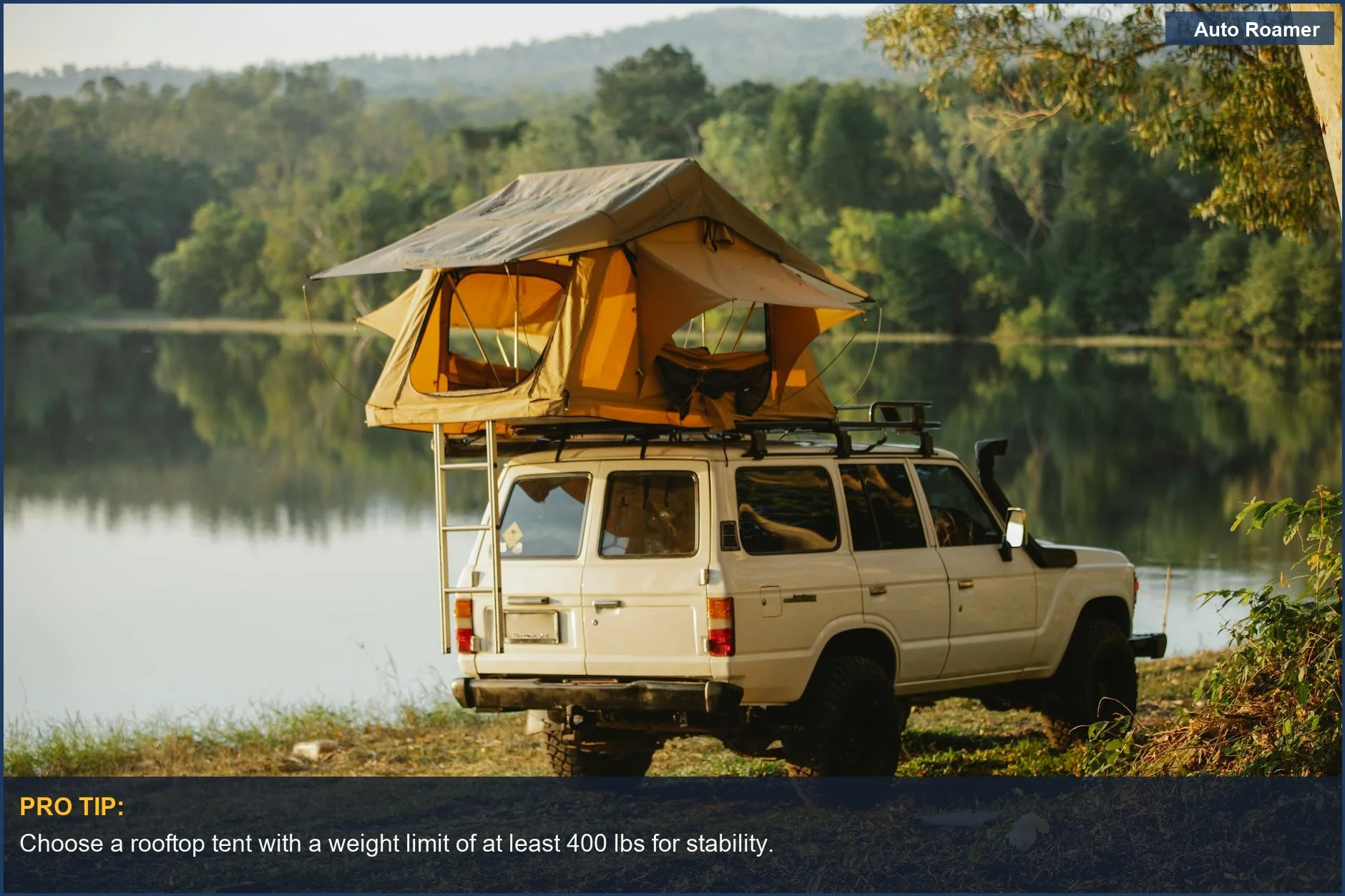
- Rooftop tent (advanced): turns the roof into a separate bedroom and keeps the cabin free, but it is a major investment and adds height, weight, and wind noise. Confirm the Telluride's dynamic and static roof ratings before committing.
The practical principle is simple: whatever you do not need during the night goes outside the sleeping area. Clothes, the kitchen kit, and dirty boots live in a roof box or hitch carrier; the cabin holds the bed and the few things you reach for in the dark. That single habit is what keeps a Telluride livable for more than one night.
Fold the seats and you trade cargo space for a bed. Plan where that displaced gear goes before the trip, not at midnight in a dark parking lot.
Organization and Cooking Outside the Vehicle
Even with the Telluride's generous interior, organization is what keeps the sleeping area usable. The working principle is to keep the bed clear at night and stash everything in defined spots so you are never excavating gear in the dark. A big cargo area fills up fast once it is also your bedroom.
The categories that earn their space:
- Stackable bins: clear, modular totes that slide under a raised platform or sit in the footwells. Clear sides mean you find things without unpacking.
- Seat-back and cargo organizers: keep phone, headlamp, and snacks within arm's reach so small items never migrate into the bed.
- A raised platform (optional): a simple plywood base over the folded seats creates a dead-flat bed with hidden storage underneath — the highest-effort, highest-reward upgrade for a Telluride.
- A 12V cooler: keeps food cold for days without ice runs and runs off your power station. See our 12V cooler guide for sizing against camping loads.
Cook outside the vehicle — always. Never run a fuel stove inside the Telluride: an open flame in an enclosed space is a carbon monoxide and fire hazard. Set up on the tailgate or a small table outside, keep food in a cooler, and lean on no-cook meals when you are parked somewhere you would rather not advertise. The cabin stays for sleeping; cooking, dishes, and anything with a flame happen outside, under the open liftgate if it is raining.
A workable Telluride packing system follows one rule: every item has a home, and the bed has none of them at night. Daytime clothes live in a duffel in a roof box, the kitchen kit lives in one bin you lift straight out to the tailgate, and the things you reach for in the dark ride in a cargo organizer where your hand already knows to find them.
The setup-and-teardown routine is worth rehearsing once at home before a trip. Folding the seats, laying the pad, and arranging bins in the same order every night turns a fumbling twenty-minute scramble into a five-minute habit, and you quickly learn which bin needs to come out first and which can stay wedged against the wheel well. That dry run also surfaces the small gaps — a missing strap, a bin that does not quite clear the folded seatback — while you are still standing in your driveway instead of discovering them after dark at a trailhead.
Safety Essentials and Putting the Setup Together
Weekend trips are forgiving; longer stints in the Telluride reward a little discipline. A few non-negotiables keep a fun trip from turning into an emergency, and none of them cost much.
The safety floor:
- Never run the engine to heat the cabin while you sleep. Carbon monoxide from a running or idling engine is the leading car-sleeping danger. Heat with proper clothing, a warm bag, and insulation — not exhaust.
- Carry a jump starter and basic tools: a compact jump pack turns a dead battery into a five-minute fix, and a small kit handles the predictable roadside problems.
- Manage moisture daily: air out bedding, wipe condensation, and keep wet gear out of the cabin, or mildew sets in over a long stay.
- Know the local rules and have a water and bathroom plan: overnight-parking legality varies widely, and the Telluride has no built-in amenities, so build a routine around rest stops, gyms, or campgrounds before you need one.
Put it all together and the Telluride is a genuinely capable basecamp: a six-foot folded floor for the bed, a power station to run a fan and lights, covered windows for privacy and warmth, cross-flow ventilation to stay dry, and a roof box to keep the cabin clear. Each category needs only one good choice, sized to the vehicle, and the links throughout this guide point to the specific picks worth comparing. If you are weighing the Telluride against other options for a camping rig, our overview of which SUV is best for camping puts its cargo space and sleeping room in context. Size your gear to the car, keep air moving, keep power off the starter battery, and cook outside — and the Telluride turns into a comfortable, stealthy place to spend the night.