Kia PV5 camping mode: what's actually confirmed so far
The Kia PV5 does not leave the factory as a camper. What exists today is a passenger van rated for 412 km of WLTP range, fitted with a 3.6 kW V2L outlet, and a small but growing list of third-party kits that turn its cargo floor into a bed. Sorting the confirmed spec sheet from concept-car renderings is the point of this guide.
Two very different things get called a "PV5 camper" online, and mixing them up leads to bad buying decisions. The first is the PV5 WKNDR, a design study Kia has shown with roof tents and off-road styling attached — it has never been listed for sale and carries no production date. The second is real: VanLab sells a bolt-in camping kit through Kia's own online shop in Korea, and Vantrack has built a working PV5-based conversion called the LightCamp, with a cabin bed and rooftop tent. Wallpaper covered one such build in detail, and Electrek reported on the first of these kits reaching buyers. Neither is Kia building a camper at the factory; both are aftermarket work bolted to a Kia-built platform.
That platform is what actually matters for a build. The published dimensions, the battery options and the V2L output are Kia's own numbers, not a converter's marketing copy, and they hold regardless of which kit eventually gets bolted to the floor. This guide sources every figure it uses to Kia's own spec sheet or to a named publication, and it says plainly where Kia has not published a number rather than estimating one.
What follows works through the van in the order a build actually happens: dimensions first, then where a body goes, then the power budget everything else depends on, then the parts that keep a night in the PV5 from being miserable — ventilation, tie-downs, insulation, food, and the charging routine around a weekend away.
What the PV5 actually is: a platform, not a minivan
Kia built the PV5 as a dedicated commercial EV platform first, with the passenger van as one body on that frame. The confirmed production lineup covers a Passenger version, a Cargo version offered in Compact, Long and High Roof configurations, and a wheelchair-accessible WAV variant — three different jobs off one chassis, which is part of why Kia is comfortable letting outside shops build the camper body rather than doing it in-house.
The battery lineup follows the same logic. According to Wikipedia's summary of the range, Kia offers a 43.3 kWh LFP pack sold only in Europe, a 51.5 kWh NCM pack badged Standard Range, and a 71.2 kWh NCM Long Range pack — the one this guide uses for every figure below. EV Database lists the Long Range pack paired with a motor rated at 89.4 kW (122 PS / 120 hp), enough to move a loaded cargo body, not a performance number worth dwelling on for a camper build.
What Kia has not done is announce a factory camper trim with its own model code. The vehicle-to-load hardware, the flat cargo floor and the load rating are Kia's contribution; the bed, the kitchen module and the insulation are aftermarket.
None of that ambiguity changes what the spec sheet says. The dimensions, the battery capacity, the range and the V2L output are Kia's own numbers, published and consistent whether the eventual build is a VanLab kit, a Vantrack LightCamp, or a plywood platform someone builds themselves. Buyers cross-shopping the format against a combustion minivan or a purpose-built RV should treat the PV5 as its own category — a commercial EV platform wearing a passenger body, not a repurposed family van and not a factory motorhome.
Computed runtime: how long each capacity this page states lasts against each draw it states. Nothing here is a spec-sheet import — it is arithmetic on figures this page already states (71.2 kWh, 67 kWh, 51.5 kWh, 43.3 kWh, 1,024 Wh, 1,800 W, 3.6 kW, 89.4 kW). The formula is the plain one: hours = watt-hours ÷ watts. No conversion-loss derating is applied, because this page states none — real-world output will be lower than the division.
| What the page states | Capacity | at 1,800 W | at 3.6 kW | at 89.4 kW |
|---|---|---|---|---|
| …and a 71.2 kWh NCM Long Range pack… | 71.2 kWh | 39.6 h | 19.8 h | 0.8 h |
| …drawn from a 71.2 kWh pack with roughly 67 kWh usable | 67 kWh | 37.2 h | 18.6 h | 0.7 h |
| …a 51.5 kWh NCM pack badged Standard Range… | 51.5 kWh | 28.6 h | 14.3 h | 0.6 h |
| …Kia offers a 43.3 kWh LFP pack sold only in Europe… | 43.3 kWh | 24.1 h | 12 h | 0.5 h |
| …with its published 1,024 Wh capacity and 1,800 W AC output… | 1,024 Wh | 0.6 h | 0.3 h | 0 h |
Read down the 1,800 W column, because that is the choice: 71.2 kWh runs 39.6 h where 1,024 Wh runs 0.6 h — at the same draw the larger capacity beats the smaller by 39 h. Every column to the right is that same choice at a heavier load, down to 0 h at 89.4 kW.
Kia PV5 dimensions and the cargo space you actually sleep in
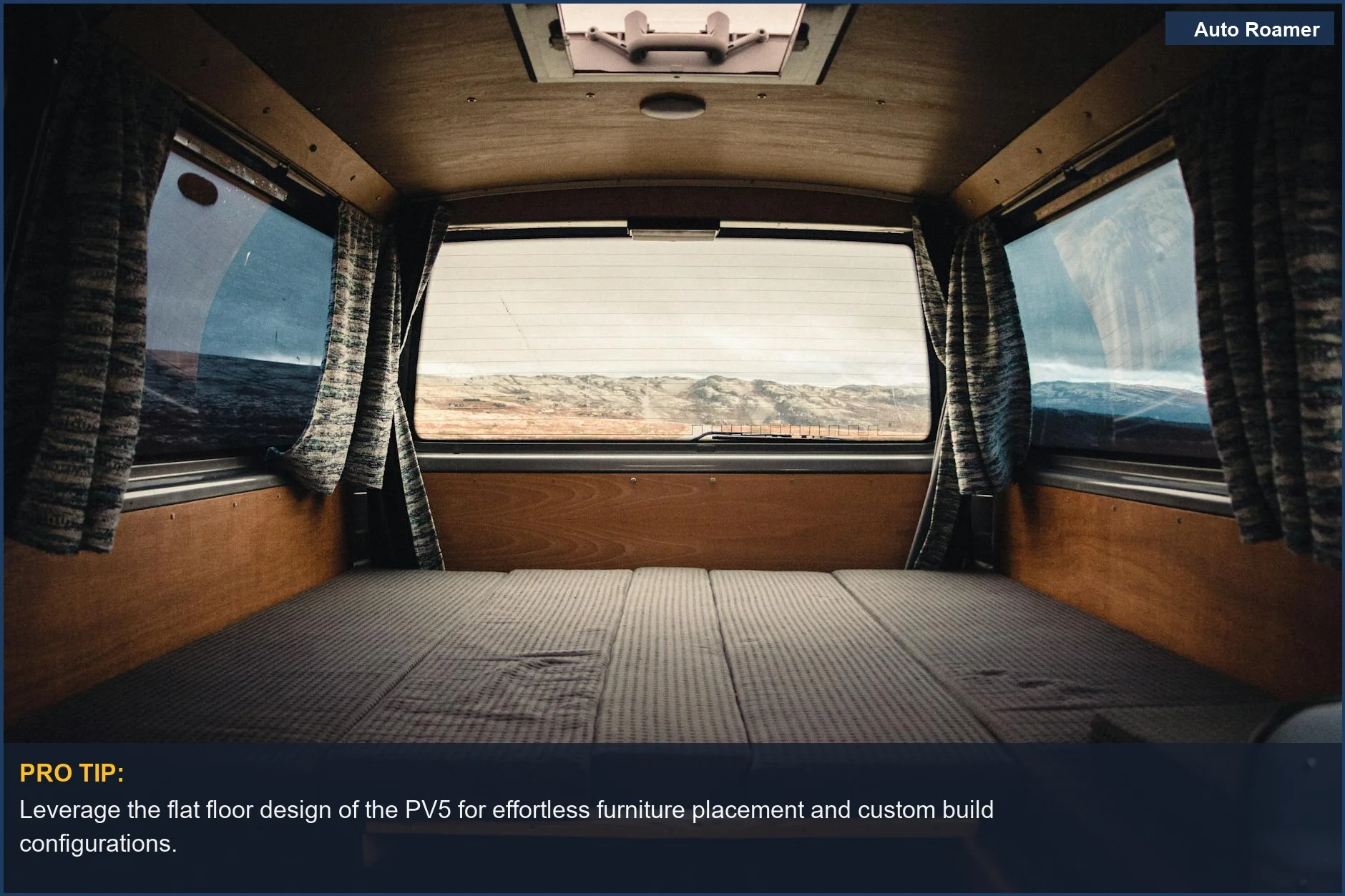
Every camper build starts with the box it has to fit inside, and on the Long Range Passenger PV5 that box measures 4,695 mm long, 1,895 mm wide and 1,899 mm tall, on a 2,995 mm wheelbase. Those four numbers set the ceiling for everything else in this guide — bed length, aisle width, and how much of the load floor is flat versus wheel-well.
The wheelbase number matters more than most builders give it credit for. At 2,995 mm, it determines how much genuinely flat floor sits between the front seats and the rear doors before the rear wheel housings start eating into the width. A platform bed built to the wheelbase length, rather than the overall vehicle length, is the number a conversion shop actually cuts plywood to.
| Spec | Figure |
|---|---|
| Overall length | 4,695 mm |
| Width | 1,895 mm |
| Height | 1,899 mm |
| Wheelbase | 2,995 mm |
| Cargo volume, seats up | 1,330 litres |
| Cargo volume, seats folded | 3,615 litres |
| Maximum payload | 530 kg |
Cargo capacity is where Kia publishes two different figures depending on seating position, and conflating them is a common mistake. With the second-row seats in place, the published figure is 1,330 litres of load volume; folded flat, that rises to 3,615 litres — the seats-folded, sleep-ready configuration a camper conversion actually starts from. Kia also publishes a maximum payload of 530 kg, a separate ceiling from the volume figures: a build can run out of payload before it runs out of floor space, particularly once a bed frame, a power station and a fridge are all on board.
None of these figures move once a kit goes in. Whatever gets bolted to the floor is working within the same 3,615-litre envelope Kia publishes for the stock van, because the body-in-white does not change.
Sleeping in 3,615 litres: platform, pad, or both
A seats-folded load volume of 3,615 litres is generous by camper-van standards, but litres do not describe what the floor feels like at 2 a.m. That comes down to two decisions: what the sleeping platform is built from, and what sits between a body and the van's steel floor.
The platform question is mostly about wheel-well intrusion inside that 2,995 mm wheelbase. A plywood deck spanning the wheelbase length gives a flat sleeping surface, but it sits directly on a floor engineered for cargo straps, not comfort — which is why the pad underneath matters as much as the platform itself. An EV cargo floor is also colder than a gas van's, because there's no engine bay radiating heat nearby, so insulation under a sleeping bag does more work here than it would in a combustion van.
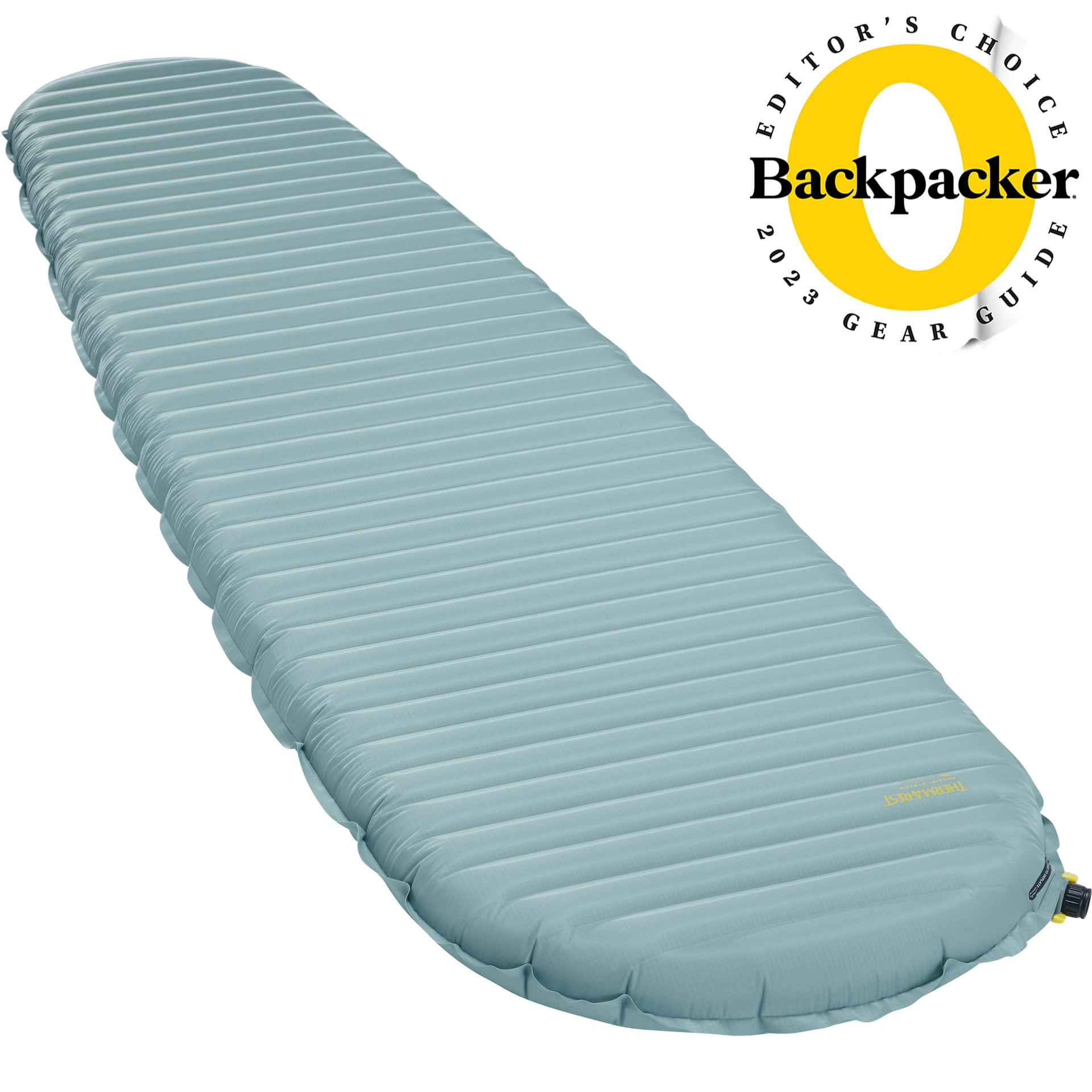
A pad rated for genuinely cold ground, not a car-camping foam mat, is the difference between a comfortable night and a cold one. The Therm-a-Rest NeoAir XTherm is built for exactly that problem: a published 7.3 R-value and 3 inches of loft, in a package that weighs 15.5 oz (440 g) — light enough to store rather than leave permanently deployed on the platform.
Twelve real buyer questions about sleeping in a vehicle, most of which apply directly to a PV5 build, are worked through in Sleeping in Your Car, Answered — condensation on the pad, a partner who sleeps cold, and what goes wrong the first night in a new vehicle. The platform and the pad are one decision, not two: a rigid platform without a cold-rated pad under it just moves the cold problem from the steel floor to the plywood.
Power: what 3.6 kW of V2L really buys you overnight
Kia rates the PV5's vehicle-to-load output at 3.6 kW AC, drawn from a 71.2 kWh pack with roughly 67 kWh usable. That is the entire power budget for a night of camping once the van is parked: whatever runs a fridge, a fan, lights and a laptop charger has to come out of that pack, alongside whatever driving range is needed the next day.
The honest way to size a camp power budget is to add up the wattage of everything that will run and compare it against the 3.6 kW ceiling, not to assume the number scales into a single runtime figure. A fridge, a fan and a laptop charger running together draw far less than 3.6 kW at any instant, which means the V2L outlet is rarely the bottleneck — the battery capacity behind it is. Working out how long a given load can run on a given amount of usable energy is arithmetic anyone can do once each device's wattage is known; a single published "hours of runtime" figure hides too many variables, from ambient temperature to how deep into the 67 kWh a driver is willing to go before the next charge.
- Fridge draw — the single largest continuous load in the budget
- Fan or ventilation draw — smaller, but constant if it runs all night
- Lighting and device charging — short bursts, low average draw
- Remaining headroom under the 3.6 kW V2L ceiling before anything else gets added
Ventilation and condensation: the problem nobody budgets for
A sealed steel box with two adults breathing inside it overnight produces a surprising amount of water vapor, and an EV cargo van has none of the passive air leaks a decades-old conversion van picks up around door seals. Condensation on cold glass and the inside of the roof is a mechanical problem, not a comfort one — it soaks a sleeping bag from underneath if it is not managed.
Active airflow does more than a cracked window ever will, particularly with a fridge adding its own heat load to the cabin. A dedicated window fan pulls damp, warm air out faster than passive venting, and running one on low overnight is a meaningfully different experience from sleeping in still air.
None of this is unique to the PV5, but an EV cargo van's tighter sealing makes it worse than average. A build that skips ventilation planning entirely is choosing between a stuffy night and a wet one — one of the cheapest problems on this list to solve.
- Cracked window — free, but lets bugs in and breaks any blackout
- Mesh window screen — keeps airflow open while blocking insects and prying eyes
- Dedicated window fan — actively pulls damp air out instead of waiting on convection
- Reflective liner behind a screen — cuts radiant heat loss as a side benefit
Securing gear so nothing becomes a projectile
Everything loaded into a 3,615-litre cargo area needs to be tied down before the van moves, not just arranged neatly. A fridge, a power station, cooking gear and a folded platform bed are all heavy enough to become dangerous in a hard stop if nothing holds them to the floor or the wall. Cargo vans generally ship with floor-mounted tie-down points for exactly this reason, and a PV5 conversion should use them rather than relying on friction and gravity.
A fridge in particular needs to be secured in a way that does not block its ventilation — most compressor fridges draw cooling air through vents on one or two sides, and a strap run across the wrong face can choke airflow and shorten the compressor's life while doing nothing extra for safety.
- Anchor heavy items — fridge, power station, water containers — to floor points, not to the platform bed frame itself
- Leave the fridge's vent faces clear of straps and stored gear
- Keep loose small items in a closed bin rather than loose on shelves
- Re-check strap tension after the first few miles of a trip; webbing settles and loosens
Weight distribution matters as much as tie-down points. Kia's published payload ceiling for the PV5 is 530 kg, and a loaded camper build — bed frame, pad, power station, fridge, food and water — can use a meaningful share of that number before a passenger even climbs in. Heavy items belong low and centered over the axle, not stacked toward the rear doors, both for handling and so a rear-end collision does not turn a fridge into a projectile aimed at whoever is sleeping closest to the doors.
Cold, insulation and what an electric camper actually loses
An EV loses heat differently than a combustion van does. There is no engine block radiating warmth through a firewall, no exhaust pipe running heat under the floor, and no idling for cabin heat without also running down the battery that has to get the van home. Insulation on an electric camper build is doing a job that a gas van's waste heat used to do partly for free.
The floor is usually the largest uninsulated surface in a cargo conversion, and it is also the surface a sleeper is in direct contact with all night. Rigid foam board under a plywood platform, combined with a properly rated sleeping pad on top, addresses the floor from both directions — the board stops heat from bleeding into the van's steel structure, and the pad stops it from bleeding into the sleeper.
Kia has not published an overnight climate-drain figure for the PV5 — there is no factory number for how much of the pack a heater or a fridge consumes while parked overnight, on any battery option. That gap is exactly why insulation matters more on an EV build than on a gas one: every watt insulation keeps in is a watt that does not have to come back out of the 71.2 kWh pack through a heater.
Windows and the roof are the next-largest losses after the floor, and a window screen that manages condensation and privacy can also help cut radiant heat loss overnight when paired with a reflective liner behind it.
Food, water and the fridge that decides your power budget
Every power decision earlier in this guide traces back to one appliance: a 12-volt compressor fridge is the single largest continuous electrical load in a parked PV5 camper, because unlike lights or a fan, it cycles on and off all night regardless of whether anyone is awake to use it. Sizing the rest of the power system starts with knowing what the fridge itself draws — its rated wattage, not a guess, is what turns a power budget from a hopeful estimate into a number worth trusting.
Capacity, wattage and cooldown time are the three specs that actually matter when shopping for a compressor fridge to run off the PV5's V2L outlet: how much food and how many cold drinks fit, what it costs to run continuously overnight, and how long it takes to catch up after the lid has been open. Whether that draw runs off the van's V2L outlet directly or off a buffer battery charged from V2L is the decision the power section above walks through — the point here is that a fridge running continuously overnight, even at a modest wattage, adds up differently than a phone charger that only draws power in short bursts.
Water storage is the lower-tech half of this section but no less important: a sealed container that will not tip or leak inside a cargo area also holding electronics is worth more than a large capacity that sloshes.
How to keep any 12V fridge from quietly draining a battery it was never sized against is covered directly in How to Keep a 12V Fridge From Draining Your Car Battery, which applies to a PV5's V2L-fed fridge exactly as it does to a truck-bed cooler wired to a starter battery.
Charging strategy around a camping weekend
A camping trip in the PV5 is really two separate charging problems stacked on top of each other: getting to the destination and back on the 412 km WLTP range, and covering whatever camp power gets drawn out of the pack overnight before that return drive. Treating them as one number invites running short on either driving range or camp power.
Fast charging is the tool for the driving half of that equation. Kia's published DC figure for the Long Range pack is 39 minutes for a 10-80% charge, fast enough to make a mid-trip top-up practical on a longer weekend without turning it into an hours-long stop. That figure is for the driving battery specifically; it says nothing about how quickly a depleted overnight camp-power draw gets replaced, because that draw comes out of the same 71.2 kWh pack that also has to cover the drive home.
- Charge the buffer battery to full at home, off wall power, before leaving
- Reserve the van's own pack for driving range plus a safety margin
- Use DC fast charging for the drive itself — the 39-minute 10-80% figure applies to that leg, not to topping off camp power
- Recharge the buffer from the van's V2L outlet once back on the road, not overnight at the campsite
The bottom line on the PV5 as a camper base
Strip away the concept renderings and the marketing copy, and what is left is a specific, well-documented electric van: 4,695 mm long, 3,615 litres of load volume with the seats folded, a 71.2 kWh pack with about 67 kWh usable, and a 3.6 kW V2L outlet that can run camp appliances without a separate generator. Those figures, not a factory camper trim that does not exist yet, are what a build actually has to work with.
What makes the PV5 a credible camper base is that Kia designed the platform with V2L and a flat cargo floor from the start, rather than an EV conversion bolted onto a van designed for something else. A YouTube walkthrough of one owner's four days living in a converted PV5 shows the format working in practice, though the video documents a single build's experience, not a guarantee every conversion performs the same way.
What keeps the PV5 from being a turnkey camper is exactly what this guide has spent most of its length on: insulation, ventilation, tie-downs and a fridge-driven power budget are all still the builder's job, whether the starting point is a VanLab kit, a Vantrack LightCamp, or a bare cargo floor.
The gaps in what Kia has published are worth taking seriously rather than papering over. There is no factory overnight climate-drain figure and no published US price, and any dollar figure attached to a kit or a conversion should be confirmed directly with the seller before budgeting around it.