
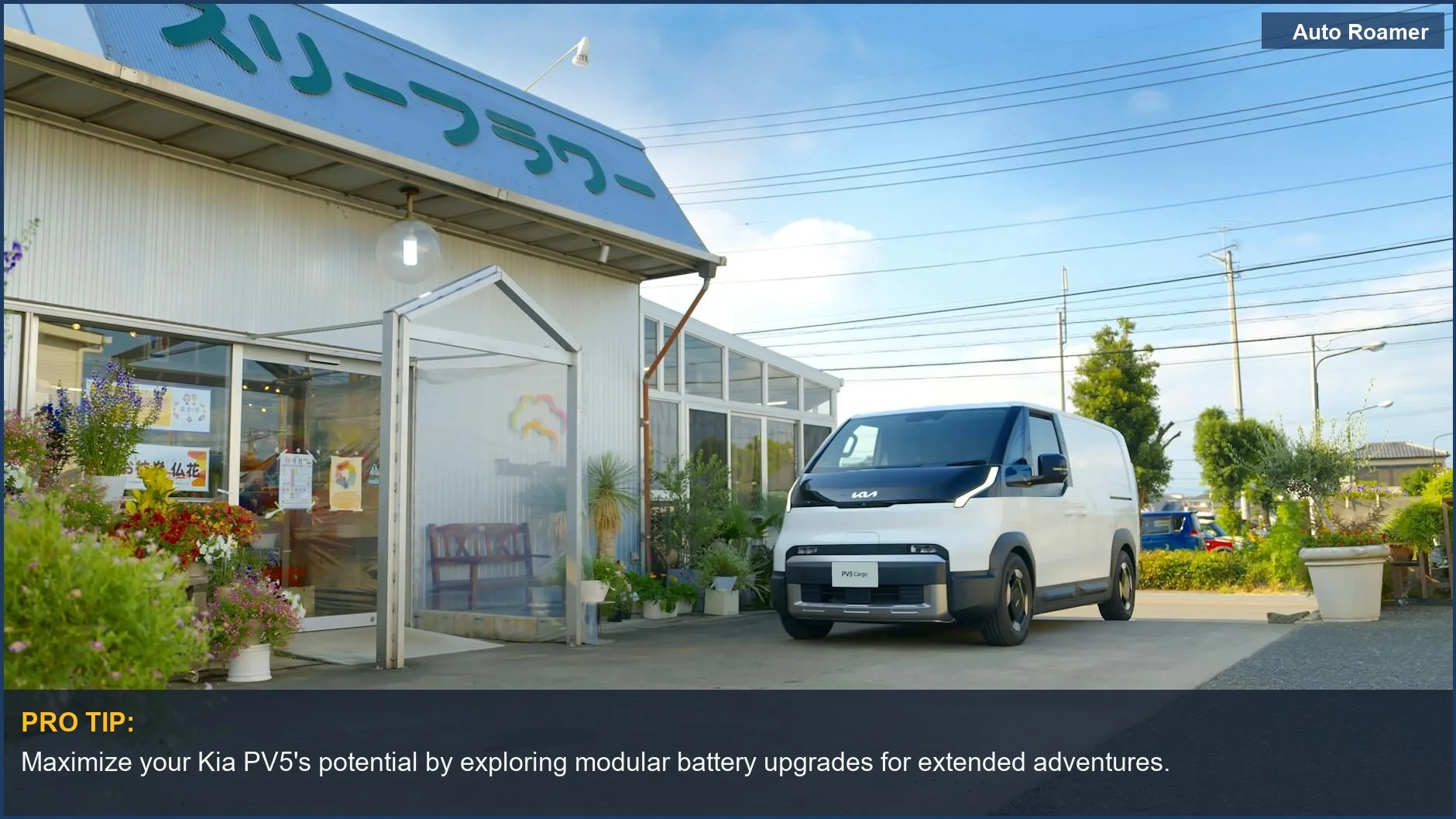
Why the PV5's Powertrain Changes the Camper Math
Most camper conversions start with a question every van builder knows well: where does the power come from? In a conventional gas or diesel van you bolt in a separate house battery, a charger, wiring, fuses, and often solar, just to run a fridge and charge phones. The Kia PV5 reframes that question, because it is an all-electric van that already carries a large traction battery and, per Kia's announcements, can feed power back out through a vehicle-to-load (V2L) system.
That single capability is the reason the PV5 keeps coming up in van-life conversations. If the vehicle's own battery can run your camp appliances directly, a meaningful chunk of the usual electrical build either shrinks or disappears. You are no longer designing a house power system from scratch; you are tapping a battery that is already engineered, cooled, and warranted.
Before going further, an honesty note that governs this whole guide. Everything here is drawn from Kia's published and announced specifications and credible reporting on the PV5, not from our own first-hand testing of a converted van. The PV5 is rolling out in markets outside the United States first, and figures vary by region, trim, and battery option, so treat the numbers as planning figures and confirm the spec for your specific market before you commit to a build.
What makes the powertrain compelling for camping comes down to three linked ideas:
- A big battery you already paid for. The traction pack dwarfs any house battery you would realistically install, so capacity stops being the bottleneck it is in a gas conversion.
- V2L turns the van into a power station. Vehicle-to-load lets you plug appliances straight into the van, running a fridge, an induction burner, or devices without a separate inverter-and-battery stack.
- A purpose-built EV platform. The PV5 rides on Kia's dedicated Platform Beyond Vehicle (PBV) architecture, designed from the start for swappable bodies and commercial duty, which is friendlier to conversion than a retrofitted passenger chassis.
The rest of this guide walks through each of those pieces in turn, then gets honest about the tradeoffs that do not show up on a spec sheet: how a heavy conversion eats into range, how you heat an electric camper without a combustion heater, how you plan charging on the road, and where US buyers actually stand today. If you want the broader picture of Kia's camper plans, our overview of the 2026 Kia camper van covers the concepts and the realistic options, while this article stays focused on the powertrain itself. See wiring dash cam power in a PV5 conversion.
The PBV Platform and PV5 Variants
The PV5 is the first vehicle in Kia's PBV lineup, where PBV stands for Platform Beyond Vehicle. The idea behind PBV is modularity: a common electric skateboard chassis, with the battery and drive unit packaged low and flat, onto which Kia can fit different upper bodies. Kia has shown the PV5 in passenger, cargo, and other configurations, and has publicly discussed more specialized derivatives built on the same base.
For a camper builder, a dedicated EV platform matters for reasons that go beyond marketing language:
- A flat floor. With the battery in the floor, there is no transmission tunnel or driveshaft hump intruding into the living space, which makes a flat sleeping platform and standing-height layouts easier to design.
- A low center of gravity. The heavy battery sits low, which helps stability once you add the weight of a conversion up high.
- Designed for body variety. Because the platform was built to accept different bodies, the cargo and high-roof variants that suit camping are part of the plan rather than an afterthought.
Kia has indicated the PV5 will come in multiple length and roof-height configurations, including cargo-oriented versions that are the obvious starting point for a conversion. A longer-wheelbase, taller-roof PV5 gives you the interior volume to build a usable galley and bed, while shorter variants stay easier to park and drive. As always with a vehicle rolling out region by region, the exact body styles and dimensions offered depend on where you are buying.
The platform decision is the one you cannot change later. Picking the right PV5 body length and roof height up front shapes every other choice in the build, from bed orientation to whether you can stand up inside.
It is worth separating the two Kia paths that are easy to conflate. The PV5 is the all-electric, conversion-friendly platform discussed here. If you want a turnkey way to camp in a Kia right now, that is a different vehicle and a different strategy, which is why we keep a dedicated look at the Kia PV5 camper van as a vehicle, separate from this powertrain deep dive. Knowing which question you are answering keeps the build realistic.
Battery Options and Real-World Range
The battery is the heart of the PV5's appeal for camping, so it is worth understanding both what Kia has announced and how to read those numbers honestly. Kia has discussed the PV5 with more than one battery capacity, with the larger pack quoted around the high-70s of kilowatt-hours in usable terms, and official range figures measured on the WLTP cycle landing in the neighborhood of a few hundred kilometers depending on battery and body. Because these are announced, region-specific figures, the safest approach is to confirm the exact rating for the battery and trim sold in your market.
The single most important thing to understand about any published EV range is that it is a laboratory figure measured under controlled conditions on an unladen vehicle. Your real-world camper range will be lower, and understanding why keeps your trip planning grounded:
| Factor | Effect on range | Why it matters for a camper |
|---|---|---|
| Conversion weight | Reduces range | A build adds hundreds of pounds of cabinetry, water, and gear the rating never accounted for |
| Highway speed | Reduces range sharply | Aerodynamic drag on a tall, boxy van climbs fast above about 65 mph |
| Cold weather | Reduces range | Cold cuts battery performance and cabin heating draws from the same pack |
| Roof load or racks | Reduces range | Solar panels, vents, and racks add drag and weight |
| Overnight camp loads | Reduces driving range | Power you spend running the fridge and heater overnight is range you cannot drive on the next day |
For planning purposes, it is reasonable to assume a loaded, converted PV5 will deliver meaningfully less than its headline rating, especially at highway speed and in cold weather. That is not a knock on the PV5 specifically; it is true of every electric van, and it is the central tradeoff you accept in exchange for the powertrain's advantages.
The flip side is that the same large battery that limits your comfortable daily driving distance is exactly what makes the camper electrical system so easy. A pack measured in the high-70s of kilowatt-hours holds far more energy than any house battery a builder would install, so even after you reserve plenty for driving, what remains for camp loads is enormous compared with a typical conversion. The art is balancing how much of the pack you are willing to spend on camping versus how far you want to be able to drive the next morning.
V2L: Running Camp Gear Without a House Battery
Vehicle-to-load, or V2L, is the feature that turns the PV5 from a vehicle with a big battery into a camper's power source. V2L draws energy from the traction battery and outputs ordinary household-style AC power through an adapter or built-in outlet, letting you plug appliances directly into the van. Kia has made V2L a headline capability across its modern EVs, and on a platform built for commercial and lifestyle use it is squarely aimed at exactly this kind of use.
What that means in practice is that the appliances a conventional conversion struggles to power become straightforward. With V2L you can realistically run:
- A compressor fridge or cooler continuously, the single biggest reason most conversions need a house battery at all.
- An induction cooktop for cooking, which is a high-draw appliance that is normally off-limits without a substantial battery-and-inverter stack.
- Devices and small gear like laptops, lights, fans, and a phone charger, all at once, without rationing.
The no-house-battery advantage is the headline, and it is real, but it deserves a careful, honest framing. The exact continuous wattage and outlet count V2L supports is set by Kia's specification for the PV5 in your market, so confirm the rated output before assuming a specific appliance will run. As a rule of thumb, V2L systems on Kia's EVs are sized to run real household loads, which is precisely why this is more than a novelty for campers.
The compelling idea is simple: an electric van's traction battery is already a giant power station on wheels, and V2L is the socket that lets your camp gear plug into it. For many builds, that removes the most expensive and complicated part of a conversion.
There is a genuine engineering elegance here. In a gas conversion, the fridge, lights, and cooking all hang off a second battery you have to buy, mount, charge, and manage. With the PV5 the energy source and the vehicle are the same thing, kept charged whenever you drive or plug in. If you want to understand how much energy your camp appliances actually consume so you can budget against the pack, our explainer on electric cooler power consumption is a useful companion, since the fridge is usually your largest steady draw.
One practical caveat keeps the picture honest: every kilowatt-hour you pull through V2L for camping is energy not available for driving. Run an induction burner and a heater hard overnight and you will notice it in the morning's available range. That is the same balancing act as the battery section, viewed from the appliance side, and it is the one discipline an electric camper asks of you that a gas van does not.
Conversion Considerations: Weight, Heat, and Layout
Converting any van is an exercise in managing weight and space, and an electric platform adds a few wrinkles worth planning for. The good news is the PV5's flat floor and low battery make the interior easy to lay out; the considerations below are about working with the powertrain rather than against it.
Weight is the first discipline. Every pound of cabinetry, water, and gear you add reduces range, and an EV is less forgiving of dead weight than a gas van because there is no easy fuel top-up to compensate. The practical responses:
- Build light. Favor lightweight materials and a minimalist layout; the PV5's electrical advantages mean you do not need a heavy battery bank, which already saves weight.
- Carry water deliberately. Water is heavy, and a large fixed tank is range you spend all the time, so size the tank to how you actually travel.
- Mind the roof. Racks, vents, and solar add both weight and aerodynamic drag, so add only what earns its place.
Heating is the consideration that surprises gas-van converters most. A diesel van conversion typically uses a diesel air heater that sips fuel and barely touches the batteries. In an electric camper you do not have that fuel source, so you face a choice: heat electrically from the traction battery, which is effective but spends precious range-energy on cold nights, or fit an independent fuel-burning heater that runs on a small dedicated tank. Many serious electric-van campers in cold climates choose the latter specifically so that heating does not eat into driving range, and it is one of the most important design decisions for four-season use.
Heat is the quiet range-killer of electric camping. Decide early whether you will heat from the battery or from a separate fuel heater, because that choice ripples through your range planning all winter.
Layout, by contrast, is where the EV platform shines. The flat floor over the battery means no driveline hump to design around, so a continuous sleeping platform and a low, stable galley come together more naturally than in many combustion vans. Keep heavy items low and centered over the axles to preserve the low center of gravity the platform gives you, and the converted PV5 will drive more like the well-balanced vehicle it started as.
If you are weighing the PV5 against another electric van for a conversion, it helps to see how a competitor approaches the same tradeoffs. Our review of the VW electric camper van looks at the same weight-versus-range and heating questions from a different platform, which is a useful reference point when judging what the PV5 brings to the table.
Charging Strategy on the Road
Charging is where electric camping demands the most planning, and being honest about it up front saves a lot of roadside stress. A gas van refuels in five minutes nearly anywhere; an electric camper needs a charging plan that matches both the vehicle's capability and the route you intend to travel.
There are three charging realities to design around:
- DC fast charging on travel days. On longer drives you will rely on public fast chargers, and the PV5's charging speed and connector standard for your region determine how long those stops take. Plan routes around charger availability the way you would plan fuel stops, but with longer dwell times.
- AC charging at camp. Where a campsite or destination offers a power hookup, slower AC charging tops the pack back up overnight, which is the most relaxed way to recover the energy you spent driving and camping.
- Conservation while parked. Because camp loads draw from the same battery you drive on, watching your overnight consumption directly protects your next day's range.
The honest truth is that charging infrastructure, not the vehicle, is usually the limiting factor for an electric camper. In areas with dense fast-charging networks, an electric van is perfectly practical for touring. In remote regions, far from the grid and far from chargers, an EV camper asks for more careful planning than a gas van that can carry jerry cans. Match the vehicle to the kind of travel you actually do, and the PV5 makes a great deal of sense for the many people whose trips stay within reach of charging.
It also pays to think of your daily rhythm differently. The natural pattern for an electric camper is to drive a moderate distance, charge while you do something else, and arrive with enough in the pack to run camp comfortably. Treating a charging stop as a meal or a sightseeing break rather than wasted time is the mindset shift that makes EV touring pleasant rather than anxious, and it suits the unhurried pace of van life surprisingly well.
US Availability: An Honest Status Check
This is the section where it matters most to separate what is available from what is announced. The PV5 has launched and is rolling out in markets outside the United States first, including Korea and Europe, with camper interest and aftermarket conversion concepts following close behind. For buyers in those regions, the PV5 is a real, orderable vehicle around which a conversion can be planned.
For US readers, the honest status is more cautious. Kia's broader electric van and PBV ambitions have been discussed for the US market, but timing, exact specifications, and which variants reach American dealers are subject to change and have not been pinned down the way the launch markets have. Treat any US-specific PV5 camper plan as forward-looking until Kia confirms availability, pricing, and battery options for the United States.
Two distinctions keep expectations realistic:
- Announced versus available. A vehicle shown, specced, or promised is not the same as one you can buy and register today in your country. The PV5 sits in different places on that line depending on where you live.
- Camper concept versus production trim. Much of the PV5 camper excitement comes from concept builds and aftermarket conversions rather than a factory camper trim, so plan around converting a cargo variant rather than ordering a finished camper.
If your interest in the PV5 is specifically about when and whether you can get one, our dedicated look at the PV5 release date and availability tracks that question in more detail, and our broader 2026 Kia camper van overview explains the realistic ways to camp in a Kia while the PV5 picture settles. The powertrain case made here holds regardless; the open question for US buyers is simply timing.
Electric Versus Gas: Which Conversion Makes Sense?
None of the PV5's advantages mean an electric conversion is automatically the right answer. The honest comparison depends entirely on how you travel, and being clear-eyed about the tradeoffs is the best way to avoid an expensive mismatch.
Where an electric PV5 conversion is compelling:
- Camp power is effortless. V2L and a huge battery run a fridge, induction cooking, and devices without a separate electrical build, which is genuinely transformative for off-grid comfort.
- A clean, quiet, flat-floor platform. No engine noise, no fumes at camp, and a flat interior make for a pleasant living space.
- Trips within charging reach. For weekend and regional travel near fast-charging networks, the range limits rarely bite.
Where a gas or diesel conversion still wins:
- Long-haul and remote travel. Five-minute refueling and the ability to carry spare fuel make combustion vans more flexible far from the grid.
- Cold-climate heating. A fuel heater warms the van without touching driving range, a real advantage in winter touring.
- Maximum payload for range. A heavy, gear-laden build punishes EV range more than it does a gas van's.
The PV5 is not a universal upgrade over a gas camper; it is a different set of tradeoffs. It rewards travelers who value effortless camp power and stay within charging range, and it asks more of those who roam far from the grid.
Put simply, the PV5's electric powertrain is one of the most compelling things to happen to van conversions in years, precisely because it folds the house electrical system into the vehicle itself. The big battery and V2L do real work, the PBV platform is built for exactly this, and the honest caveats around range, charging, heating, and US timing are all manageable for the right kind of traveler. If your trips live within reach of a charger and you want a quiet, clean basecamp with appliance-grade power built in, the PV5 deserves a serious place on your shortlist. For the full landscape of Kia camper options today, start with our 2026 Kia camper van guide and our look at the PV5 as a camper van.