
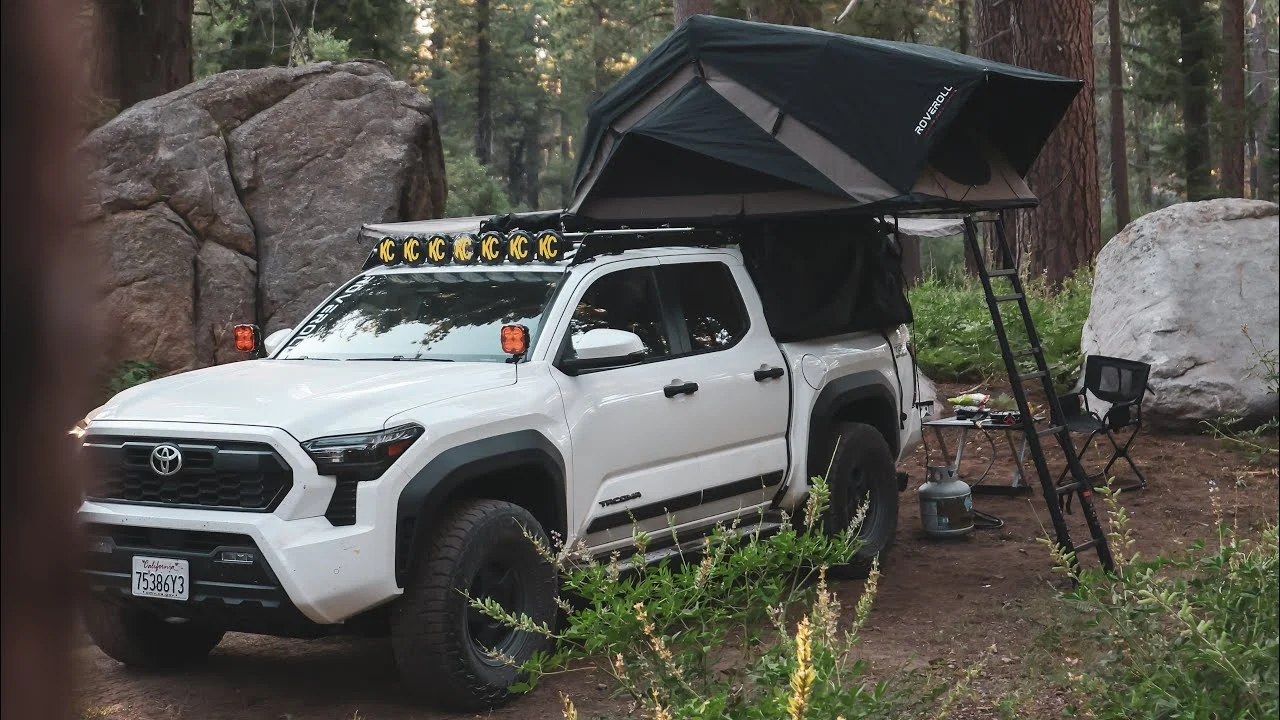
The 2024 Tacoma quietly became a generator you sleep next to
Here's the spec that matters on a fourth-generation Tacoma, and it isn't the one in the trail photos: the i-FORCE MAX hybrid carries a 2400-watt AC inverter with an outlet in the bed (some gas trims get a 1500-watt version). Translate that from brochure to campsite and it means you can run a 12V fridge, an electric griddle, and a night of charging straight off the truck — no separate power station required for the light stuff.
That's the thing the older Tacoma guides — and the Colorado and Ridgeline write-ups — can't lead with, so this one does. The Tacoma's old reputation rests on getting where camping gets good, and that's still true. But the 2024 redesign changed the power math, and power is what most people actually get wrong when they build a truck camper. You don't sleep in the cab; you sleep in the bed, which keeps your living space separate from your driving space — the quiet luxury of truck camping. Get the power and the bed length right and the rest is trim.
Eighteen years under hoods taught me to trust the spec sheet over the badge, so everything below is built on Toyota's published figures, reviewer consensus from outlets like Car and Driver, and owner reports — not a rig I'm pretending I bench-tested. Where a number swings with cab, bed, trim or model year, I'll say so, because on a Tacoma it swings a lot. For how the truck stacks up against other rigs, our camping-vehicle comparison sets the wider field.
Power off the truck: i-FORCE MAX vs the gas 2.4T for camping
Start where the new Tacoma is genuinely different. The two powertrains aren't just a fuel-economy choice — for a camper they're a power choice, and that's the spec the reps won't put in big type.
- i-FORCE MAX hybrid (2.4L turbo + motor): the one with the 2400W bed AC inverter. That's enough to run a compressor fridge, lights, device charging and a modest electric cooktop or kettle off the truck itself — a real generator in the bed. For weekend camping it can replace a portable power station entirely.
- Gas 2.4L turbo (the “2.4T”): lighter, simpler, and on equipped trims it offers an inverter up to about 1500W — still plenty for a fridge and charging, just less headroom for the bigger resistive draws. Many gas trims, though, give you only 12V and USB, so confirm the inverter on the exact truck you're buying.
The honest take: the hybrid's inverter is the single best camping feature on the 2024 Tacoma, and the one that separates it from the Colorado and Ridgeline for off-grid power. But it costs more and rides heavier, and a portable power station gives any Tacoma the same capability you can move between camp, the picnic table and the next vehicle you own. Buy the hybrid if you want the truck to be the battery; run a station on the gas truck if you'd rather keep the power separate and portable.
Short bed or long bed: the number that decides your whole build
Everything else about a Tacoma camper starts with one measurement, and it's the one buyers most often skip. The short bed runs about 60-61 inches; the long bed about 73-74 inches; bed width is roughly 56-58 inches at the floor, narrowing at the wheel wells, and depth is about 19-21 inches.
Those lengths decide whether you sleep flat. The long bed clears six feet, so most adults stretch out fully with the tailgate up. The short bed is shorter than most adults are tall — you drop the tailgate and add a bed extender to claw back length, sleep on a slight diagonal, or build a platform that reclaims usable run. None of that is a dealbreaker; it's just a decision you make before you buy a mattress, not after.
Two width notes worth memorizing. The 56-58 inches is the floor measurement at its widest; between the wheel wells you lose several inches, which is exactly why a platform built above wheel-well height is the best upgrade a truck camper makes — it reclaims full rectangular width an SUV's intruding seatbacks never give you. And the 19-21 inches of depth is your headroom budget under a topper: build the platform low, just high enough to slide bins beneath, or you'll sit up into the cap. To turn these into a mattress choice, our guide to sizing a sleeping surface applies directly.
What tent and topper actually fit each bed
The bed length you chose drives the weather-protection decision, and this is where short and long beds really part ways.
- Topper (cap/canopy): encloses the bed into a dry, lockable room you sleep inside, low and stealthy, and it lets you build a platform underneath. A topper sizes to your specific bed length, so a short-bed cap and a long-bed cap are different parts — order to the bed, and plan for the few inches of headroom the shell adds above the rails.
- Rooftop tent: mounts on a bed rack and gives an off-ground bed that frees the bed floor for gear, at the cost of height and nightly setup. A long bed's rack footprint accepts a larger hard-shell rooftop tent more comfortably; a short bed works too, but watch the rack's load rating and the tent's footprint against the shorter rails.
The short version: a long bed gives you the most flexibility — flat sleeping inside or a big rooftop tent. A short bed pushes you toward either a platform-plus-extender build inside or a rooftop tent that frees the cramped floor. Pick the surface itself with our sleeping-pad guide, and build the deck from our DIY platform guide, which translates straight to a truck bed.
Payload: the spec that quietly limits your camper
Here's a number nobody prints big, and the one that bites a fully-built Tacoma later: payload. Depending on cab, bed, trim and powertrain, a Tacoma's payload runs roughly 1,100 to 1,700 pounds — and the heavier, more capable trims often sit at the lower end, because the truck's own equipment eats into it.
That matters because a camping build adds up fast: a topper is 150-250 pounds, a drawer-and-platform system another 150-300, a rooftop tent 100-200, then water, fuel, gear, a fridge, and two adults. It is genuinely possible to build a Tacoma over its payload rating without trying, especially on a TRD trim already near the low end. The i-FORCE MAX hybrid adds weight too, which trims its payload versus a comparable gas truck — one more reason the powertrain choice isn't free.
The fix is simple discipline: check the door-jamb payload sticker on the actual truck, total your build and passengers honestly, and keep a margin. A rooftop tent in particular pushes weight up high where it also hurts handling, so match the tent and rack to the truck's dynamic rating and keep the heavy, dense gear — water, tools, the fridge — low in the bed. Payload is the spec that decides whether your dream build is a rig or a liability.
Building the bed: platform, drawers and storage
The classic Tacoma setup is a platform in the bed — a low deck spanning the wheel wells for a flat, full-width sleeping surface with storage underneath. It's the single best upgrade because it solves two problems at once: it flattens the bed and it organizes your gear into the cavity below. On top goes a custom-cut foam pad, a truck-bed air mattress, or a standard self-inflating pad.
The storage standard is a drawer system under that platform — slide-out drawers for the kitchen, tools and clothes, with the flat deck above doubling as the bed. Our truck drawer-system guide is written for exactly this vehicle, and it scales from a simple two-drawer build to a full galley. Because the bed sits open to the world, weatherproofing the storage matters: a topper or sealed drawers keep gear dry and locked, where an open bed leaves everything visible and exposed.
- Drawer system under a platform = organized gear plus a flat bed deck.
- Topper or sealed drawers keep an open bed's gear dry and secure.
- A cab or topper roof rack handles bulky overflow without crowding the sleeping area — mind the payload note above.
- Labeled bins inside the drawers make camp setup fast and the day-to-night flip painless.
Ventilation: a topper fogs just like a sealed cabin
A topper-enclosed bed traps moisture exactly like a closed SUV — the separate sleeping space doesn't magically breathe better, which surprises new truck campers every time. Two people breathing overnight will fog the topper windows and dampen bedding if the space is sealed tight, and a damp bag is a cold bag.
Toppers actually help here once you use them right: most have sliding side windows plus a rear window, so crack windows on opposite sides for cross-flow and add a small USB fan to move air. A roof vent, where fitted, exhausts the warm rising air well. Keep wet gear out of the sleeping zone, and never cook under the topper — the carbon-monoxide and fire risk is real and the moisture only worsens the fog. Our explainer on managing condensation covers the physics and the fixes. A rooftop tent breathes far better through its mesh panels, so in a wet climate it sidesteps much of the condensation a sealed cap fights.
Cold weather is where the discipline pays off. An enclosed topper holds heat reasonably, and a properly rated bag plus a foam pad to block the cold rising off the bed floor carries most three-season nights with no powered heat at all — and on an i-FORCE MAX, a 12V electric blanket off the bed inverter is the safe way to add warmth, never a fuel heater inside the cap. The mistake is sealing everything tight to trap heat; you wake up in a wet bag instead. Crack the windows even when it's cold, because the damp from a sealed cap is colder than the air you let in — one of those spec-versus-reality lessons you learn once and never forget.
Off-road and trim: where the Tacoma earns its name
The Tacoma's reputation rests on getting where camping gets good, and the hardware backs it. Available four-wheel drive, real ground clearance and skid plates handle the washed-out forest roads and rutted two-tracks that stop a crossover cold. On the trail to a dispersed site it's clearance and traction — not horsepower — that decide whether you make it.
Capability climbs with trim, and the camper's sweet spot is clear. The SR and SR5 cover graded roads and established sites fine. The TRD Off-Road is the value pick: it adds a locking rear differential, Multi-Terrain Select and crawl control without the range-topper price. The TRD Pro and the overlanding-focused Trailhunter pile on upgraded suspension, skid plates and aggressive tires for the most demanding terrain — and a firmer daily ride and a higher sticker to match. Match the trim to how rough your access roads really get, not to the brochure's trail photos.
Pair that with Toyota's durability reputation and an enormous aftermarket, and the trade is clear: heavier on fuel and harder to park than an SUV, but built to get deep into remote country and bring you home. That durability isn't a slogan for a camper — a rig that strands you a day's hike from help is a liability, and getting home reliably is part of what you're buying. Plan the remote trips well with our trip-planning guide.
The tailgate galley: cooking off the back of the truck
One of the Tacoma's underrated camping strengths is how naturally it hosts a kitchen, and the hybrid's inverter makes it better. The tailgate is a sturdy, waist-height work surface, and with a drawer system your stove, pots and food slide out at exactly the right height to cook standing up. On an i-FORCE MAX, the bed outlet means an electric griddle or kettle runs off the truck — no fuel canister juggling for the simple stuff.
The classic layout puts a slide-out drawer or fold-down table at the tailgate, a burner or griddle on top, and a water jug within reach. You cook facing out the back, sheltered by the open topper hatch in light rain. The hard rule that never changes: never run a stove or any combustion inside an enclosed topper — the carbon-monoxide and fire risk is real, and the moisture worsens condensation. Cooking belongs at the open tailgate or beside the truck, full stop.
A few touches make the bed galley far better: a rear awning or tarp off the topper extends the cooking zone in rain, an LED strip under the hatch lights the counter hands-free, and a slim water jug with a spigot at the tailgate turns cleanup into a quick job. Keep the whole kitchen in one drawer or bin so it's self-contained and the sleeping deck above stays clear, and store the cooler on a slide so it rolls out at the tailgate. Our essentials checklist covers the cookware that suits a bed-based galley.
Tacoma vs. Colorado vs. Ridgeline: the honest midsize call
The Tacoma isn't the only midsize that camps, so here's the straight comparison, spec-first. All three put you in the bed, not the cab, with similar bed lengths in the same 60-74 inch range — the differences are in character and in one or two specs that matter.
- vs. Chevy Colorado: the Colorado is the strong off-road alternative, especially in ZR2 trim, and a fine bed camper. The Tacoma's edge is the i-FORCE MAX's 2400W bed inverter and Toyota's resale and aftermarket depth; the Colorado counters with a roomier feel and competitive trail hardware.
- vs. Honda Ridgeline: a different animal — unibody, car-like, with a clever in-bed trunk and a dual-action tailgate, smoother on pavement but less of a hardcore trail truck with no low-range. The Ridgeline wins on ride and that in-bed trunk; the Tacoma wins on real off-road capability and the hybrid's power.
The Tacoma's distinct pitch in this trio: it's the body-on-frame truck that pairs serious trail capability with a genuine power-off-the-truck option, backed by Toyota's reliability reputation. If your camping is remote and self-reliant, that combination is hard to beat. If you mostly camp at maintained sites and live on pavement, the Ridgeline's manners or the Colorado's value may fit your life better — match the truck to where you actually go.
A weekend in a Tacoma camper, build to breakdown
Picture an actual trip with a short bed, a topper and a simple platform, and the build decisions get concrete. The platform lives in the bed permanently and the drawers below hold the kitchen, tools and clothes — so getting camp-ready means loading food and the cooler, and dropping a pad and bag on the deck. The truck is ready in minutes because the build never leaves it.
At the site, setup is almost nothing: open the topper's rear hatch, slide out the kitchen drawer at the tailgate, plug the fridge into the bed outlet if you've got the hybrid, and crack the side windows for airflow. The bed is already a bed. You're cooking dinner before a tent camper has staked their first corner — which, after eighteen years of watching people fight tent poles in the dark, never stops being satisfying.
- Arrive: park reasonably level so you're not sleeping on a slope.
- Power up: fridge to the bed inverter (hybrid) or the power station (gas).
- Kitchen out: stove or griddle on the tailgate drawer.
- Vent: opposing topper windows cracked, fan on.
- Sleep: the platform is the bed — roll out the pad and bag.
Morning reverses just as fast: bag and pad stow, drawer slides shut, hatch closes and locks, and the Tacoma drives away as a normal truck with the whole camp secured and dry inside. That speed and security is the payoff for the build cost — and the reason a truck camper, once dialed, beats almost anything for a fast weekend.
The verdict: buy the hybrid for power, the long bed for sleep
The 2024 Toyota Tacoma is a benchmark camping truck for two reasons that finally line up: you sleep in a long, flat, weatherproof, lockable bed (short ~60-61 in, long ~73-74 in), and the i-FORCE MAX hybrid's 2400W bed inverter lets you run real gear off the truck — capability and power in one rig, backed by Toyota durability.
Skip the marketing and the decision comes down to two specs. Bed length: buy the long bed if lying fully flat without a tailgate extension matters; the short bed is the popular, practical pick once a platform and extender reclaim the length. Powertrain: the i-FORCE MAX hybrid is the camper's pick if you want the truck to be the battery — that 2400W bed outlet is the feature that separates it from a Colorado or Ridgeline; the gas 2.4T plus a portable power station gets you the same camp power for less money and less weight, just not built in.
From there it's the standard build: a topper or rooftop tent for weather, a drawer-and-platform system for organization, real ventilation under the cap to beat condensation, and the kitchen run at the open tailgate. Mind the payload sticker so the build stays a rig and not a liability. Do that and the Tacoma becomes a go-anywhere, last-forever basecamp. Still cross-shopping? Our camping-vehicle comparison and essentials checklist will help you finish the call.