Where to Start
Trying to keep a dashcam powered 24 hours while car camping is a constant battle against parasitic draw and thermal cycling. The standard 12V cigarette lighter port often cuts power when the ignition is off, leaving your rig vulnerable. You're looking at a 100mA to 300mA draw for most cameras, which can kill a standard car battery in less than a week if left unchecked.
Vantrue explains the basic power options, but they don't get into the real-world failure modes.
The Short Answer
Dashcams need a constant 5V or 12V supply, typically pulling between 100mA and 300mA. Most modern vehicles shut off 12V accessory ports with the ignition, preventing battery depletion. This is a design choice to protect the primary 12V lead-acid battery from deep cycling, which severely reduces its lifespan. Autoroamer discusses basic charging, but glosses over the 'why' of power cuts.
Running a dashcam in 'parking mode' means it's constantly drawing power, even when the engine is off. This continuous current flow can exceed the battery's reserve capacity, especially if the vehicle isn't driven daily to recharge. A 60Ah battery has a nominal 720 Wh capacity. Pulling 200mA (0.2A) means 2.4W (0.2A * 12V). This drains 57.6Wh per 24 hours. That's nearly 8% of the battery's total capacity gone every day.
This isn't just about 'battery dying.' It's about sulfation on the lead plates from sustained discharge below 12.4V, reducing the battery's ability to hold a charge. The internal resistance increases, leading to higher voltage drop under load and eventually, failure to crank the engine. The body control module might also detect low voltage and start shutting down non-essential systems, including your dashcam, to preserve starting power.
Thermal cycling also plays a role. If you're camping in a hot climate, the internal temperature of the dashcam and its power supply can exceed operating limits. Components like capacitors and voltage regulators degrade faster at elevated temperatures, leading to premature failure. The plastic casing can outgas, and the circuit board's solder joints can experience fatigue from differential thermal expansion. Reddit threads often highlight the frustration of constant power, but rarely the underlying thermal stress.
The Reality Check
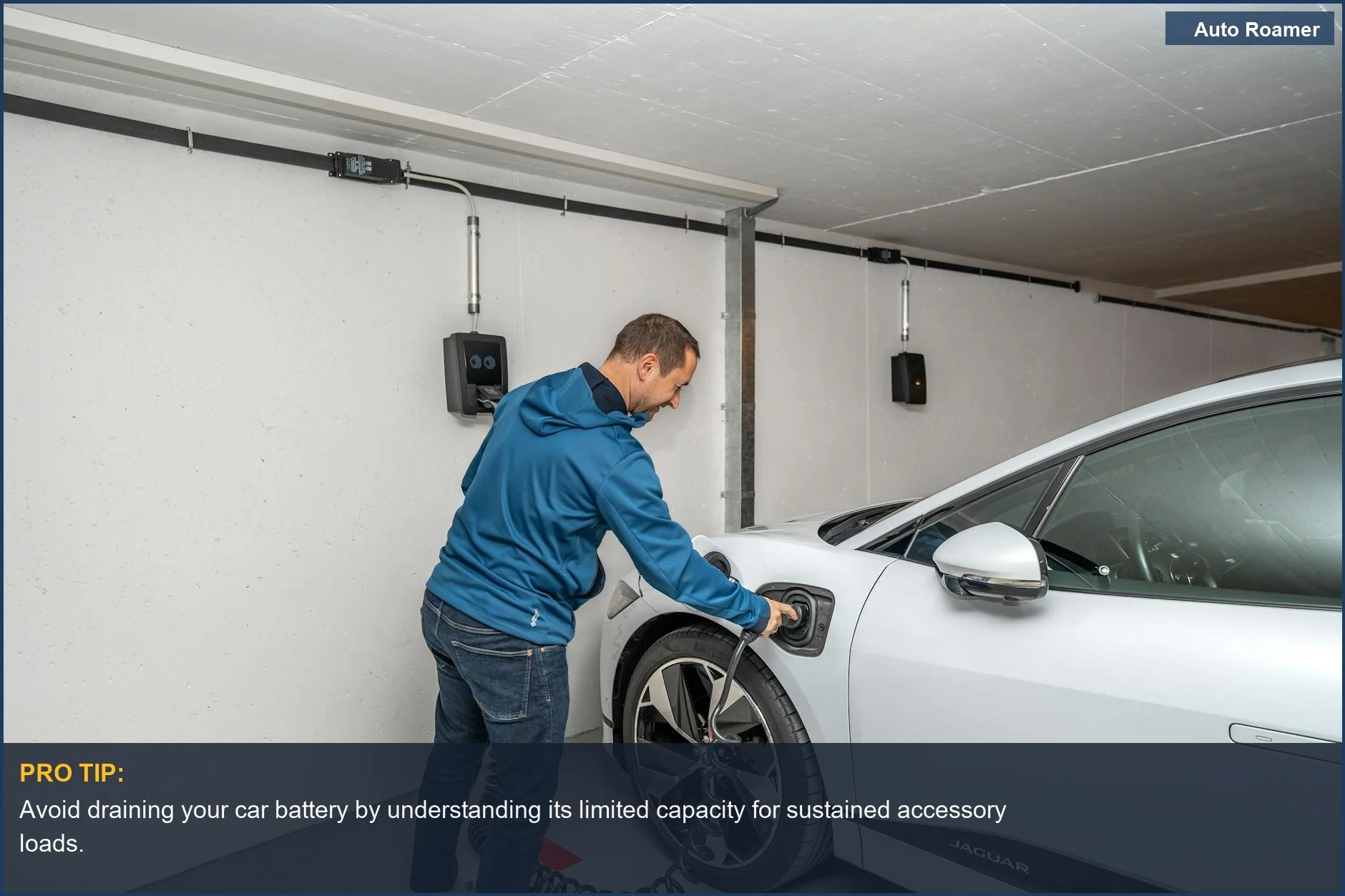
The real challenge is that vehicle electrical systems are not designed for continuous low-power accessory loads. They're built for high-current, short-duration events like engine cranking, and then maintaining charge. The alternator generates power, and the battery stores it. When the engine is off, you're running on borrowed time, and the car's electronics prioritize starting the engine over your dashcam.
Most dashcams use a USB 5V input, stepping down from the car's 12V. This DC-DC conversion isn't 100% efficient; some energy is lost as heat. If you're drawing 200mA at 5V, that's 1W. But from the 12V side, with 85% efficiency, you're pulling closer to 100mA at 12V, which is 1.2W. Every watt matters when you're trying to stretch battery life.
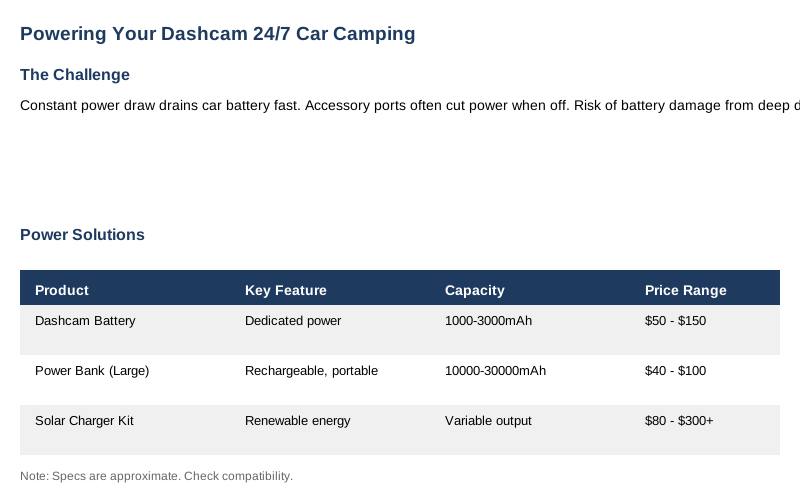
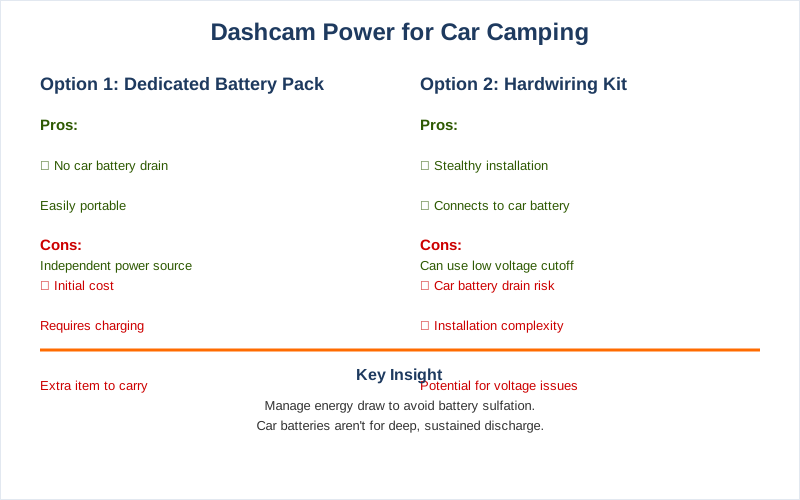
Dedicated dashcam battery packs, like those mentioned in this YouTube review of an EcoFlow River 2, are essentially LiFePO4 or Li-ion power banks. They're designed for deeper discharge cycles and have integrated battery management systems (BMS) to prevent over-discharge, over-charge, and thermal runaway. They're built for this specific use case, unlike your car's starting battery.
This video tests a dashcam power bank, confirming their utility for extended parking mode. The key is their internal chemistry and BMS, which handle continuous draw and deep cycling without the same degradation rate as a lead-acid starter battery. They're a parallel power system, not a parasitic draw on your main battery.
| Component | How It Fails | Symptoms | Fix Cost |
|---|---|---|---|
| Car Battery (Lead-Acid) | Sulfation from deep discharge; plate corrosion from low voltage. | Slow crank, no crank, dim lights, BCM errors. | $150-$300 (new battery) |
| Dashcam Internal Capacitor | Electrolyte dry-out from thermal cycling; ESR increase. | Settings reset, corrupt files, sudden power loss. | $50-$100 (dashcam repair/replacement) |
| Cigarette Lighter Socket | Spring tension loss, corrosion, poor contact resistance from wobble. | Intermittent power, blown fuses, arcing. | $10-$30 (socket replacement) |
| Dashcam Power Adapter | Voltage regulator failure from heat, cheap component failure. | No power to cam, cam reboots, adapter gets hot. | $15-$40 (new adapter) |
The table above lays out the weak points. Every single one of these failure modes is a direct consequence of mechanical stress, thermal stress, or circuit integrity compromise. The dashcam's internal capacitor, if it has one, will degrade with constant thermal cycling, losing capacitance and increasing equivalent series resistance (ESR). This leads to voltage ripple and unstable power delivery. Brilliant engineering, that. The dealer won't diagnose this; they'll just sell you another dashcam.
How to Handle This
- Assess Your Dashcam's Draw: First, you need to know what you're up against. Use a multimeter in series with your dashcam's power supply. Pull the fuse for the 12V socket, insert the multimeter probes into the fuse terminals (with the fuse removed), and set it to measure DC current. Note the current draw in parking mode. Most will show 100mA to 300mA. If you don't know the draw, you're guessing. This is not a guess-and-check operation.
- Install a Dedicated Power Bank: This is the cleanest solution for 24-hour coverage. Purchase a LiFePO4 or Li-ion power bank with a 12V output or a USB-C PD output that can power your dashcam. Mount it securely, perhaps under a seat or in the glovebox, to prevent it from becoming a projectile during a sudden stop. Many car campers on Facebook groups swear by this method.
- Charge the Power Bank Independently: Do not rely solely on your car's alternator to charge the power bank during short drives. Charge it with a wall adapter or a separate solar panel when parked. A 100Wh power bank can run a 2.4W dashcam for over 40 hours. If your car only runs for 20 minutes a day, that won't fully recharge a significantly depleted power bank.
Solar power can be a viable option for continuous charging, especially when camping.
- Hardwire with Low-Voltage Cutoff (LVC) (Optional): If you absolutely must use the car's battery directly, install a hardwire kit with a configurable LVC. This module monitors the car's battery voltage and cuts power to the dashcam when it drops below a set threshold (e.g., 12.2V for lead-acid, 13.0V for AGM). This prevents deep cycling, but you'll still lose parking mode when the voltage drops. This isn't 24/7, but it protects your starting battery.
- Secure Cabling: Route all power cables to minimize mechanical stress. Use zip ties or cable clips to secure them away from moving parts, sharp edges, and high-heat areas. Loose cables can chafe, leading to insulation breakdown, short circuits, and fire hazards. Don't let your power cable become a vibration failure point. The wiring should be tucked into trim gaps, not dangling.
What This Looks Like in Practice
Scenario 1: Weekend Camping Trip (48 Hours, Moderate Climate)
Your 2020 Subaru Outback has a 62Ah battery. Your dashcam draws 150mA. Without an external power source, that's 3.6W per hour, or 86.4Wh over 24 hours. Over 48 hours, that's 172.8Wh. This is roughly 24% of your battery's nominal capacity. Combined with other parasitic draws from the ECU, BCM, and alarm, you're looking at a dead battery on Sunday morning. A 200Wh dedicated power bank would handle this with ease, drawing 0.0mA from your car battery.
Scenario 2: Remote Work Trip (5 Days, Hot Desert Climate)
Your Ford F-150 is parked for five days in 100 degrees F heat. Your dashcam pulls 250mA. A hardwired setup with LVC will constantly cycle on and off as the battery voltage fluctuates with thermal expansion and discharge. The dashcam's internal components are also suffering from the high ambient temperatures, accelerating capacitor degradation. A power bank is critical here, ideally charged via a small solar panel to offset the continuous draw and thermal stress.
Redtiger mentions battery packs as a solution.
Scenario 3: Urban Overnight Parking (12 Hours, Cold Climate)
Your Honda Civic is parked in 20 degrees F weather. Your dashcam draws 180mA. Not only is the lead-acid battery's chemical reaction significantly slowed, reducing its effective capacity, but the engine oil viscosity is also greatly increased, demanding more cranking amps. Even a modest draw can push the battery below starting voltage. An external power bank, kept inside the warmer cabin, prevents this thermal-mechanical stress on the car's primary system. Forum discussions often touch on backup battery performance.
Scenario 4: Long-Term Storage (1 Month, Garage)
Leaving a dashcam hardwired for a month will guarantee a completely dead battery. Even with an LVC, the cumulative parasitic draw from the vehicle's systems will eventually drain it. The LVC only protects against the dashcam's draw, not the car's baseline. Disconnect the dashcam or use a battery maintainer for the vehicle's main battery, and a separate power bank for the dashcam, if recording is critical.
Mistakes That Cost People
| Mistake | Why It Fails | Consequence |
|---|---|---|
| Relying on Car's 12V Socket | Most sockets are switched with ignition; direct wiring causes parasitic draw, deep cycles battery. | Dead battery, reduced battery lifespan, vehicle won't start. |
| No Low-Voltage Cutoff (LVC) | Allows continuous drain below critical voltage, leading to sulfation and permanent battery damage. | Battery replacement, stranded in remote areas. |
| Undersized Power Bank | Insufficient capacity for desired recording time; constant deep cycling of power bank. | Dashcam stops recording prematurely, power bank degrades quickly. |
| Poor Cable Management | Cables chafe on sharp edges, get pinched, or interfere with pedals/airbags. | Short circuits, fire hazard, airbag malfunction, unreliable power. |
| Ignoring Thermal Limits | Dashcam or power supply overheats in direct sunlight, exceeding component spec sheets. | Component failure, corrupt data, reduced device lifespan. |
| Improper Fuse Tapping | Tapping into critical circuits (e.g., ECU, ABS) or using an undersized fuse. | Vehicle electrical system faults, blown factory fuses, potential fire. |
| Assuming 'Parking Mode' is Always On | Many parking modes require specific hardwire setups or external power to function for extended periods. | No recording when parked, false sense of security. |
One common mistake I see is people thinking 'parking mode' means 24/7 power from the car's battery without consequence. It means the dashcam can record, but not how it's powered. Without an LVC or external battery, you're just deep cycling your starter battery. Facebook groups are full of these dead battery stories.
Another gem is using an undersized power bank. If your dashcam pulls 2.4W and you buy a 50Wh power bank, you've got maybe 20 hours of runtime before the power bank's own LVC kicks in. Then you're back to square one, or worse, deep cycling the power bank itself, which reduces its cycle life. It's basic energy balance, people.
Key Takeaways
- Car batteries are for starting, not sustained low-current drain: They're designed for high-amp bursts, not continuous discharge. Deep cycling a lead-acid battery below 12.4V causes sulfation and reduces its lifespan dramatically.
- External power banks are the gold standard: LiFePO4 or Li-ion power banks with integrated Battery Management Systems (BMS) are designed for deep, continuous discharge without degrading like a car's starter battery.
They're a separate, robust power source.
- Know your current draw: Use a multimeter to measure your dashcam's actual current draw in parking mode. Without this number, any power solution is a guess, and guesswork leads to dead batteries.
- Thermal management is critical: High ambient temperatures degrade electronic components, especially capacitors and voltage regulators.
Securely mount power sources away from direct sunlight and high-heat areas.
- Proper wiring prevents failure modes: Use appropriate gauge wire, secure cables to prevent chafing, and use an add-a-fuse kit for clean, protected connections. Don't create a fire hazard to save $12 on a proper fuse tap. This video emphasizes careful selection of dashcam power options, and I agree. Don't cheap out on circuit integrity.