
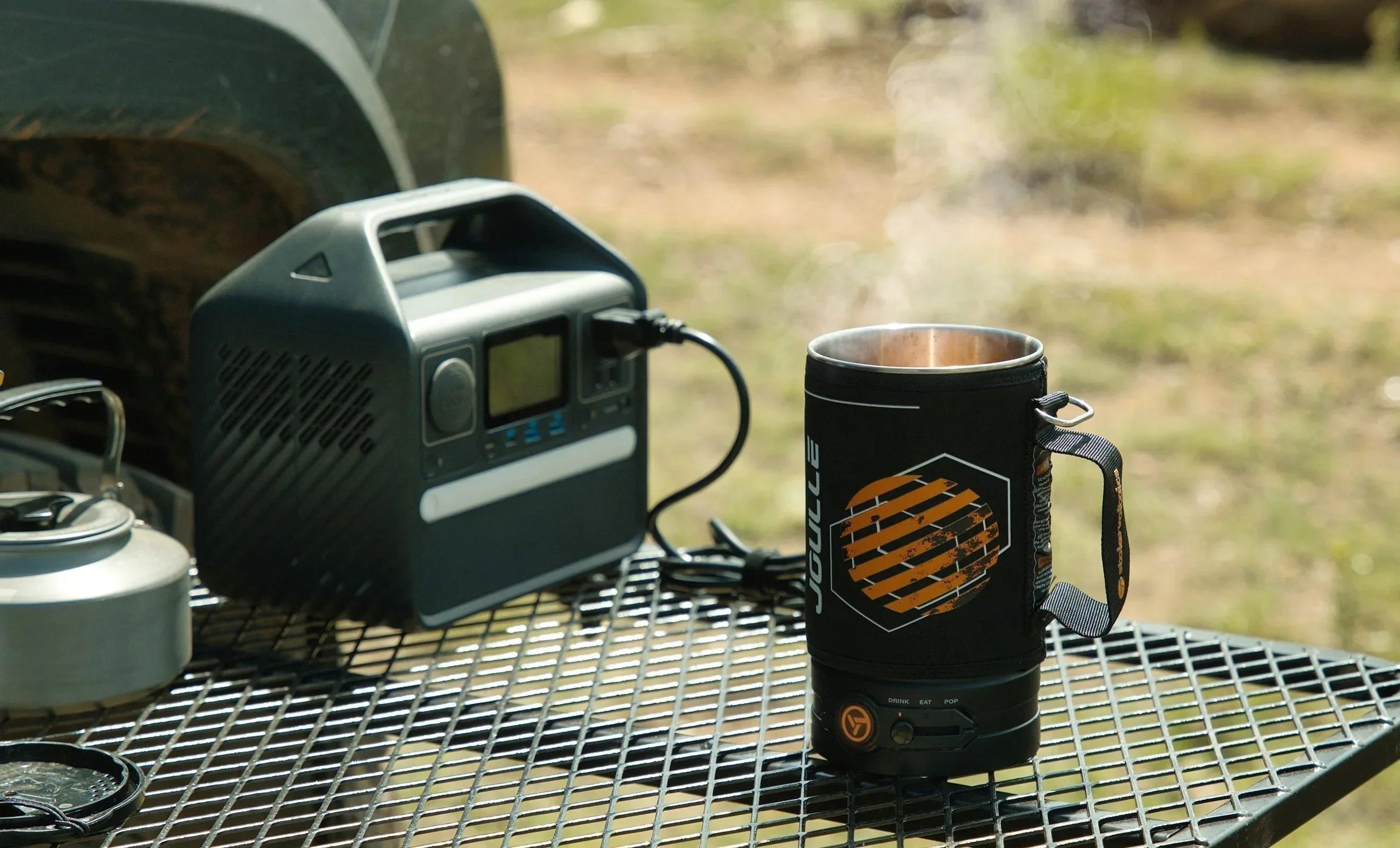
Can you actually power an electric kettle while car camping?
Short answer: yes, but only if your power source is honest about two numbers — how many watts your kettle pulls, and how many watt-hours your battery holds. A standard household electric kettle draws somewhere between about 1,000 and 1,500 watts, and that single figure decides everything. Plug a 1,000-watt kettle into a power station whose inverter only outputs 500 watts and nothing happens; the unit either refuses or trips. Plug it into a station rated for 1,000 watts or more and it boils exactly like the one on your kitchen counter.
The part most guides skip is the arithmetic. Boiling a full liter of water takes roughly 100 to 116 watt-hours in the real world — close to the textbook 93 watt-hours of pure physics, plus the losses every kettle has. That number, divided into your power station's capacity, tells you how many cups of coffee you actually get before the battery is flat. This guide walks the math, names the stations whose published specs can and cannot run a kettle, covers the slow-but-frugal 12-volt alternative, and gives you the honest verdict on whether it is worth it.
It is worth saying up front what this guide deliberately does not do: it does not claim anyone here boiled water in a parking lot to bring you these numbers. The figures come from manufacturer spec sheets, the fixed physics of heating water, and the fuse ratings printed in vehicle documentation — all cited below — because those are the numbers you can actually act on. The boils-per-charge estimates in particular are arithmetic (capacity divided by the energy a boil costs), presented as estimates rather than tested results, so you can re-run the math for whatever kettle and station you own rather than trusting a single anecdote.
The watt and watt-hour math that decides every cup
Two rules cover the whole problem. First, your power station's continuous AC watt rating has to be at least as high as your kettle's wattage, or it will never run. Second, capacity in watt-hours divided by the energy a boil costs tells you how many boils you get. Here are the figures, with the source for each:
| Quantity | Figure | Source / note |
|---|---|---|
| Travel / compact kettle | ~600–1,000 W | low-wattage models made for vans and campsites |
| Full-size kitchen kettle (120V) | ~1,100–1,500 W | the type most people already own |
| Energy to boil 1 liter | ~100–116 Wh | physics is ~93 Wh; device losses add the rest |
| Energy to boil ~2 cups (0.5 L) | ~45–55 Wh | roughly half a liter |
| The formula | Wh = Watts × hours | 1,000 W for 6 minutes = 100 Wh |
Work an example. Say you own a 1,000-watt kettle and a 1,000 watt-hour station. The inverter rating (1,000 W) clears the kettle's draw (1,000 W), so it runs. Each full-liter boil costs about 110 watt-hours, so 1,000 ÷ 110 lands near nine boils on paper — call it seven to eight once you allow for inverter inefficiency and the battery never giving up its last drop. That is several mornings of coffee for one person, or a weekend for two, from a single charge.
Flip the example to see the trap. A 500 watt-hour station with a 500-watt inverter cannot run a 1,000-watt kettle at all — the inverter is under the kettle's draw, so the math never even starts. The mistake people make is shopping on capacity (the watt-hour number on the box) while ignoring the inverter's continuous watt rating, which is the figure that actually gates a kettle.
It helps to see why the energy cost barely moves no matter what kettle you buy. Bringing a kilogram of water (one liter) up from a typical 20-degree-Celsius campsite morning to a boil takes about 93 watt-hours of pure physics — water's specific heat is fixed, so that figure is the same for a cheap kettle and an expensive one. Real kettles lose some heat to the air and the housing, which is why the practical number lands closer to 100 to 116 watt-hours. A higher-wattage kettle does not cost more energy per boil; it just delivers that same energy faster, so a 1,500-watt kettle reaches a boil in roughly four minutes where a 1,000-watt one takes about six. The wattage decides speed and which inverters can run it; the watt-hours-per-boil decides how many cups you get. Keeping those two ideas separate is the whole skill here.
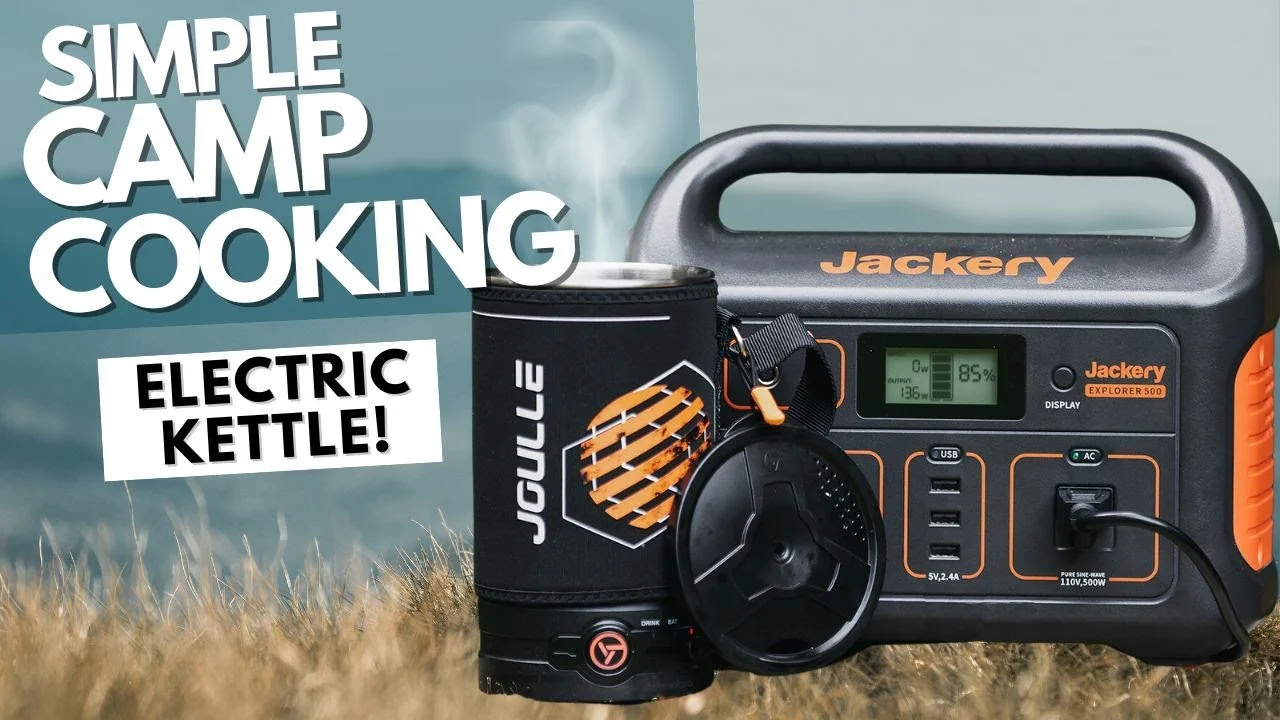
Which power stations can really run a kettle, by published spec
Sorted by the only test that matters — does the inverter's continuous watt rating clear a 1,000-watt kettle — the popular stations split cleanly into three groups. Boils-per-charge below are estimates from capacity ÷ ~110 watt-hours, not tested results.
Runs a full kettle comfortably. The Jackery Explorer 1000 v2 pairs 1,070 watt-hours with a 1,500-watt inverter (3,000-watt surge), so it handles even a 1,500-watt kettle and estimates to roughly eight or nine liter-boils per charge. The EcoFlow Delta 2 (1,024 watt-hours, 1,800-watt inverter) and the Bluetti AC180 (1,152 watt-hours, 1,800-watt inverter) clear any household kettle with margin and land near eight to ten boils. The original Jackery Explorer 1000 (1,002 watt-hours, 1,000-watt inverter, 2,000-watt surge) also works, though a 1,000-watt kettle sits right at its continuous ceiling, so a slightly lower-wattage kettle is the safer pairing.
Marginal — size the kettle down. The EcoFlow River 2 Pro holds a usable 768 watt-hours but its native inverter is 800 watts, under a 1,000-watt kettle. Its X-Boost mode advertises up to 1,600 watts by lowering output voltage, but that trick is unreliable for a pure resistive heater like a kettle. Treat the River 2 Pro as an up-to-800-watt-kettle device and expect around five or six boils.
Not really a kettle machine. The small units — Jackery Explorer 300 (293 watt-hours, 300-watt inverter), Explorer 500 (518 watt-hours, 500-watt inverter), EcoFlow River 2 (256 watt-hours, 300-watt native), and Bluetti EB3A (268 watt-hours, 600-watt inverter) — have inverters below most kettles and capacity that would give only one or two small boils even if the inverter cleared. They are excellent for phones, lights and a fan, but a kettle is the wrong job for them.
One subtlety worth flagging on the larger units: the surge or peak rating — the 2,000-watt or 3,000-watt figure manufacturers print next to the continuous one — does not help a kettle. Surge headroom exists to absorb the brief startup spike of motor-driven gear like a fridge compressor or a drill, which draws several times its running wattage for a fraction of a second. A kettle is a pure resistive element: it pulls its full rated wattage steadily from the first second to the last, with no spike. That means the continuous rating is the only number that matters for a kettle, and reading the surge figure as though it were the limit is exactly how people buy a station that quietly refuses to boil water.
The 12-volt kettle alternative: slow but frugal
If a big power station is more than you want to buy or carry, a 12-volt kettle that plugs straight into the accessory socket is the other route. It sidesteps the inverter problem entirely by never asking for AC power — but it trades speed for that simplicity. Here is what to know before you rely on one:
- It sips power. A 12-volt car kettle typically draws only about 80 to 170 watts (120 watts is common), so it barely touches your reserves compared with a 1,000-watt AC kettle.
- It is slow. Expect roughly 15 to 45 minutes to heat a small amount — around 30 minutes to reach a boil is typical. Good for a leisurely camp morning, frustrating at a cold trailhead.
- Mind the fuse. A cigarette-lighter socket is usually fused at 10 amps (about 120 watts), sometimes 15 amps (about 180 watts). A 150-watt kettle pulling roughly 12 amps can blow a 10-amp fuse, so check your socket's rating.
- Watch the starter battery. Run it with the engine off and you are drawing down the same battery that starts the car. For longer sessions, run it while driving, or wire it to a dedicated deep-cycle battery, not the starter.
The honest place for a 12-volt kettle is a frugal, patient setup: one person who wants a hot drink without buying a power station and does not mind waiting. If you want kitchen-speed boiling, it will disappoint — that is the AC station's job.
It is worth understanding why the 12-volt route is slow rather than just accepting it. The energy to boil water is the same roughly 110 watt-hours per liter no matter how you supply it, so a 120-watt kettle simply takes far longer to deliver that energy than a 1,000-watt one — about eight times as long for the same boil, which is where the half-hour wait comes from. The upside of that low draw is real, though: a 120-watt kettle pulls only about ten amps from the socket, well inside the fuse limit, and over a 30-minute boil it consumes roughly 60 watt-hours, a trivial dent in even a modest battery. So the trade is stark and clear: the AC kettle is fast and power-hungry, the 12-volt kettle is slow and power-thrifty, and which one is right depends entirely on whether your scarce resource is time or watt-hours.
Why you can't just plug a 1,000-watt kettle into the cigarette socket
The single most common bad idea is buying a cheap inverter, plugging it into the cigarette lighter, and running a normal kettle off it. The reason it fails is Ohm's law, not bad luck. Power equals volts times amps, so at the car's 12 volts a 1,000-watt load demands about 83 amps (1,000 ÷ 12). The cigarette socket and its thin wiring are fused for roughly 10 to 15 amps — somewhere around 120 to 180 watts maximum. Asking it for 83 amps blows the fuse instantly or melts the wiring; it never delivers the power.
This is exactly why any inverter big enough to run a kettle has to be bolted directly to the battery terminals with heavy cable, not plugged into a socket. A self-contained power station handles all of that internally, which is the whole reason it is the clean answer: the high-current path lives inside the box, and you just plug the kettle into a normal AC outlet on its face.
So there are really only two safe configurations. Either an AC kettle on a power station with a big-enough inverter, or a purpose-built 12-volt kettle drawing within the socket's fuse limit. The thing in between — a household kettle on a socket-plugged inverter — is the configuration that strands people, and it is worth understanding why so you never try it.
Electric kettle versus a stove or jetboil for camp water
Before committing to the power-station route, it is fair to ask whether boiling water electrically is even the right call. A canister stove or an integrated system like a Jetboil boils water faster than almost any kettle, weighs a fraction as much, and never asks about inverter ratings or watt-hours. For a backpacker, that comparison is not close — fuel wins. The electric kettle earns its place specifically in car camping, where weight is not the constraint and the appeal is a quiet, flameless, push-button boil you can run inside the vehicle on a wet morning without managing a flame or a fuel canister.
There is also a running-cost angle that surprises people. A canister stove burns fuel you keep buying, while an electric kettle on a power station you recharge from the car's alternator or a solar panel boils water at essentially no marginal cost once the hardware is paid for. Against that, the stove is far cheaper to buy and weighs almost nothing. The honest framing is that the electric kettle is a comfort and convenience upgrade for people already carrying a power station for other reasons — a fridge, lights, charging laptops — rather than a device most people buy a 1,000 watt-hour station just to run. If the station is going on the trip anyway, adding a kettle is nearly free; if it is not, a stove is the lighter, cheaper answer for boiling water alone.
Stretching a charge: practical ways to boil less often
Once you have the right station, a few habits make the difference between a weekend of hot drinks and a flat battery by Saturday lunch. The biggest lever is simply not boiling more water than you need: a kettle that shuts off at a rolling boil costs about 110 watt-hours per liter whether you wanted one cup or four, so fill it to the cup line rather than the brim and you cut the energy roughly in proportion. A two-cup boil costs around 45 to 55 watt-hours, which nearly doubles the number of rounds a given station gives you.
It also pays to top the station back up while you drive. The 12-volt charging input trickles capacity back in on the way to the next site, so the morning's boils are replaced before evening tea, and on a sunny trip a folding solar panel keeps a midsize station hovering near full. Pre-boiling water at home and carrying it in an insulated bottle is the zero-energy cheat for the first morning, and choosing a lower-wattage travel kettle (around 600 to 1,000 watts) over a 1,500-watt full-size one widens the range of stations that can run it without changing the energy each boil costs. None of this is exotic — it is just spending the watt-hours you measured deliberately instead of by accident.
Temperature has a quieter effect that is easy to miss. Water you start from a cold alpine morning at 5 degrees Celsius needs more energy to reach a boil than water that starts at room temperature, simply because there is a wider gap to close — so the same kettle costs a little more per boil on a freezing night than on a mild one. Storing your water bottles inside the vehicle overnight rather than in an exterior box shaves a few degrees off that gap for free. None of these moves is dramatic on its own, but together — smaller fills, warmer starting water, recharging on the drive, and a lower-wattage travel kettle — they can comfortably double the number of hot drinks a midsize station delivers over a long weekend, which is often the difference between carrying one power station and needing two.
A quick checklist for matching kettle to power source
Before you buy either piece, run these four checks in order — getting them in the wrong order is how people end up with a station that cannot run the kettle they already own:
- Read the kettle's wattage first. It is printed on the base. That number, not the station's capacity, is the gate — the inverter has to beat it.
- Check the inverter's continuous rating, not the surge. A kettle is a steady resistive load, so the continuous watt figure is what counts; surge only covers the brief startup spike of motors, which a kettle does not have.
- Estimate your boils. Divide capacity in watt-hours by about 110 for liter boils, then shave a little for inefficiency. If the answer is fewer boils than your trip needs, size up or plan to recharge.
- Plan the recharge. Confirm the station refills off the 12-volt outlet while driving or off a solar panel, so a multi-day trip is not capped at one charge.
Do those four and the purchase decision makes itself: the smallest station whose inverter clears your kettle and whose capacity covers a day of boils, with a recharge plan for anything longer. Everything else — ports, weight, screen — is secondary to those two matched numbers.
The honest verdict
Powering an electric kettle while car camping is genuinely practical — but only with a power station of about 1,000 watt-hours or more whose inverter is rated at least 1,000 watts continuous. Units like the Jackery Explorer 1000 v2, EcoFlow Delta 2 and Bluetti AC180 run a full household kettle and give an estimated seven to ten liter-boils per charge.
Below that tier the answer gets honest fast. A 300-to-500 watt-hour station has an inverter too small for most kettles and capacity for only one or two small boils, so it is the wrong tool no matter how convenient it looks. A 12-volt car kettle is the frugal alternative — it sips around 120 watts straight from the socket — but it crawls, taking 15 to 45 minutes for a small amount, and you must respect the socket's 10-to-15-amp fuse. And the configuration to avoid entirely is a household kettle on a cigarette-socket inverter: at 12 volts a 1,000-watt kettle wants about 83 amps against a fuse rated for a small fraction of that. Match the two numbers — kettle watts under inverter watts, trip boils under capacity — and a hot cup of coffee at a dispersed campsite is no harder than at home.
If you take one thing away, make it the buying rule: read the wattage off the kettle base, then choose the smallest station whose continuous inverter rating clears it and whose capacity covers a day of boils, with a recharge plan for anything longer. Do that and the rest is comfort rather than calculation.