The Big Picture
Understanding battery pack ratings can feel like deciphering ancient hieroglyphs, especially when you're just trying to keep your dash cam running overnight without draining your car battery. The common units are mAh and Wh, and frankly, most guides just throw them at you. My first dash cam setup, a cheap $40 model from Amazon, died by 3 AM during a cold snap in the Adirondacks.
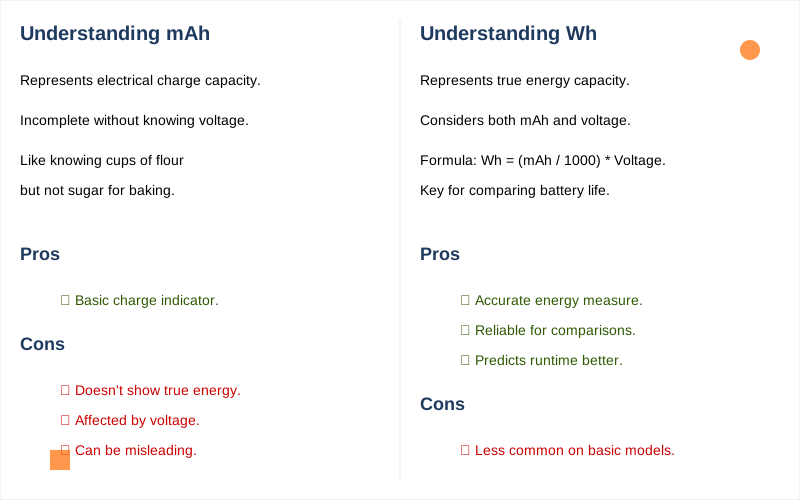
The battery pack, rated at a seemingly high 5,000 mAh, couldn't handle the cold and the draw. I learned real quick that mAh alone isn't the whole story. It's like knowing how many cups of flour you have but not how much sugar - you can't bake the cake. mAh and Wh express battery capacity, but they tell different parts of the story, and Wh is the one that really matters for comparing true energy.
The Core Answer
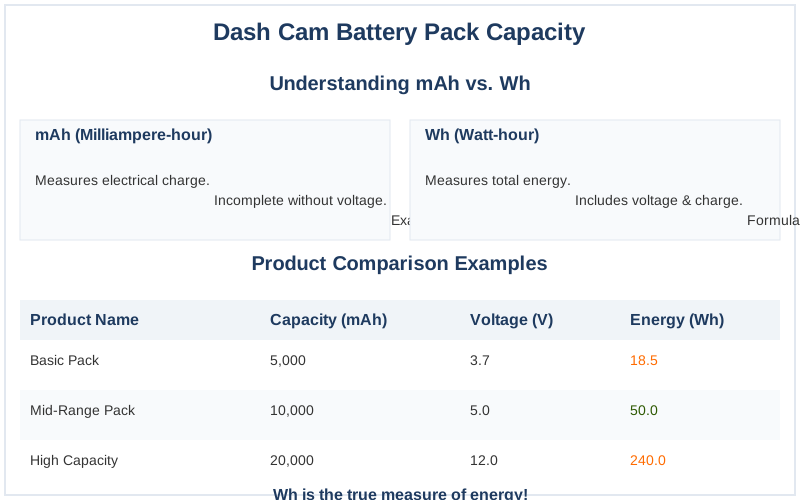
Here's the honest version: mAh (milliampere-hour) tells you about the electrical charge capacity, but it's incomplete without knowing the voltage. Think of it like this: a gallon of water is a volume, but it doesn't tell you how much energy it has if it's ice cold versus boiling hot. My first dash cam battery pack was rated at 5,000 mAh, but its voltage was only 3.7 volts. That's a rookie mistake, relying on just one number.
Wh represents the true power capacity of a battery, taking both charge and voltage into account. It's the total energy the battery can deliver. The formula is simple: Wh = (mAh / 1000) * Voltage. So, that 5,000 mAh battery at 3.7 volts is actually only about 18.5 Wh (5000 / 1000 * 3.7). Compare that to a different battery pack rated at 10,000 mAh but at a higher voltage, say 12 volts, and you're looking at 120 Wh.
That's a massive difference in actual stored energy. What nobody tells beginners is that a higher mAh number doesn't automatically mean longer runtime if the voltage is lower. I learned this the hard way when my dash cam died prematurely on a chilly night. The real move is to look for the Wh rating. It's the universal translator for battery capacity, letting you compare apples to apples, regardless of the battery's internal setup.
When I bought my second dash cam power bank, I specifically looked for the Wh rating, and it lasted me all night, even in freezing temperatures. Using Wh instead of mAh means you can compare the capacity of two batteries regardless of their nominal voltage. It's the game-time metric for real-world power. Your car's cigarette lighter adapter is usually 12V, but internal battery packs are often lower, typically around 3.7V or 5V.
This is why a 10,000 mAh power bank from your phone charging kit might not last as long powering a dash cam as a dedicated dash cam battery pack with a lower mAh but compatible voltage. The Wh rating cuts through that confusion like a hot knife through butter. Wh measures the amount of energy that a battery can deliver over time, not just its charge potential.
Why This Matters for Your Setup
Why does this matter? Because it directly impacts how long your dash cam can record without needing to be plugged into your car's constant power. I remember my first trip to Big Bear Lake, California. It was freezing, probably 20 degrees F. My dash cam battery pack, rated at 10,000 mAh, barely lasted 3 hours. I was furious. I thought 10,000 mAh meant it should last forever! Turns out, that pack had a low voltage.
My current setup uses a pack rated at 30 Wh, and it easily runs for 12 hours straight, even in that same kind of cold. It's the difference between waking up to a dead camera and having continuous footage. Here's the breakdown:
- Runtime Guessing Game: Without understanding Wh, you're just guessing. A 5,000 mAh battery might be great for your phone (often 5V), but useless for a dash cam if its internal voltage is also low. At the same rated voltage, a higher mAh value indicates a larger capacity, but voltage is the missing piece of the puzzle.
- Cold Weather Woes: Batteries hate the cold. My first dash cam battery pack died within 4 hours on a 15 degree F night in rural Pennsylvania. A higher Wh rating generally means more resilience, but extreme cold will still impact performance. I learned to always check the Wh rating for colder climates.
- Comparing Power Banks: You can't just compare mAh ratings between different devices or brands. A 20,000 mAh power bank for your laptop (which uses higher voltage) is a completely different beast than a 20,000 mAh power bank for your phone. A watt-hour tells you how much energy a device consumes, while mAh describes its storage or charge capacity.
Making the Right Choice
So, the next time you're looking at a dash cam battery pack, don't just blindly trust the mAh number. It's like looking at a menu and only seeing the appetizer descriptions. You need the whole meal. My $50 power bank with a decent Wh rating has saved me more headaches than I can count. Here's the takeaway:
- Wh is King: For comparing true energy capacity, Wh is your go-to. It's the most reliable metric for understanding how long your device will actually run.
- Voltage Matters: Remember that Wh = (mAh / 1000) * Voltage. If a product only lists mAh, try to find the voltage. If you can't, move on.
- Real-World Performance: Don't expect advertised mAh ratings to hold up perfectly in extreme temperatures or under heavy load. mAh and Ah are use to measure the unit of energy, only the difference between mAh and Ah is the amount.
- Your Car's Power: If you're just plugging into your car, the car's electrical system handles the voltage. But for standalone battery packs, Wh is crucial for knowing your actual runtime.