
Bluetooth Adapter or FM Transmitter? The Short Answer
If your car has an aux (3.5mm) or USB input, a Bluetooth audio adapter is the better choice: it sends a direct digital signal to your stereo, so the sound is clean and free of radio interference. If your car has only a radio and no aux or USB port, an FM transmitter is the universal fallback — it works in almost any vehicle, but it broadcasts over the FM band, so quality is lower and static is common.
One question comes up constantly, so let's clear it up immediately: no, a Bluetooth audio adapter does not pick up or receive FM radio. A Bluetooth aux adapter is a receiver — it takes the audio your phone streams over Bluetooth and feeds it into your car stereo through a cable. An FM transmitter does the opposite job: it is a tiny broadcaster that puts your audio onto an empty FM channel your radio tunes into. They are two different devices solving the same problem from opposite ends, and that single distinction explains almost every difference between them.
Below is the full comparison — how each one actually works, what they cost, where each wins, and how to figure out which your car can even use — so you can buy once and stop fighting your stereo.
How a Bluetooth Car Adapter Works
A Bluetooth car adapter (often sold as a "Bluetooth aux receiver" or "Bluetooth audio adapter") is a small dongle that pairs with your phone over Bluetooth and outputs that audio through a 3.5mm aux plug, and on some models a USB connection. Your phone streams the music wirelessly to the adapter; the adapter passes it into your car's audio system over a wire. Because that final hop is a direct, wired electrical connection into the stereo's line input, the signal never has to compete with anything in the air around it.
That's the core of why these devices sound good. Bluetooth itself compresses audio (it is not lossless), but modern profiles like A2DP — and codecs such as SBC, AAC, or aptX on supported hardware — are good enough that most listeners hear a clean, full-range result through a car's speakers. The audio arrives as data, gets decoded inside the adapter, and is handed to the stereo as a proper line-level signal. There is no broadcast step, so there is no static, no hiss from passing power lines, and no frequency to re-tune as you drive.
The practical catches are about ports and power, not sound. First, your car needs an aux or USB input for the adapter to plug into — if it has neither, this option is off the table without rewiring. Second, the adapter needs its own power: most are charged over USB or run on a small built-in battery, so you'll have a charging cable to manage, or you'll need to remember to top it up. Battery-only models are tidy but eventually die mid-trip; USB-powered models are tethered but never run flat. Neither problem affects sound quality — they're just the small chores you trade for a clean signal.
For hands-free calling, most Bluetooth adapters add a built-in microphone, which an aux cable alone can't do — a real advantage over a plain wired connection. Pairing is the usual Bluetooth dance: power the adapter, find it in your phone's Bluetooth list, connect once, and it should reconnect automatically after that.
How an FM Transmitter Works
An FM transmitter takes the opposite approach. It is, in effect, a miniature radio station that plugs into your car's 12V power outlet (the old cigarette-lighter socket). It receives your phone's audio — older models over a cable, newer ones over Bluetooth — and then broadcasts that audio over a low-power FM signal on a frequency you choose. You tune your car radio to that same empty frequency, and the radio plays your audio as if it were a station.
The headline advantage is universal compatibility. Because every car with a working radio can receive FM, a transmitter works in vehicles that have no aux jack, no USB port, and no Bluetooth — the 1998 sedan, the base-trim work truck, the rental with a locked-down head unit. If a vehicle can tune in a radio station, it can play your phone through an FM transmitter. That single fact is why these devices refuse to die: they're the lowest common denominator that fits everything.
The trade-off is built into the physics. You are broadcasting over public airwaves, and the FM band is crowded. In or near any city you have to hunt for a truly empty frequency, and even then a real station broadcasting on a nearby channel can bleed in. Audio purists and car-audio shops widely note that an FM transmitter almost always introduces some hiss, static, or distortion compared with a direct connection, because the signal is being modulated onto a radio carrier, sent through the air, and demodulated again — with engine and electrical noise able to creep in along the way (Sorena Car Audio).
Geography matters more than with any other option. In rural areas with few stations, an FM transmitter can sound surprisingly decent because there's little to interfere with. Drivers themselves report the same pattern — they tend to work well mainly where the airwaves are quiet, and degrade as you approach populated areas with dense radio traffic (Reddit r/ipod discussion). You may also need to re-tune mid-drive as you pass through different stations' coverage, which a Bluetooth aux adapter never asks of you.
Sound Quality: Direct Signal vs. Broadcast Signal
The shortest way to remember it: a Bluetooth aux adapter sends a private wired signal, while an FM transmitter broadcasts over public airwaves. Everything about their sound quality follows from that one difference.
This is where the two diverge most, and the reason comes straight from how they work. A Bluetooth aux adapter delivers a direct wired signal to your stereo's line input. The only quality loss is Bluetooth's own audio compression, which is modest on modern codecs and largely inaudible through typical car speakers. The result is clean, consistent, and the same in a city as on an empty highway.
An FM transmitter delivers a broadcast signal over the air, and that path is inherently noisier. Even on a clear frequency, FM broadcasting narrows the audio bandwidth and adds the characteristic background hiss of radio. Add a competing station, an electrically noisy alternator, or a long antenna run, and you can get static, dropouts, or a thin, compressed sound. Car-audio specialists and direct-input adapter makers consistently describe the direct-connection path as the higher-fidelity option and the FM path as the compromise you accept for compatibility (iDaffodil comparison).
A useful way to picture it: a Bluetooth adapter is like a clear phone call on a good connection, while an FM transmitter is more like a walkie-talkie — perfectly intelligible, often fine for podcasts and audiobooks, but not where you go for full, detailed music. If your priority is the best sound your factory speakers can produce, the direct connection wins. If your priority is simply hearing your phone at all in a car that offers no other way in, the FM transmitter is what makes that possible.
One honest caveat in the Bluetooth column: a tiny number of cheap adapters introduce a faint ground-loop whine when powered from the car's USB, audible as a high-pitched hum that rises with engine RPM. It's uncommon, fixable with a cheap ground-loop isolator, and not a reason to choose FM — but it's worth knowing the direct path isn't magically perfect on every unit.
Compatibility: Does Your Car Even Have the Right Port?
Before you buy anything, the deciding question is what inputs your car actually has. This single check often makes the choice for you.
If your car has a 3.5mm aux input (a small round headphone-style jack, usually labeled AUX or AUX IN), a Bluetooth aux adapter is the natural fit and the better-sounding option. Most vehicles built from roughly the mid-2000s onward have one, often hidden in the center console, glovebox, or below the climate controls.
If your car has a USB port that supports audio (not all do — some are charge-only), some Bluetooth adapters and many head units can take a USB-based connection, which can be even cleaner than aux. Check your owner's manual for whether the USB port is a media input or just for charging.
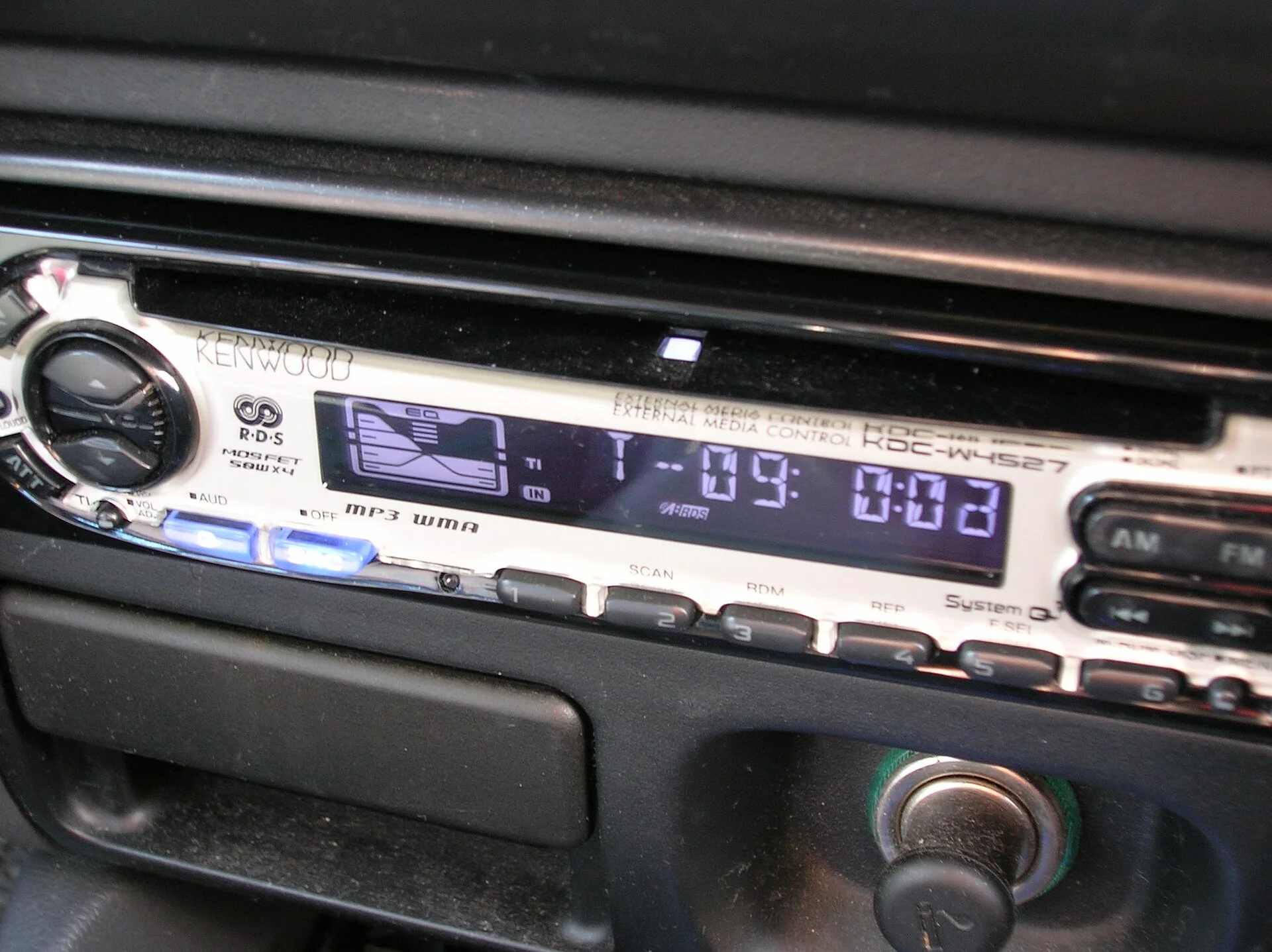
If your car has only a radio — no aux, no usable USB, no factory Bluetooth — then a Bluetooth aux adapter has nothing to plug into, and an FM transmitter becomes the realistic option. This is the classic case for older vehicles, base trims, and some commercial fleet stereos. Drivers weighing the same three-way choice — FM transmitter, aux-in adapter, or replacing the head unit — land here regularly when the dash simply has no modern input (Mechanics Stack Exchange).
There's a third path worth naming: replacing the head unit (the stereo itself) with an aftermarket unit that has Bluetooth built in. That typically runs from around $100 to $500 with installation, but it gives you a modern, integrated system with no dongles or broadcast hops. It's the most seamless long-term answer if you're keeping the car for years — just a bigger upfront cost than either adapter.
Interference, Reliability, and the FM Band Problem
Reliability is mostly an FM-transmitter concern, and it traces back to one thing: you don't control the airwaves. A Bluetooth aux adapter's connection is private and wired at the stereo end, so once it's paired it just plays — consistently, in any location, with no frequency to babysit. The only reliability questions are keeping it charged or powered and the occasional Bluetooth re-pair.
An FM transmitter, by contrast, is sharing a public, finite band. Every city you drive through has its own set of occupied frequencies, so a channel that was crystal-clear at home may be buried under a local station 40 miles away. On longer trips you may re-tune several times. Sources of interference include nearby broadcast stations, your car's own ignition and electrical noise, and even other drivers' FM transmitters in heavy traffic. None of this damages your equipment — the devices are very low power — but it does mean the listening experience is variable in a way the Bluetooth path is not.
There are ways to make an FM transmitter behave better: pick a frequency at the extreme low or high end of the dial where stations are sparser, use the manual frequency-scan feature many models include, and keep the transmitter's antenna (often the power cable itself) away from other wiring. Hybrid devices that receive your phone over Bluetooth and then rebroadcast over FM are convenient for connecting your phone, but they are still subject to every FM broadcast problem — the Bluetooth part only handles the phone-to-device hop, not the device-to-radio hop, so it doesn't fix interference.
The takeaway most people reach: if you can avoid the FM band entirely, you remove an entire category of problems. That's the strongest argument for the direct Bluetooth-into-aux route whenever your car allows it.
Ease of Use, Setup, and Cost
Cost. The two categories overlap heavily. A decent Bluetooth aux adapter typically runs about $20–$40, with feature-rich units (longer battery, better codecs, dual-device pairing) climbing toward $50. FM transmitters are similarly priced, often starting a little cheaper around $15–$30. Price alone rarely decides it — the real cost difference is in sound and hassle, not dollars.
Setup. A Bluetooth adapter is plug-the-aux-cable-in, supply-power, pair-once. After that first pairing it should reconnect automatically each time you start the car. An FM transmitter is plug-into-12V, set-a-frequency, tune-the-radio-to-match, and (if it's a Bluetooth model) pair the phone. The FM setup has one extra recurring step — confirming or re-finding a clear frequency — which is exactly the step you skip with a direct connection.
Day-to-day friction. Bluetooth adapters ask you to manage power (charge a battery or run a cable). FM transmitters ask you to manage frequencies (re-tune when interference creeps in). Which chore you'd rather live with is a genuine personal preference — but for sound quality, the frequency chore comes with a quality penalty that the charging chore does not.
Extras. Many FM transmitters double as a 12V charger with USB ports, a small bonus in older cars short on charging. Many Bluetooth adapters add a hands-free mic for calls. Match the extras to what you actually need rather than to the longest spec list.
When Each One Wins: Picking the Right Device
- Choose a Bluetooth car adapter when your car has an aux or audio-capable USB input; you care about sound quality; you mostly drive in or near populated areas where the FM band is crowded; or you want hands-free calling without a station to tune. For the large majority of cars from the mid-2000s on, this is the better answer: a clean signal, set once, that sounds the same everywhere you drive.
- Choose an FM transmitter when your car has only a radio with no aux, no usable USB, and no Bluetooth; you drive mostly in rural areas where the airwaves are quiet; you want the cheapest possible fix; or you need something that will work in any borrowed or rented vehicle. It's the universal fallback: lower fidelity, but it gets your audio playing where nothing else can plug in.
- Consider replacing the head unit when you're keeping the car for years, you want a built-in, dongle-free experience, and you're comfortable spending $100 to $500. It's the premium answer that makes the whole adapter question disappear.
So the decision really collapses to one inspection: look at your dashboard and center console for an aux jack or a media USB port. If it's there, get a Bluetooth aux adapter and enjoy clean sound. If it isn't, an FM transmitter is your honest, universal option — or step up to a new head unit if the long-term upgrade is worth it to you. Either small adapter beats fighting a stereo that won't talk to your phone.
Real-World Scenarios: Matching the Device to How You Drive
Specs only get you so far; the right choice usually falls out of how and where you actually drive. A few common situations make the trade-offs concrete.
The daily city commuter with a 2012 sedan. A car this age almost certainly has an aux jack, and a dense urban FM band is the worst case for a transmitter. Here a Bluetooth aux adapter is the clear pick: a clean, interference-free signal that never asks you to re-tune while you crawl through traffic past a dozen local stations. The only upkeep is keeping the adapter powered, which a permanent USB cable solves.
The rural driver with a 1999 pickup. No aux, no USB media port, just an AM/FM radio. A Bluetooth adapter has nowhere to plug in, so an FM transmitter is the move, and the quiet rural airwaves are exactly where it performs best. With few competing stations, a clear low-end frequency can sound perfectly acceptable for music and great for podcasts and audiobooks. This is the transmitter at its best.
The road-tripper who covers several states. This is the hardest case for an FM transmitter, because each new metro area brings a fresh set of occupied frequencies and you'll re-tune repeatedly. If the car has an aux or USB input, the Bluetooth adapter's set-once-and-forget consistency is worth a lot on a long haul. If the car has only a radio, accept that an FM transmitter will be a manage-as-you-go experience and keep the manual scan feature handy.
The person who mostly takes calls. If hands-free calling matters more than music fidelity, a Bluetooth adapter with a built-in mic is the better tool, since it adds a microphone an aux cable alone can't. Some Bluetooth FM transmitters also support calls, but you inherit the FM quality trade-off on the audio.
The driver who'll keep the car for a decade. When the time horizon is long, the math shifts toward replacing the head unit. The upfront cost is higher, but a built-in Bluetooth stereo removes the dongle, the charging cable, the frequency hunting, and the broadcast static all at once, and it tends to integrate with steering-wheel controls and the dash display in a way no adapter can. For a short-term car, that spend rarely makes sense; for a keeper, it often does.
Common Mistakes and How to Avoid Them
Most disappointment with either device comes from a handful of avoidable missteps. Knowing them up front saves a return trip and a one-star review.
- Buying a Bluetooth adapter for a car with no aux or media USB. The single most common mismatch. Confirm the port exists and that a USB port actually carries audio (many are charge-only) before you buy. If neither is present, no Bluetooth aux adapter can help; that's an FM-transmitter or new-head-unit situation.
- Blaming the FM transmitter for the FM band. A transmitter that sounds terrible in the city isn't necessarily defective; it's doing its best on a crowded band. Use the frequency scanner, choose an empty channel at the far end of the dial, and judge it on a quiet stretch before deciding it's bad.
- Expecting a hybrid Bluetooth FM transmitter to sound like a wired adapter. The Bluetooth label only covers the phone-to-device hop; the audio still rides an FM broadcast to the radio. If clean sound is the goal, a hybrid won't deliver it, but a direct wired connection will.
- Cranking both volume controls to maximum. Pushing your phone's output and the stereo volume both to the top can cause clipping and distortion that sounds like a broken device. Set the phone to roughly 75 to 90 percent and use the car's volume for the rest.
- Ignoring power. A battery-only Bluetooth adapter that dies mid-commute feels like a failure but is just a flat battery; a USB-powered model or charging overnight fixes it. For FM transmitters, make sure the 12V outlet actually has power with the ignition in the right position.