The Short Answer
An FM transmitter is the cheapest way to get Bluetooth music and hands-free calling into a car that has nothing but an FM radio. It plugs into the 12V socket, broadcasts a whisper-quiet FM signal on an empty frequency, and your factory stereo plays it like any station. No installer, no dash surgery, no $280 head unit.
Here is the honest headline most buyer's guides bury: every FM transmitter you can legally buy in the US broadcasts at exactly the same strength. The FCC caps them all. So the unit that wins is not the one with the "strongest signal" — that spec does not exist — but the one with the best Bluetooth radio, the fastest charging, and the clearest display. Sorted on those, the five picks below shake out like this:
Why Every FM Transmitter Is the Same 'Strength' (the spec nobody tells you)
Walk any product listing and you will see claims about "strong signal," "crystal-clear broadcast," and "no interference." Here is the reality that reframes the entire buying decision: a car FM transmitter is an unlicensed low-power broadcaster, and the FCC caps how powerful it is allowed to be. Under Part 15 rule 15.239, the field strength of an FM device like this may not exceed 250 microvolts/meter measured at 3 meters, within a 200 kHz channel. That limit is identical for every consumer unit, cheap or premium.
What that means in practice:
- No unit can legally "out-broadcast" another. A $14 transmitter and a $30 transmitter put the same tiny signal into your car's antenna.
- The intended range is roughly the inside of your own vehicle — a few feet. That is by design; the signal is meant to reach your car radio and nothing more.
- Marketing that promises a "more powerful" or "longer-range" broadcast is either misreading the rules or hoping you do not know them.
The single most misunderstood fact about FM transmitters is that transmit power is not a variable you can shop for. The FCC fixed it at 250 microvolts/meter at 3 meters for all of them. Once you accept that, you stop paying for imaginary signal strength and start paying for the things that genuinely differ.
There is a practical reason the limit is set so low. An FM transmitter shares the exact same airwaves as licensed radio stations, and those stations broadcast with thousands of times more power. If your car gadget were allowed to be strong, it would stomp on real broadcasts for blocks around you every time you drove past. The 250 microvolts/meter cap is deliberately tuned to reach the inside of one vehicle and effectively nothing beyond it.
That is why two cars sitting at the same red light, each running a transmitter on 88.1 MHz, do not interfere with each other — neither signal travels far enough to matter. It is a feature of the design, not a weakness of any particular unit.
So if raw power is off the table, what actually changes the experience? Three things, and only three, are worth your money: the Bluetooth generation (how reliably the audio gets from phone to transmitter), the charging wattage (whether your phone tops up fast or trickles), and your tuning technique (finding a truly empty channel). We take each in turn.
The FM Band, Briefly: Why an Empty Channel Is Everything
To understand why the same transmitter sounds great on one drive and noisy on another, it helps to know how little room the FM dial actually has. The US FM broadcast band runs from 87.9 to 107.9 MHz and is divided into just 101 channels, each 200 kHz wide, spaced in steps of 0.2 MHz. Engineers number them channel 200 through channel 300; channel 201, for example, is the familiar 88.1 MHz.
Your transmitter has to squeeze its signal onto one of those 101 slots — the same slots real radio stations use. When you pick a frequency, three outcomes are possible:
- Truly empty: no station anywhere near it. Your transmitter owns the channel and audio comes through clean.
- Occupied: a real station is broadcasting there with far more power than your legal 250 microvolts/meter. It wins; you get their programming bleeding into yours.
- Adjacent-channel bleed: a strong station one or two slots away (within 200 kHz to 400 kHz) leaks into your channel as hiss even though it is not exactly on your frequency.
This is why location decides sound quality more than brand does. A rural area may have a dozen genuinely dead channels; a dense metro can have almost none. The low end of the band — roughly 87.9 to 88.5 MHz — is often the least crowded because commercial stations cluster higher up, which is why experienced users try there first. None of this is a defect in your unit. It is the physics of sharing 101 public channels with licensed broadcasters who are allowed to be thousands of times stronger than you.
The Three Specs That Actually Separate Good From Cheap
With transmit power ruled out, here is what genuinely differs between units, in order of how much it changes daily use.
1. Bluetooth generation. This is the biggest real difference, and newer is not marketing here — it measurably holds the connection better. Bluetooth 5.0 units have an audio latency in the range of 80–120ms and drop more often; Bluetooth 5.3 cuts latency to roughly 40–60ms and adds channel-classification logic that steers the connection away from congested radio frequencies, so it stays locked in crowded environments. Bluetooth 5.4 refines that further, though in day-to-day use the gap between 5.3 and 5.4 is small. The meaningful jump is from 5.0 to 5.3.
Note one thing that Bluetooth version does not fix: audio fidelity is limited by the analog FM hop, not the Bluetooth codec — even the efficient LC3 codec introduced with recent versions (about 20–30% less battery draw than the older SBC codec) cannot make the FM stage sound better.
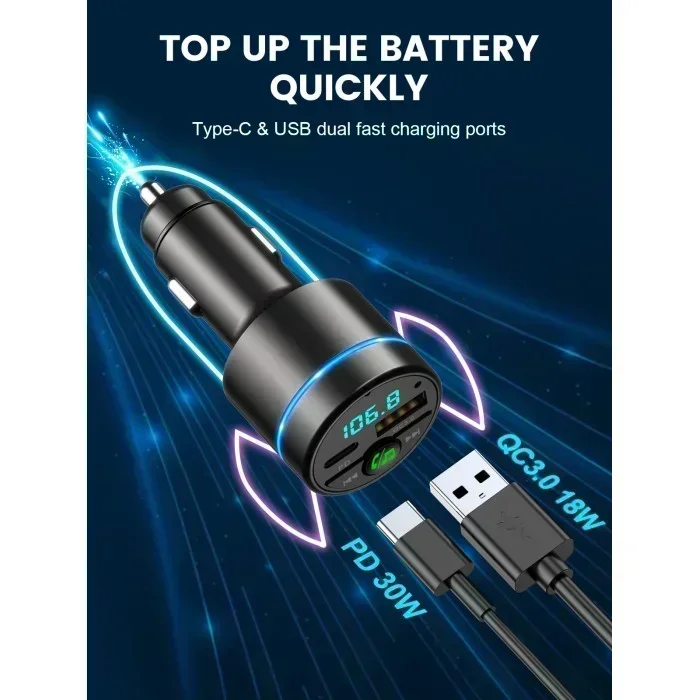
2. Charging wattage (the passthrough spec). This is where prices actually diverge, and it is easy to measure. A USB-C Power Delivery (PD) port rated at 30W will genuinely fast-charge a modern phone; pair it with a Quick Charge (QC3.0) USB-A port and you can fast-charge two devices at once — a combined 48W on the best units here. Budget models instead give you plain 5V/2.4A and 1A ports that only trickle-charge. If your phone lives on the charger during long drives, this is the spec to pay for.
3. Display and controls. A larger, readable screen makes it faster to see your frequency, caller ID, and your car's battery voltage. A 1.44-inch screen is the common baseline; a 1.8-inch color screen is a real upgrade for glanceability.
Here is how the five picks compare on exactly those specs:
Nulaxy 48W FM Transmitter — Best All-Round
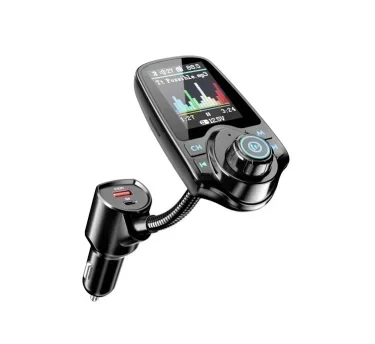
The Nulaxy 48W FM Transmitter is the one we point most people to because it does the unglamorous things right and skips the fake claims. The 2026 upgraded version runs Bluetooth 5.4 for fast, sticky pairing, and it carries the most complete charging setup in this group: a USB-C PD 30W port alongside a QC3.0 18W USB-A port, for a combined 48W that fast-charges a phone and a second device at the same time.
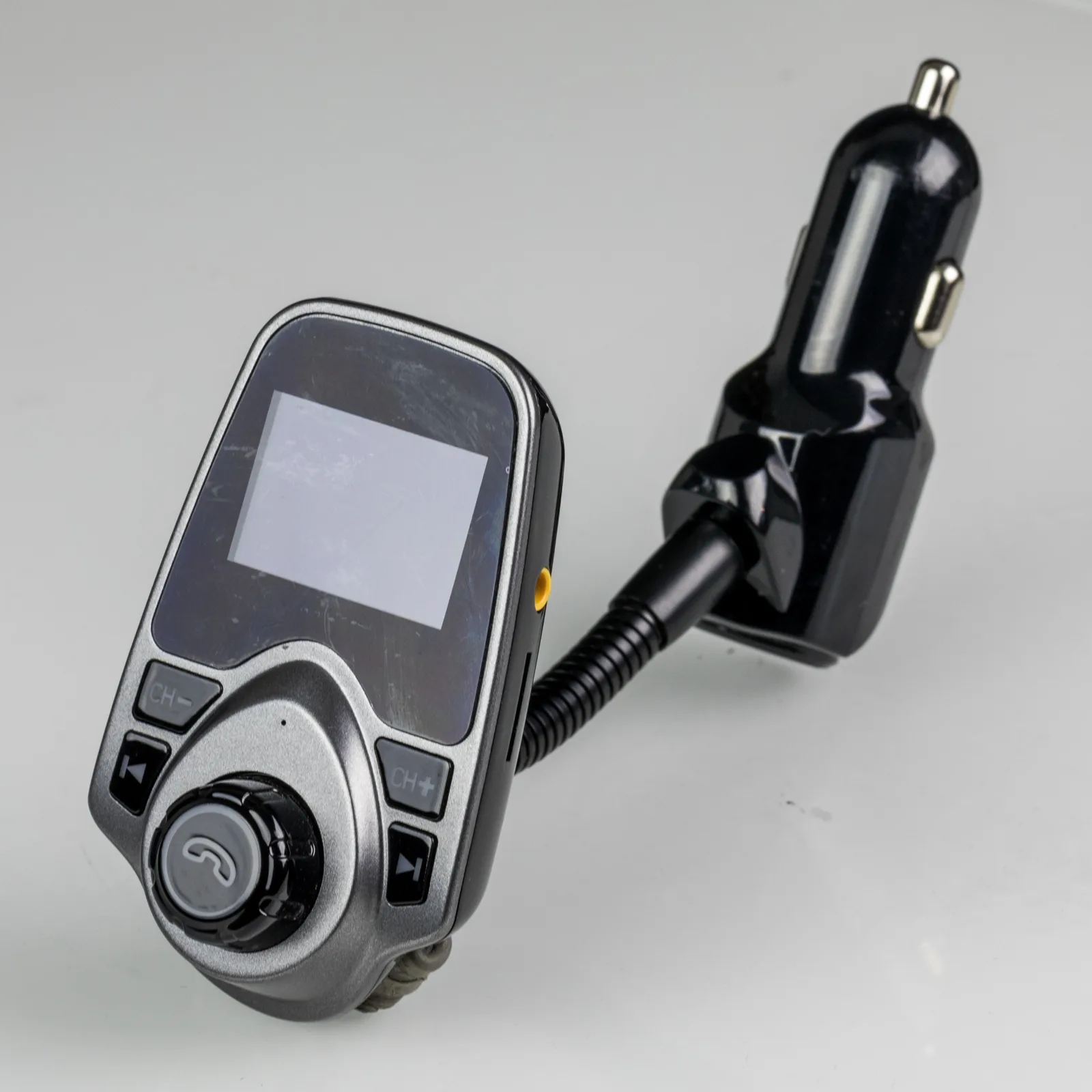
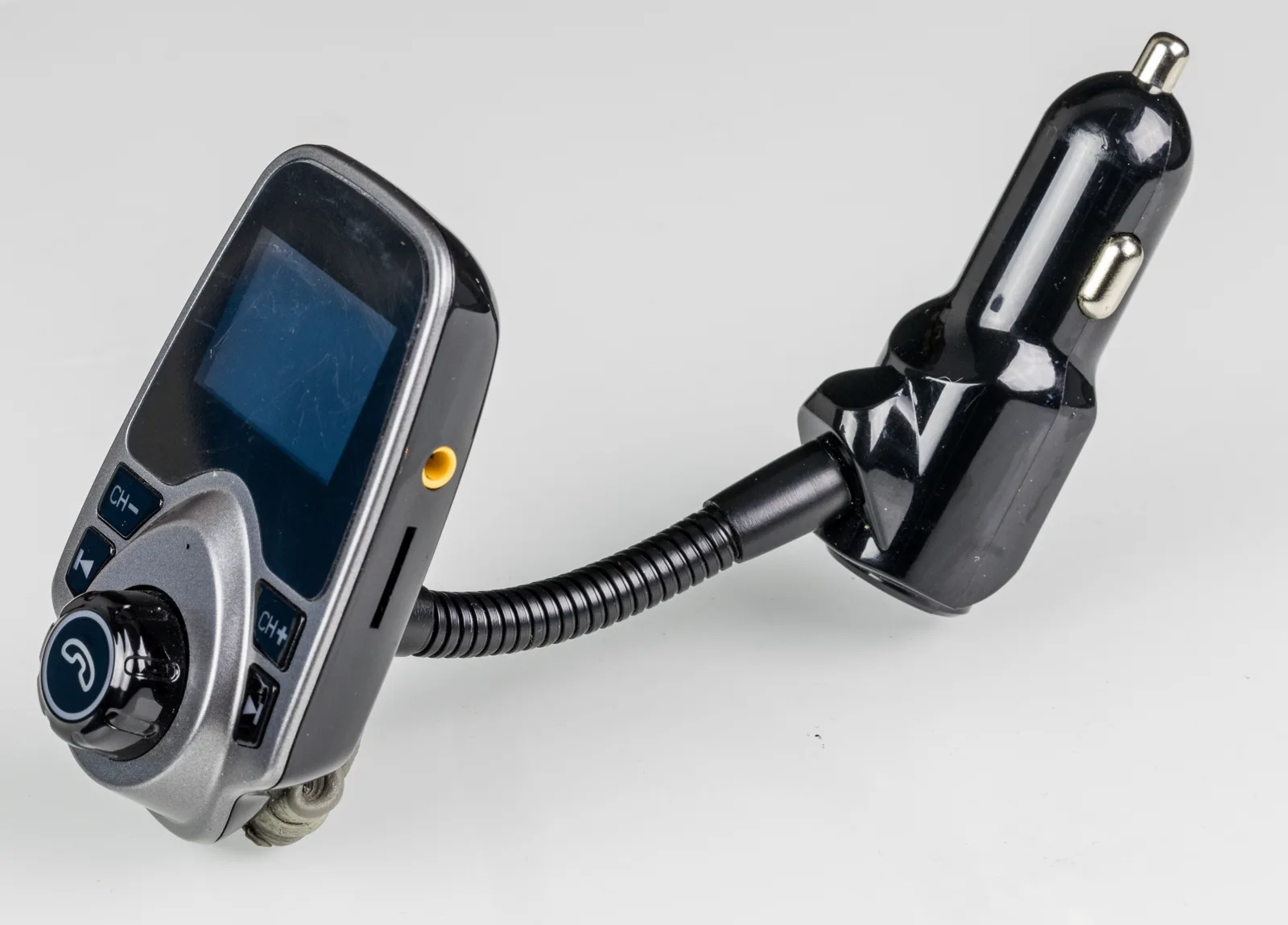
The 1.8-inch color display is the easiest to read at a glance of any unit here — it shows the frequency, caller ID, and your car's battery voltage in large type — and a flexible gooseneck lets you angle it away from vents and shifter. It plays from Bluetooth, a TF card, aux, or a USB stick, and it adds 7 EQ modes if you like to shape the tone. For hands-free calling it uses echo and noise reduction that keeps you intelligible at highway speed.
What it does not do — and cannot, like every unit here — is broadcast any stronger than the FCC-capped 250 microvolts/meter. So you are not paying for signal; you are paying for the best Bluetooth radio, the fastest charging, and the clearest screen in one package. That is exactly why it earns the all-round pick. Expect roughly $28, though the price moves — confirm before buying.
- Best for: anyone who wants one unit that nails connection, charging, and readability.
- Watch for: it is the priciest here; if you never fast-charge, cheaper picks do the audio job identically.
LENCENT & RIWUSI — Best Fast Charging Without the Premium
If fast charging is your priority but you do not want the top price, two units deliver the same PD 30W punch for less.
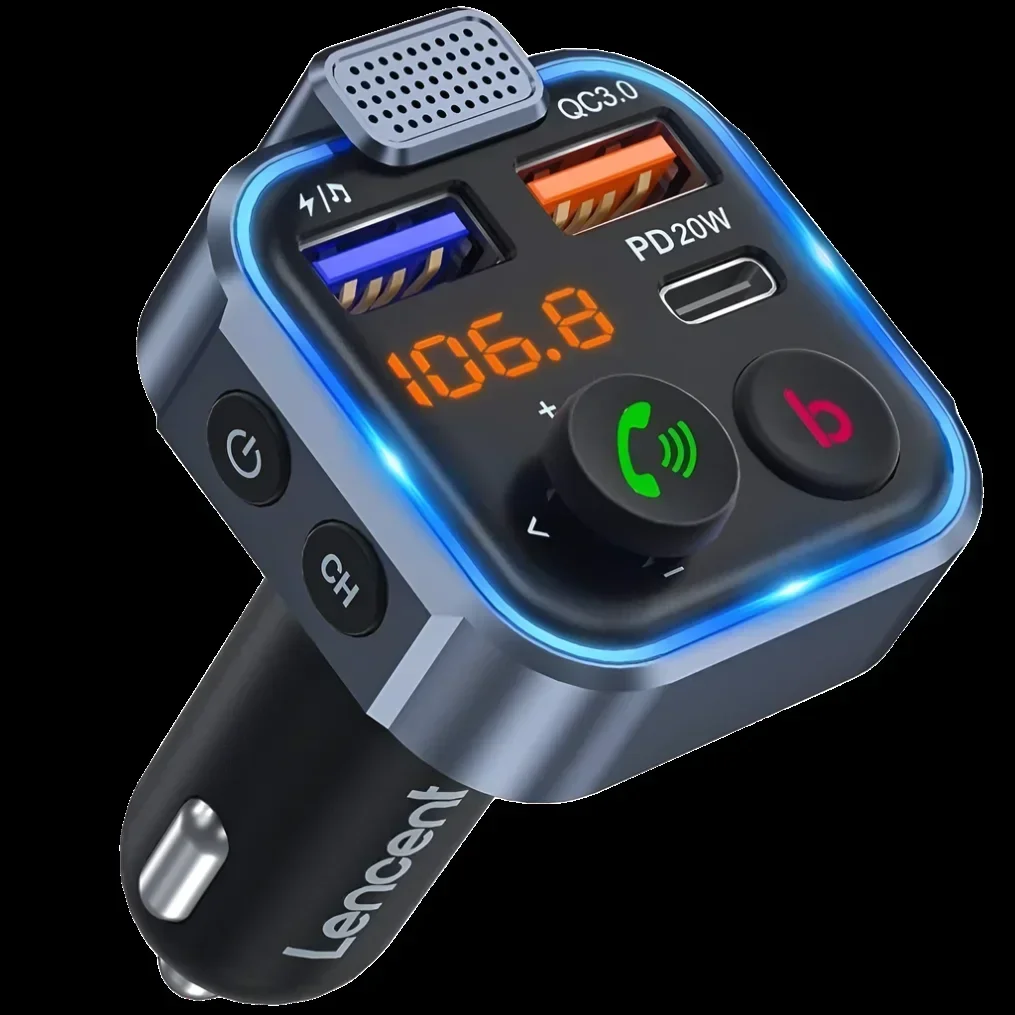
The LENCENT Bluetooth 5.3 FM Transmitter is frequently the cheapest way to get true PD 30W fast charging, often around $19. It pairs that USB-C PD 30W port with a QC3.0 USB-A port in a compact body, adds a color ambient light, hands-free calling, and USB-stick playback, and runs Bluetooth 5.3 — the meaningful generation for a stable connection. For most buyers this is the value sweet spot: 90% of the Nulaxy's usefulness at two-thirds the price.
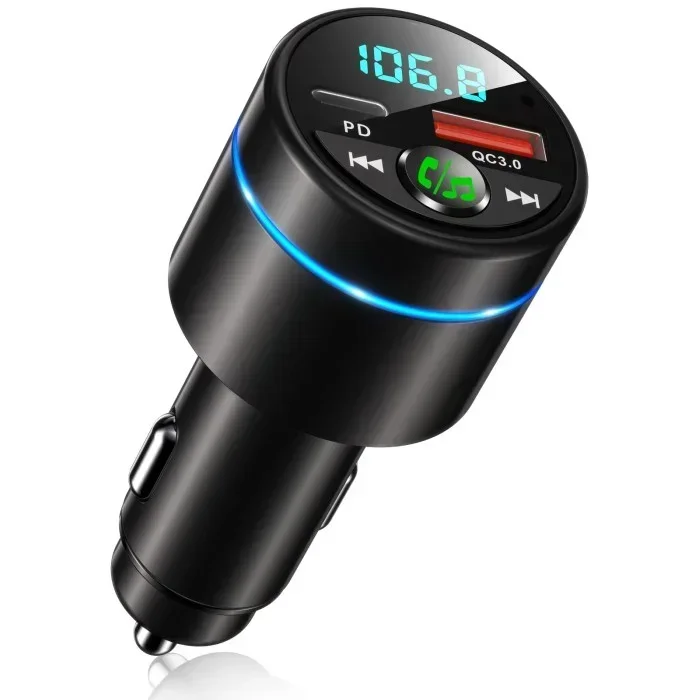
The RIWUSI All-Metal Bluetooth 5.3 FM Transmitter offers the same PD 30W plus QC3.0 charging, also on Bluetooth 5.3, but wraps it in a machined-metal housing that feels far more durable than the usual glossy plastic. It adds noise-cancelling hands-free calling and a subtle blue light, and typically sells near $22. Choose it if you keep gear for years and want something that survives the glovebox and the drops.
The LENCENT and RIWUSI make the same point in two ways: once you are on Bluetooth 5.3 with real PD 30W charging, you already own the two specs that matter. The extra dollars past that buy build quality and screen size, not audio — the FM hop caps that for all of them.
Between the two: take the LENCENT Bluetooth 5.3 FM Transmitter for the lowest price on fast charging, and the RIWUSI All-Metal Bluetooth 5.3 FM Transmitter if a metal body and longevity matter more than saving three dollars.
IMDEN — The Cheapest That Still Works Well
At the bottom of the price range, one unit earns its keep for buyers who mainly want clean Bluetooth audio and a charging port without spending much.
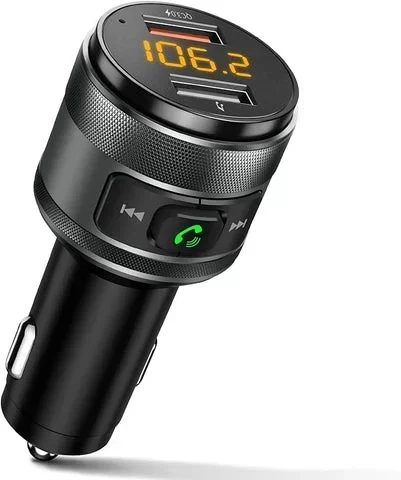
IMDEN Bluetooth 5.4 FM Transmitter (~$16) is the standout value on connection. It punches above its price by running the newest Bluetooth 5.4 radio, which gives it the same connection-stability edge as units costing far more. It includes a QC3.0 fast-charge port and a yellow LED display showing frequency and car voltage, and it is rated for both 12V and 24V vehicles — so it works in trucks and larger vans, not just cars.
What it lacks is the second PD 30W port, so you fast-charge one device rather than two. If that matters, the LENCENT above is the cheapest way here to get the pair.
When an older budget unit is enough - and when to step up
- You want a proven, widely-used unit and do not need fast charging.
- You mostly play music and rarely make hands-free calls, so the older Bluetooth radio's occasional reconnect does not bother you.
- You value a long history of buyer feedback over the newest spec sheet.
If any of those fit, a proven older budget unit will serve you fine. If you make calls or want your phone to charge quickly, step up to the LENCENT Bluetooth 5.3 FM Transmitter or the IMDEN Bluetooth 5.4 FM Transmitter instead — the newer Bluetooth and real fast charging are worth the few extra dollars for most people.
Getting the Cleanest Possible Sound From Any Unit
Because transmit power is fixed by law and audio quality is capped by the FM hop, your setup technique does more for sound than spending an extra $10 ever will. These habits matter more than the brand on the box:
- Hunt for a truly dead channel, not a faint one. Scan your dial for a frequency that is pure static with no station whispering underneath. Set both the radio and the transmitter to that exact frequency. Many units have an auto-scan that suggests open channels.
- Start at the low end of the band. Frequencies around 87.9 to 88.5 MHz are often the least crowded because commercial stations cluster higher, so try there first.
- Re-tune on long drives. A channel that is empty in your city may collide with a station 100 miles down the highway — remember there are only 101 channels to share. If hiss creeps in, scan again.
- Drive the phone hot, the radio moderate. Set your phone's output near maximum and the car radio to a normal level. That gives the transmitter the strongest audio to work with and the best signal-to-noise ratio.
- Mind the antenna path. A transmitter buried under a phone or behind thick trim has a slightly harder time reaching the car's antenna. A clear line from the 12V socket helps a little.
- Save your good channel as a radio preset. Once you find a dead frequency that works on your regular commute, store it as a station preset on the car radio. Now switching to your transmitter is one button, not a re-scan every trip — and you keep a mental shortlist of two or three good frequencies for the routes you drive most.
Set expectations honestly before you spend anything: the best any FM transmitter can sound is "clean FM radio," not "wired aux." That is not a knock on these units — it is the format. On a quiet rural channel most people never notice the difference; in stop-and-go city traffic on a crowded dial, even the priciest unit here will hiss when a nearby station bleeds in. If you know your commute is dense with stations, temper expectations accordingly, and lean harder on the low end of the band where the dial is emptiest.
If persistent interference survives all of that, the cause is a congested FM band, not a bad unit — and no purchase fixes it, because every transmitter is stuck at the same 250 microvolts/meter. That is the honest ceiling of the technology. Whenever your car actually has an aux jack or built-in Bluetooth, use it; a wired or aux-Bluetooth path skips the FM hop entirely and will always sound cleaner.
How We Chose These Picks
We did not lab-test these units, and we will not pretend we did. This guide is a research synthesis: we compared published manufacturer specifications, the documented Bluetooth and USB charging standards each model uses, the FCC Part 15 rules that govern all of them, and the broad pattern of owner feedback across thousands of reviews. The goal was to pick five distinct, established brands that each mark a clear point on the price-and-feature curve — not five near-identical clones with a different logo.
Our weighting, in order:
- Bluetooth generation and connection reliability — the single spec that measurably changes daily use (5.3 and 5.4 over 5.0).
- Real charging capability — genuine PD 30W and QC3.0, up to 48W combined, versus plain 5V trickle ports.
- Hands-free call quality — noise suppression that survives highway speed.
- Display usefulness — a 1.8-inch color screen beats a plain 1.44-inch LED for glanceability.
We deliberately ignored audio-fidelity marketing, because the analog FM stage caps sound quality for every model no matter the claim, and we ignored "signal strength" entirely, because the FCC fixes it at 250 microvolts/meter at 3 meters for all of them. Prices here are approximate and move constantly — treat every figure as a ballpark, from about $16 to $30, and confirm the current price before you buy. And the standing caveat: if your car has an aux jack or built-in Bluetooth, those routes beat any FM transmitter. This guide is for the cars that have neither.