BlackVue DR970X-2CH: The Top Dash Cam for Truckers
The BlackVue DR970X-2CH is often touted as the top dash cam for truckers, but let's be honest, it's a passenger vehicle unit scaled up. You're paying a premium, often upwards of $400-$500, for brand recognition and a sleek, cylindrical form factor that barely matters when it's stuck to a windshield. For commercial operations, you need something built for 16-hour days, constant vibration from rough roads, and extreme temperature fluctuations – not a device designed for the occasional commute.
While the DR970X-2CH boasts impressive 4K UHD resolution for its front camera and Full HD for the rear, along with cloud connectivity and advanced parking mode features, these come with caveats in a trucking environment. The cloud features, while useful, rely heavily on consistent Wi-Fi or a separate LTE module, adding complexity and potential data costs. Its reliance on a supercapacitor is a plus for heat resistance, but the overall build isn't designed for the relentless abuse a commercial truck endures.
Consider the practicalities: a typical passenger car might see a few hours of operation daily. A long-haul truck, however, operates for 10-14 hours straight, often in direct sunlight or freezing conditions. The constant engine vibration, the jarring over potholes, and the sheer duration of recording put immense strain on internal components, SD cards, and mounting hardware. The BlackVue, with its relatively delicate design and consumer-grade mounting, simply isn't engineered for this level of sustained punishment. You're more likely to experience mounting failures, corrupted footage due to heat and vibration affecting the SD card, or premature unit failure compared to purpose-built fleet solutions.
Tech.co even named it the 'best overall option for truckers,' which tells me they haven't spent a week in a semi. Their recommendation overlooks the critical differences between consumer electronics and ruggedized commercial equipment, prioritizing features that look good on a spec sheet over real-world durability and reliability in a demanding professional setting.
Best Dash Cam for Long-Haul Trucking: Samsara vs. Verizon Connect
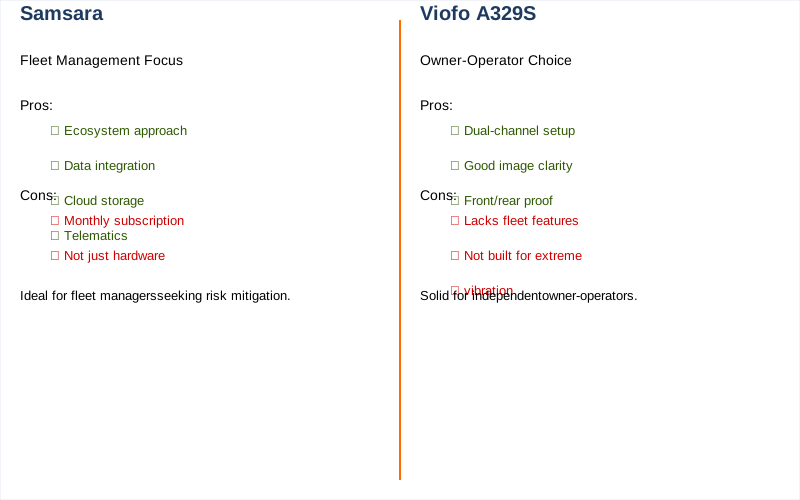
When you're running a fleet, the decision isn't about picture quality, it's about data integration and fleet management. Samsara and Verizon Connect aren't just selling dash cams; they're selling an ecosystem. You're looking at a monthly subscription for cloud storage and telematics, not just a one-time hardware purchase. This is where the real money goes, and where real value can be found if it prevents even one fraudulent claim. TruckersReport forum users often praise Samsara for its fleet capabilities.
For Fleet Managers: AI Driver Monitoring with Lytx DriveCam
For fleet managers, the calculus shifts from individual driver protection to overall risk mitigation and operational efficiency. AI driver monitoring systems like those from Lytx DriveCam promise to revolutionize safety, but it's all about the algorithm and the data pipeline. You're buying predictive analytics, not just a camera. YouTube guides often gloss over the backend infrastructure required for these systems.
Lytx's approach, for instance, integrates high-definition cameras (often 1080p or higher, capturing wide-angle views both inside and outside the cab) with sophisticated AI that constantly analyzes driving behavior. This isn't just recording; it's real-time event detection. The system can identify critical incidents such as:
- Hard braking or acceleration: Indicating aggressive driving or sudden stops.
- Lane departure warnings: Signaling potential distraction or drowsiness.
- Following too closely: A major contributor to rear-end collisions.
- Distracted driving: Detecting phone use, eating, or other non-driving activities.
- Unbelted drivers: A critical safety violation.
When an event is detected, a short video clip (typically 12-20 seconds) is automatically uploaded to the cloud for review by fleet managers or Lytx's professional review service. This proactive identification allows for immediate coaching opportunities, potentially preventing future incidents. Consider a scenario where a driver consistently exhibits hard braking in a specific delivery zone. The AI flags this, allowing a manager to review the footage, understand the context (e.g., poor route planning, aggressive driving habits), and provide targeted training. This level of insight goes far beyond what a standalone dash cam offers, which primarily serves as post-incident evidence.
While the initial investment for a comprehensive AI driver monitoring system can range from several hundred to over a thousand dollars per vehicle, plus monthly subscription fees (often $50-$100+ per vehicle for data, analytics, and support), the return on investment can be substantial. Fleets often report reductions in accident rates by 50% or more, leading to significant savings in insurance premiums, repair costs, and worker's compensation claims. The predictive power of these systems transforms reactive incident response into proactive risk management, ultimately fostering a safer and more efficient fleet operation.
Best Dash Cam for Independent Owner-Operators: Viofo A329S
The Viofo A329S is often recommended as a solid all-around dash cam for independent owner-operators, and I can see why. It's got the dual-channel setup that's essential for proving fault from front or rear impacts. This means you're getting both a front-facing camera, typically recording at 1440p Quad HD, and a rear camera, often at 1080p Full HD, providing comprehensive coverage. For an owner-operator, this dual perspective is invaluable, offering crucial evidence in the event of a fender bender or a more serious collision, whether you're backing into a loading dock or navigating heavy highway traffic.
The image clarity is usually decent, especially from the front camera. During daylight hours, license plates are generally legible within a reasonable distance, and details like road signs and vehicle makes are clear. At night, its performance is acceptable for its price point, often utilizing a Sony STARVIS sensor to improve low-light recording, though it won't match the crispness of higher-end models. It also handles thermal cycling reasonably well for its price point, which is a significant factor for truckers who experience extreme temperature fluctuations, from freezing winter nights to scorching summer days. The capacitor-based power system, rather than a traditional battery, is a big plus here, as capacitors are far more resilient to heat and cold, reducing the risk of premature failure.
But 'decent' isn't 'bulletproof' when your livelihood depends on it. While the Viofo A329S offers excellent value at around the $150-$200 mark, you do get what you pay for in terms of component longevity. For instance, while the video quality is good, some users report that after a year or two of continuous, heavy use in a commercial vehicle, the rear camera cable or the internal components can start to show wear. This isn't to say it's unreliable, but rather that a dash cam that costs upwards of $400-$500 might offer more robust construction and higher-grade components designed for even longer service life under demanding conditions. For an independent owner-operator looking for a reliable, feature-rich dash cam without breaking the bank, the A329S is a strong contender, but it's wise to consider its lifespan in the context of your operational demands.
Understanding Dash Cam Price Tiers for Commercial Vehicles
Understanding dash cam price tiers for commercial vehicles is less about features and more about expected duty cycle and support. Your $50 Amazon special might last six months of daily commuting, but it'll be dead in six weeks in a hot, vibrating truck cab. The plastics outgassing, the internal solder joints fatiguing from constant 120Hz engine vibration - it's a ticking time bomb. Tech.co breaks down various options, but doesn't always explain the 'why' behind the cost.
Dash Cam Installation Gotchas for Large Trucks and Vans
Dash cam installation for large trucks and vans isn't just about sticking it to the windshield. You've got power routing, cable management to prevent chafing, and vibration isolation to consider. Running a rear camera cable through 50 feet of chassis means dealing with frame flex and exposure to road grit. If you don't use proper loom and strain relief, that cable will fail due to shear forces from vehicle movement within a year.
A Reddit thread on dash cam essentials barely scratches the surface of truck-specific challenges.
Best Value Dash Cam for Delivery Drivers: Vantrue E1 Pro
For delivery drivers, the Vantrue E1 Pro is frequently touted as the 'best value,' and for good reason: it focuses on the front-facing camera with a decent sensor without breaking the bank. You don't always need a full 360-degree surveillance rig when you're making local stops. The key here is reliable recording of the immediate road ahead. Car and Driver praises its value, and I agree, for specific use cases.
Priced typically around the $100-$120 mark, the Vantrue E1 Pro offers a compelling package for those who prioritize essential front-facing coverage. Its primary strength lies in its 2.5K QHD resolution (2560x1440P) at 30 frames per second, powered by a Sony STARVIS sensor. This combination ensures clear, detailed footage, even in challenging low-light conditions often encountered during early morning or late-night deliveries. Imagine a scenario where you need to prove you stopped at a red light, or capture the license plate of a vehicle that cut you off – the E1 Pro delivers the clarity needed for such evidence.
While it lacks the rear or interior cameras found in more expensive setups, this simplicity is precisely what makes it a 'best value' for many delivery professionals. Less complexity often means easier installation and fewer points of failure. The compact design also ensures it doesn't obstruct your view, a crucial factor when navigating busy urban routes. It includes essential features like G-sensor incident detection, which automatically locks footage upon impact, and loop recording, preventing the memory card from filling up. For a driver who primarily needs to document their journey on the road ahead, avoiding false claims or providing evidence in minor fender-benders, the Vantrue E1 Pro provides robust performance without the unnecessary bells and whistles that would drive up the cost. It's a pragmatic choice for the daily grind of package delivery.
Best Midrange Dash Cam for Rideshare Drivers: 70Mai T800
The 70Mai T800 is often listed as a 'best midrange' option for rideshare drivers, probably because it balances price and features like a cabin-facing camera. For passenger transport, internal recording is as critical as external. You need to document passenger interactions, not just road incidents, making its dual-channel recording a significant advantage for its typical price point of around $120-$150. The T800 records in crisp 1944p (2.5K) for the front camera, capturing license plates and road details effectively, while the interior camera typically records in 1080p, providing clear footage of your vehicle's cabin. This dual-camera setup is essential for accountability, protecting drivers from false claims or documenting unruly passengers, which can be a common occurrence in rideshare scenarios.
One of the T800's key strengths for rideshare drivers is its discreet design. While it features a small 2.2-inch IPS display, which one 1-star review famously called 'way too small,' you're not watching movies on it; you're confirming recording status and adjusting settings. The compact size means it doesn't obstruct your view or draw undue attention from passengers. Its integrated GPS allows for location and speed data to be embedded in your footage, providing crucial context for any incident. Furthermore, the T800 often includes parking surveillance features, requiring a hardwire kit (sold separately, typically $20-$30), which can monitor your vehicle for bumps or impacts even when you're not in it – a valuable addition for drivers who park in busy urban areas between fares.
Compared to entry-level single-channel dash cams that might cost $50-$80, the T800 offers a significant upgrade in terms of resolution, dual-camera functionality, and GPS, justifying its midrange price. While high-end models from brands like BlackVue or VIOFO might offer 4K resolution, cloud connectivity, or more advanced parking modes, they often come with a price tag upwards of $250-$350. The 70Mai T800 strikes a sweet spot, providing robust protection without breaking the bank. Viofo's blog, while promoting their own products, acknowledges the importance of features like those found in the T800 for professional drivers.