The Big Picture
Connecting a dash cam directly to your car's electrical system, bypassing the 12V socket, is called hardwiring. This isn't some black magic; it's just about tapping into your car's fuse box to give your dash cam a constant, clean power source. The real move is understanding why you'd do this. It unlocks features like parking mode so your camera keeps an eye on things even when the engine's off.
My first attempt involved a spaghetti-like mess of wires from the cigarette lighter, and the thing would randomly shut off. This whole hardwiring thing is about tidiness and reliability. It means no more dangling cords that get in the way or look like a squirrel's nest. The honest version: it makes your dash cam setup look like it actually belongs there, not like an afterthought. Think of it as upgrading from a foam pad to a real sleeping bag.
It's a small upgrade that makes a huge difference in daily use.
The Core Answer
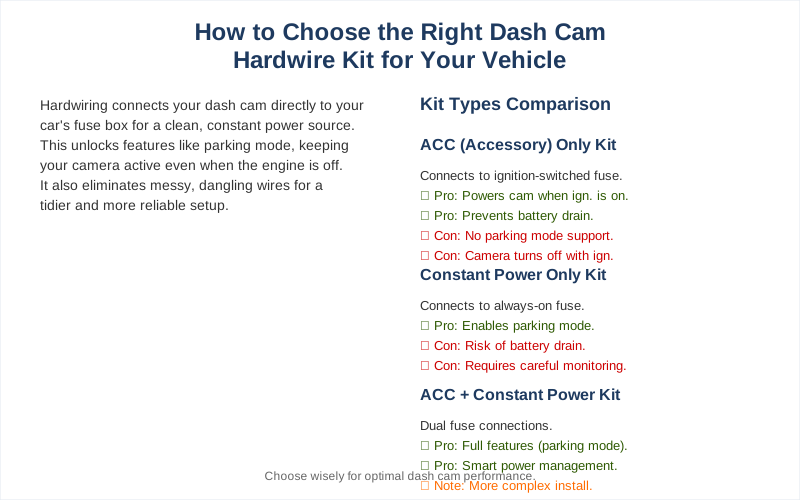
The game-time decision when hardwiring a dash cam is picking the right kit. This isn't about the fanciest lights or the most buttons; it's about how it talks to your car's power. Most kits are basically a cable with a plug on one end for your dash cam and a connection for your car's fuse box on the other.
What nobody tells beginners is that your car's fuse box has two main types of power: one that's always on, and one that only comes on when the ignition is on. You need to figure out which is which. My first try, I plugged into the always-on one for both wires, and my battery died overnight at a campground in Pennsylvania. Rookie mistake. The kit has wires that tap into specific fuses.
One wire needs constant battery power (BAT) so your dash cam can record when parked. The other needs ignition power (ACC) so it turns on and off with your car. You can often find these by looking at the fuse box diagram in your car's manual. Or, if you're feeling brave and have one, a cheap multimeter can tell you which fuse is hot when the car is off and which is hot when it's on.
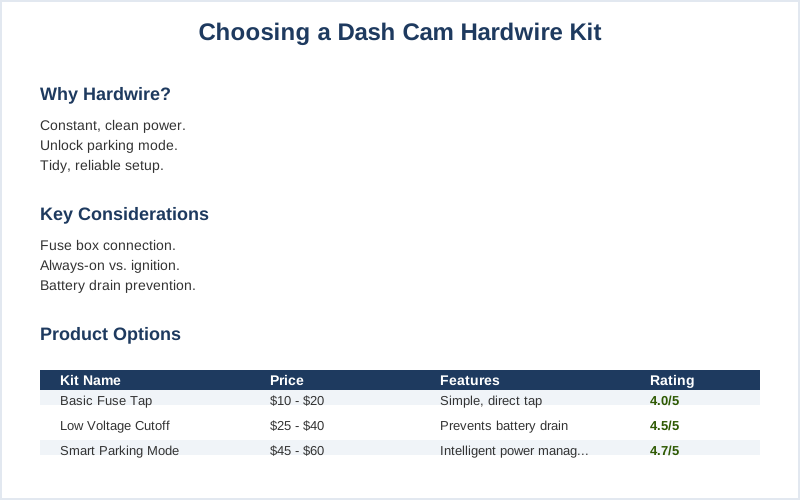
Apparently, some kits have a little switch or a voltage cutoff to prevent draining your battery. That's the 'smart' kind of kit. Others just send power. I learned the hard way that a smart kit is worth the extra few bucks. It saves you from waking up to a dead car. The honest version: get a kit that has a low-voltage cutoff. It's like a safety net.
Some kits also come with different types of fuse taps, which are little adapters that let you plug the kit into existing fuse slots without cutting wires. You need to match the fuse tap to the type of fuses in your car, which are usually either 'mini' or 'micro'. Figure out what your car uses before you buy. I had to run to the auto parts store at 10 PM once because I bought the wrong size fuse taps.
Brilliant engineering, these fuse taps. The length of the wire is also a factor. Most cars need about 10-15 feet of cable to run from the fuse box to the dash cam. If you have a huge truck or SUV, you might need a longer one, like a 20-foot cable. Don't skimp on length; you don't want to be short when you're trying to tuck wires neatly.
The $50 version of a kit might have all these features, while the $15 one might just be a cable. It's a field notes kind of thing: what works for one car might not work for another. But the core concept of finding ACC and BAT power is universal.
Why This Matters for Your Setup
- Clean Install: This is the biggest win. No more dangling cords that look like a bird's nest. My first car camping trip with a dash cam involved a cord that kept falling from the rearview mirror. A hardwired kit tucks everything away neatly. It looks professional, like it came with the car.
- Parking Mode: This is the killer feature. When your car is off, the dash cam can still record if it detects motion or impact.
This is huge for catching hit-and-runs or vandalism. I learned this when someone dinged my bumper in a parking lot and I had no idea who did it. This is what people are asking about when they want '24/7 recording'.
- Battery Protection: A good hardwire kit will have a low-voltage cutoff. This means if your car battery gets too low, the dash cam shuts off so you can still start your car.
I've had my battery die from leaving dome lights on, and the thought of a dash cam doing it too was terrifying. This prevents that headache.
- Always Ready: You don't have to remember to plug anything in. The camera is always powered and ready to go. It's the ultimate set-it-and-forget-it solution. My second dash cam setup was hardwired, and I never even thought about it again until I needed the footage.
Making the Right Choice
- Voltage Cutoff is Key: Don't be like me and kill your battery. Look for a kit that automatically shuts off the dash cam when your car battery gets low. This is the single most important feature for preventing a dead car. It's a simple insurance policy.
- Fuse Taps Matter: Make sure the kit comes with fuse taps that match your car's fuse types. Trying to jury-rig something is a recipe for disaster.
My first attempt involved a lot of electrical tape and regret. Matching the fuse is crucial.
- Wire Length: Measure from your fuse box to where you want your dash cam. Getting a kit that's too short is a pain. I learned this the hard way after trying to stretch a 5-foot cable across my dashboard.
Get a little extra just in case.
- Parking Mode Needs: If you want your camera to record when parked, you need a kit that provides constant battery power (BAT) and ignition power (ACC). Some kits are simple 2-wire setups, but for parking mode, you need the proper setup. This is non-negotiable for that feature.