
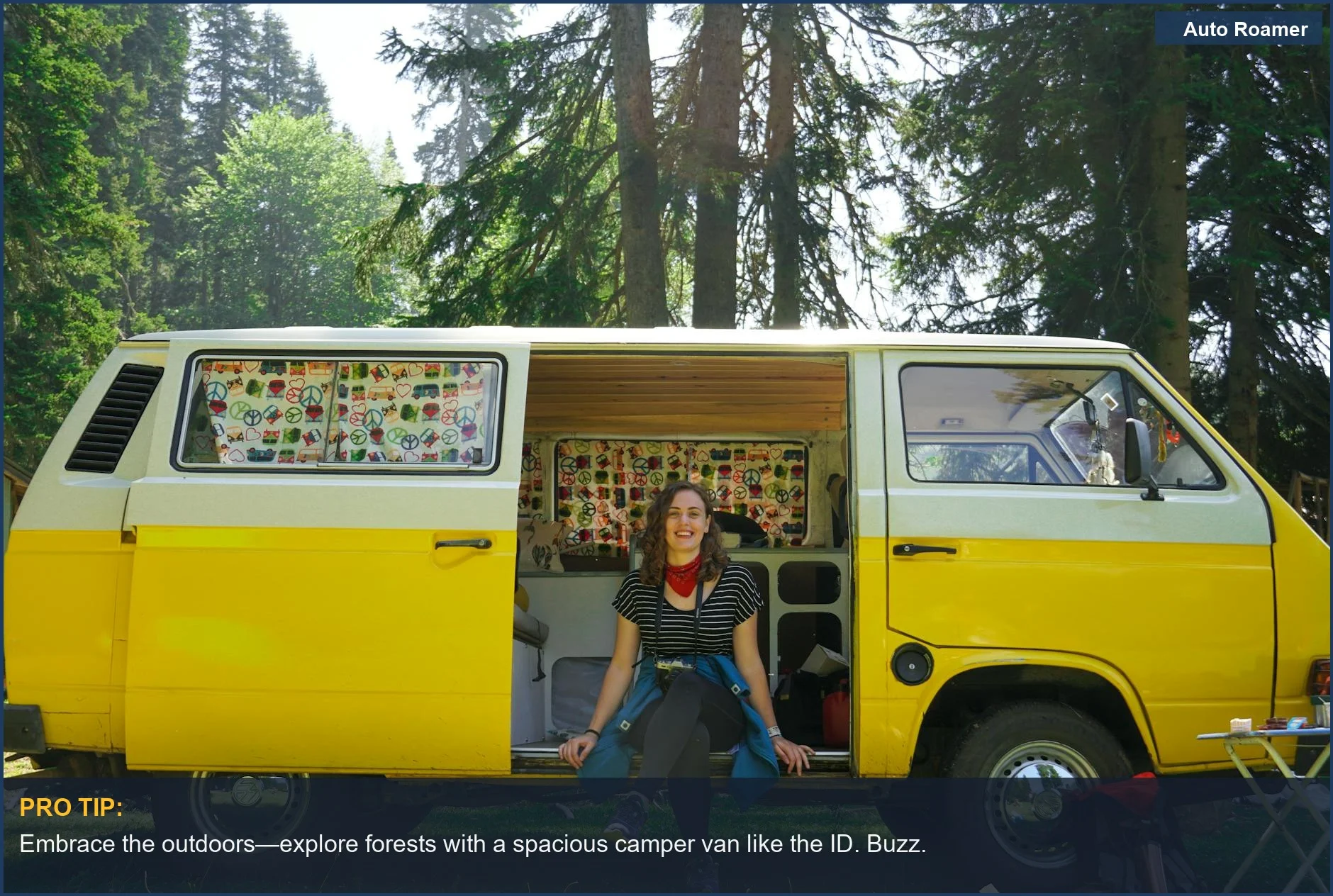
The Electric VW Camper, Honestly: Production Buzz vs. Concept California
Search “VW electric camper van” and the results blur two very different things into one fantasy. There is a real electric VW you can buy and camp in today, and there is a factory electric camper VW has shown but not yet sold. Keeping them straight is the single most useful thing this guide can do for you, because the gap between them is the difference between planning a trip and planning a wish.
The vehicle you can actually drive home is the ID. Buzz, the all-electric revival of the Microbus. It is a roomy electric minivan, sold at US dealers, with a flat-folding floor that makes a genuinely capable camper base. It is not a factory camper — there is no built-in kitchen and no pop-top from the Volkswagen showroom — so an ID. Buzz camper is a build you create on top of a very good base, not a trim you tick on the order form.
The vehicle people are really dreaming about is the ID. California, the fully electric factory camper Volkswagen has confirmed it is developing on the ID. Buzz platform — a pop-top, a kitchen and camper systems, but battery-powered. As of 2026 it is a confirmed future model, not a car on a dealer lot. Here is the split that matters before you read another word:
- ID. Buzz — production, US-available now, an electric camper base you convert.
- ID. California — a confirmed future factory EV camper, Europe-first, not yet on sale anywhere.
Everything below is drawn from Volkswagen's published specifications, press reveals and pricing rather than an invented test drive, and it labels concept versus production at every turn so you can match the right electric VW to the way you actually travel.
The ID. Buzz as a Camper Base: The Numbers That Actually Matter
For an American shopper, the ID. Buzz is the entire practical answer to “which electric VW can I camp in?” It arrives as a minivan, so what makes or breaks it as a camper is the published hardware, not the marketing. These are the specs worth planning a build around:
- Cargo and sleeping floor: fold the second and third rows of the US long-wheelbase ID. Buzz and you open up about 145.5 cubic feet of space behind the front seats. The optional Flexboard system creates a raised, level platform flush with the folded seatbacks, and Volkswagen notes it is sized to hold a full-size mattress — the one feature that turns the Buzz from a roomy van into a real camping base.
- Battery and range: a 91 kWh battery delivers up to roughly 234 miles of EPA-estimated range in rear-wheel-drive form, or about 231 miles with 4Motion all-wheel drive, at around 80–83 MPGe.
- Footprint: at roughly 195 inches long the US Buzz is a long-wheelbase three-row minivan — big enough to sleep in, small enough to park in a normal space and drive like a car the rest of the week.
- Pricing: roughly $59,995 for the Pro S, about $63,495 for the Pro S Plus, and around $65,495 for the launch 1st Edition — minivan money, not motorhome money, before any conversion.
The honest limit to plan around is width. Between the interior walls the usable sleeping width lands closer to a full-size mattress than a queen, so aftermarket builders typically run two narrow pads side by side; mattress maker HEST, for example, recommends two of its Foamy pads linked together for the ID. Buzz. Volkswagen does not publish a single bed-length figure, so if a flat lie-down matters to you, fold the seats and run a tape measure yourself before buying a pad or platform. One more order-sheet detail saves money: the Flexboard is standard on the 1st Edition and optional on the Pro S Plus, so confirm whether the trim you are pricing already includes it before paying separately for a platform.
The one number that decides whether the Buzz works as your camper is the folded sleeping width, and it is the one Volkswagen does not print. Measure it yourself before you buy a single pad.

Seats to Bed: What Sleeping in an ID. Buzz Is Really Like
The brochure photos make the seats-to-bed transition look effortless. The reality is good but not magic, and being clear about it now saves a disappointing first night. Without a factory camper interior, the ID. Buzz sleeps two comfortably across the folded floor, and a family of four needs an added pop-top or roof tent — the factory van does not give you a second berth.
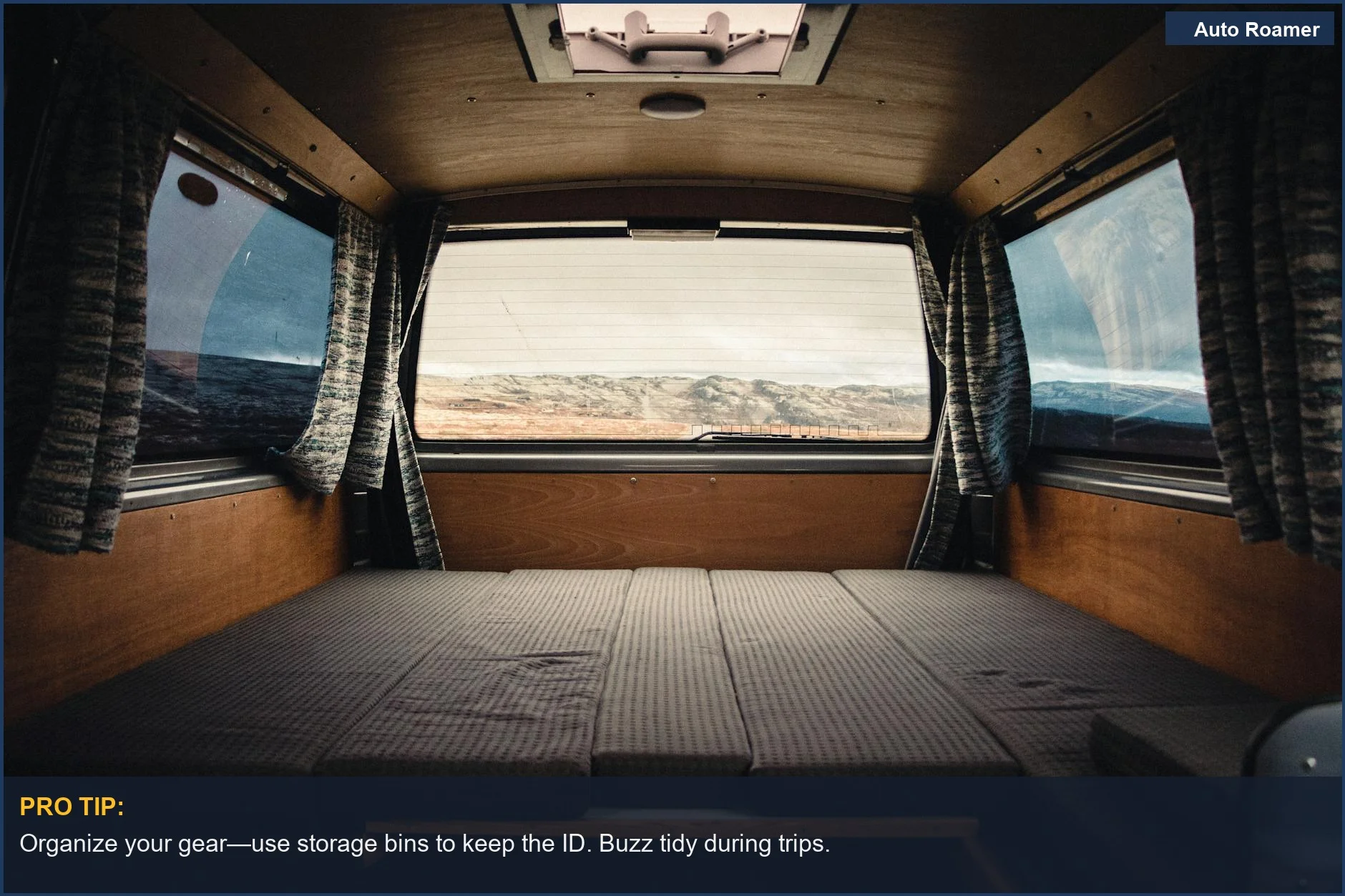
The catch the photos hide is that the folded floor is not perfectly flat on its own; the seatbacks leave a gentle step, which is exactly why the Flexboard (or an aftermarket leveling platform) exists. Without one, a single thick pad sags into the gaps; with one, you get a genuinely level, full-size-mattress-friendly sleeping deck with usable storage underneath. So a realistic sleeping setup is a short stack of decisions, in order:
- Level the floor. The Flexboard or an aftermarket platform turns the stepped, folded seatbacks into a flat deck. This is the foundation; skip it and nothing on top of it sleeps well.
- Choose a pad that fits the width. Because usable width is nearer a full size than a queen, two narrow pads side by side beat one wide one that hangs over the wheel arches. Our car-camping mattress guide covers sizing the pad to a folded floor like this.
- Control light and air. The Buzz has a lot of glass, so reflective window covers are not optional for privacy and temperature; see our camping window shade guide for cut-to-fit options.
An ID. Buzz makes an excellent two-person sleeper once the floor is leveled and the windows are covered — but it is a base you finish, not a finished camper. Budget for the platform, the pads and the covers as part of the vehicle, not as an afterthought.
One more comfort note specific to a sealed metal van: condensation. Two people breathing overnight in a tightly closed EV will fog the glass and dampen bedding, and an electric van has no warm idling engine to dry it out. A cracked window and a small vent fan handle it; our guide to reducing condensation when sleeping in a car applies directly to the Buzz.
It is also worth thinking about how the cabin lives around the bed, because a van that sleeps two is only half a camper if there is nowhere to sit, cook or stash gear. The same flat-deck-on-a-platform approach that solves sleeping also creates the storage that keeps a two-person trip livable: the void beneath a leveling platform swallows a power station, a 12V fridge and soft bags, keeping the sleeping surface clear and the floor uncluttered. The front seats swivel on many builds to face the cabin, turning the Buzz into a small lounge in the evening, and a slide-out tailgate kitchen module lets you cook outside rather than filling the sleeping space with cooking smells and moisture. None of this is exotic — it is the standard minivan-camper playbook — but it is the difference between a van you merely sleep in and one you can comfortably spend a rainy afternoon inside.
Power While You Camp: The Real Edge of an Electric Van (and Its Catch)
The most genuine advantage an electric VW has over a gas camper is electrical capacity. The ID. Buzz carries a large 91 kWh traction battery — orders of magnitude more than the small accessory battery in a conventional van — and it is built to power accessories, not just start an engine. In principle that runs camp lights, a fan, a 12V fridge and device charging for far longer than any combustion van could, and crucially without idling an engine, which on a gas vehicle is a carbon-monoxide and fuel-waste hazard you should never sleep through.
There are two honest catches, and skipping them is how range anxiety becomes range reality:
- Vehicle-to-load output varies by trim and market. Not every ID. Buzz ships with true household-style outlet power, and US availability of vehicle-to-load has differed by configuration. Confirm the exact outlet and V2L spec on the specific van you are looking at rather than assuming it can run everything.
- Anything you run is range you spent. Every watt-hour pulled from the traction battery for camp is a watt-hour you no longer have to drive home. On a remote multi-night trip that math turns a relaxing weekend into a worried one.
The fix the experienced electric campers use is simple: keep camp loads off the vehicle. A dedicated portable power station handles the fridge, lights and charging so your driving range stays intact, and it recharges off the van as you drive between sites. A 300-to-700 watt-hour LiFePO4 unit covers a typical low-draw weekend with margin — our portable power station guide walks through sizing, and the electric cooler power consumption breakdown shows why a 12V fridge sips far less than people fear. Used that way, the Buzz's big battery becomes a backstop rather than the thing you nervously watch.
Range Anxiety and Charging While Camping: The Practical Reality
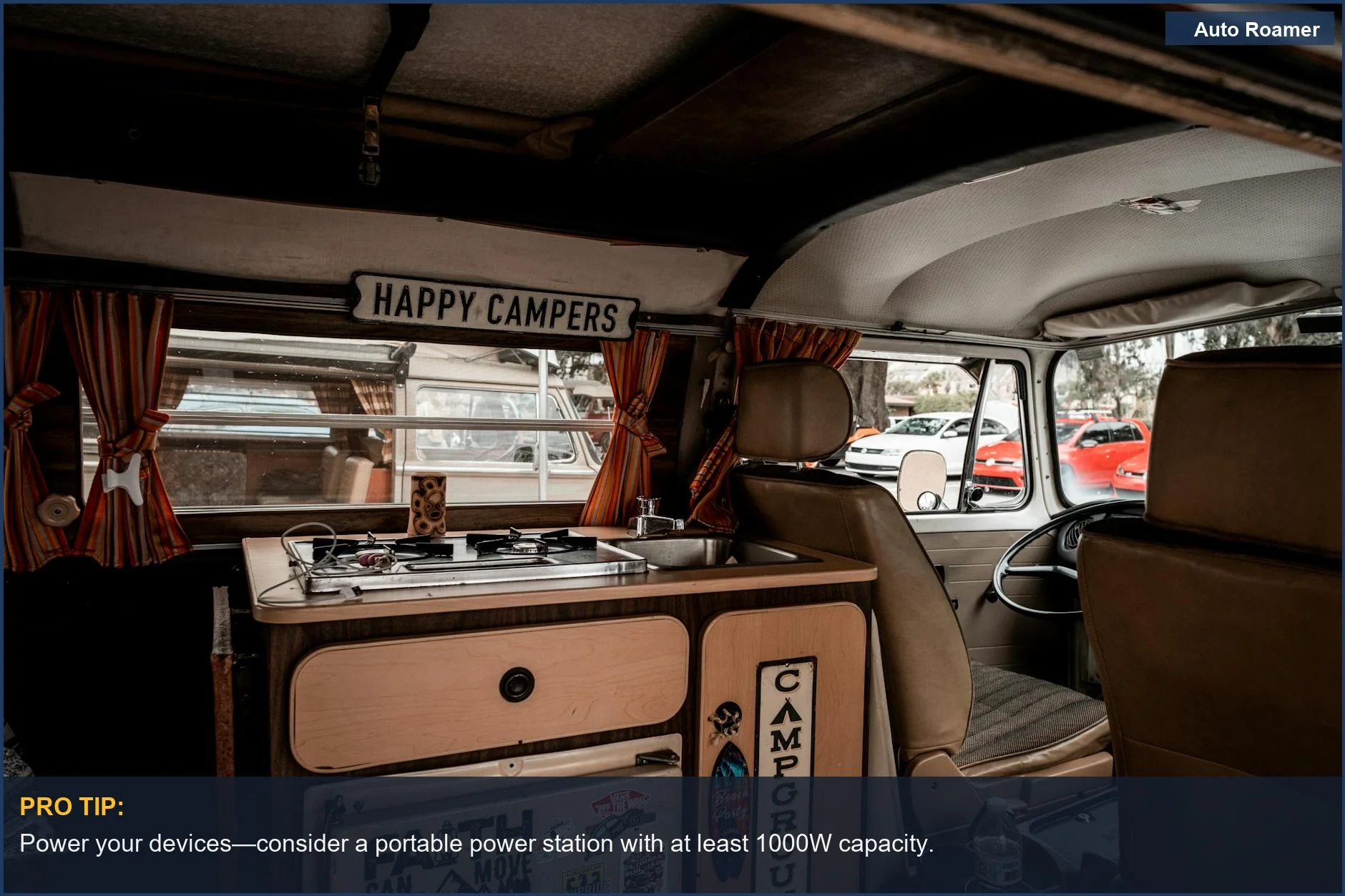
Range is where the electric-camper dream meets the map, and honesty here matters more than enthusiasm. About 234 miles of EPA range is comfortable for regional and weekend trips but demands planning for remote destinations — especially because real-world range drops with a full van, a roof load, cold weather and highway speed, the exact conditions a camping trip stacks up all at once.
The charging picture splits cleanly into the part that works well and the part that needs forethought:
- Getting to camp: on routes with DC fast chargers the Buzz is straightforward — plan stops the way any EV road trip does, and arrive with a buffer rather than on fumes.
- Charging at camp: this is the honest weak spot. Most campgrounds and trailheads have no EV charger, and a standard 120V campground outlet (where one exists) trickle-charges so slowly it adds only a few miles overnight. A 240V RV pedestal helps where available, but you cannot assume it.
- Leaving camp: plan your departure charge before you arrive. The worst position is a beautiful remote site, a low battery and the nearest fast charger an hour of driving you do not have away.
The realistic rule for an electric VW camper: treat the traction battery as your drive, not your campsite. Arrive with enough range to leave, run camp off a separate power station, and choose destinations within a confident round-trip of known charging.
It also helps to put the anxiety in proportion with a little arithmetic. Camp loads and driving loads are completely different scales. A weekend of lights, a fan, device charging and a 12V fridge might draw a few hundred watt-hours a day — a single-digit percentage of a 91 kWh pack — whereas driving 200 highway miles spends nearly the whole battery. That is precisely why the right mental model is to ring-fence the traction battery for movement and let a small portable power station carry the campsite: the camp draw is trivial against the pack, but the peace of mind of never touching your drive-home range is not. Plan the drive carefully and the camp almost takes care of itself.
None of this makes the Buzz a poor camper — for the regional weekend trips most people actually take, it is excellent. It simply rewards the planner and punishes the optimist, which is true of every EV and doubly true when the EV is also your bedroom for the night.
The ID. California: VW's Factory Electric Camper, and Why It's Not Here Yet
The vehicle that would end the “base, not a camper” caveat is the ID. California — Volkswagen's confirmed plan to build a factory electric camper on the ID. Buzz platform, applying the beloved California pop-top-and-kitchen formula to an EV. It is important to be precise about its status: this is a confirmed future model that Volkswagen Commercial Vehicles has publicly committed to, not a vehicle on sale anywhere as of 2026.
Based on Volkswagen's own statements and the ID. Buzz it is built on, the picture of what the ID. California aims to be is reasonably clear, while the details remain unconfirmed until launch:
- What it should bring: the factory camper features the ID. Buzz lacks today — an integrated kitchen unit, camper control systems and very likely a pop-top or elevating roof to add a second berth — all powered electrically rather than by a combustion drivetrain.
- Where and when: like the combustion California, it is expected to launch in Europe first; a US release is not confirmed, and Volkswagen has separately signaled an ID. Buzz camper variant could appear around 2027. Treat any firm date or US-availability claim with skepticism until VW announces it.
- What it does not change today: for anyone shopping now, the ID. California is a reason to be optimistic, not a reason to wait indefinitely. If you want to camp in an electric VW in the next year, the answer is still an ID. Buzz you build out.
There is also a sensible middle path between waiting and building from scratch: the aftermarket. A growing ecosystem already turns the production ID. Buzz into a camper today, offering sleeping platforms, slide-out kitchen modules, insulated window covers and even pop-top roof conversions designed specifically for the van. These kits deliver much of what the future ID. California promises — a level bed, a place to cook, a second berth up top — without waiting for a launch date or a US release that may be years out. The trade is that you are assembling a camper from parts and a base vehicle rather than buying one finished and warranted as a unit, so factor in installation, fit and the support of whoever builds the kit. For many buyers that aftermarket route, not the concept, is the realistic way to a fully-featured electric VW camper this decade.
The honest takeaway is that Volkswagen is clearly moving toward a factory electric camper, and when the ID. California arrives it should be the turn-key EV camper this category has been missing. But buying decisions live in the present tense: the ID. California is a concept-to-production promise, and the ID. Buzz — bare or aftermarket-converted — is the electric VW you can actually camp in right now.
Electric vs. Gas VW Campers: The Trade-Offs That Decide It
An electric VW camper is not simply a gas one with a plug. The drivetrain changes the whole ownership and trip-planning picture, and the right choice depends on how and where you travel rather than on which is “better” in the abstract. Set side by side, the trade is clear:
- Where electric wins: near-silent driving and camp, no engine idling and no carbon-monoxide risk for cabin power, a huge house-capable battery, lower running costs where you charge at home, and that unmistakable retro-future ID. Buzz charm.
- Where gas still wins: fast refueling anywhere, no charging math for remote or long-haul trips, established factory camper options abroad, and a lower entry price for the vehicle itself.
- Where they tie: as a place to sleep and live, a well-built ID. Buzz and a comparable gas van are similar — the camping comfort comes from your platform, pad, covers and power setup, which are the same regardless of what turns the wheels.
The drivetrain does not decide whether a van is a good camper — your build does. The drivetrain decides how, where and how far you can travel between comfortable nights.
If you want to weigh the VW options against one another directly, our VW camper van comparison lines the models up side by side, and the broader VW camper van review surveys the whole lineup including the gas and hybrid options. The short version for the electric-curious: if your trips are regional and weekend, with the van living as a daily driver in between, the ID. Buzz's quiet, low running cost and big battery make the EV trade-off easy to accept. If you genuinely live on the road for weeks in remote country, the charging reality argues for a gas base — for now.
The Verdict: Who an Electric VW Camper Is Really For
Pulling the whole electric picture together honestly: there is no factory VW electric camper you can buy today, but there is an outstanding electric camper base, and a factory EV camper on the way. The decision comes down to who you are and how you travel.
- Buy an ID. Buzz now if you want an electric VW to camp in this year, your trips are mostly regional and weekend, you can charge at home, and you are happy to build out a leveling platform, pads, window covers and a portable power station. For that buyer it is genuinely one of the most appealing camper bases on sale.
- Wait for the ID. California if you specifically want a turn-key factory EV camper with a built-in kitchen and pop-top, you are in (or can wait for) the markets it launches in, and you are not in a hurry — understanding it has no confirmed on-sale date or guaranteed US release.
- Look at a gas base instead if you do long-haul or deep-remote trips where charging is scarce, or you want the lowest entry price — the electric premium and charging planning may not pay off for your style.
The ID. Buzz delivers the real spirit of the VW camper in electric form: a daily van that becomes a weekend home, quiet and idle-free at camp. It just asks you to finish the camper yourself and to respect the charging map — do both and it is a superb electric camper base.
Whichever way you lean, the same honest steps protect the purchase: measure the folded floor for your pad rather than trusting a brochure, confirm the exact trim's outlets and any flat-floor option on the specific vehicle, size a separate power station to your real camp draw, and plan destinations within a confident round-trip of known charging. Do that, and an electric VW gives you the rarest thing in camping — a silent, zero-emission night under the stars with the lights on and the engine off — instead of a fantasy from someone else's brochure.