How Much Power Does an Electric Cooler Use? The Direct Answer
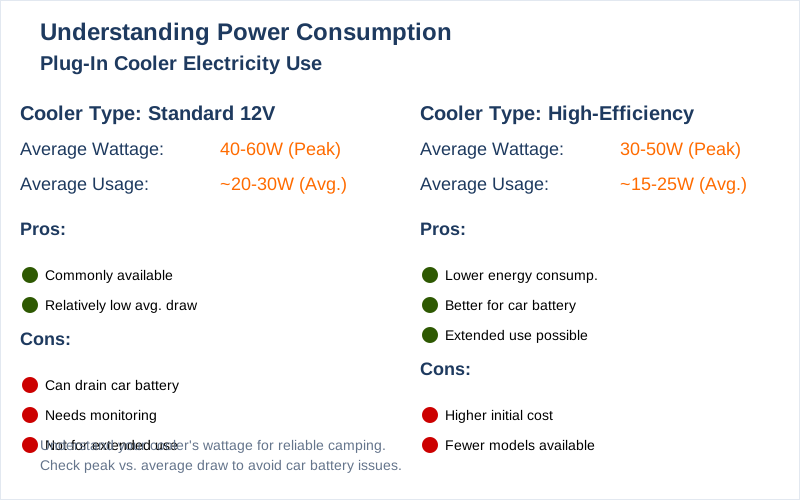
An electric cooler's power draw depends almost entirely on which of the two cooling technologies it uses. A thermoelectric (Peltier) cooler typically draws a steady 3–5 amps at 12 volts — roughly 40–60 watts — continuously, all day, because it has no real temperature control: it simply pushes heat as long as it is plugged in. A compressor cooler (a true 12V fridge) draws more when its compressor is running — commonly 1–6 amps depending on size and setpoint — but it cycles on and off to hold a temperature, so its average draw over a day is far lower than its peak, and it gets genuinely cold rather than just cool.
That difference is the whole story. The thermoelectric unit is cheaper to buy but expensive to run because it never stops drawing power. The compressor unit costs more up front but sips energy over time because it only works when the cabinet warms up. Published manufacturer figures and owner reports for both types cluster around the ranges above; treat them as typical planning numbers, not a guarantee for your specific model, which will have its own rated draw on the label.
For planning a trip, the number that actually matters is not the peak watts but the energy used over time — watt-hours (Wh) or, for 12V systems, amp-hours (Ah) per day. A compressor cooler that draws 4 amps but only runs 40% of the time averages about 1.6 amps, or roughly 38 Ah over 24 hours. A thermoelectric unit drawing a steady 4 amps with no cycling burns about 96 Ah in the same 24 hours — more than twice as much, for worse cooling. The rest of this guide walks through that math and what it means for your battery, your power station, and your trip.
So the short version: expect roughly 40–60 W continuous from a thermoelectric cooler and a cycling 1–6 A from a compressor cooler whose average draw is what you budget for. Knowing which type you have, and reading its label, turns a vague worry about 'draining the battery' into a number you can plan around.
It is worth saying clearly that these figures are typical published and reported ranges, not measurements taken from one particular unit. Cooler power draw varies with the model's size, its insulation quality, the brand of compressor, and the conditions you run it in, so the honest approach is to start from these ballpark numbers and then confirm against your own cooler's rating plate — or, better still, against a real watt-meter reading from a representative day of use. The math in this guide is the framework; your label and your meter supply the exact inputs.
Thermoelectric vs Compressor: Two Very Different Power Profiles
Before any math makes sense, it helps to understand why the two cooler types use power so differently, because the mechanism dictates the draw. They are not two versions of the same thing — they cool in fundamentally different ways.
Thermoelectric (Peltier) coolers use a solid-state device that moves heat when current flows through it. There are no moving parts beyond a small fan, which makes them cheap, light, and quiet. The catch is efficiency: a Peltier element pushes heat in proportion to the current you feed it, and it typically only cools the interior to about 18–22°C (32–40°F) below ambient temperature. It cannot freeze, it struggles on hot days, and crucially it usually has no thermostat that shuts it off — so it draws its full 3–5 amps the entire time it is on. That constant draw is what makes it a battery hazard on a long stop.
Compressor coolers use the same vapor-compression cycle as your kitchen fridge, shrunk down and run on 12V DC. A compressor pulls a meaningful current while running — often in the 1–6 amp range depending on size and how hard it is working — but it is controlled by a thermostat. Once the interior reaches the setpoint, the compressor switches off and draws nothing until the temperature drifts up again. This cycling is why a compressor unit can hold a freezing setpoint on a hot day and still use less energy over 24 hours than a thermoelectric unit that never gets properly cold.
The honest rule of thumb: a thermoelectric cooler is a cheap way to keep drinks cool on a short trip with the engine running; a compressor cooler is the only sensible choice if you need real cold, freezing capability, or multi-day runtime off a battery. The power difference is not marginal — it is the deciding factor.
If you are choosing between models, this mechanism difference matters more than any single spec. Our 12V car cooler buying guide walks through specific compressor and thermoelectric units, but the power logic here applies to all of them: continuous draw versus cycling draw is the line that divides the two categories.
Continuous vs Cycling Draw and the Duty-Cycle Idea
The single most misunderstood number in cooler power planning is the rated amp draw, because people assume the cooler pulls that current all day. For a thermoelectric unit that assumption is roughly correct — it really does draw continuously. For a compressor unit it is badly wrong, and that error is what leads to wildly oversized (or dangerously undersized) battery estimates.
The key concept is duty cycle: the fraction of time a compressor cooler's compressor is actually running. A compressor that is rated at 4 amps but only runs 40% of the time has an effective average draw of about 1.6 amps (4 A × 0.40). Duty cycle is not a fixed number — it rises in hot weather, with a low (freezing) setpoint, or when you open the lid often, and it falls in cool weather with a modest setpoint and a well-packed, well-insulated cabinet.
Typical real-world duty cycles for a compressor cooler in moderate conditions land somewhere around 30–50%, which is why owners so often report 'it barely sips power.' On a hot day with a freezing setpoint, the same cooler might run 70–80% of the time, and its average draw climbs accordingly. This is the variable that turns a single rated number into a range, and it is why honest planning uses a range, not a point estimate.
- Thermoelectric: duty cycle is effectively 100% — it draws its rated current the whole time it is plugged in.
- Compressor, mild conditions: roughly 30–50% duty cycle, so average draw is well under the rated peak.
- Compressor, hot day or freezing setpoint: 70–80%+ duty cycle, pushing average draw close to the rated peak.
Get the duty-cycle idea straight and the rest of the math falls into place. Peak amps tell you what size wiring and fuse you need; average amps (peak × duty cycle) tell you how much battery the trip will actually eat. Confuse the two and you will either lug around far more battery than you need or run out far sooner than you expected.
The Ah and Wh Math: Turning Draw Into a Daily Number
Everything practical about cooler power comes down to one calculation: how much energy it uses per day, expressed in amp-hours (Ah) for a 12V system or watt-hours (Wh) for a power station. Once you have that daily figure, sizing a battery or power station is simple division. Here is the math, step by step, with worked examples you can copy for your own cooler.
Start with the relationship between amps and watts on a 12V system: watts = amps × volts. A cooler drawing 4 amps at 12 volts is using 48 watts while it runs (4 × 12). Energy over time is just power multiplied by hours: a device using 48 W for one hour uses 48 watt-hours.
For a compressor cooler, fold in the duty cycle to get the average draw, then multiply by 24 hours:
- Average amps = rated amps × duty cycle. Example: 4 A × 0.40 = 1.6 A average.
- Amp-hours per day = average amps × 24. Example: 1.6 A × 24 = about 38 Ah/day.
- Watt-hours per day = Ah × 12 V. Example: 38 Ah × 12 = about 460 Wh/day.
For a thermoelectric cooler there is no duty cycle to apply — it runs continuously — so the numbers are larger:
- Amp-hours per day = rated amps × 24. Example: 4 A × 24 = about 96 Ah/day.
- Watt-hours per day = Ah × 12 V. Example: 96 Ah × 12 = about 1,150 Wh/day.
Side by side, the compressor cooler in this example uses about 38 Ah/day and the thermoelectric uses about 96 Ah/day — the Peltier unit burns roughly two and a half times the energy for cooling that is, on a hot day, distinctly worse. That single comparison is the strongest argument for spending more on a compressor model if you plan to run off a battery for more than a few hours.
One practical tip: a cheap plug-in or inline 12V watt-meter (the kind that reads real-time amps and accumulated amp-hours) takes all the guesswork out. Run your cooler for a representative day and read the actual Ah it consumed; that measured figure beats any estimate because it captures your real duty cycle, your real ambient temperature, and your real lid-opening habits.
How Long Will a Cooler Run Off a Car Battery? (And the Dead-Battery Risk)
The most common real-world question — and the one that strands people — is how long a cooler can run from the car's own battery with the engine off. The answer is uncomfortable: usually not nearly as long as people assume, and a typical car starter battery is the wrong tool for the job.
A standard car starter battery holds roughly 45–70 Ah, but it is a starter battery, designed to deliver a huge burst to crank the engine and then be immediately recharged by the alternator. It is not built for deep discharge. Drawing it down below about 50% repeatedly damages it, and below roughly 70–80% of full charge it may no longer have the punch to start the engine. So the usable energy before you risk a no-start is far smaller than the battery's nominal capacity — realistically only 10–20 Ah on a typical starter battery you still need to drive home.
Run the numbers and the danger is obvious. A compressor cooler averaging 1.6 A would consume your safe 15 Ah buffer in roughly 9–10 hours — an overnight stop is right at the edge. A thermoelectric cooler drawing a continuous 4 A would chew through that same buffer in under 4 hours, which is exactly how a quick 'I'll just leave it running' turns into jumper cables in a parking lot. The thermoelectric unit's lack of cycling makes it the far bigger battery threat.
- Estimate your cooler's average amps (compressor: rated × duty cycle; thermoelectric: rated amps).
- Decide your safe energy budget — on a starter battery you still need to drive, keep it small (around 10–20 Ah).
- Runtime in hours = safe Ah ÷ average amps. The result is usually shorter than people expect.
The practical takeaway is that running any cooler off the starter battery overnight with the engine off is a gamble. For a deeper treatment of this exact scenario, our guide to how long a 12V car cooler runs off a car battery works through battery types and runtimes in detail. The safe answer for anything beyond a short stop is a separate power source, which the next section covers.
Low-Voltage Cutoff: The Feature That Saves Your Starter Battery
If there is one feature that separates coolers that strand people from coolers that do not, it is the low-voltage cutoff (sometimes called battery protection). Understanding what it does — and what it does not do — is the difference between confidently running a cooler off your battery and rolling the dice.
A low-voltage cutoff monitors the voltage of the battery the cooler is plugged into. When that voltage drops below a set threshold — indicating the battery is getting depleted — the cooler shuts itself off to leave enough charge to start the engine. Better compressor coolers offer selectable protection levels (often labeled low, medium, high), where 'high' cuts off earliest and is the setting to use when you are running off your starter battery and absolutely must drive home.
The important honest caveats are these. First, many cheap thermoelectric coolers have no low-voltage cutoff at all — they will happily run your battery flat, which is precisely why they cause so many no-starts. Second, a cutoff protects against a flat battery, but it does not give you more runtime; it just stops the cooler before the damage is done, so your food warms up while you are still parked. It is a safety net, not a runtime extender.
- Check for it before you buy — assume a thermoelectric cooler lacks one unless the spec sheet says otherwise.
- Set it to 'high' protection when running off a starter battery you need to drive home on.
- Set it lower only when running off a deep-cycle or auxiliary battery you can afford to discharge further.
Think of the cutoff as insurance, not as permission to leave the cooler running indefinitely. It prevents the worst outcome, but the real solution for long runtimes is still to power the cooler from something other than the battery you need to start your car — which brings us to power stations.
Running Off a Power Station: How to Size It Correctly
The cleanest way to run a cooler for days without touching your starter battery is a portable power station — a self-contained lithium battery with 12V, USB, and AC outputs that you charge before the trip. Sizing one is straightforward once you have your cooler's daily Ah or Wh figure from the math above.
Power stations are rated in watt-hours (Wh) of usable capacity. To size one, take your cooler's daily watt-hour consumption, multiply by the number of days you want to run between recharges, and add a buffer for inefficiency and other devices. Using the earlier example of a compressor cooler at about 460 Wh/day:
- Daily consumption: about 460 Wh/day (compressor) or about 1,150 Wh/day (thermoelectric).
- Multiply by days of runtime wanted. Two days for the compressor: 460 × 2 = 920 Wh.
- Add roughly 20% for conversion losses and headroom: 920 × 1.2 = about 1,100 Wh.
So a power station with around 1,000–1,100 Wh of usable capacity comfortably runs that compressor cooler for two days, and a 500 Wh unit would cover about a single day with a margin. Run the same exercise for a thermoelectric cooler and you will see why it is impractical for power-station use: at roughly 1,150 Wh/day it would drain a 1,000 Wh station in under a day, which again is the efficiency penalty of continuous draw.
Two efficiency notes when sizing. Always run a 12V cooler from the power station's 12V DC output rather than plugging an AC-powered cooler into the AC inverter — the DC-to-AC-to-DC round trip wastes 10–20% of your energy as inverter losses. And plan to recharge: pairing a power station with a solar panel or charging it from the car's 12V socket while driving extends multi-day trips indefinitely. Our roundup of power stations for car camping under $500 covers capacities that match the cooler loads described here.
Ambient Temperature, Setpoint, and the 12V-vs-AC Question
The estimates above use moderate conditions, but real-world draw swings with two things you control and one you do not: the setpoint you choose, how often you open the lid, and the ambient temperature around the cooler. Understanding their effect keeps your planning honest rather than optimistic.
Ambient temperature is the biggest lever on a compressor cooler's duty cycle. The hotter it is around the cooler, the more heat leaks in and the harder the compressor works to hold the setpoint — so a cooler that sips power at 20°C ambient can draw markedly more parked in direct sun at 35°C. Keeping the cooler shaded, off a hot surface, and out of direct sunlight is the single cheapest way to cut its energy use. For a thermoelectric cooler, high ambient temperature is worse still: because it only cools a fixed amount below ambient, a hot day can leave it unable to keep food safe at all while still drawing full power.
Setpoint matters almost as much. Each degree colder you ask a compressor cooler to hold raises its duty cycle and therefore its average draw; running it as a freezer uses far more energy than running it as a fridge at 4°C. Set it only as cold as the contents actually require. And every lid opening dumps cold air and forces a recovery cycle, so fewer, quicker openings meaningfully reduce consumption over a day.
Finally, the 12V DC versus AC question. Most portable coolers are natively 12V DC devices; many ship with both a 12V car plug and an AC adapter for home use. The efficiency rule is simple: power a 12V cooler from a 12V source whenever you can. Running it on AC from a power station means the station inverts DC to AC and the cooler's adapter rectifies it back to DC — two conversions, each losing energy. On the car or a power station, use the 12V output; reserve the AC adapter for genuine wall-outlet use at home where efficiency matters less.
It also pays to pre-cool both the cooler and its contents before a trip. Starting with a cooler that is already at temperature and food that is already cold means the compressor has far less work to do on the road, which keeps the duty cycle — and the battery drain — low from the moment you set off. Loading warm drinks into a warm cabinet forces a long, energy-hungry pull-down cycle right when you can least afford it.
Put together, these factors explain why two people with the 'same' cooler report very different battery drain. Manage ambient heat, choose a sensible setpoint, open the lid less, pre-cool before you leave, and power from 12V, and a compressor cooler will land at the efficient end of its range — turning the daily-Ah math from a worry into a number you can rely on.