What You Need to Know
A dash cam is basically a security camera for your car, recording what happens in front of and sometimes behind you while you drive. My first attempt at understanding these things involved staring blankly at a wall of options at an electronics store, feeling like I was trying to pick a new identity. It felt overwhelming, like trying to pack for Everest when I just wanted to go camping in the backyard.
The real move is to break it down into what actually matters for your everyday driving and potential emergencies. This isn't about having the fanciest gadget; it's about having proof if someone else makes a mistake on the road. You're essentially buying peace of mind, and sometimes, a good laugh at other people's driving.
My goal is to cut through the jargon so you can get a camera that works without feeling like you need an engineering degree to operate it. Car and Driver tested a bunch, and they all boil down to a few key things.
The Core Answer
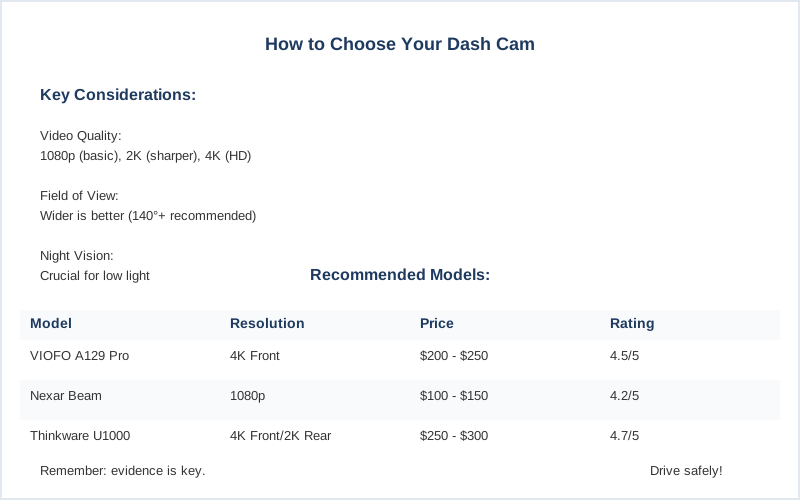
When you're looking at a dash cam, the first thing that hits you is video quality. Nobody wants grainy footage that looks like it was filmed on a potato. You'll see numbers like 1080p, 2K, and 4K. Think of it like this: 1080p is your basic TV signal, 2K is a bit sharper, and 4K is super high definition.
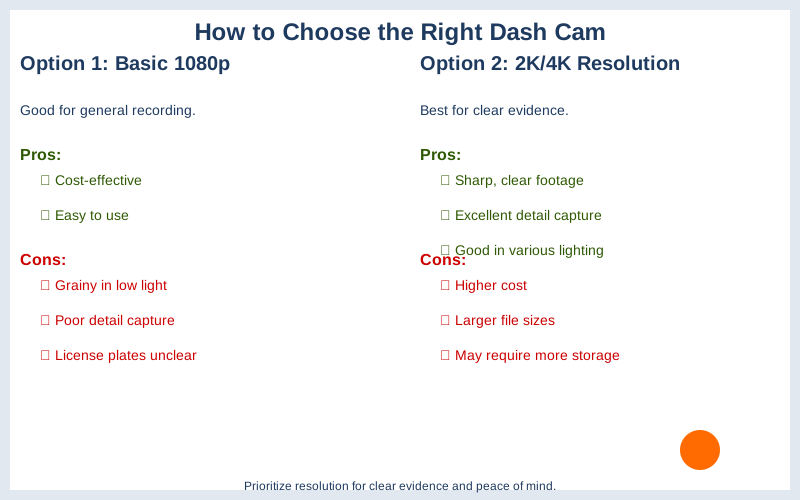
For capturing license plates or details in bad lighting, 4K is the gold standard, but even 2K can be perfectly fine for most situations Consumer Reports notes. I learned this the hard way at a dimly lit parking lot one night; my cheap 1080p camera couldn't even make out my own license plate, let alone anyone else's. Rookie mistake. Reddit's dash cam community often emphasizes that resolution is king for evidence.
Insta360 also points out that higher resolution often means larger file sizes, so you'll need a decent memory card. Speaking of memory cards, you'll need a microSD card. The size matters - think of it like how much storage you have on your phone. Most cams come with some basic storage, but you'll likely want to upgrade.
A 64GB or 128GB card is a good starting point for most people; it holds a decent amount of footage before it starts overwriting older clips. Some cameras offer looping recording, which automatically deletes the oldest footage to make space for new recordings. Brilliant engineering, really, so you don't have to manually manage it. Then there's field of view. This is how wide the camera's 'eye' is. A wider angle, like 140 degrees or more, captures more of the scene.
I once had a near-miss where the other driver swerved out of nowhere, and my narrow-angle camera barely caught their car before it was on top of me. You want enough coverage to see what's happening on the sides, not just straight ahead. Think about parking mode too. This feature lets the camera record if it detects motion or impact while your car is parked. It's like having a stationary security guard for your vehicle.
I had a shopping cart mysteriously appear on my hood once, and the parking mode footage was the only reason I knew it wasn't an actual person. The honest version: it's a lifesaver when your car is vulnerable. Rearview Safety covers this well. Finally, consider if you need a rear camera. A dual-channel system records front and rear simultaneously.
It's like having eyes in the back of your head, which is incredibly useful in traffic or if someone rear-ends you. My buddy got rear-ended on the highway, and his rear camera footage was the only thing that proved the other guy ran a red light. That alone made the extra cost worth it.
Why This Matters for Your Setup
{'heading': 'Why This Matters for Your Setup', 'bullets': ['Evidence in Accidents: This is the big one. If you\'re in an accident, clear video footage from a dash cam can be the difference between being found at fault or not. My first fender bender involved a guy who swore I cut him off, but my dash cam footage showed him running a stop sign. The honest version: it saved me a ton of hassle and potential insurance hikes.
Car and Driver hammered this point home.', 'Protection While Parked: Think about those times you leave your car in a busy parking lot or on the street. Parking mode features can catch hit-and-runs, vandalism, or even just shopping carts being carelessly pushed into your vehicle. I once had someone ding my door in a grocery store lot, and the dash cam caught their license plate. That was a $200 repair that cost them nothing.
Consumer Reports says this is a major benefit.', 'Monitoring Teen Drivers: If you have a new driver in the house, a dash cam can offer some peace of mind. You can see how they\'re driving, if they\'re speeding, or if they\'re being distracted. It\'s not about spying, but about ensuring safety. My niece\'s first week with her license was nerve-wracking, but knowing her driving was being recorded gave me some comfort.
Rearview Safety highlights this use case.', 'Capturing Unexpected Moments: Sometimes, you just see crazy things on the road. From meteors to bizarre animal crossings, a dash cam can record it all. My buddy caught a deer leaping over his car on video once. It was hilarious and made for a great story. It\'s not the primary reason to buy one, but it\'s a fun bonus. Wirecutter even mentioned capturing oddities.']}
Making the Right Choice
{'heading': 'Making the Right Choice', 'bullets': ['Focus on Core Features First: Don\'t get bogged down by every single bell and whistle. What\'s crucial is good video quality (1080p minimum, 2K or 4K better), a decent field of view (140 degrees+), and reliable storage. My first dash cam had a tiny screen and weird buttons I never used. The honest version: stick to what gets the job done.
Reddit users confirm this.', 'Consider Your Needs: Do you live in a city with crazy drivers? A dual-channel system with parking mode is probably a good idea. Do you mostly drive on quiet country roads? Maybe a single-channel camera is enough. It's about matching the tech to your reality. Rearview Safety emphasizes personalized selection.', 'Don\'t Overspend Initially: You don\'t need to drop $500 on your first dash cam.
There are perfectly good options in the $50-$150 range that will serve you well. Think of it like buying your first camping tent - you don\'t need the expedition-grade one for car camping. My $70 camera has saved me twice. Car and Driver has tested budget options.', 'Installation is Key: Most dash cams are plug-and-play, but a clean installation makes a difference. Routing the power cable neatly can make it look like it came with the car.
I spent 30 minutes hiding my wire behind trim panels on my old Civic, and it looked way better than just dangling. It's the little things that make it feel less like a tacked-on gadget. Blackboxmycar has guides for this.']}