Hardwiring to the Fuse Box: The Gold Standard for 24/7 Security
For reliable 24/7 parking surveillance, the answer is almost always hardwire it. Yeah, it’s not as plug-and-play as some other options, but for solid, consistent power, especially when you’re dealing with motion-triggered recordings over extended periods, this is the way to go. Across the range of hardwire kits, from simple two-wire setups to more complex three-wire ACC/BATT/GND configurations, the principle remains the same: direct, fused power from the source.
The biggest benefit here is control and reliability. You tap directly into your vehicle's electrical system, using either a constant 12V supply (for parking mode) and a switched 12V supply (for ignition-on recording). Most hardwire kits, like the Dash Cam Hardwired Kit, 12V-24V to 5V Adapter Power Cable, come with built-in low-voltage cutoff (LVC) circuits. These are critical; they monitor your car battery's voltage and shut off power to the dash cam if it drops below a user-selectable or preset threshold – typically around 12.0V or 11.8V for a 12V system. This prevents you from coming back to a dead car battery, a real risk on a cold morning after a cheap kit has been left running for a couple of days.
Installation involves identifying suitable fuse slots. The reliable method is to use a multimeter (such as a Fluke 117) to back-probe the fuse box, finding a constant 12V (always on) and an accessory 12V (on with ignition). Then it's a matter of using quality fuse taps – not those flimsy T-taps that can damage wiring – to cleanly integrate the dash cam’s power cable. Route the wires neatly under the trim, connect your ground to a solid chassis point, and you’re good. This setup minimizes parasitic draw when the camera is off, and when it’s active, it’s pulling directly from the car battery, often with more stable voltage than an OBD-II port can offer during vehicle startup (voltage sag under crank is a real thing, dropping to 9.5V briefly).
One common flaw with many hardwire kits, including some in the sub-$20 range, is the quality of the fuse tap itself; the wire gauge is often 22AWG, which is fine for a 2-amp accessory, but the crimp connections can be suspect. A common upgrade is to snip off the included fuse tap and crimp on a higher-quality one with 18AWG wire and proper heat shrink, which adds about 8 minutes to the install time. If you’re serious about 24/7 coverage and want the cleanest, most integrated look, hardwiring is your path. It takes about an hour and a half for a first-timer, but the peace of mind is worth the effort.
OBD-II Port Power: Convenience with Caveats
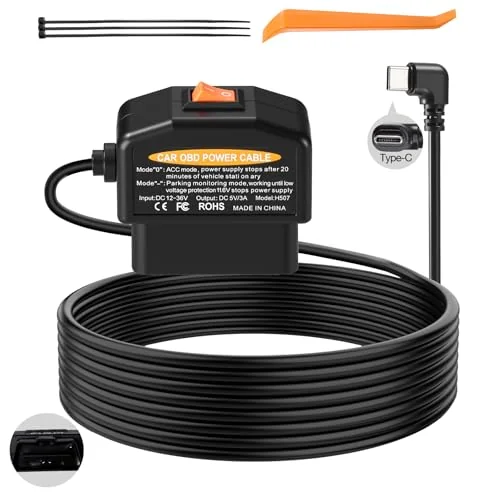
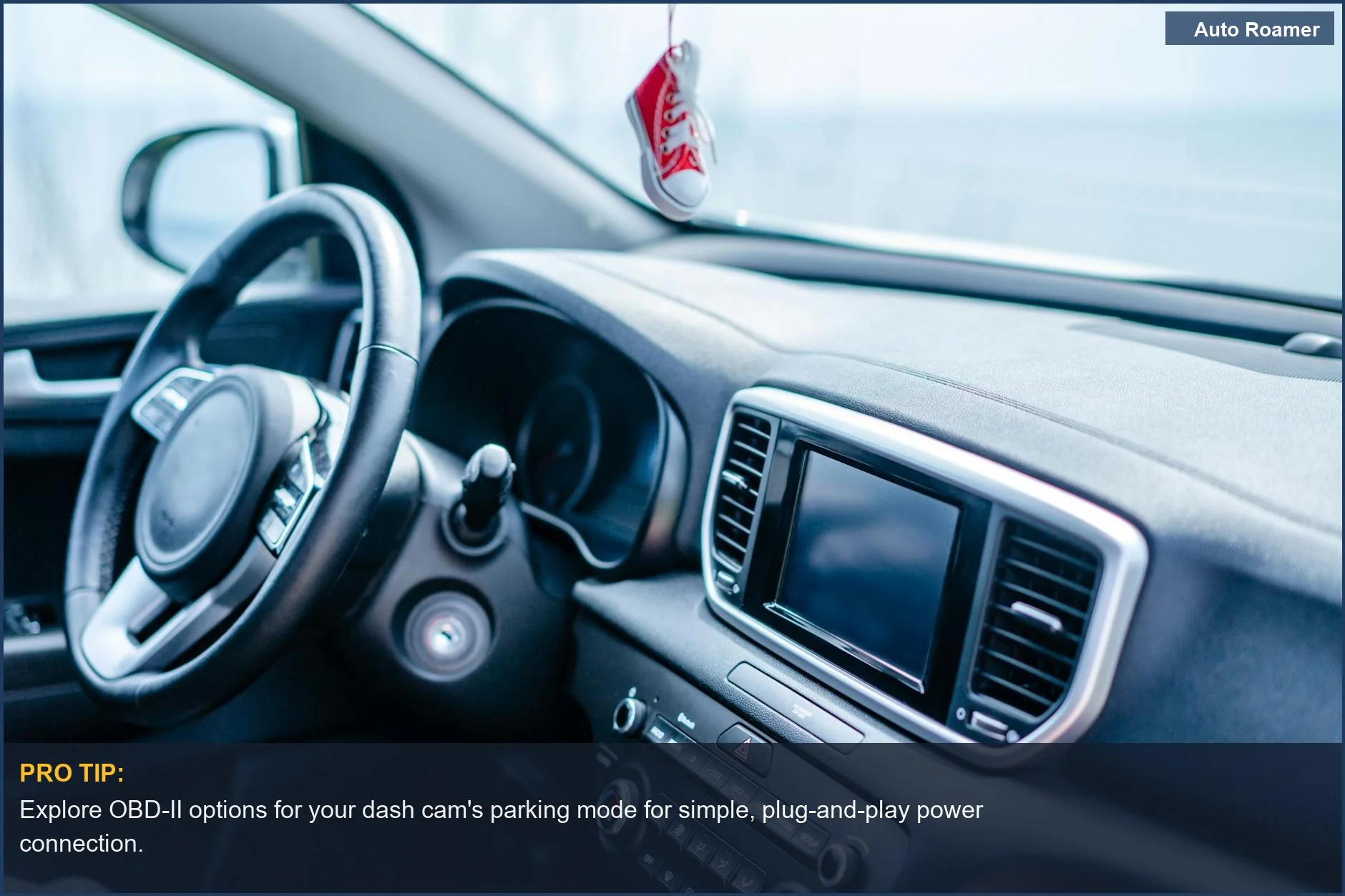
Next up, the OBD-II port. This method has gained popularity for its sheer convenience – it’s literally plug-and-play for power. You just plug a specialized cable into your car's diagnostic port, and it powers your dash cam. Products like the OBD2 Dash Cam Power Cable Hardwire Kit with Acc and the OBD2 Power Cable for Dash Camera, Type-C OBD promise easy installation and often include their own LVC circuits. Great for renters, or those who frequently swap cameras between vehicles.
However, that convenience comes with a few caveats that any gear-tinkerer worth their salt should consider. First, not all OBD-II ports are created equal in terms of constant power. While Pin 16 is typically constant 12V, some vehicles (especially newer ones with complex CAN bus systems) will keep the OBD-II port 'awake' for a period after the ignition is off, even if the dash cam’s LVC has triggered. This can lead to a slightly higher parasitic draw on the car battery, though reputable cables do a good job of minimizing it. This can cause issues over a two-week airport parking stint, where the battery ends up noticeably lower than usual even with an advertised 11.9V cutoff.
Another point: the OBD-II port is intended for diagnostic tools. Having a dash cam permanently plugged in can sometimes interfere with other OBD-II devices or even trigger false codes on very sensitive vehicle systems, although this is rare with modern dash cam cables that only draw power. The physical placement of the OBD-II port (usually under the dashboard near the driver's knees) can be a bit awkward. The cable often hangs down, which isn't the cleanest look unless you route it carefully behind trim panels, defeating some of the 'easy install' appeal. For example, the Dash Cam Hardwire Kit OBD, Type C Dash Camera has a fairly bulky OBD-II connector, making stealth routing a bit of a pain. The build quality of the OBD-II connector itself, especially on generic cables, can sometimes be flimsy, leading to intermittent connections over time, particularly if you're frequently plugging/unplugging it or if it gets kicked by passengers.
The verdict here: an OBD-II power cable is a solid choice for someone who wants minimal installation effort and doesn't need absolutely bulletproof 24/7 parking mode for weeks on end. It's fantastic for a daily driver who just needs a few hours of parking protection while running errands. But for a 7-day trip where the car sits the whole time, a hardwire or an external pack is the better call.
External Battery Packs: Peak Performance, Minimal Car Battery Strain
When you absolutely, positively need continuous parking mode recording without touching your car's main battery, an external battery pack is the answer. These dedicated dash cam power banks, often lithium-iron-phosphate (LiFePO4) for their stability and longevity, charge up while you drive and then power your dash cam independently when the ignition is off. This completely isolates the dash cam's draw from your vehicle's starting battery, eliminating any concerns about parasitic drain or LVC settings.
An external pack is the strongest choice for a primary dash cam setup, especially on a long road trip that needs continuous recording across multiple overnight stops in remote areas. A fully charged 1-channel dash cam pack can run for up to 40 hours, and a 2-channel setup around 25 hours, which is more than enough for most extended parking situations. The charging logic is usually smart, too – they'll often charge via a hardwire connection to an accessory fuse (so they only charge when the car is running) or a 12V cigarette lighter socket. This means when you drive, the pack tops up, and when you stop, it takes over.
The downside? Cost and complexity. A good external battery pack isn't cheap, and you still need to install it, often requiring a hardwire connection to charge it effectively. It's essentially a secondary hardwire installation just for the battery pack. Also, space can be an issue; these packs aren't tiny and need to be mounted securely, usually under a seat or in the glove compartment. Despite this, for ultimate peace of mind, especially if you have a sensitive car battery or an older vehicle, this is the superior option.
Here's a quick comparison of the three primary power options:
| Feature | Hardwire Kit | OBD-II Power Cable | External Battery Pack |
|---|---|---|---|
| Installation Time (avg.) | 60-90 minutes | 5-15 minutes | 90-120 minutes (including charging hookup) |
| Parasitic Draw (parking mode) | ~10-30 mA (camera dependent) | ~30-60 mA (vehicle dependent) | ~0 mA (from car battery) |
| Voltage Cutoff | Adjustable (11.8V-12.4V typical) | Fixed (11.7V-12.0V typical) | N/A (powers from internal battery) |
| Best-Fit Driver | Daily driver, long-term parking | Casual driver, short parking | Car camper, extended parking, sensitive battery |
As the table shows, for demanding scenarios the external pack or a robust hardwire are the real contenders. The external pack is overkill if your parking needs are minimal, say, just a few hours at the grocery store.
Managing Voltage Cutoffs and Parasitic Draw Effectively
Understanding low-voltage cutoff (LVC) and parasitic draw is fundamental to keeping your car battery healthy while running parking mode. LVC is the safeguard: it’s the voltage threshold at which your dash cam will stop drawing power from your car battery to prevent it from draining completely. Most hardwire kits offer adjustable LVC settings, usually ranging from 11.8V to 12.4V for a 12V system. A safer setting, especially in colder climates, is a bit higher, around 12.2V. In cold weather a 12.0V setting can barely leave enough juice for a quick crank after 36 hours parked.
Parasitic draw, on the other hand, is the constant, low-level power draw your car has even when it’s 'off.' Every ECU, every alarm system, every memory preset pulls a tiny bit of current. Adding a dash cam in parking mode adds to this. A well-designed hardwire kit or OBD-II cable for dash cams, like the OBD2 to USB-C Power Cable for Dash Cam with Low-Voltage Cutoff, will have its own built-in LVC to minimize this. However, don't confuse the dash cam's draw with your car's baseline parasitic draw. A typical vehicle's baseline measures around 20-30mA on a multimeter set to the 10A fused range. A dash cam in motion-detection parking mode might add another 10-20mA, totaling around 40-50mA. While this doesn't sound like much, over several days, it can accumulate, especially if your battery isn't in peak condition.
The key here is understanding your battery's health and your typical parking duration. If you drive every day for at least 30 minutes, keeping your battery topped off, then even a small parasitic draw from a hardwired dash cam or a quality OBD-II cable (with an effective LVC) is usually fine. But if you store your car for weeks or only take short trips, that cumulative draw can become an issue. This is where an external battery pack truly shines, as it completely isolates the dash cam's power needs from your car's main battery, making the parasitic draw from the car battery virtually zero.
Always check the LVC hysteresis on your chosen power solution. A good circuit will not just cut off at 11.8V but will also have a slight delay or a slightly higher 're-enable' voltage to prevent rapid on-off cycling as the battery voltage fluctuates under load. This little detail often separates the robust kits from the budget-bin options. Cheap kits are known to cycle on and off every few minutes as the voltage hovers right at the cutoff point, leading to corrupted files and unnecessary battery stress.
Choosing Your Power Source: Daily Driver, Road-Tripper, or Car-Camper?
Alright, let’s tie this all together with some real-world use cases. Your driving habits dictate the best power source for your dash cam’s parking mode. There’s no single 'best' solution; it’s about matching the tech to your lifestyle.
For the Daily Driver (Short Parking, Regular Use): If you’re like most folks – commuting, running errands, parking for a few hours at work – an OBD-II power cable or a basic hardwire kit is usually sufficient. You drive regularly, so your car battery stays charged. The ease of installation for an OBD-II cable, like the OBD2 Power Cable for Dash Camera, Type-C OBD, makes it a compelling choice. Just make sure it has a reliable LVC. If you want a cleaner install and slightly better voltage stability, hardwiring with a kit like the Dash Cam Hardwired Kit is the recommendation. It’s a bit more work initially, but it’s a set-it-and-forget-it solution.
For the Road-Tripper (Extended Parking, Irregular Use): This is where things get interesting. If you’re frequently on longer trips, parking overnight in unfamiliar places, or leaving your vehicle for multiple days at trailheads (think a multi-day backpacking trip where the car sits at the trailhead), you need more robust parking mode protection. A hardwire kit with a precise LVC is a good option here, allowing for 24-48 hours of recording without excessive battery drain. However, the external battery pack truly shines. It provides the longest runtimes (up to 40 hours for a 1-channel cam), completely isolating your car battery. You charge it while driving, and it takes over when parked. A go-to for any trips longer than 24 hours of continuous parking.
For the Car-Camper/Van-Lifer (Very Long-Term Parking, Auxiliary Power Systems): If your vehicle doubles as your living space, and you already have an auxiliary battery system (like a Battle Born or similar LiFePO4 setup), then hardwiring your dash cam (and its external battery pack if you use one) directly to your house battery is the ultimate solution. This provides virtually unlimited parking mode recording without any impact on your starting battery. You’re already managing a complex power system, so integrating a dash cam is trivial. If you don't have an auxiliary battery, then an external battery pack is non-negotiable for any kind of serious car camping where you might be parked for days on end without driving. The consistent power from a dedicated pack ensures your camera is always ready, and you won't wake up to a dead starter battery.
Ultimately, buy the hardwire kit for most daily drivers, especially if you have an hour to dedicate to a clean install. Skip the OBD-II cables if you're leaving your car for more than 24 hours. And go with the external battery pack if you demand maximum uptime and zero car battery impact, regardless of cost or installation complexity.