Dashcam Guides

Can Dashcam Footage Be Used In Court (2026 Complete Guide)

Auto Roamer
16 min read
Includes Video

The screech of tires, the sickening crunch of metal - it's a moment that plays out in terrifying slow motion. You've just been in a car accident, and the other driver is already pointing fingers, claiming you're at fault. But you remember the steady hum of your dash cam, its lens capturing every second.

The screech of tires, the sickening crunch of metal - it's a moment that plays out in terrifying slow motion. You've just been in a car accident, and the other driver is already pointing fingers, claiming you're at fault. But you remember the steady hum of your dash cam, its lens capturing every second. Can that footage actually hold up in court?

Yes, dashcam footage can absolutely be used in court, but it's not a slam dunk. For it to be admissible, it needs to be relevant to the case and properly authenticated Tucker Law. This means proving the video is exactly what it claims to be, without any edits or alterations that could change its meaning personalinjury.com. Think of it as a silent, unbiased witness. If your dash cam captured the other driver running a red light, or swerving into your lane, that's powerful evidence. In fact, Reddit users report insurance companies and courts accepting footage that proves innocence. It's why so many drivers, with 39% buying one after a close call, rely on these devices Vantrue. Beyond simply showing the event, the footage must also serve to prove or disprove pivotal aspects of the accident Scholle Law. This could include establishing the speed of vehicles, the sequence of events, or even the presence of contributing factors like road conditions or distractions. Crucially, the footage must be obtained legally, meaning it shouldn't violate any privacy laws. For example, recordings made in public locations are generally considered admissible as long as the video can be validated TrackNet. Furthermore, maintaining a clear chain of custody for the digital evidence is essential to ensure its integrity and prevent challenges to its authenticity personalinjury.com. This means keeping the original file secure and documenting any transfers or handling of the footage. The admissibility often hinges on the specific facts of each case, with courts evaluating whether the dash cam evidence is material and relevant to determining liability Tucker Law. In many jurisdictions, dash cam footage is routinely accepted as evidence, even being used to determine fault in accident claims DDPAI.
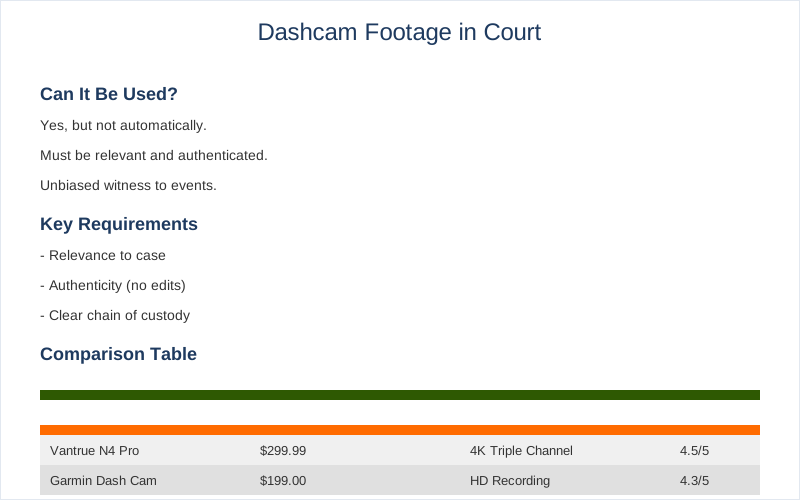
Dashcam footage in court: specs comparison infographic
Key specifications for can dashcam footage be used in court

The Short Answer

Yes, dashcam footage can absolutely be used in court, but its admissibility hinges on strict criteria. The core framework for its use is proving relevance, authenticity, and a clear chain of custody.

For dashcam footage to be considered admissible evidence in a court of law, it must directly pertain to the case at hand. This means the footage needs to clearly show events that are pivotal to determining fault or liability in an accident or incident. For instance, if the video clearly shows the sequence of events leading up to a collision, it's highly relevant. If it captures a traffic violation that contributed to an accident, its relevance is undeniable. The footage must serve to prove or disprove pivotal facts of the case The Role of Dash Cam Footage in Proving Your Auto Accident Case. In many cases, dash cam evidence is considered admissible in court, especially when it can validate claims or disprove them How Dash Cam Videos Are Used in Court: Legal Insights - TrackNet. The videos are also accepted as evidence in a court of law and can be used to determine liability 2026 Honda HRV sport Dash cam guide - Reddit.

Crucially, the footage must be authenticated - meaning you have to prove it is what it claims to be and hasn't been tampered with. This often involves demonstrating that the video is an accurate representation of what occurred, often by preserving original metadata like timestamps and GPS data. Any alteration, cropping, or editing that could mislead or change the context of the recording will likely lead to its exclusion. Courts are vigilant about unaltered evidence; if you intend to use it, do not edit it in any way that compromises its integrity Nagel Rice LLP. Dash cam footage must be authentic, meaning it accurately represents the events captured without manipulation Guide to Dash Cam Crashes in Car Accident Injury Cases. Recording on-duty police officers is also permitted, and this footage can be used as evidence Understanding Dash Cam Laws in Every State (2025) - DDPAI.

Maintaining a clear chain of custody is also vital. This involves documenting how the footage was obtained, stored, and transferred, ensuring there are no gaps or opportunities for manipulation. Digital forensic experts can analyze dashcam data to verify authenticity and detect tampering Guide to Dash Cam Crashes in Car Accident Injury Cases. The footage must be obtained from a public location and be verifiable How Dash Cam Videos Are Used in Court: Legal Insights - TrackNet. While dashcams are generally legal and their videos are accepted as evidence, consulting with a legal professional before submitting footage is always advisable to ensure all criteria are met Cobra.com. Dashcam footage must meet certain criteria, depending on the facts of each case, to be used as evidence Can Dash Cam Footage Be Used as Evidence in Court? - Tucker Law.
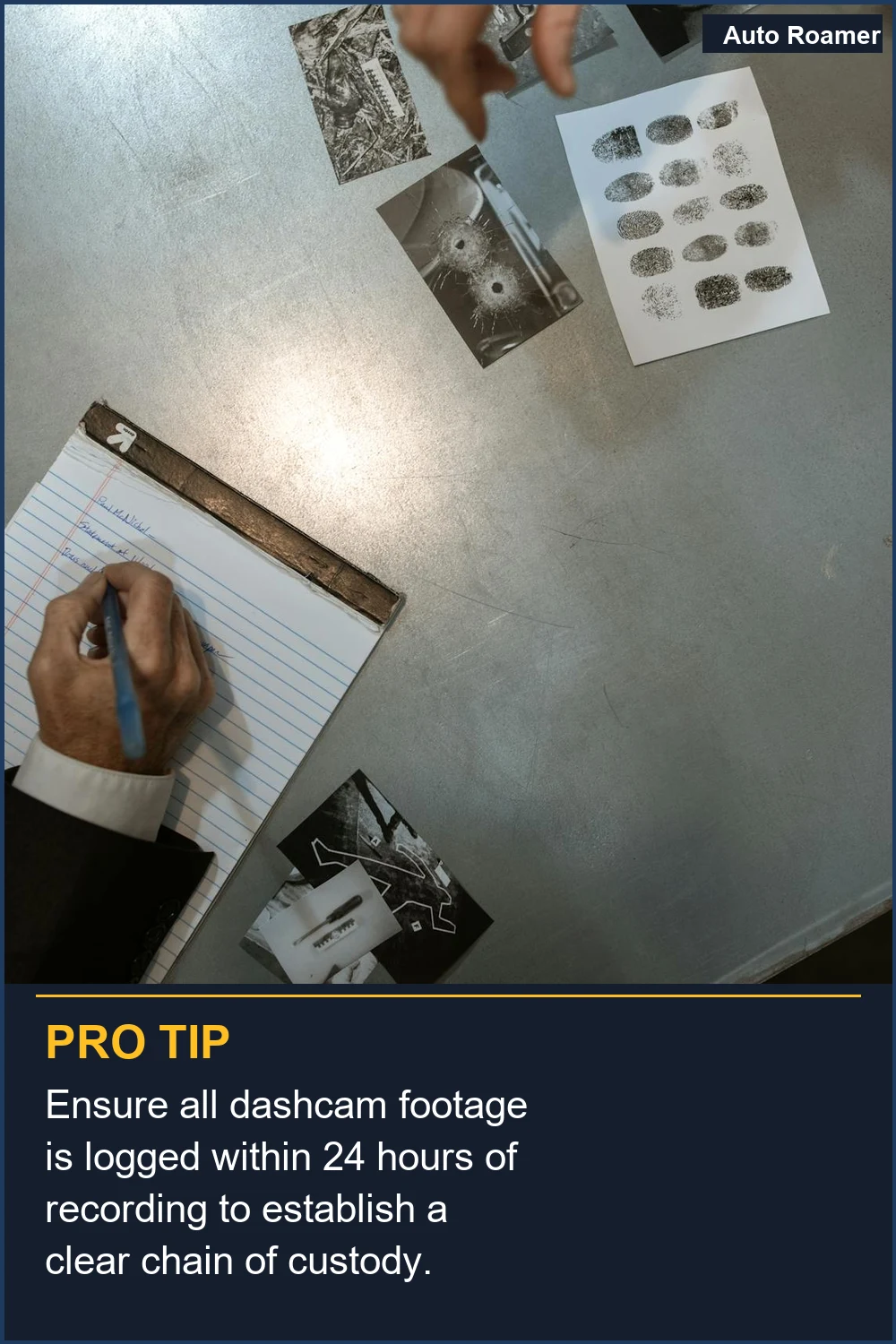
Understanding dash camera policies is crucial, especially in light of the evolving dash cam laws that govern their use.
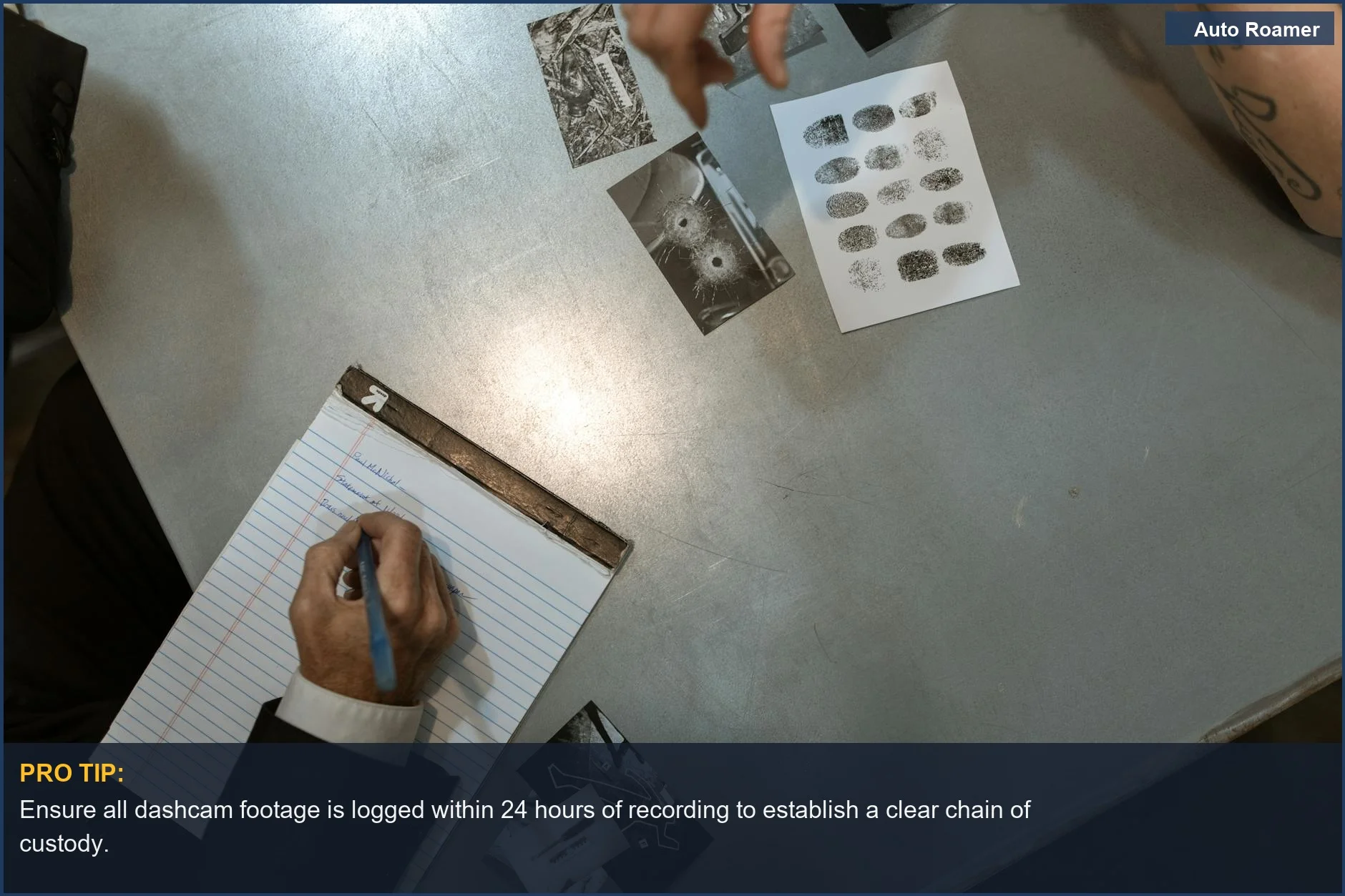
Ensure all dashcam footage is logged within 24 hours of recording to establish a clear chain of custody.
Admissibility of dashcam footage in court requires meticulous evidence handling. Officers review recordings, ensuring its relevance and authenticity for legal proceedings. | Photo by RDNE Stock project

What You Need to Know

1
Dashcam footage is admissible in court, but authenticity is key. The original recording, including its metadata like timestamps and GPS data, must be preserved without alterations. Dash cam footage can be admissible in court, but must meet specific requirements. This means the video file itself, as it was captured by the dashcam, is crucial. Any alteration, no matter how minor, can cast doubt on its integrity. The metadata, such as the exact date and time of the incident and the vehicle's location, provides vital context and helps to verify the footage's accuracy. Courts are particularly interested in whether the footage can be independently verified.
2
Relevance is paramount. The footage must directly pertain to the case. If it clearly shows fault or disproves a claim, its relevance is high. For instance, footage showing another driver running a red light is directly relevant to an accident caused by that action. The admissibility of dash cam footage in court is determined by its relevance and materiality to the case. This means the video must help prove or disprove a key fact in dispute. For example, in a hit-and-run case, footage showing the suspect vehicle's license plate or distinctive features would be highly relevant. Conversely, footage of a scenic drive unrelated to the incident would likely be deemed irrelevant.
3
Never edit your footage if you intend to use it as evidence. Any editing, cropping, or manipulation can render it inadmissible, as courts scrutinize video evidence for tampering. Do Not Edit Footage: If you intend to use dash cam footage as evidence in court, do not edit it. This includes cutting out parts of the video, speeding it up or slowing it down without proper annotation, or adding any text or graphics. Even seemingly innocuous edits can raise red flags with legal professionals and judges, potentially leading to the exclusion of the evidence altogether. The goal is to present the raw, unadulterated truth captured by the camera.
4
Chain of custody matters. A clear record of who handled the footage from recording to presentation is necessary to prevent questions of compromise. Dash cam footage must be authentic, relevant, and maintain a clear chain of custody to be admissible in court. This means documenting every person who had access to the footage, when they accessed it, and what they did with it. For instance, if a police officer collects the footage, a lawyer receives it, and then it's presented to the court, each step needs to be recorded to show that the evidence hasn't been tampered with or altered in any way. This meticulous record-keeping ensures the evidence's reliability.
5
Public location recordings are generally accepted. Footage from public spaces like streets and highways is typically admissible. However, privacy laws, especially concerning audio in two-party consent states, can still apply. Yes, you can use dash cam footage in court or insurance claims if you have it properly authenticated. The footage must be recorded in a public. While recording in public spaces is generally permissible, be mindful of audio recordings. In states with two-party consent laws for audio recording, capturing conversations without the consent of all parties involved could be problematic. It's often advisable to disable the audio recording feature on your dashcam or to be aware of the specific laws in your jurisdiction. Recording on-duty police officers, however, is generally permitted. Recording on-duty police officers is permitted.
6
Vehicle type doesn't disqualify footage. The courts treat footage from sedans, SUVs, trucks, or vans similarly. The focus is on the recording's content and adherence to evidentiary standards, not the vehicle. Whether the footage comes from a personal car, a commercial truck, or even a motorcycle, the legal standards for admissibility remain the same. The crucial elements are the footage's authenticity, relevance, and the proper chain of custody, not the type of vehicle it was recorded from. The videos are also accepted as evidence in a court of law and by insurance companies because they can prove innocence and help resolve claims. The videos are also accepted as evidence in a court of law.
7
Consulting a lawyer is wise. Before submitting dashcam video as evidence, speak with an attorney. They can guide you on specific legal requirements in your jurisdiction and ensure your footage meets admissibility criteria. Speak to a lawyer before submitting any dash cam video as evidence. Attorneys are well-versed in the rules of evidence and can help navigate the complexities of presenting digital evidence effectively. They can advise on how to properly preserve the footage, establish the chain of custody, and argue for its admissibility in court, significantly increasing the chances of it being accepted as evidence. Dashcam footage must meet certain criteria in order to be admissible.
Understanding the legality of dashcam usage can help you navigate issues surrounding dashcam legality in your state.
Preserve dashcam metadata like timestamps and GPS data; it's vital for proving authenticity in court.
Authenticity is paramount for dashcam footage used in court. This detective reviews evidence, highlighting the importance of intact metadata for admissibility. | Photo by cottonbro studio

How to Handle This

1
Preserve the original footage - This is non-negotiable. Do not edit, crop, or alter the video in any way, not even to improve clarity. Any modification can lead to the footage being deemed inadmissible. Think of it like a crime scene; you don't want to contaminate the evidence. If you're tempted to trim out a boring section, resist. The court needs to see the entire context to assess its relevance and authenticity Nagel Rice LLP.
2
Document metadata and chain of custody - Your dash cam likely records crucial metadata like timestamps, GPS location, and speed. These details are vital for proving the footage's authenticity and relevance. Keep a detailed log of when and where the footage was recorded, who recorded it, and how it was stored. If you share the footage with an attorney or law enforcement, document every transfer. This "chain of custody" proves the evidence hasn't been tampered with Guide to Dash Cam Crashes in Car Accident Injury Cases.
3
Ensure relevance to the incident - Dash cam footage is only useful if it directly pertains to the event in question. If you're in a fender-bender at a quiet intersection at 3 AM, footage showing a high-speed chase across town later that night won't help your case. The court needs to see that the footage has a direct bearing on the issues being tried Can Dash Cam Footage Be Used as Evidence in Court? - Tucker Law. For example, if the video clearly shows the other driver running a red light, that's highly relevant.
4
Understand location and audio recording laws - Most dash cam footage recorded in public spaces is admissible, as it's generally understood that there's no expectation of privacy in public How Dash Cam Videos Are Used in Court: Legal Insights - TrackNet. However, audio recording laws vary significantly by state. Some states require consent from all parties involved in a conversation (two-party consent states), while others only require one party's consent. Recording audio illegally can lead to fines or lawsuits, so be aware of your local laws Just in Case: 10 Legal Questions About Dash Cams - Vantrue. If you're unsure, err on the side of caution and disable audio recording or ensure you have consent.
To maximize your dashcam's utility, it's essential to understand how long dashcams keep footage.
Never edit dashcam footage; even minor alterations can render it inadmissible in court proceedings.
Preserving the integrity of dashcam footage is crucial. A forensic investigator collects evidence, emphasizing that any modification can disqualify it for court. | Photo by cottonbro studio

What This Looks Like in Practice

  • Urban Intersection in a Pickup Truck: A driver making an abrupt lane change cut off a pickup truck. The truck's dashcam captured the maneuver, providing clear evidence of the other vehicle's fault. This footage was instrumental in the subsequent insurance claim, validating the pickup driver's account and leading to a swifter resolution. The key here was the unaltered recording of the incident from a public vantage point. TrackNet, Cobra.com
  • Suburban Street During Daytime in a Sedan: A sedan ran a red light, colliding with another vehicle. The dashcam footage from the affected vehicle clearly showed the light was indeed red and the other car entered the intersection against it. This undeniable visual proof was crucial in proving the other driver's liability, even if they contested the signal's status. The footage's timestamp and GPS data further strengthened its authenticity. Personal Injury Co., Tucker Law
  • Highway at Night in an SUV: An SUV was rear-ended by a speeding vehicle. The dashcam, equipped with good night vision, captured the excessive speed of the tailgating vehicle and the subsequent impact. This evidence helped establish the other driver's negligence and was accepted to support the claim for damages. The lack of any audio recording in this instance was not a detractor, as the visual evidence was sufficient. Scholle Law, Justice Counts
  • Rural Road in Snowy Conditions in a Minivan: A minivan slid on icy roads, causing a minor collision with a parked vehicle. While the footage showed the challenging conditions and the vehicle's loss of traction, it didn't definitively prove fault for the parked car's owner. The dashcam did, however, show the minivan was traveling at a reasonable speed given the weather, which aided in negotiating the insurance settlement. This highlights that while footage is powerful, context and completeness are vital. DDPAI, Vantrue
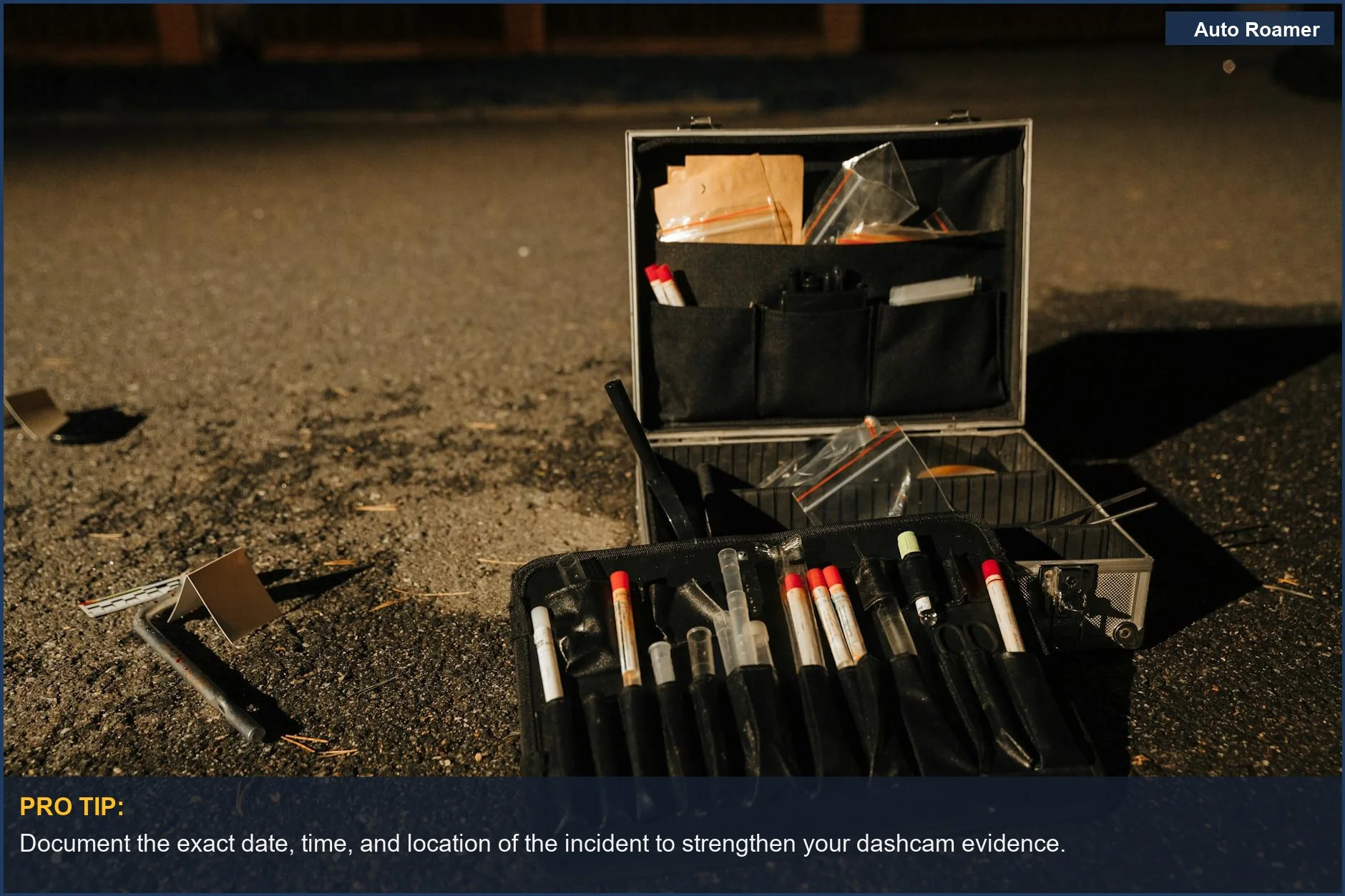
To ensure optimal performance during your summer drives, understanding essential dash cam features is crucial.
Document the exact date, time, and location of the incident to strengthen your dashcam evidence.
Dashcam footage can provide clear evidence of fault, as seen in this urban intersection scenario where a pickup truck's recording proved crucial. | Photo by cottonbro studio

Mistakes That Cost People

Mistake Assuming any dashcam footage is automatically admissible.
Why people make it It's a video recording of the event, so it seems usable.
What actually happens Courts require footage to be relevant, authentic, and material. Unedited, clear footage recorded in a public location is generally accepted, but it must meet specific legal criteria. Tucker Law notes admissibility depends on the facts of each case.
The fix Ensure your dashcam records in a public space and that you can prove its authenticity, potentially with metadata like timestamps and GPS data.
Mistake Editing or altering the footage.
Why people make it To "clean up" the video or emphasize a point.
What actually happens Any alteration can render the footage inadmissible. Courts scrutinize footage for tampering. Nagel Rice LLP warns against editing to avoid severe consequences.
The fix Never edit dashcam footage if you intend to use it in court. Preserve the original file. If you need to present it, use editing software only to add annotations or timestamps without altering the core content.
Mistake Believing older dashcam footage is less valuable or unusable.
Why people make it Newer vehicles have integrated systems, making older units seem outdated.
What actually happens The age of the dashcam is less critical than the quality and integrity of its footage. As long as the older unit provides clear, verifiable video, it can be admissible.
The fix Focus on maintaining functionality and ensuring footage preservation with older dashcams. Regularly check recordings for clarity and ensure the device is properly secured and powered.
Mistake Not considering audio recording laws.
Why people make it Most dashcams record audio, and drivers assume this is always permissible.
What actually happens Audio recording laws vary by state. In two-party consent states, recording conversations without all parties' consent can lead to legal issues. Vantrue highlights this pitfall.
The fix Be aware of your state's audio recording laws. In two-party consent states, consider disabling audio or placing a visible sign indicating audio is being recorded.
Mistake Overlooking the chain of custody for evidence.
Why people make it People assume a video file is ready for court.
What actually happens For footage to be admitted, it must maintain a clear chain of custody. This means documenting who handled the footage, when, and how, from recording to presentation. Personal Injury Co emphasizes this.
The fix Document every step of handling your dashcam footage. Save original files to multiple secure locations and keep a log of any transfers or access.
Understanding these mistakes can help you adhere to your vehicle's dash camera policy more effectively.
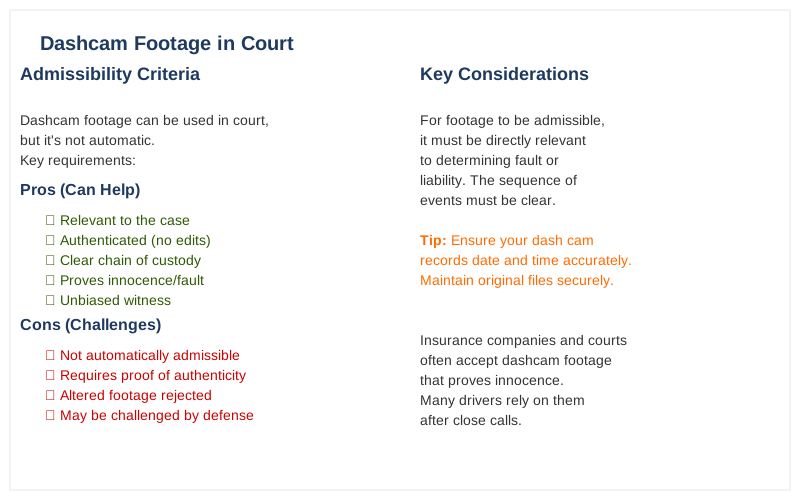
Dashcam footage in court: pros & cons infographic.
Comparison overview for can dashcam footage be used in court

Key Takeaways

  • Dashcam footage is generally admissible in court, but its acceptance hinges on meeting specific legal criteria. The footage must be relevant to the case, directly proving or disproving pivotal issues Scholle Law. This means the video should directly shed light on the circumstances of an accident, a traffic violation, or any other event pertinent to the legal proceedings, such as establishing fault or the sequence of events.
  • Crucially, the footage must be properly authenticated to prove it is what it claims to be and has not been tampered with Vantrue. This often involves testimony from the person who recorded the footage or an expert witness who can verify its integrity. Any alteration, including editing or cropping, can render it inadmissible Nagel Rice LLP, as even minor changes can cast doubt on its reliability.
  • Maintaining a clear chain of custody is also vital, ensuring the integrity of the digital evidence from the dashcam to the courtroom Personal Injury Co. This involves documenting every person who handles the footage, from the moment it's recorded until it's presented as evidence, to prevent any claims of unauthorized access or manipulation.
  • The footage must have been recorded in a public location, and its reliability will be scrutinized by the court TrackNet. Recording on-duty police officers, for instance, is generally permitted and the footage can be used to determine liability DDPAI. However, privacy concerns might arise if the footage captures private property or individuals without their consent, depending on local laws.
  • Ultimately, the most important thing to remember is that while dashcam footage can be incredibly powerful evidence, its admissibility is not guaranteed and depends on meticulous adherence to legal standards for authentication and relevance Tucker Law. The court will assess its probative value against any potential prejudice it might cause.
To maximize your dash cam's functionality, it's important to address common dash cam problems that may arise.

Frequently Asked Questions

So, what's the big deal with dash cam videos in court? Can they actually be used?
You bet. In most situations, dash cam footage is admissible in court if it's recorded in a public place and can be proven to be authentic. Think of it as a reliable, unbiased witness that captured exactly what happened on the road.
What are people messing up when they try to use dash cam footage in a legal situation?
The biggest pitfall is editing the footage. Even seemingly minor changes, like cropping or adding text, can make the video unusable as evidence because it compromises authenticity. Also, make sure you maintain a clear chain of custody for the original video files.
Is it risky to have a dash cam running? Could the footage cause problems for me?
Generally, dash cams are safe and legal to use across the US, but there are some nuances. While recording on-duty police officers is usually permitted, be aware of audio recording laws in two-party consent states, as recording conversations without consent can lead to issues.
What do the pros say about making sure dash cam footage holds up legally?
Experts stress the importance of authenticity, relevance, and maintaining the integrity of the footage. This means not editing it and ensuring it clearly pertains to the incident at hand. If you're unsure, it's always wise to consult with a legal professional before submitting anything.
What are the legal hoops I need to jump through for my dash cam video to be accepted by a court?
For your footage to be considered, it needs to be relevant to the case, meaning it directly proves or disproves something important. It also has to be authenticated, proving it's exactly what it claims to be, and shouldn't have been tampered with in any way.

Sources

Related Articles