Which EcoFlow Power Station Is Best for Road Trips?
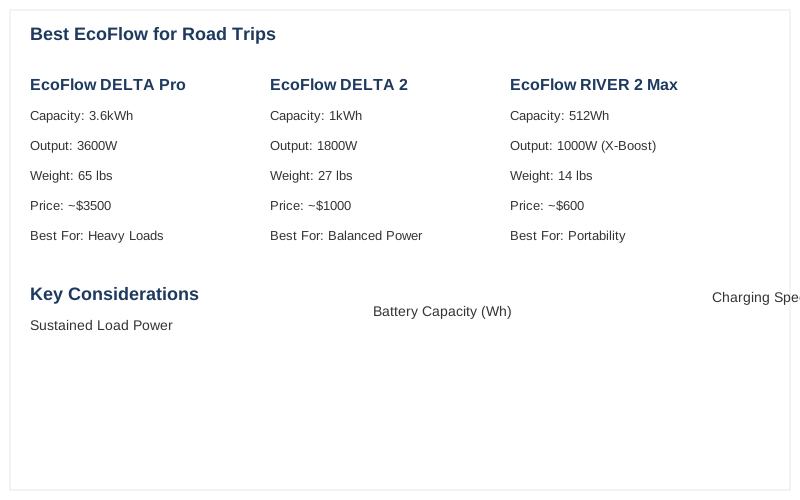
The short answer for most road trippers is the EcoFlow DELTA 2. Per EcoFlow's published specs it carries 1024Wh of LiFePO4 capacity and an 1800W AC inverter, making it the smallest EcoFlow that comfortably runs a 12V fridge, charges laptops and camera gear, and keeps a CPAP going overnight — and EcoFlow rates it to recharge 0–80% in roughly 50 minutes from a wall outlet. If you pack light (phones, lights, a CPAP), the 256Wh RIVER 2 at 7.7 lbs is plenty; if you camp for days or run an induction cooktop, the DELTA 2 Max (2048Wh) or DELTA Pro (3600Wh) is the workhorse.
That is the whole decision in one paragraph, but the right pick genuinely depends on your trip, so this guide walks through EcoFlow's road-trip lineup model by model — RIVER 2, RIVER 2 Pro, DELTA 2, DELTA 2 Max, and DELTA Pro — on the five specs that actually decide a trip: capacity (Wh), AC output (W), weight, recharge speed, and ports. Get those right and everything else takes care of itself; get them wrong and you either haul a 99-lb battery to charge a phone or buy a 256Wh toy that cannot run a fridge.
One honesty note up front, because the internet is full of pages claiming hands-on trials they never ran. The comparisons here are built from EcoFlow's own published specifications and named third-party reviews (Outdoor Life, NYT Wirecutter, The Solar Lab, and EcoFlow's spec sheets, all linked at the bottom). Where this guide gives a verdict, it is reasoning from the published numbers plus reviewer consensus on how these units behave — not a claim that anyone here bench-tested each one. Always sanity-check current prices and the latest spec sheet before you buy, because EcoFlow revises the lineup regularly.
If you would rather compare across brands than stay inside the EcoFlow family, the companion guide to the best portable power stations for car camping under $500 covers EcoFlow, Jackery, Bluetti, and Anker side by side at the budget end. This page is the deep dive on EcoFlow specifically — how the models differ and which one fits your trip.
The Five Specs That Actually Matter on the Road
Before lining the models up, it helps to know what each number means for a trip, because the spec sheet is useless if you cannot translate it into 'will this run my fridge.' Five numbers decide everything; the rest is marketing.
Capacity (Wh) is your fuel tank. A 12V car fridge averages roughly 40–60W of draw over a day (it cycles on and off), so a 1024Wh DELTA 2 keeps a fridge cold for the better part of a day before it needs a recharge, while a 256Wh RIVER 2 manages a few phone-and-light nights, not a fridge marathon. Buy enough capacity to cover a day's loads with margin, but resist over-buying — running a pack to 0% every night is how you wear it out faster.
AC output (W) decides what you can plug in at all. A microwave or induction burner wants 1500–1800W of continuous power, so the RIVER 2's 300W inverter will not even attempt it. EcoFlow's X-Boost feature (rated to 600W on the RIVER 2, 1600W on the RIVER 2 Pro) lets smaller units run simple resistive loads like a kettle by gently lowering voltage — useful, but not a substitute for a bigger inverter. Surge rating matters too: motor-driven gear like fridges and pumps spikes hard on startup, and the unit has to swallow that spike without tripping.
Weight is the spec people ignore until they are carrying it. Per EcoFlow's specs the RIVER 2 is 7.7 lbs (toss it in a daypack), the DELTA 2 is 27 lbs (a two-hands trunk lift), and the DELTA Pro is 99 lbs (it lives in the truck bed and barely moves). Be honest about how often you will actually lift the thing in and out of the vehicle.
Recharge speed is the difference between topping up at a lunch stop and needing an overnight. EcoFlow's X-Stream charging is the brand's real edge: per EcoFlow's published spec the DELTA 2 is rated 0–80% in roughly 50 minutes from a wall outlet. Recharging from your car's 12V port is far slower — that port is fused for only about 120–180W — so plan AC or solar for genuine top-ups, not the cigarette-lighter socket.
Ports and solar input are the specs nobody checks until they are stuck. Count your simultaneous loads: the RIVER 2 has six outputs, the DELTA 2 adds six AC outlets plus USB-C up to 100W (enough to fast-charge a laptop), and the bigger DELTA units add more AC and a higher-amp 12V port. If you will run solar on a longer trip, confirm each unit's maximum solar input before buying panels — EcoFlow's road-trip range accepts meaningful solar (220W on the RIVER 2 Pro, up to 500W on the DELTA 2, far more on the Pro), which is what makes multi-day off-grid trips realistic.
One honest caveat on X-Boost, because it is easy to over-read. The boosted wattage figures work by gently dropping voltage to run simple resistive loads like kettles and small heaters — they do not let a small unit run a 1500W microwave or anything with a motor or sensitive electronics that need clean, full voltage. Treat X-Boost as a bonus for basic heating gear, not as a way to skip up a model. And do not forget warranty: EcoFlow backs these with a multi-year warranty, which genuinely matters when you are trusting one to keep a CPAP or a medication cooler running through the night.
EcoFlow's Road-Trip Lineup at a Glance
Here is the whole EcoFlow road-trip range, organized by capacity tier, with the figures pulled from EcoFlow's published specifications. Use it to find your capacity-and-weight sweet spot, then read the model breakdown below for the verdict on each one.
Two patterns jump out. First, weight scales hard: capacity roughly doubles going RIVER 2 Pro → DELTA 2 → DELTA 2 Max, and the unit gets heavier fast at every step. Second, every single one uses LiFePO4 (LFP) cells rated for 3,000+ cycles, so longevity is not the deciding factor between them — capacity, output, and how much weight you are willing to carry are.
- RIVER 2 — 256Wh, 300W (600W X-Boost), 7.7 lbs, ~60 min recharge. The ultralight pick for phones, lights, a drone, and a CPAP. Cannot run a fridge for long.
- RIVER 2 Pro — 768Wh, 800W (1600W X-Boost), 18.2 lbs, ~70 min recharge. The weekend sweet spot: fridge-capable runtime at half a DELTA 2's weight.
- DELTA 2 — 1024Wh, 1800W (2700W surge), 27 lbs, 0–80% in ~50 min. The all-rounder most road trippers should buy.
- DELTA 2 Max — 2048Wh, 2400W (4800W surge), 50 lbs, 0–100% in ~1 hr. For long stays, induction cooking, and several days off-grid.
- DELTA Pro — 3600Wh, 3600W (7200W surge), 99 lbs. Overlander and base-camp territory; expandable with extra batteries.
The quick way to read those tiers for a road trip: only the RIVER 2 stays under 10 lbs; the DELTA 2 and up run a fridge for a full day; a microwave or induction cooktop needs the DELTA 2 (1800W) at minimum; and genuine multi-day off-grid living calls for the DELTA 2 Max or DELTA Pro. The detailed comparison table at the foot of this article lays the same figures out side by side.
EcoFlow DELTA 2: The All-Rounder Most Road Trippers Should Buy
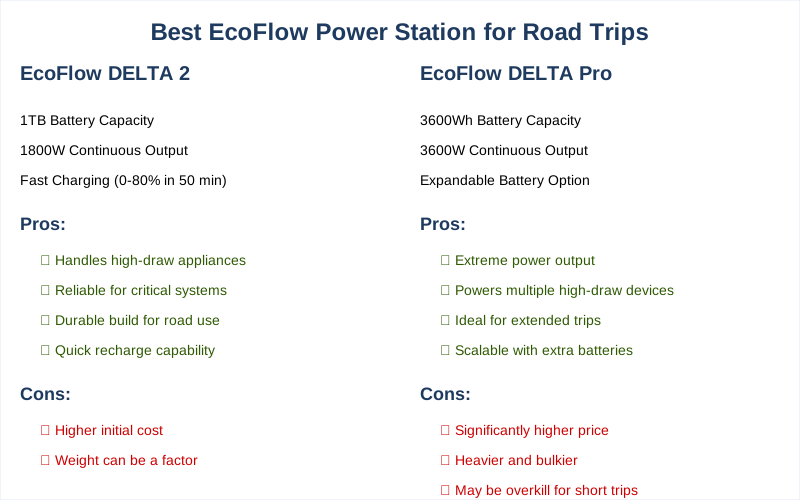
If the lineup had to be narrowed to one unit for a typical road trip, it would be the EcoFlow DELTA 2. At 1024Wh and an 1800W inverter (2700W surge per EcoFlow's spec), it is the smallest EcoFlow that runs a full road-trip load without compromise: a 12V fridge, a couple of laptops, camera batteries, a CPAP overnight, and the occasional high-draw appliance. Both Wirecutter and Outdoor Life land on roughly this capacity class as the practical default for car camping, and the published numbers back up that consensus.
Its standout feature is the recharge. Per EcoFlow's spec sheet, X-Stream charging takes it from 0–80% in roughly 50 minutes off a wall outlet — meaning a single lunch stop at a diner with an outlet essentially refills your trip's power. At 27 lbs it is a two-hands-but-manageable lift in and out of a trunk. It pairs six AC outlets with USB-C up to 100W, and like the rest of the family it runs LiFePO4 cells rated for 3,000+ cycles. For something like 90% of road trippers, this is the right answer.
Rule of thumb: if you run a 12V fridge and want one battery that handles everything else a road trip throws at it without a second thought, the DELTA 2 is the size to buy.
It also pairs naturally with a 12V cooler or fridge — if you are building the whole kit, the guide to the best 12V car fridges for road trips covers the matching cold box, and how much power a 12V fridge actually draws shows the runtime math that makes the DELTA 2's 1024Wh the sweet spot.
RIVER 2 and RIVER 2 Pro: When You Want Lighter and Cheaper
Not every trip needs a 27-lb battery. If your power list is phones, a laptop, camp lights, a drone, and maybe a CPAP, the lighter RIVER series is the honest pick — and it saves both money and back strain. The two models cover quite different needs, so it is worth knowing where the line falls.
The RIVER 2 is the minimalist's unit: 256Wh, 300W (600W with X-Boost), and just 7.7 lbs — light enough to actually carry on a hike, and per EcoFlow's spec rated for a full recharge in roughly an hour. It will not run a fridge for long or touch a microwave, and that is fine; it is not pretending to. For a weekend of keeping devices, a camp light, and a CPAP alive, it does exactly the job at a fraction of a DELTA's weight and price.
The in-between option is the RIVER 2 Pro at 768Wh and 800W (1600W X-Boost), 18.2 lbs, with a manufacturer-rated ~70-minute recharge. This is the weekend sweet spot for people who want fridge-capable runtime without DELTA-class weight. The Solar Lab and other named reviews rate the RIVER 2 Pro well for exactly this use — enough output for most camp gear, still close to one-hand portable. If your trips run two or three nights and you do not run heavy AC appliances, the RIVER 2 Pro is the value play over a DELTA 2.
How to choose between the two comes down to one question: does your trip include a 12V fridge?
- No fridge, just devices and lights: the 256Wh RIVER 2 is enough, and the lightest, cheapest way in.
- A small fridge for a weekend: step up to the 768Wh RIVER 2 Pro, which has the capacity to cycle a fridge for a couple of days.
- A fridge plus heavier AC loads or longer trips: skip the RIVER series and go to the DELTA 2.
DELTA 2 Max and DELTA Pro: For Long Stays and Heavy Loads
At the top of the range sit the two big-battery units, and they answer a different question entirely: not 'which one for a weekend' but 'which one if I live out of my rig or boondock for days.' Both are vehicle-based units — you do not casually carry them anywhere — but for the right trip they are the only sensible choice.
The EcoFlow DELTA 2 Max (2048Wh, 2400W, 4800W surge per EcoFlow's spec) is the move if you boondock for several days, run an induction cooktop, or want to power a CPAP plus a fridge plus device charging across a long weekend without recharging. At 50 lbs it is a stay-in-the-vehicle unit, not a carry-it-to-the-campsite one. It sits a clear step beyond what most road trips need, but if your trips are long and load-heavy, it is the smart buy — doubling the DELTA 2's capacity while keeping the same fast-charging X-Stream advantage.
At the very top, the EcoFlow DELTA Pro brings 3600Wh and a 3600W inverter (7200W surge). This is overlander and off-grid-base-camp territory: per EcoFlow's specs it will run a full-size fridge for days, power tools, even a small AC unit, and it chains with extra batteries if you need more capacity. The catch is obvious — it is 99 lbs and well north of $3,000. Named overlanding coverage puts this class of unit in the 'home backup that happens to travel' bracket. For a weekend camper it is overkill; for full-time rig living it is the workhorse.
If overlanding is your use case specifically, the dedicated guide to the best portable power stations for overlanding compares this big-battery tier across brands and use cases in more depth than a road-trip page needs to.
Recharging, Solar, and LiFePO4 Longevity on the Road
Buying the right capacity is only half the equation; how you keep it topped up determines whether a trip lasts two days or two weeks. EcoFlow's road-trip range gives you three recharge paths, and understanding their real speeds keeps your planning honest rather than optimistic.
Wall (AC) charging is by far the fastest, and it is EcoFlow's signature. X-Stream charging is rated, per EcoFlow's spec, to take the DELTA 2 from 0–80% in roughly 50 minutes — fast enough that a single meal stop with an available outlet is a meaningful top-up. The RIVER units recharge fully in roughly an hour to seventy minutes. This is the path to lean on whenever you pass through anywhere with mains power.
Car (12V) charging is the slow trickle. A vehicle's 12V cigarette-lighter port is fused for only about 120–180W, so charging from it while you drive adds capacity slowly — useful for keeping a unit from draining over a long driving day, but not a real recharge. Treat the car port as maintenance, not as your primary fill-up.
Solar charging is what turns a power station into a self-sufficient system for multi-day off-grid trips. EcoFlow's units accept meaningful solar input (220W on the RIVER 2 Pro, up to 500W on the DELTA 2, far more on the DELTA Pro per EcoFlow's specs), and on a sunny day a couple of folding panels can offset or even exceed a fridge's daily draw. One safety note: confirm a unit's maximum solar input voltage before buying panels, because overshooting it can damage the charge controller.
The single biggest reason to choose EcoFlow over a cheaper brand is the combination of X-Stream wall charging and LiFePO4 chemistry — you can refill fast on the road and the battery survives years of weekend cycling without meaningful fade.
That LiFePO4 (lithium iron phosphate) chemistry deserves its own mention. Every current EcoFlow road-trip model uses LFP cells rated for 3,000+ charge cycles — roughly a decade of weekend use before noticeable degradation, versus the 500-ish cycles you get from the cheaper lithium-ion packs in budget units. LFP also handles heat better and is more chemically stable, which matters when the thing lives in a hot vehicle. It is a real, durable advantage rather than a marketing line.
A practical recharge strategy ties all three paths together on a longer trip. The habit that works is to leave on a full charge, run the fridge and devices off the unit overnight, let solar refill it through the day while you drive or hike, and top up fast on wall power whenever you pass through a town with an outlet. Used that way, even a single DELTA 2 can sustain a fridge-plus-devices load almost indefinitely on a sunny trip, because you are replacing what you draw rather than slowly emptying a fixed tank. That is the real reason recharge speed and solar input matter as much as raw capacity: they decide whether your battery is a tank that runs dry or a system that refills itself.
EcoFlow vs Other Brands, and Which Model to Actually Buy
EcoFlow is not the only good name in power stations — Jackery, Bluetti, and Anker all make strong units — so it is worth being honest about where EcoFlow leads and where it does not. EcoFlow's clear advantages are recharge speed (X-Stream is genuinely faster than most rivals' wall charging) and an app ecosystem that is well regarded. Jackery often wins on price and simplicity; Bluetti frequently offers more capacity per dollar at the high end. For a cross-brand comparison at the budget end, the companion guide to the best portable power stations for car camping under $500 puts these brands head to head so you are not deciding inside one family alone.
Inside the EcoFlow lineup, though, the decision is clean once you match the model to how you travel:
- Most road trippers and car campers: the DELTA 2 (1024Wh, 1800W). Runs a fridge and everything else, recharges in under an hour, reasonable to carry.
- Light and cheap (phones, lights, CPAP): the RIVER 2 (256Wh, 7.7 lbs). Does exactly what a minimalist trip needs and nothing it does not.
- Weekend sweet spot with a small fridge: the RIVER 2 Pro (768Wh). Fridge-capable runtime at half the weight of a DELTA 2.
- Long, load-heavy trips and induction cooking: the DELTA 2 Max (2048Wh).
- Full off-grid rig living: the DELTA Pro (3600Wh), expandable with extra batteries.
Buy for the trips you actually take, not the apocalypse you are imagining. A DELTA 2 you will genuinely use beats a DELTA Pro that lives in the garage. And because the verdicts here are reasoned from EcoFlow's published specs and named third-party reviews rather than first-hand bench testing, do a quick sanity check against current prices and your own load list before you commit — the right size is the one that matches what you really plug in, not the biggest number on the shelf.
If you are still torn between two adjacent models, default to the smaller one unless you have a concrete reason to go bigger. The most common buyer's regret with power stations is not 'I wish I had bought less capacity' — it is hauling a heavy unit that mostly sits at full charge while you carry its weight everywhere. Capacity you never cycle is dead weight and dead money. The exception is if you know your trips are trending longer or more off-grid over time; in that case the next size up gives you headroom to grow into rather than a unit you replace in a year. Match the model to the trips you actually take now, lean toward portability when it is a close call, and add solar before you add a whole extra battery — that is how you end up with the right EcoFlow rather than the most expensive one.