Bottom Line First: Buy the Compressor, and Here Is Why
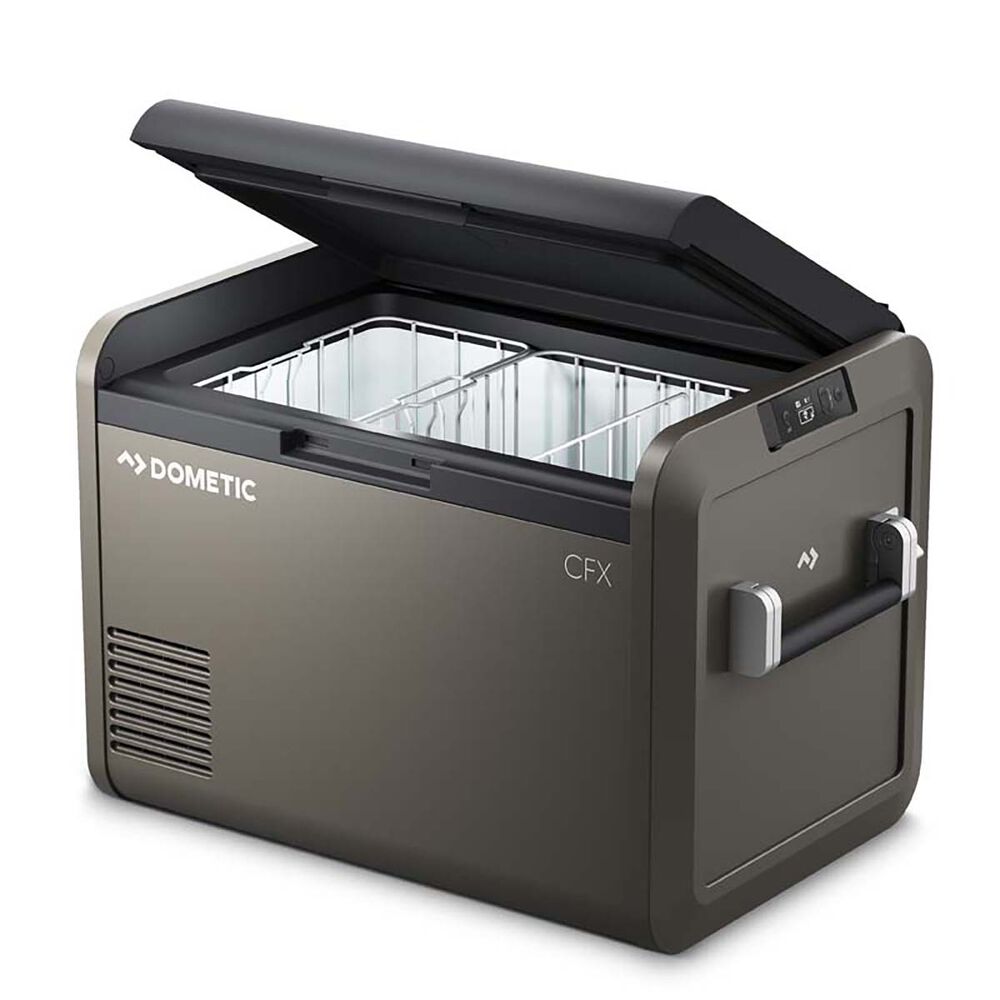
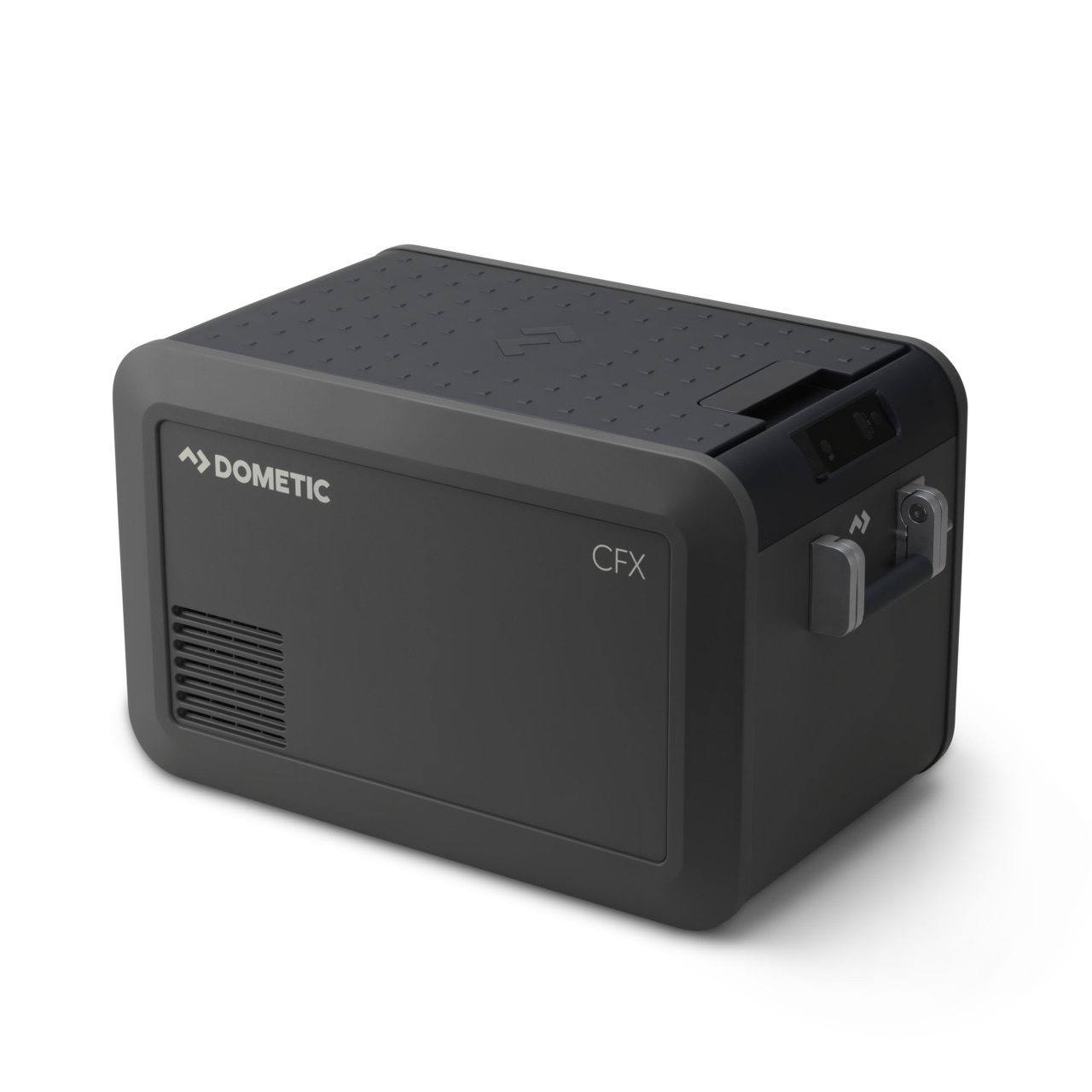
Buy a 12 V compressor cooler. If your budget cannot reach one, buy ice and a good passive cooler instead of a thermoelectric box. That is the whole recommendation, and it holds for essentially every road trip longer than an afternoon. The one listing on this page whose Amazon title we have actually read is the Dometic CFX Electric Cooler (CFX5 / CFX3 series), and it is a compressor unit.
The reason is a single specification, and it is not the one the packaging advertises. A thermoelectric cooler works by the Peltier effect: current through a semiconductor junction moves heat from one face to the other. It has no thermostat in any meaningful sense, because a Peltier module has no off state that still holds temperature. It pulls its rated current, continuously, forever, and produces a fixed temperature difference from the air around it — typically 30 to 40 degrees F below ambient, a figure Autoweek quotes for this class of cooler.
Park in the sun with a 90 degree F cabin and your food sits at 50 to 60 degrees F. That is not refrigeration. Food-safety guidance puts the cold-holding line at 40 degrees F.
A compressor cooler runs a real vapour-compression refrigeration cycle. You set a temperature, it reaches it whatever the ambient is, and then the compressor cycles off. That duty cycle is the entire argument, and the next section turns it into numbers. For the smaller socket-powered boxes people cross-shop against these, see our 12 V car cooler guide.
Peltier vs Compressor: Where the Money Actually Goes
Both boxes look the same from the outside and both plug into the same socket. Here is what the extra money is buying.
| Thermoelectric (Peltier) | Compressor | |
|---|---|---|
| What it can achieve | A fixed difference below ambient, roughly 30 to 40 degrees F | A set temperature, typically down to freezing, independent of ambient |
| Behaviour once cold | Keeps drawing full rated current — no duty cycle | Compressor shuts off and restarts on the thermostat |
| Typical rated input | 45 to 60 W, drawn continuously | Higher peak while running, roughly 1 A average at 12 V once cold |
| Moving parts | A fan, or two | A fan and a sealed compressor |
| Tilt tolerance | Any angle | Manufacturer-rated, commonly around 30 degrees |
| Insulation it is usually paired with | Thin expanded polystyrene | Injected polyurethane; vacuum panels on premium models |
| What kills it | Fan bearings and the module itself | Vibration fatigue on compressor mounts, latch and hinge hardware |
Notice that build quality appears once, at the bottom, and it is not the reason for the price gap. A steel-cased compressor cooler and a plastic-cased one both refrigerate; a thermoelectric box in a titanium shell still cannot get below 30 degrees under ambient. You are paying for the thermodynamic cycle, not the box around it.
The Current-Draw Arithmetic That Settles It
This is the spec that justifies the premium, and it is easy to do on paper.
Thermoelectric coolers in the road-trip size class are commonly rated between 45 and 60 W. At 12 V that is roughly 4 to 5 A, and because a Peltier module has no duty cycle it pulls that the entire time it is plugged in. A compressor cooler pulls more while the compressor is running — and then stops. Over a day in a shaded cabin a well-insulated box spends the large majority of its time with the compressor off, and the average for a 40 to 50 L compressor box lands near 1 A.
Now put a battery under it. Take a 60 Ah lead-acid or AGM auxiliary battery, of which roughly half is usable before you damage it — call it 30 Ah:
- Thermoelectric at 4.5 A continuous: 30 divided by 4.5 is about seven hours. One overnight stop flattens the battery, and it never actually got your food below 40 degrees F.
- Compressor at roughly 1 A average: 30 divided by 1 is about thirty hours. More than a night, at a real refrigeration temperature.
That is a factor of four in runtime on the same battery, in the same direction as the temperature advantage. It is also why the cheap option quietly costs more: the thermoelectric box that needs the engine running to survive the night is burning fuel, and the one that flattens your starter battery costs a jump start.
The specification to look for on any listing is average current draw or daily amp-hour consumption, not peak wattage. Peak tells you what the compressor pulls; average tells you what the trip costs.
Budget vs Premium: What Each Price Tier Actually Changes
Street prices move constantly, so treat these as bands rather than quotes. What matters is what changes as you cross each one.
| Tier | What the money buys | What it does not buy |
|---|---|---|
| Entry — thermoelectric | A Peltier module, a fan, thin polystyrene | Refrigeration. Everything in this band shares the same 30 to 40 degree F ceiling |
| Middle — entry compressor | A real setpoint, the duty cycle, low-voltage battery protection | Rough-road survival hardware |
| Premium — heavy-duty / vacuum-insulated | Shorter duty cycle, tougher shell and hardware, dual-zone dividers | Any extra cooling capability — the setpoint is the same |
The entry band is the one to think hardest about. Paying more inside it buys cup holders and colours, not cold, because the physical ceiling does not move. If this is your budget, a passive cooler and a bag of ice genuinely outperforms it.
The middle band is the single biggest jump on this page. You cross from a temperature difference to a temperature setpoint, you gain the runtime the duty cycle brings, and you gain a low-voltage cut-out that disconnects before your starter battery is ruined. A plastic-shelled compressor box in this band does the actual job. Almost everyone should stop here.
The premium band is justified by duration and road surface, not by temperature. Vacuum insulated panels shorten the compressor's duty cycle further, glass-fibre-reinforced or steel shells tolerate corrugations, and dual-zone dividers let one box freeze and chill at once. The first jump changes what the appliance is; the second changes how long it survives and how little it drinks. Only one of those is a capability. How much box you can carry at all is a separate question.
How Insulation Changes the Number You Just Calculated
The 1 A average above is not a constant. It is the output of a heat-leak equation, and insulation is the term you can buy. A compressor runs to remove the heat that leaks in through the walls; halve the leak and you roughly halve the run time, which roughly halves the average draw. That is why premium boxes advertise their insulation rather than their compressors.
- Expanded polystyrene — the white bead foam in cheap boxes. Light, inexpensive, and it absorbs moisture over time, which degrades it.
- Injected polyurethane — the standard for real compressor coolers. Closed-cell, moisture-stable, and it fills every cavity because it is foamed in place.
- Vacuum insulated panels — a rigid core inside an evacuated barrier envelope, used in the premium band. Far better per inch of wall, which is how a box gains interior litres without gaining exterior inches.
Two practical consequences. Wall thickness is a real spec: a box with more litres in the same footprint has thinner walls somewhere. And the lid seal matters as much as the foam, because a compressed gasket is the difference between a sealed cavity and a slow leak — and a gasket is the part that hardens with UV and age. Shade beats every one of these; a box in direct sun through a rear window is fighting a heat load no insulation tier fixes.
When Not to Buy a Compressor Cooler
A page that says buy the expensive one in every case is a sales page. Three cases where the cheap box, or no box, is correct.
Day trips where you are never far from ice. A passive rotomolded cooler with a block of ice holds below 40 degrees F for a couple of days, has no electrical draw at all, and cannot fail. For a weekend within reach of a shop, this is simply the better appliance.
Keeping drinks cool in a running car. A thermoelectric box plugged into a socket on a moving vehicle, with the alternator carrying its 4 to 5 A, does hold drinks pleasantly cool. If that is genuinely the whole use case — drinks, engine running, never overnight — it is fit for purpose and nothing here says otherwise.
Warming, which a Peltier does and a compressor cannot. Reverse the current and a thermoelectric module heats instead of cools. Compressor boxes have no equivalent, so for keeping food warm on the way home the cheap box is the only one of the two that can do it.
Outside those three cases, the arithmetic on this page points one direction, and it is not the direction the shelf price suggests.
The Parts That Fail, and What That Costs
Compressor coolers rarely fail at the compressor. They fail at their hardware, and the failures are predictable enough to shop against.
- Latches. A moulded polypropylene latch on a lid opened twenty times a day and then left in UV is the most common casualty. Stainless or glass-filled nylon is worth looking for, because a broken latch turns a refrigerator into a box — the seal no longer compresses.
- Hinges. Same material story, plus a leverage problem: a lid held open by wind loads the hinge in a direction it was never designed for.
- Compressor mounts. This is where a corrugated road does its damage. Rubber isolators fatigue, and the noise complaint that shows up in month six is usually a mount rather than a motor.
- The 12 V plug and its wiring. A cigarette-socket connection carrying several amps through a spring contact heats up, and a hot contact is a voltage drop. A cooler that keeps tripping its own low-voltage cut-out is often reporting a wiring problem, not a flat battery.
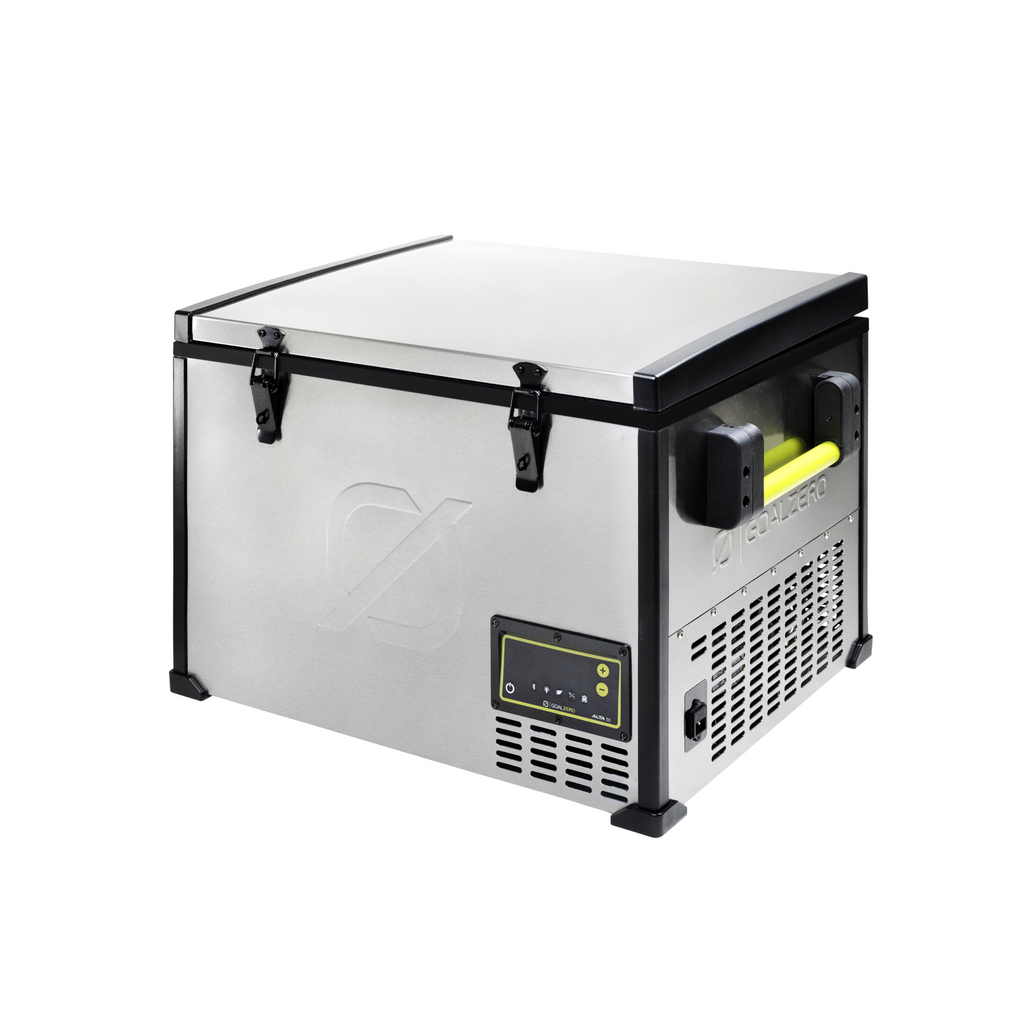
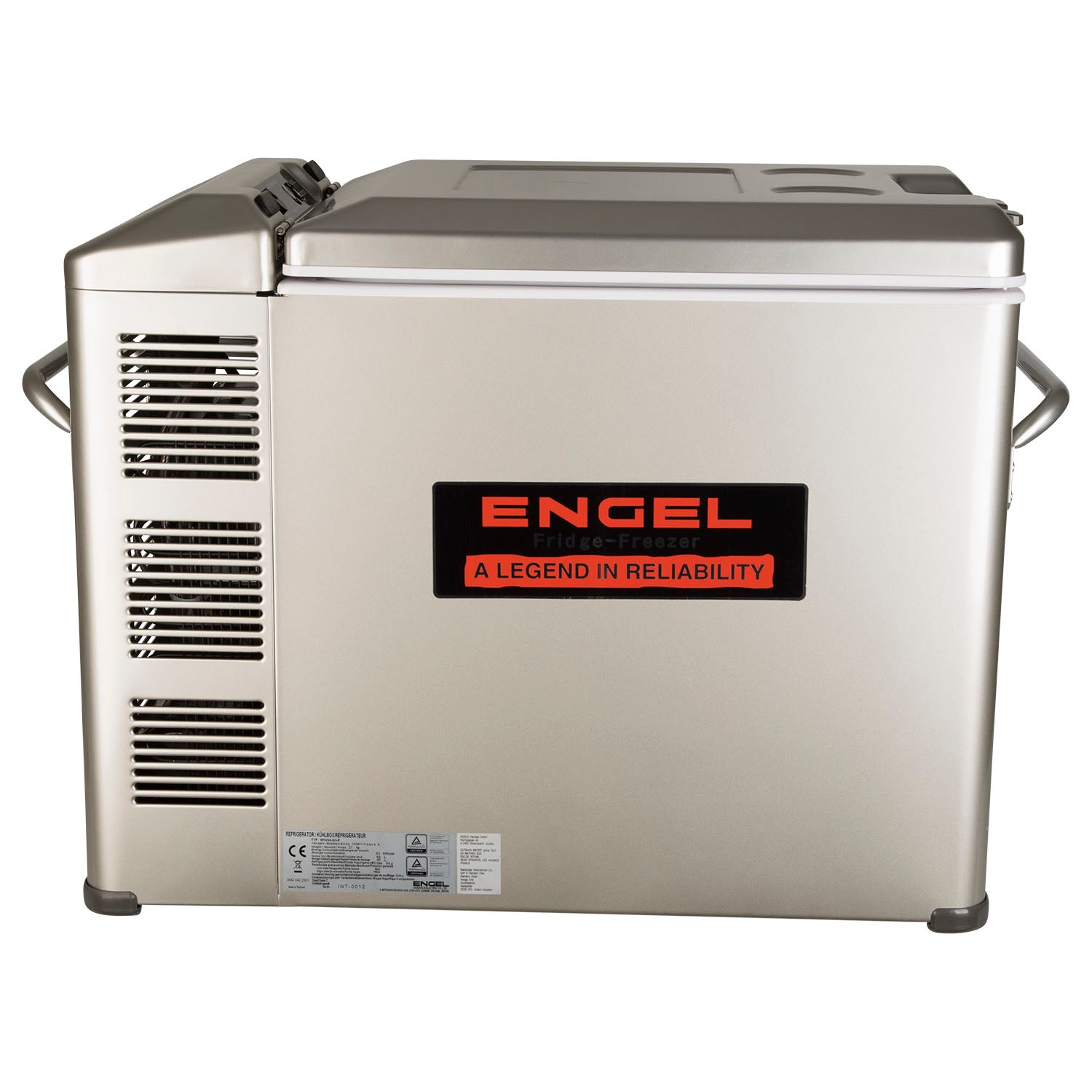
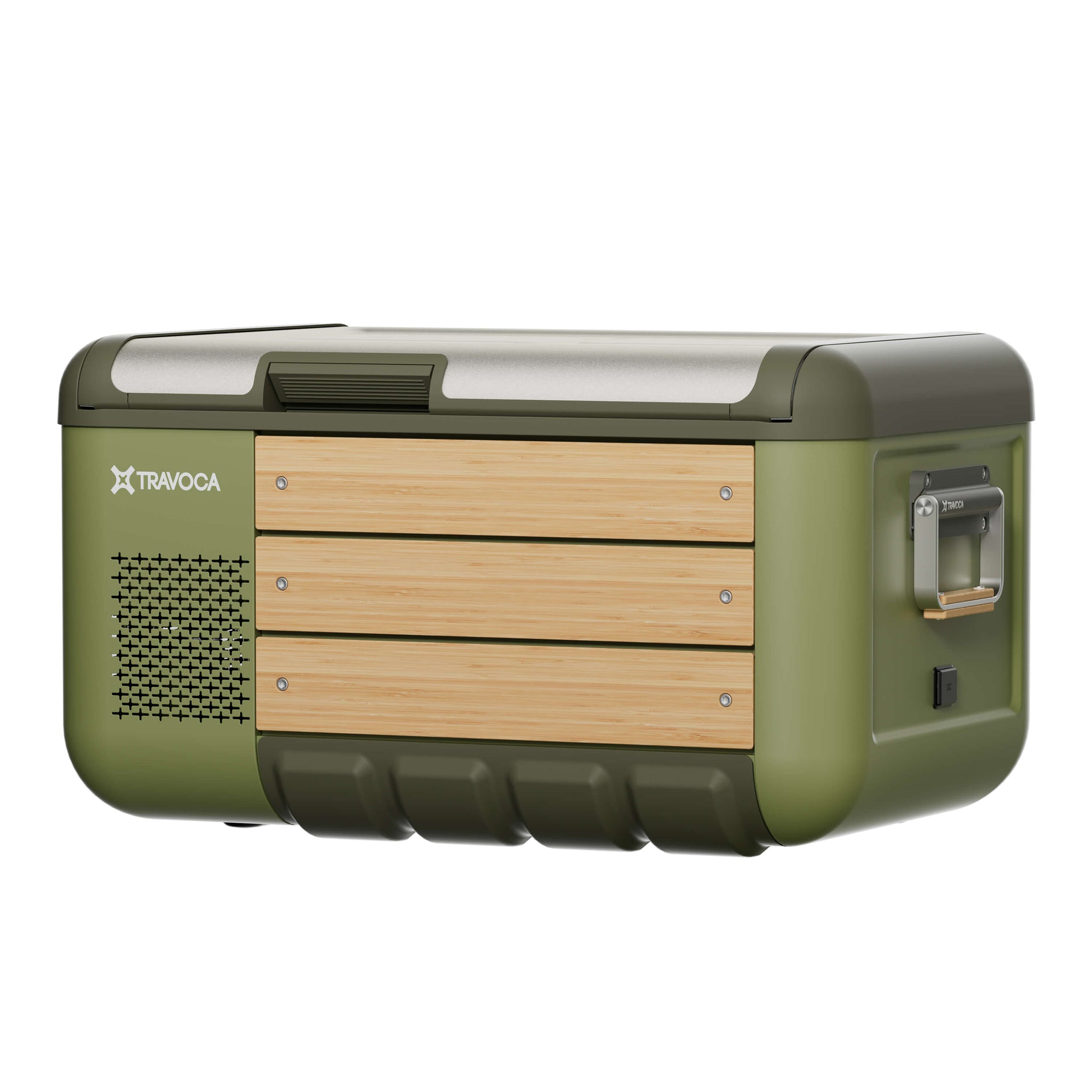
The other products named on this page — the steel-cased Engel MT45 with its swing-motor compressor, the rotomolded Goal Zero Alta 50, the dual-zone Travoca Rigel 45 — all sit in the compressor tier and differ mostly on that hardware, not on cooling. The Dometic CFX Electric Cooler (CFX5 / CFX3 series) is the one whose listing we could verify.
Named, not linked: Amazon blocks automated checks from this server, so for those three we cannot currently confirm that any specific listing is live and selling the product it claims. Rather than send you to a page nothing has verified, we have named them and left the links off.