How To Read Tire Sidewall Numbers And What They Mean
Auto Roamer
10 min read
Prices verified February 2026
Includes Video
You're on the side of the road, staring at a flat, or maybe you're at the auto parts store trying to buy replacements. The string of numbers and letters on your tire's sidewall seems like a secret code. You need to know how to read tire sidewall numbers and what they mean.
You're on the side of the road, staring at a flat, or maybe you're at the auto parts store trying to buy replacements. The string of numbers and letters on your tire's sidewall seems like a secret code. You need to know how to read tire sidewall numbers and what they mean. This isn't just about guessing; it's about ensuring your vehicle runs safely and efficiently. Understanding these markings tells you the tire's exact size, its load capacity, and its speed rating, all critical for proper car maintenance. Without this knowledge, you risk buying the wrong tires, leading to poor performance, increased wear, and even safety hazards. We'll break down what each part of that code signifies, from the tire width in millimeters to the rim diameter in inches. These numbers are your direct line to understanding your tire's capabilities. The information is standardized, so once you learn it, you'll have it for any tire on any vehicle.
The Short Answer
The numbers and letters on your tire's sidewall are a standardized code that tells you everything about its size, load capacity, and speed rating, crucial for safe and optimal car maintenance.
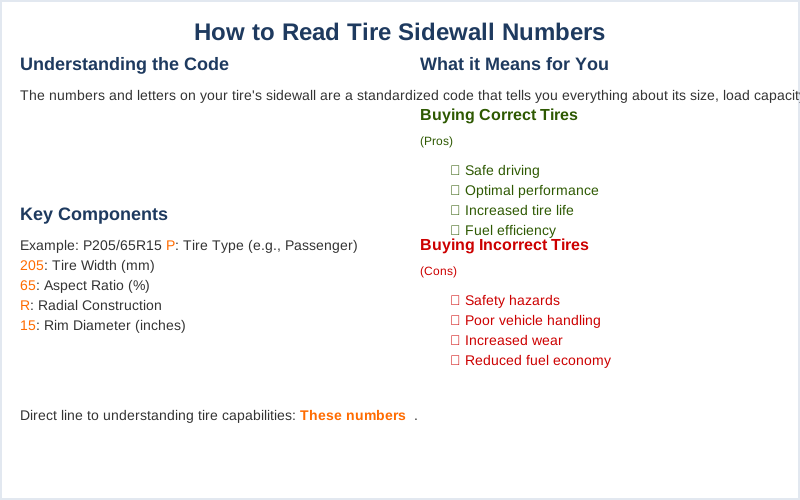
Reading tire sidewall numbers is like deciphering a secret language that unlocks vital information for your vehicle's performance and safety. The primary sequence, like P205/65R15, breaks down into key components. The first number, 205, indicates the tire's width in millimeters from sidewall to sidewall . Following the slash, the 65 is the aspect ratio, representing the tire's sidewall height as a percentage of its width.
The letter after the aspect ratio, typically an 'R', signifies radial construction, which is standard on most modern vehicles . The final number, 15 in our example, denotes the wheel diameter in inches that the tire fits . Understanding this core sequence is the first step in knowing how to read tire sidewall numbers and what they mean.
Beyond size, you'll find a load index (a two- or three-digit number) indicating the maximum weight a single tire can carry, and a speed rating (a letter) showing the maximum speed the tire can sustain . For instance, speed ratings can range from L (75 mph) up to Y (186 mph) . Always ensure these ratings meet or exceed your vehicle manufacturer's recommendations for safety.
To ensure optimal safety, it's important to understand the full scope of tire maintenance found in our complete guide.
The illuminated dashboard and speedometer are a reminder of how crucial tire information is. Learn how to read tire sidewall numbers and what they mean for your car's safety.
| Photo by Mike Bird
The illuminated dashboard and speedometer are a reminder of how crucial tire information is. Learn how to read tire sidewall numbers and what they mean for your car's safety.
| Photo by Mike Bird
What You Need to Know
1
Decoding tire sidewall numbers is crucial for proper car maintenance and ensures you're using the correct tires for your vehicle. These markings provide a wealth of information, from the tire's dimensions to its load-carrying capacity and speed rating. Understanding this code helps you make informed decisions when purchasing replacements and ensures optimal vehicle performance and safety.
2
Tire size is the most prominent marking, usually appearing as a series of numbers and letters. For example, P205/65R15. The "P" signifies a passenger vehicle tire, suitable for cars, SUVs, and minivans, while "LT" indicates a light truck tire for heavier duty use Tire Size Explained: What the Numbers Mean. The first three digits, like 205, represent the tire's width in millimeters from sidewall to sidewall What Do the Numbers and Letters on Your Tire's Sidewall ....
3
The aspect ratio follows the width, separated by a slash. In our example, "65" means the tire's sidewall height is 65% of its width What Do the Numbers and Letters on Your Tire's Sidewall .... A lower aspect ratio generally means a shorter sidewall for better handling. The letter "R" after the aspect ratio indicates radial construction, which is the most common type. Finally, the last number, "15", specifies the wheel diameter in inches that the tire fits What Do the Numbers and Letters on Your Tire's Sidewall ....
4
Beyond size, load and speed ratings are critical. A two-digit number, like 91, is the load index, indicating the maximum weight a single tire can support Tire Markings Explained: How to Read a Tire?. A higher number means greater load capacity. Following this is a letter, the speed rating, signifying the maximum speed the tire can safely handle; for instance, "S" is rated for 112 mph, while "H" is for 130 mph, and "Y" can go up to 186 mph Decoding the Numbers on Your Car's Tire Sidewall. Always match or exceed your vehicle manufacturer's recommendations for both load and speed ratings to ensure safety.
Once you’ve ensured your tire tread is sufficient, it’s crucial to know how to handle a flat tire by learning to change a flat tire.
This close-up of a car's dashboard highlights the importance of understanding your vehicle. Decoding tire sidewall numbers is a key step in proper car maintenance.
| Photo by Caleb Oquendo
This close-up of a car's dashboard highlights the importance of understanding your vehicle. Decoding tire sidewall numbers is a key step in proper car maintenance.
| Photo by Caleb Oquendo
How to Handle This
1
Locate the tire size code - This critical sequence, often P205/65R15, is essential for understanding your tire's specifications What Do the Numbers and Letters on Your Tire's Sidewall .... If you're stranded, finding this is your first step to getting the right replacement.
Identify construction and rim diameter - The letter after the aspect ratio, usually 'R', signifies radial construction What Do the Numbers and Letters on Your Tire's Sidewall .... The final number, like 15, is the wheel diameter in inches. This is non-negotiable; a tire for a 17-inch wheel won't fit a 15-inch wheel.
4
Understand load index and speed rating - After the size, you'll find a number and letter, like 91V. The number, 91, is the load index, the maximum weight a single tire can carry Tire Markings Explained: How to Read a Tire?. The letter, V, is the speed rating, the maximum safe speed. Overloading or exceeding speed ratings can lead to catastrophic tire failure. Always match or exceed manufacturer recommendations.
To ensure optimal performance, it's also important to know how to check your tire tread depth at home; learn more about it here.
The sleek digital dashboard showcases modern technology. Locating the tire size code, like P205/65R15, is essential for understanding your tire's specifications.
| Photo by Vlad
The sleek digital dashboard showcases modern technology. Locating the tire size code, like P205/65R15, is essential for understanding your tire's specifications.
| Photo by Vlad
Real-World Scenarios
Commute in Heavy Rain with a Sedan: Driving a standard sedan with P-metric tires, like P205/65R15 P205/65R15, during a sudden downpour can be unnerving. The reduced traction means braking distances increase significantly, and hydroplaning becomes a real risk, especially if the tread depth is less than optimal. Understanding your tire's aspect ratio (e.g., 65, meaning the sidewall height is 65% of the width) helps gauge its responsiveness, but in heavy rain, even a lower aspect ratio tire can struggle.
Long Road Trip in an SUV on Dry Pavement: A family road trip in an SUV equipped with LT tires, designed for heavier loads, on highways across dry terrain requires attention to load index and speed ratings. While LT tires offer durability, a passenger vehicle might use P-metric tires with a specific load capacity. Ensuring the tires meet or exceed the vehicle manufacturer's recommended speed rating, such as an S (112 mph) or H (130 mph) speed rating, is crucial for sustained high-speed driving.
Navigating Potholes in a Compact Car: Encountering unexpected road hazards like potholes in a compact car fitted with tires like 205/55R17 205/55R17 can be problematic. The aspect ratio, in this case 55, indicates the sidewall height as a percentage of the tire's width, and a lower number generally means a stiffer ride. Hitting a deep pothole with a tire that has a lower aspect ratio and a smaller rim diameter (like 17 inches) can increase the risk of rim damage or tire sidewall failure if the impact is severe.
It's crucial to understand tire maintenance to prevent issues like a blowout, so learn how to handle a tire blowout while driving in our guide tire blowout guide.
Driving at night with an illuminated dashboard emphasizes the need for reliable car maintenance. Understand what do the numbers on tire sidewalls mean for safe commutes.
| Photo by Doci
Driving at night with an illuminated dashboard emphasizes the need for reliable car maintenance. Understand what do the numbers on tire sidewalls mean for safe commutes.
| Photo by Doci
Common Mistakes to Avoid
Common Mistakes to Avoid
Mistake Assuming all numbers on the sidewall are equally important or follow the same logic.
Why people make it The sheer volume of markings can be overwhelming. People often glance at the most prominent numbers without understanding their distinct meanings.
What actually happens You might misinterpret tire size, leading to improper fitment, or overlook critical information like the load index, potentially causing tire failure. For example, treating the aspect ratio (like 65) the same way as the width (like 205) is a common error. Tire Size Explained: What the Numbers Mean
The fix Learn to distinguish between the tire size components (width, aspect ratio, rim diameter) and other markings like load index and speed rating. Understand that a number like 65 represents a percentage, while 205 is a width in millimeters. What Do the Numbers and Letters on Your Tire's Sidewall ...
Mistake Believing the tire manufacturing date is always a three-digit code, especially on older tires.
Why people make it Newer tires consistently use a four-digit code for the manufacturing date. This leads to confusion when encountering older tires.
What actually happens You might incorrectly estimate a tire's age, leading to using tires that are past their safe service life. Older tires, manufactured before the current standard, used a different system to denote the week and year of production. How to Read a Tire Sidewall
The fix Recognize that older tires may use a three-digit DOT code to indicate the manufacturing week and year. Modern tires use a four-digit code (e.g., '3319' for the 33rd week of a specific year). Tire Markings Explained: How to Read a Tire?
Mistake Ignoring the load index and speed rating, assuming they are standardized across all tires.
Why people make it These are often less obvious than the tire size numbers and are sometimes overlooked in favor of simpler metrics.
What actually happens You could end up with tires that cannot safely support the weight of your vehicle or handle its top speed. This is a critical safety concern and can lead to premature tire wear or even catastrophic failure. For example, a tire with a load index of 91 has a specific maximum load capacity. Tire Size Explained: What the Numbers Mean
The fix Always match the load index and speed rating to your vehicle manufacturer's recommendations. These ratings are essential for safe operation and are often found in your owner's manual. Decoding the Numbers on Your Car's Tire Sidewall
Mistake Assuming a radial tire (indicated by 'R') is the only common construction type.
Why people make it Radial construction is overwhelmingly the most prevalent type on modern vehicles, making other types seem obsolete or non-existent.
What actually happens You might not recognize or be able to properly identify older or specialized tires. While 'R' for radial is standard, understanding that other designations like 'B' for belted bias or 'D' for diagonal bias exist is important for comprehensive knowledge. What Do the Numbers and Letters on Your Tire's Sidewall ...
The fix Be aware that while radial construction ('R') is most common, other tire construction types exist. This awareness is particularly useful when dealing with older vehicles or specialized equipment. What Do the Numbers and Letters on Your Tire's Sidewall ...
If you notice any unusual smells while driving, it may be time to investigate with our tips on burning rubber odors.
Product comparison for how to read tire sidewall numbers and what they mean
Key Takeaways
Understanding your tire's sidewall is crucial for car maintenance and safety. The sequence of numbers and letters details tire type, width (e.g., 205mm), aspect ratio (e.g., 65%), construction (like radial 'R'), and wheel diameter (e.g., 15 inches) What Do the Numbers and Letters on Your Tire's Sidewall ....
Also on the sidewall is the DOT serial number, which includes the tire's manufacture date (last four digits) - essential for knowing when tires are nearing the end of their service life How to Read a Tire Sidewall.
When in doubt about interpreting these markings or selecting replacement tires, consulting a trusted mechanic or tire professional is always the safest bet for how to read tire sidewall numbers and what they mean.
Maintaining your vehicle's health also involves regular checks, such as monitoring your tire pressure.
Frequently Asked Questions
I'm looking at my tires and see a bunch of numbers and letters. What do the main ones tell me about the tire size?
You'll usually see a code like P205/65R15. The 'P' means it's for a passenger vehicle, '205' is the width in millimeters, '65' is the aspect ratio (sidewall height as a percentage of width), 'R' means radial construction, and '15' is the wheel diameter in inches. This is crucial for getting the right fit when you need new tires.
What does the 'load index' and 'speed rating' on my tire mean?
After the tire size, you'll see a number and a letter, like '91V'. The '91' is the load index, indicating the maximum weight that tire can safely support - you can look up charts to find the exact poundage. The 'V' is the speed rating, showing the maximum speed the tire can handle while carrying its rated load; for most cars, you'll see ratings like S, T, H, or V.
How can I tell when my tires were made?
Look for the DOT code on the sidewall, which is a string of letters and numbers. The last four digits are the key: they represent the week and year of manufacture. For example, '3319' means the tire was made in the 33rd week of 2019. It's generally recommended to replace tires that are six years or older, regardless of tread wear.
I need to replace my tires. How important is it to match the exact numbers on the sidewall?
It's absolutely critical to match or exceed the specifications from your vehicle manufacturer. Using tires with an incorrect load index could lead to dangerous situations, and a lower speed rating can limit your car's performance. Always refer to your owner's manual or consult a tire professional to ensure you get the right replacement.
What's the difference between 'P' and 'LT' on a tire sidewall?
The first letter usually indicates the tire type. 'P' stands for passenger vehicle, which is what most cars, SUVs, and minivans use. 'LT' means light truck, designed for heavier loads, towing, or off-road use, typically found on larger trucks and some SUVs that require more robust tires.
🏅 Looking for Gear Recommendations?
Check out our tested gear guides for products that work with this setup: