Car Accessories

How to Choose the Right Size Roof Rack for Your SUV

Casey - The Weekend Warrior
5 min read
Includes Video

My first SUV roof rack was a $150 mystery box from a discount auto parts store. It claimed to fit 'most SUVs,' which turned out to be marketing speak for 'good luck, pal.' The bars were too short for my Forester, leaving my kayak looking like it was about to take a swan dive off the side.

My first SUV roof rack was a $150 mystery box from a discount auto parts store. It claimed to fit 'most SUVs,' which turned out to be marketing speak for 'good luck, pal.' The bars were too short for my Forester, leaving my kayak looking like it was about to take a swan dive off the side. I learned real quick that SUV roof rack size isn't a suggestion, it's a physics problem.

You gotta match the bar length to your vehicle's actual roof width. It's the difference between hauling gear and causing a roadside spectacle. Rhino-Rack spells it out: function over fashion, usually. My first trip proved that the hard way.

The Core Answer

Choosing the right SUV roof rack size boils down to one thing: measuring your car's roof. Seriously, grab a tape measure. The real move is to figure out how wide your roof is from the factory side rails, or from the edge of the door frame if you don't have rails. Yakima suggests using their 'Fit My Car' tool, which is a decent starting point, but I still double-check with a tape measure. It's like buying shoes - you don't just guess your size. Most aftermarket crossbars come in standard lengths, like 50 inches, 60 inches, and 70 inches. If your roof is wider than the bars, you're asking for trouble. Your gear will overhang, which is a massive safety hazard and just looks plain janky. I saw a dude once with a kayak sticking out like a medieval catapult. Not the look we're going for. What nobody tells beginners is that you want your crossbars to be slightly wider than your roof, but not excessively so. Think of it like this: you want a little bit of overhang for mounting accessories like bike racks or cargo boxes, but you don't want your gear to be able to fall off if you sneeze. A good rule of thumb is to have about 2-6 inches of overhang on each side. Discount Ramps mentions the items you want to put on your roof are the determining factor. For my Subaru Forester, which has factory side rails, I ended up with 58-inch crossbars. This gave me just enough extra space to mount my awning without it looking like it was about to fly off at highway speeds. The key is to ensure the towers or feet that hold the crossbars are securely clamped to your vehicle's mounting points. Rack Attack breaks down how towers, bars, and fit kits work together. If you have a bare roof (no rails), you'll need specific fit kits or clips designed for your car model. This is where the 'Fit My Car' tools become more crucial. A rookie mistake is assuming a universal rack will just magically fit. It rarely does without the correct vehicle-specific landing pads or clips. Public Lands says materials matter, but so does fit. Ultimately, the honest version is to measure twice, buy once. A rack that's too short is useless, and one that's too long is a hazard. Don't be like me and buy the $150 mystery box. Spend the extra $20 for the correct length bars. It's game-time for your adventures.
Once you've determined the right size, it's crucial to understand the weight limits for your roof rack.
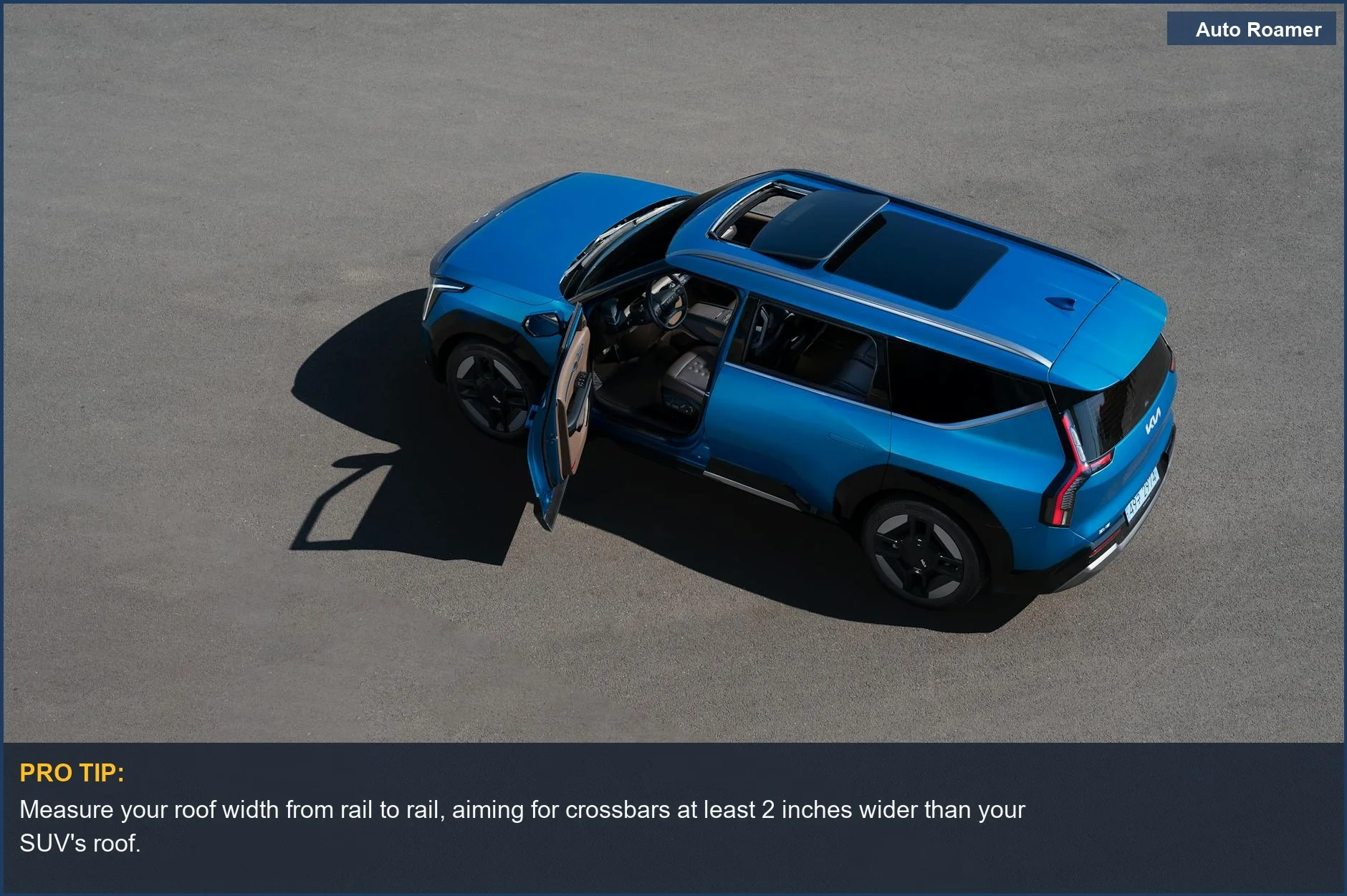
Measure your roof width from rail to rail, aiming for crossbars at least 2 inches wider than your SUV's roof.
Before selecting a roof rack, understand your SUV's roof dimensions. Accurate measurements ensure a secure fit, preventing wind noise and instability. | Photo by Hyundai Motor Group

Why This Matters for Your Setup

  • Kayak Catastrophe Avoidance: On my second car camping trip to the Delaware Water Gap, I tried to strap a kayak to crossbars that were about 8 inches too short for my old RAV4. The front of the kayak was practically kissing the windshield. It was a nerve-wracking 2-hour drive, and I spent more time checking my mirrors than enjoying the scenery. YouTube videos show how to strap gear, but they assume you have the right base.
  • Cargo Box Wobble: I once borrowed a buddy's cargo box for a ski trip. His crossbars were the exact same length as mine, but his setup had a slightly wider stance due to different towers. The cargo box felt wobbly on the highway, making me question every bump. The width of the crossbars matters for how securely accessories mount, not just how far they stick out. Rhino-Rack calls them 'Overhang' for function.
  • Awning Angle Angst: When I first got my awning, I mounted it on bars that were a little too short. This meant the awning deployed at a weird angle, collecting rainwater like a tiny, fabric swimming pool. The proper overhang gives you flexibility to position your accessories correctly and avoid water pooling or wind catching.
  • Bike Rack Blues: My friend tried to mount two mountain bikes on crossbars that were barely wide enough. The handlebars were bumping, and it looked like a metal pretzel. You need enough space between the bars to mount your accessories without them interfering with each other. Too narrow, and your gear starts to look like a Jenga tower waiting to fall.
  • The $50 Version vs. The Right Version: I know people who try to MacGyver roof rack solutions with cheap universal bars. They often end up with damaged paint, loose mounts, and gear that shifts. Spending $300-$500 on a proper system with the right crossbar length for your vehicle is cheaper than replacing damaged gear or, worse, causing an accident. Reddit threads are full of these cautionary tales.
  • To maximize your space and efficiency, understanding roof rack size is key for camping trips.
    Avoid kayak catastrophes by ensuring your roof rack crossbars extend at least 8 inches beyond the vehicle's mounting points.
    Don't let a poorly sized roof rack ruin your adventure. Choosing the right SUV roof rack size prevents dangerous cargo overhangs and ensures peace of mind. | Photo by revac film's&photography

    Making the Right Choice

    So, the real move for SUV roof rack size is simple: measure your roof. Don't rely on vague 'fits most' claims. Discount Ramps agrees that your intended cargo dictates the rack.
  • Measure your roof width where the crossbars will sit. This is non-negotiable. Yakima has tools, but your tape measure is the ultimate authority.
  • Aim for a slight overhang on your crossbars, usually 2-6 inches per side, to give you mounting flexibility. Too much overhang is dangerous; too little is restrictive. Rhino-Rack shows overhang as functional.
  • Understand your vehicle's mounting points. Factory rails, fixed points, or bare roof all require different towers and fit kits. Rack Attack explains these components.
  • Don't cheap out. A $150 generic rack might seem like a deal, but it's a rookie mistake. The right rack, even if it costs $400, will be safer and last longer. Gobi Racks emphasizes understanding basics.
  • This isn't rocket science, but it does require a bit of actual science. Get the size right, and your adventures will be much smoother.
    To maximize your roof space, consider pairing your rack with a properly sized roof rack cargo box.
    Verify your roof rack's load capacity; ensure it can support at least 100 pounds for most SUV adventures.
    Precision is key for a perfect vehicle roof rack fit. Relying on exact measurements, not general claims, guarantees your rack performs as intended. | Photo by asim alnamat

    Frequently Asked Questions

    I saw a "universal fit" roof rack kit online for $75. Is that a good way to save money compared to the $300+ systems?
    That $75 universal kit is basically a gamble. The 'universal' part usually means it comes with a million tiny pieces and a prayer. I blew $120 on one of those for my first car, and the metal clips that were supposed to grip the door frame bent after two uses. You'll spend more time wrestling with it than actually camping. Stick to reputable brands like Yakima or Thule, even if it means saving up for a bit.
    Do I really need a specific roof rack fit kit, or can I just use some heavy-duty zip ties to secure the bars?
    Zip ties? Seriously? That's a recipe for disaster. Those kits are vehicle-specific for a reason – they're designed to clamp into specific points on your car's roof structure. Zip ties will stretch, snap, or just slide right off. My buddy tried zip ties once, and his canoe ended up in a ditch. You need those $50-100 fit kits to be safe.
    What if I buy crossbars that are a little too long, and my gear still overhangs? Will it really cause problems?
    Yeah, it's a big problem. On a trip to the Adirondacks, I had crossbars that stuck out about 10 inches on each side. My roof box looked like it was on stilts, and I scraped it on a low-hanging branch within the first hour. Plus, that much overhang is a serious safety hazard if you have to swerve. It’s not just about looks; it’s about staying on the road.
    Could having the wrong size roof rack permanently damage my SUV's paint or roof structure?
    Absolutely. If the mounting points aren't correct or the bars are too long and flex too much, they can rub through your paint, leaving rust spots. I’ve seen people with deep gouges in their roof from poorly fitted racks. The clamping force from incorrect towers can also put stress on the roof structure over time, especially with heavy loads. It's not worth the risk for a few bucks saved.
    Is it true that longer crossbars always mean more weight capacity?
    Not necessarily. While longer bars might give you more surface area to spread the load, the actual weight capacity is determined by the towers, the bars themselves, and, most importantly, your vehicle's roof load limit. A 60-inch bar from a cheap brand might have a lower rating than a 50-inch bar from a quality manufacturer. Always check the manufacturer's specs for both the rack system and your vehicle.

    🏅 Looking for Gear Recommendations?

    Check out our tested gear guides for products that work with this setup:

    C

    Casey - The Weekend Warrior

    Weekend car camper and road trip enthusiast. Focuses on practical, budget-friendly solutions for families and first-time campers.

    Sources

    Related Articles