
Gear

Choosing the Right Field of View for Your RV Rear View Dashcam

Casey - The Weekend Warrior
5 min read
Includes Video

The field of view on your RV's rear-view dashcam is more critical than you might think. It dictates how much you actually see and, more importantly, what you miss. My first attempt at setting one up left me blind to half the road, which is a rookie mistake I won't repeat.

The field of view on your RV's rear-view dashcam is more critical than you might think. It dictates how much you actually see and, more importantly, what you miss. My first attempt at setting one up left me blind to half the road, which is a rookie mistake I won't repeat. Getting this right means understanding the trade-offs between seeing everything and seeing details.

It's not just about the camera itself, but how it's aimed to capture the world behind you. Getting the angle right is key to useful footage. A poorly aimed camera is just a fancy paperweight. We're talking about safety here, not just collecting blurry videos of license plates. It's about having eyes where you need them most. Understanding the camera's angle is the first step to a safer drive.
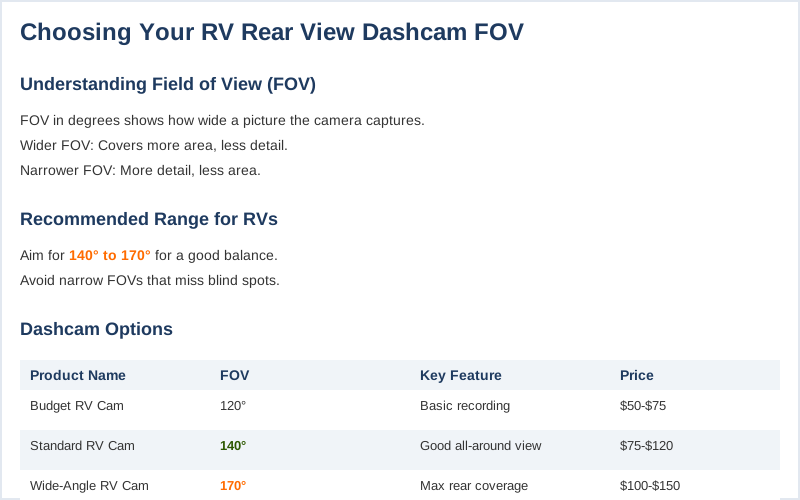
Choosing the Right Field of View for Your RV Rear View Dashcam — Key Specifications Compared
Key specifications for Choosing the Right Field of View for Your RV Rear View Dashcam

The Core Answer

When you're looking at dashcams, the 'field of view' (FOV) is usually listed in degrees, like 140 or 170. This number tells you how wide of a picture the camera can capture. Think of it like the beam of a flashlight: a wider beam covers more area but might not show details as clearly. A narrower beam is like a spotlight, showing more detail but missing stuff on the sides. For an RV, you generally want something on the wider side. I learned this the hard way trying to use a camera that was too narrow on my first big trip. I couldn't see cars merging from the next lane until they were practically on top of me. My $75 camera from Amazon felt like a joke because it missed half the action. The real move is to aim for something in the 140 to 170-degree range. This gives you a good balance. You get a broad view of what's happening behind you, but it's not so distorted that you can't make out important details. A wider angle helps capture more of the scene. Anything less than 140 degrees might be too narrow for an RV, especially if you're trying to back into a tight spot or change lanes. You'll be relying more on your mirrors, which is fine, but the camera should be your primary backup. Too wide, like 180 degrees or more, and you start getting a fisheye effect that can make everything look curved and distant. It can be hard to judge distances accurately, and the edges of the video can get really warped. Choosing the right FOV depends on your needs. My first RV dashcam had a 120-degree FOV. It was like looking through a mail slot. I couldn't see anything to my sides, and judging how far away cars were was a guessing game. I ended up buying a new one with a 165-degree lens for about $120, and it made a world of difference. The honest version: don't skimp on this spec. It's the difference between useful evidence and a blurry mess. Most cameras have wide angles, so don't overthink placement too much, but the FOV number is what matters most for what you'll see. It's not rocket science, but it does require a little thought before you buy.
To ensure optimal coverage on your trips, understanding how to choose the right dash cam field of view is essential.
Select an RV camera with at least a 140-degree field of view for comprehensive rear coverage.
A clear view of your RV's dashboard highlights the importance of understanding dashcam field of view. Aim for a 150-degree angle for optimal clarity. | Photo by Mike Bird

Why This Matters for Your Setup

Why does this even matter? Because a camera's field of view directly impacts what you can and can't see. My first dashcam, a cheap thing I got for $50, had a FOV that was too narrow. I couldn't see cars in my blind spots until they were right next to me. That's a terrifying feeling when you're piloting something as big as an RV. Here's the breakdown:
  • Too Narrow (< 140 degrees): You'll miss a lot on the sides. This is a major problem for lane changes and general awareness. You'll be relying solely on your mirrors, which isn't always enough. I once nearly merged into a motorcycle because my camera couldn't see him. The $50 camera was almost a $500 mistake.
  • The Sweet Spot (140-170 degrees): This range offers a good balance. You can see a wide area behind you, including adjacent lanes, without excessive distortion. This is the real move for RVs. It allows you to see potential hazards coming from further away. This range is generally recommended.
  • Too Wide (> 170 degrees): While it seems like 'more is better,' extreme wide angles can distort the image badly. Distances become hard to judge, and objects at the edges might look warped. It's like looking through a fisheye lens, which isn't ideal for critical driving decisions. This can be a problem.
  • Ultimately, the goal is to get a camera that gives you the best possible situational awareness. My second dashcam, which cost about $130, had a 165-degree FOV and it was night and day. I could actually see what was going on behind me. Dual-view cameras are also worth considering.
    Understanding the importance of lens choice also plays a crucial role in maximizing your dash cam's field of view when towing.
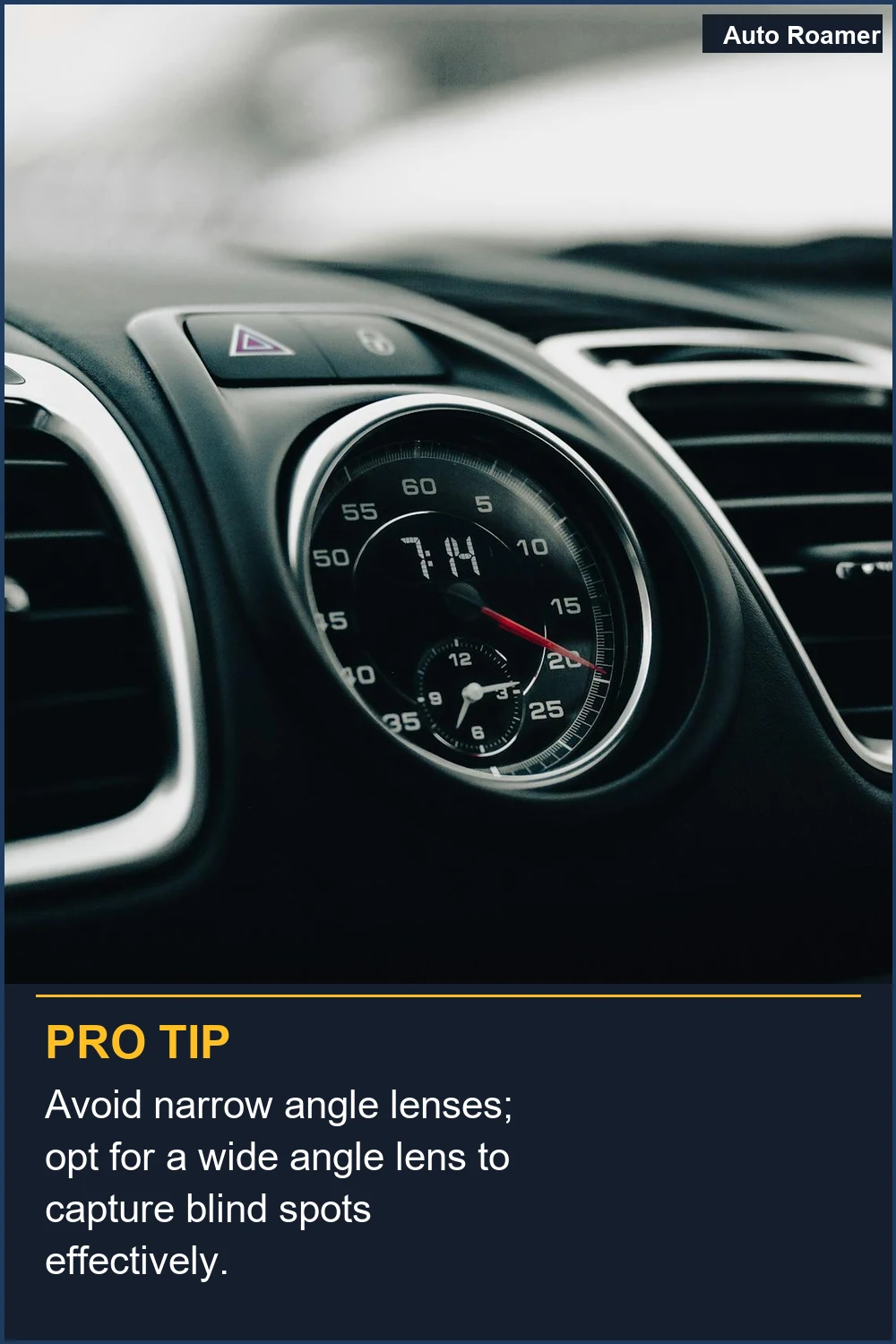
    Avoid narrow angle lenses; opt for a wide angle lens to capture blind spots effectively.
    This dashboard view emphasizes how a limited dashcam field of view can miss crucial details. A wide angle lens is essential for safety. | Photo by Jeffrey Paa Kwesi Opare

    Making the Right Choice

    Choosing the right field of view for your RV dashcam isn't about the most expensive gadget. It's about making an informed decision based on what you actually need to see. My first dashcam was a $40 lesson in 'you get what you pay for.' It barely covered half the road behind me. Here's the takeaway:
  • Don't settle for anything less than a 140-degree field of view. My $70 upgrade was worth every penny for the peace of mind.
  • Aim for the 140-170 degree range. This is where you get the best combination of coverage and clarity for an RV. This range is generally ideal.
  • Anything more extreme might look cool, but it can actually hurt your ability to judge distances and see details. It's a rookie mistake to think wider is always better.
  • Think about what you'd see if you were standing on the roof of your RV looking back. That's roughly the kind of coverage you want. This ensures you have a good view. It's not complicated, but it is important.
    To enhance your RV experience further, consider the importance of dashcam lens selection for effective camping surveillance.
    Upgrade your RV's rear view camera to capture more of the road, not just a small segment.
    Understanding your RV's dashboard setup is key. Choosing the right rear view camera FOV, ideally over 170 degrees, ensures you see everything. | Photo by Ayyeee Ayyeee

    Frequently Asked Questions

    I saw a dashcam for $30 with a 170-degree view. Is that the same as the $150 ones you're talking about?
    Probably not. That $30 camera might list 170 degrees, but the quality of the lens and sensor is likely garbage. My $75 camera claimed 150 degrees, but the image was so warped and blurry at the edges I couldn't tell if it was a car or a giant squirrel. You're paying for better optics and image processing with the pricier units, not just the degree number. It's like comparing a $10 pair of binoculars to a $100 pair.
    Do I need a special tool to measure the field of view on my camera?
    No, you don't need any fancy tools. The field of view is a spec listed by the manufacturer, usually in degrees. You just need to look at the product description or the box. Don't overcomplicate it; just find the number. If they don't list it, run away. My first camera didn't list it, and that was a huge red flag I ignored.
    What if I get a camera with a wide FOV, but it's mounted too high on my RV windshield? Will it still be useful?
    It might be less useful than you hope. If the camera is aimed too high, you'll see a lot of sky and distant road, but the area directly behind your bumper will be invisible. That's a common mistake, and it means you could miss a small child or a curb. You'll need to adjust the camera's angle to see the ground close behind you, not just the horizon. Proper aiming is crucial.
    Can having a super-wide angle lens permanently damage my RV's windshield?
    No, a wide-angle lens itself won't damage your windshield. The camera mounts to the glass with adhesive. The only way it could cause damage is if you try to rip it off incorrectly, which could leave sticky residue or, in rare cases, chip the glass if you're being really rough. Just be patient when removing it, and use a proper adhesive remover if needed.
    I heard that 170-degree cameras cause too much distortion and aren't good for evidence. Is that true?
    It's partially true. While 170 degrees offers great coverage, it *can* lead to more distortion, especially at the edges. This makes judging distances harder and might make details look a bit warped. However, 'too much' is subjective. For an RV, the extra coverage is often worth a little distortion, as long as the center of the image is clear. My 165-degree camera is fine for evidence, but I wouldn't try to use the extreme edges for precise measurements. It’s a trade-off.

    🏅 Looking for Gear Recommendations?

    Check out our tested gear guides for products that work with this setup:

    C

    Casey - The Weekend Warrior

    Weekend car camper and road trip enthusiast. Focuses on practical, budget-friendly solutions for families and first-time campers.

    Sources

    Related Articles