
Understanding Dash Cam Parking Mode for Car Camping Security
Parking mode on dash cams lets your camera keep an eye on your car even when the engine's off, acting like a little security guard for your rig. Think of it as the dash cam's way of saying, 'I'm still on duty, even when you're not.' It's designed to catch those sneaky hit-and-runs or the occasional parking lot ding that happens when you're miles away setting up your tent.
Parking mode on dash cams lets your camera keep an eye on your car even when the engine's off, acting like a little security guard for your rig. Think of it as the dash cam's way of saying, 'I'm still on duty, even when you're not.' It's designed to catch those sneaky hit-and-runs or the occasional parking lot ding that happens when you're miles away setting up your tent.
This isn't just for city driving; it's a solid peace-of-mind upgrade for anyone who leaves their vehicle unattended, especially in more remote car camping spots. It's the real move for ensuring you've got footage if something goes down.24/7 Car Security Explained. Without it, your camera is basically just a fancy paperweight when you're asleep in your tent.
The Core Answer
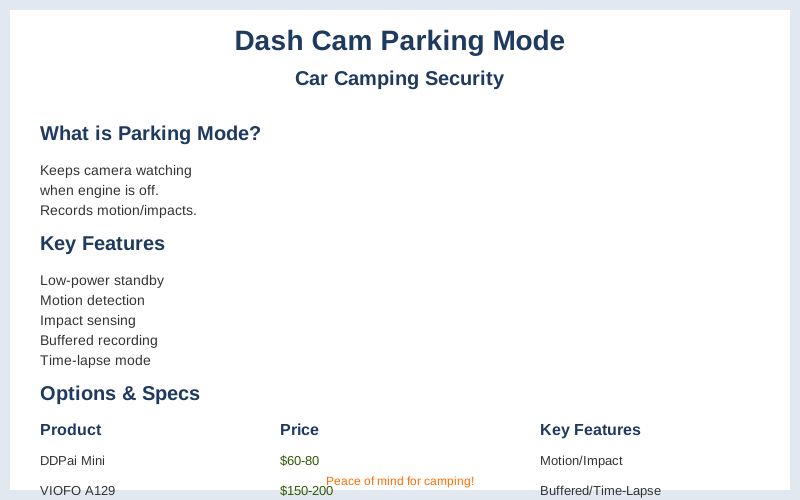
The core idea behind parking mode is that your dash cam doesn't just shut off when you kill the engine. Instead, it enters a low-power state, ready to spring into action if it detects something.Parking mode is a feature of dash cams. It uses its sensors to watch for motion or impacts.When motion is detected in front of the lens, or if the camera gets bumped (like someone's door hitting your car), it wakes up and starts recording. This is a huge upgrade from basic dash cams that only record when you're driving.
Some systems use buffered recording, meaning they'll save a few seconds *before* the event happened, plus the aftermath. This is the crucial part for catching what actually caused the disturbance. It's not just about seeing what happens after the fact; it's about seeing the whole story.
Other modes, like time-lapse, record at a super-low frame rate to capture long periods without filling up your memory card. It's like a sped-up movie of your parked car. This is great for seeing if someone was lurking around for a while.
The real trick is how it gets power. Most systems need to be hardwired into your car's fuse box. This bypasses the car's battery drain protection, allowing the dash cam to run when the ignition is off. Brilliant engineering, right?
However, you absolutely need to make sure your hardwire kit has voltage cut-off protection. You don't want your dash cam to drain your car battery completely, leaving you stranded miles from anywhere with no way to start your engine. That's a rookie mistake you only make once.
If your car battery is constantly dying, you might need a dedicated dash cam battery pack. This is a separate battery that charges while you drive and powers the parking mode when the engine is off. It's the $100-$200 version of not draining your car battery, but it gives you more peace of mind.
The honest version: most people just need motion or impact detection. Time-lapse is good if you're worried about prolonged loitering. Low bitrate is less common but can work if storage is tight.
It's all about finding the balance between capturing enough footage and not killing your car's battery. This is where the $50-$100 hardwire kits with built-in battery protection really shine.
What nobody tells beginners is that your parking mode settings are game-time decisions. Too sensitive, and you get a thousand clips of leaves blowing by. Not sensitive enough, and you miss the actual event. It takes some tweaking.
I've seen forum posts where people's dash cams drained their batteries in under 12 hours because they didn't have proper voltage cut-off. That's why understanding how your system is powered is non-negotiable.
Think of it like this: your dash cam is a tiny, vigilant roommate who only wakes up for important news. You just need to make sure it has a reliable power source and knows when to pay attention.Parking mode on modern dashcams is activated automatically.
Why This Matters for Your Setup
- For car camping, parking mode is your silent guardian. Imagine parking at a remote trailhead overnight. You're sleeping soundly, but your dash cam is still watching. If someone messes with your car, you've got the footage.Basic dashcam without parking mode is meant to only be on when the car is powered on.
- This is especially useful when you're parked in an area where you don't know the locals or if there's a lot of nighttime activity. My first trip to a state park in Ohio, someone dinged my bumper overnight and drove off. If I'd had parking mode then, I would have had proof.
- It's not just about theft; it's about vandalism too. A lot of people get their tires slashed or side mirrors kicked in just because their car was in the wrong place at the wrong time. Parking mode captures that.
- The real move is to set it to motion detection. This way, you're not recording hours of nothing. You're only getting clips of actual events. That saves battery and makes reviewing footage way easier.
- Consider the power draw. A basic parking mode setup might sip power for days, but if you're going for longer trips without running the engine, you might need a dedicated battery pack. That's the $150 solution versus the $50 hardwire kit.
- Field notes: Make sure your camera's G-sensor isn't set too high. You don't want every bump from a passing truck to trigger a recording. That's just annoying and fills up your card with junk.
- It provides that extra layer of security that makes me feel way more comfortable leaving my rig parked while I'm out hiking or sleeping. It's a small investment for a lot of peace of mind.Parking mode is a specialized feature.
Making the Right Choice
- Choosing a dash cam with parking mode is a smart move for car camping security. It's like having a cheap security guard for your vehicle, 24/7.
- Think about how you camp. If you're usually at established campgrounds with rangers, maybe it's overkill. If you're dispersed camping or in sketchy areas, it's practically mandatory.Benefits and Drawbacks of Using Dashcam Parking Mode.
- The biggest factor is power. You need a reliable way to power it without killing your car battery. That means a good hardwire kit or a separate battery pack.
- Don't overcomplicate it. For most people, a simple motion or impact detection mode is all you need. You don't need all the bells and whistles unless you've got specific concerns.Parking Mode Feature.
- The honest version: it's not foolproof, but it's a massive deterrent and a crucial tool for evidence if something happens. It's the $50-$150 upgrade that can save you thousands in headaches.
Frequently Asked Questions
If I have a dash cam with parking mode, do I need to pay a shop to install the hardwire kit, or can I just do it myself?
Do I really need a special 'parking mode' hardwire kit, or can I just plug my dash cam into a USB adapter that stays powered?
What if I install parking mode and my dash cam still drains my car battery? What did I screw up?
Can running my dash cam in parking mode for days on end permanently damage my car's battery?
Myth: Parking mode is only for catching car thieves. Is that true?
🏅 Looking for Gear Recommendations?
Check out our tested gear guides for products that work with this setup:
Sources
- Front and Rear Car Camera Parking Mode | Nextbase
- Best Dash Cams with Parking Mode: 24/7 Car Security Explained
- Dash cam parking mode? : r/Dashcam - Reddit
- Benefits and Drawbacks of Using Dashcam Parking Mode
- Everything You Need to Know About Parking Mode - viofo
- Dashcam Parking Mode - Wireless Links