The Short Version
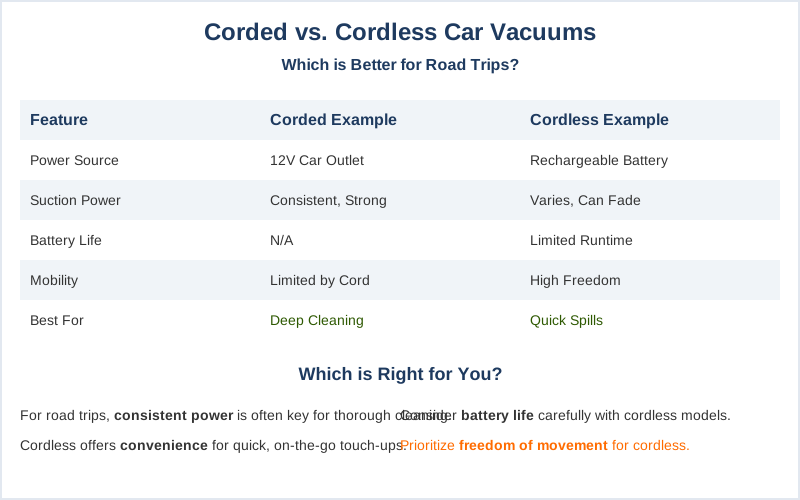
On a road trip the choice between a corded and a cordless car vacuum comes down to a single trade-off: unlimited steady power on a leash versus limited power you can take anywhere. A corded vacuum plugs into your car’s 12V accessory outlet (the old cigarette-lighter socket) and runs as long as you keep cleaning, with suction that stays constant because it draws directly from the car. A cordless vacuum carries its own battery, so it reaches every corner without a cable, but it typically runs about 15 to 30 minutes per charge and its suction tapers off as the battery drains.
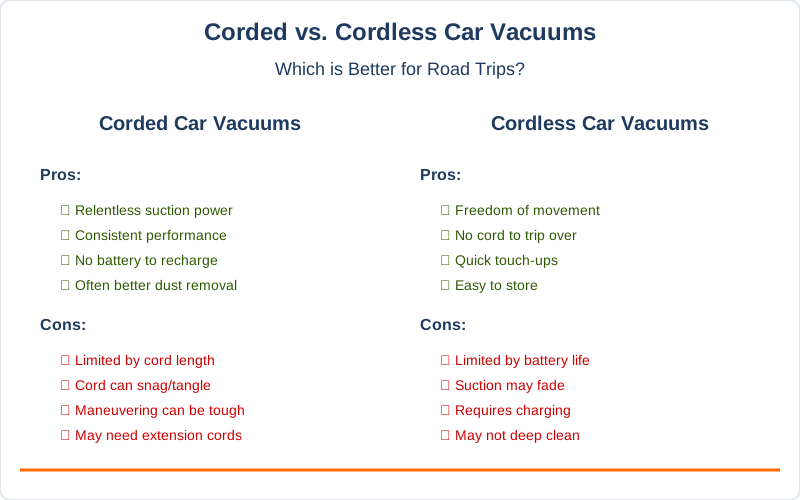
- Pick corded if you want to fully clean the whole interior in one session, value steady suction, and do not mind working within reach of the outlet.
- Pick cordless if you mostly do quick spot-cleans at rest stops, want to reach the trunk and far corners freely, and can recharge between uses.
- The deciding question is how you clean on the road: long detail sessions favor the cord; short, frequent grab-and-go cleanups favor the battery.
Both are legitimate road-trip tools, and neither is a compromise so much as a different answer to the same question. The marketing on each side tends to oversell its strength and stay quiet about its weakness: corded packaging emphasizes “unlimited power” without dwelling on the cord, and cordless packaging emphasizes “total freedom” without dwelling on the runtime. The rest of this guide cuts through that by walking through every factor that actually changes your experience on the road — power, runtime, suction consistency, reach, recharging, capacity, weight, and cost — so you match the vacuum to the way you genuinely travel rather than to the louder claim on the box.
Power and Runtime: The 12V Tether vs the Battery
Everything else flows from how each vacuum is powered, so this is the comparison that matters most. A corded car vacuum has no battery at all — it converts your vehicle’s 12V electrical supply straight into suction. As long as the plug is in a live outlet, it runs indefinitely, which is why corded models are the natural choice for a full interior clean where you want to keep going without watching a clock.
A cordless car vacuum stores its energy in a rechargeable lithium-ion pack. That pack is finite, so runtime is one of the first numbers you should check before buying. Most handheld cordless car vacuums advertise somewhere in the range of 15 to 30 minutes of continuous use, and higher-suction modes drain the battery faster than that figure suggests. For a quick crumb cleanup that is plenty; for shampooing-out a season of kid-and-dog debris across an SUV, it often means stopping to recharge partway through.
- Corded runtime: effectively unlimited — limited only by how long you keep the engine or accessory power on.
- Cordless runtime: typically 15 to 30 minutes per charge, often less on max-suction mode.
- Power source dependency: corded needs a working 12V outlet; cordless needs a charged battery and somewhere to recharge it.
One practical caveat for the corded side: running a vacuum off the 12V outlet with the engine OFF draws on the starter battery, and a long session can leave you with a car that will not start. The safe habit is to run a corded vacuum with the engine idling or at a fuel stop, which on a road trip is usually no inconvenience at all. It is also worth noting that the 12V outlet itself has a current limit — most automotive accessory sockets are fused around 10 to 15 amps — which is one reason corded car vacuums are sized for that supply and are not as powerful as a household plug-in vacuum. You are getting steady, dependable suction tuned to the car’s electrical system, not full home-vacuum power.
For the cordless side, the runtime figure on the box is a best case measured on the lowest power setting with a brand-new battery. In real road-trip use — max suction on ground-in dirt, a battery a year or two old — expect less. That is not a flaw so much as physics: a small handheld can only carry so much battery before it becomes too heavy to be the convenient grab-and-go tool that is its whole reason for existing. The honest way to read a cordless spec is to assume the real working runtime is toward the lower end of the advertised range, and to plan your cleaning in short sessions around it.

Suction Consistency: Steady Pull vs a Fading Charge
Raw suction numbers (often quoted in pascals, or Pa) matter less on a road trip than whether that suction holds through the whole job. This is a real, structural difference between the two designs rather than a matter of quality.
A corded vacuum draws constant voltage from the car, so its motor spins at full speed from the first second to the last. The five-hundredth crumb gets the same pull as the first, which is exactly what you want when you are working methodically across seats, mats, and crevices. There is no “getting weaker” phase.
A cordless vacuum behaves differently because battery voltage sags as the charge depletes. Many models feel strong for the first several minutes and then noticeably lose bite toward the end of a charge, and on a battery that has aged through hundreds of cycles that fade arrives sooner. For short bursts you will rarely notice it; for a long detailing session it can mean the last corner of the car gets a weaker clean than the first.
For road-trip cleaning, think of corded suction as a marathon runner holding a steady pace and cordless suction as a sprinter who starts fast and tires — great for short dashes, less ideal for the long haul.
There is a second, easy-to-miss factor that affects suction on both designs more than the headline number: a full bin and a clogged filter choke airflow, and airflow is what actually lifts dirt. A cordless vacuum running low on charge and carrying a half-full cup of pet hair will feel dramatically weaker than its spec sheet, while a corded vacuum with a clean filter keeps pulling steadily even as the bin fills. If you want consistent suction across a long trip, emptying the bin and rinsing the filter often matters as much as which power source you chose.
Reach and Convenience: Where the Cord Helps and Hurts
Convenience is where cordless designs earn their premium, and it is worth being honest about both sides. A cordless vacuum is a grab-and-go tool: pull it from the door pocket, clean the spilled fries, and drop it back, with nothing to plug in and no cable snaking across the cabin. It reaches the far corners of a third row, the trunk floor, and the footwells behind the seats without you hunting for the nearest outlet.
A corded vacuum trades that freedom for endurance. The cord length and the location of your 12V outlet decide how far you can reach, and on a larger vehicle you may need an extension or have to move the plug between front and rear outlets to cover the whole interior. The cable itself can get in the way, dragging across just-cleaned seats. None of this is a deal-breaker for a planned full clean, but it is friction the cordless design simply does not have.
Put plainly, cordless wins reach for the trunk, the third row, and any spot far from an outlet, and it adds genuine grab-and-go ease at rest stops. Corded wins endurance but ties your working radius to the cord and the outlet, which is a real constraint in a big SUV or van. Outlet count tips the balance further: if your vehicle has multiple 12V outlets you can reposition a corded vacuum to cover more of the cabin, whereas if it has only one socket up front, a corded vacuum’s reach gets tight in a hurry.
If knowing your outlet positions matters for either choice, it is worth checking how many 12V sockets your vehicle has and where they sit before a trip — our overview of car accessories for long road trips covers powering gear from those outlets.
It is also worth thinking about where the mess tends to be in your specific vehicle. In a sedan, almost everything is within a cord’s reach of a front outlet, so the tether barely registers and the corded design’s endurance comes free. In a three-row SUV, a minivan, or a wagon set up for camping, the worst messes are often farthest from the outlet — the cargo floor, the third-row footwells, the trunk seams — which is exactly where a cordless vacuum’s freedom pays off and where a corded one fights you. The bigger and more compartmentalized the interior, the more the convenience argument tilts toward cordless, and the smaller and simpler the cabin, the less the cord costs you.
Recharge Logistics on a Road Trip
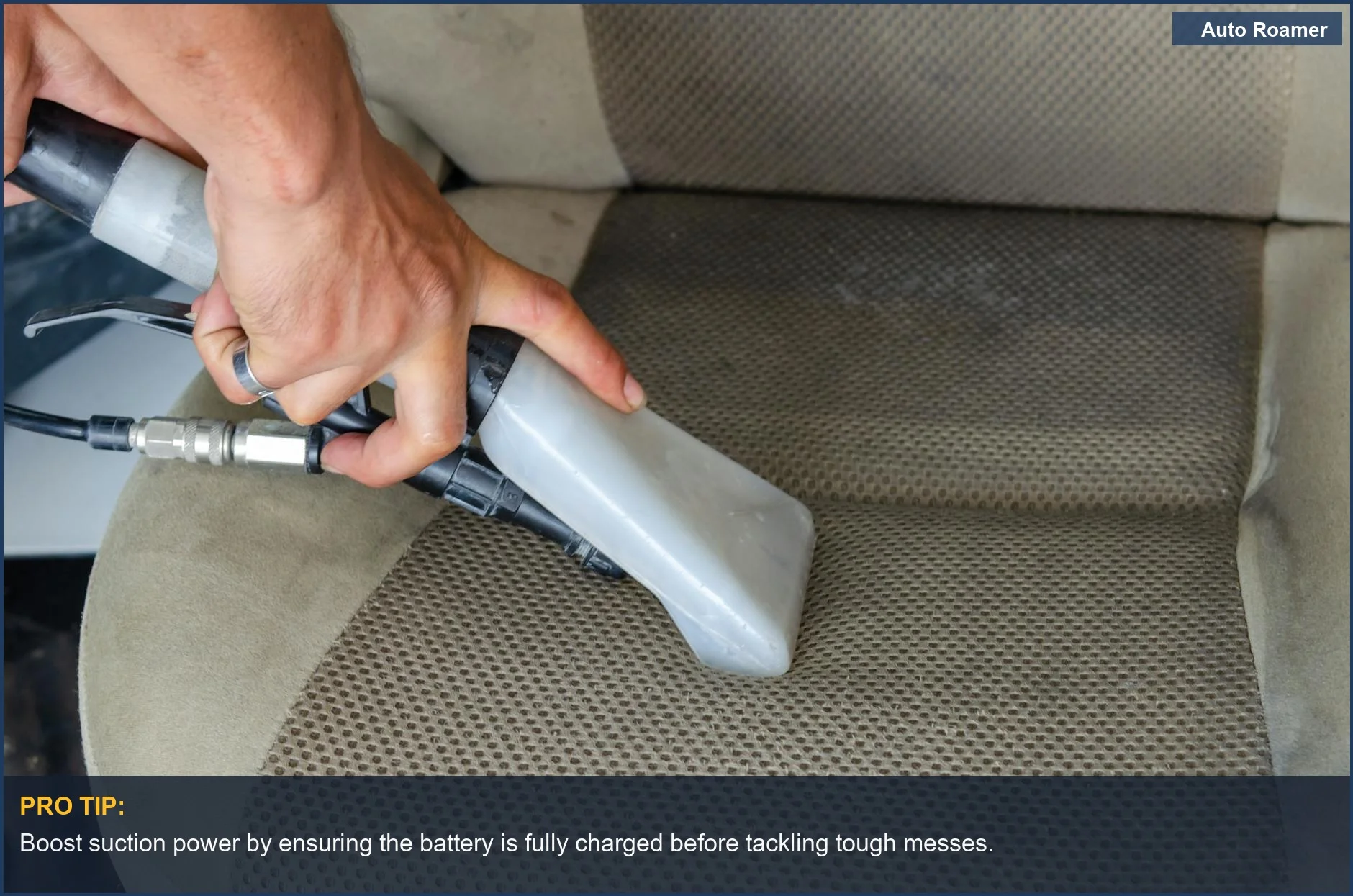
The convenience of a cordless vacuum comes with a planning cost that only shows up on a multi-day trip: you have to keep it charged. Most cordless car vacuums recharge over USB or a wall adapter, and a full charge commonly takes a few hours — far longer than the 15-to-30-minute runtime it buys you. That ratio is the heart of the road-trip problem: a single big mess can flatten the battery, and then the tool is useless until it recharges.
- Charge before you leave. Start every travel day with a full battery so the vacuum is ready for the inevitable spill.
- Top up overnight. Hotel and campsite outlets are your friend; a cordless vacuum left on the charger overnight is ready each morning.
- Carry the cable. Some cordless models can charge from a 12V or USB port while you drive, which partly closes the gap — check whether yours supports this.
A corded vacuum sidesteps this entirely. There is nothing to charge and nothing to plan around: as long as your car runs, the vacuum runs. For travelers who would rather not add another battery to the nightly charging shuffle of phones, cameras, and tire inflators and other 12V gear, the cord is one less thing to manage.
The recharge gap also compounds on a trip with more than one mess per day, which is the norm with kids or dogs. A cordless vacuum that gets flattened cleaning up a spilled drink at lunch may not be ready for the sand everyone tracks in at the beach that afternoon, because a few hours of charging cannot keep pace with a few minutes of heavy use repeated throughout the day. If your travel days involve frequent, unpredictable cleanups, the always-ready nature of a corded vacuum is a genuine advantage that has nothing to do with suction at all — it is simply available every single time you reach for it.

Capacity, Filters, and Weight
Beyond power, three practical specs shape how pleasant each vacuum is to use on a trip, and here the picture is more mixed than power and runtime suggest.
Dust capacity tends to favor neither side inherently — both corded and cordless handhelds use small bins that fill quickly with pet hair or sand, so for a messy road trip look for a model with an easy-empty, washable cup regardless of how it is powered. Filtration is similar: a quality washable HEPA-style filter keeps suction up and is reusable, and you will want to rinse it often on a sandy or dog-friendly trip. These factors track the specific model more than the corded-versus-cordless decision.
Weight does split along the divide. A cordless vacuum carries its battery, which adds heft you hold in your hand the entire time you clean; a corded vacuum keeps the power source in the car, so the handheld unit itself can be lighter. Over a long detailing session that difference is noticeable, and it nudges the corded design ahead for anyone who finds a heavy handheld tiring to maneuver around seats.
Quick read on the specs: capacity is model-dependent on both designs, so prioritize an easy-empty, washable bin for a messy trip; a washable, reusable filter is worth more than a high headline suction figure on a long trip; and corded units can be lighter in-hand because the battery stays out of the tool.
Attachments deserve a mention too, because road-trip messes hide in awkward places. A crevice tool reaches the seams where crumbs collect, a brush head lifts dust from vents and the dashboard, and an upholstery tool helps with pet hair embedded in fabric. Both corded and cordless models ship with these, so it is not a deciding factor between the two designs — but it is worth confirming the attachments clip on securely and store with the vacuum, because a tool you cannot find at a rest stop is a tool you will not use. On a long trip, a model whose attachments tuck into an onboard caddy beats one whose pieces scatter across the trunk.
Noise is the last small consideration. Both types are loud enough that you would not run one beside a sleeping passenger, and there is no consistent advantage either way; the motor and airflow design drive the noise far more than the power source. If a quiet cabin matters, save the vacuuming for fuel and food stops rather than expecting either design to be discreet on the move.
Cost and Long-Term Value
Price is rarely the headline reason to choose one design over the other, but it deserves an honest look because the two age differently. At the budget end, simple corded 12V vacuums are often the cheapest car vacuums you can buy, because there is no battery to pay for. Cordless models span a wider price range, from inexpensive low-power handhelds up to premium units with strong suction and bigger batteries.
The long-term cost story is the battery. A corded vacuum has no battery to degrade, so barring a motor failure it tends to keep performing the same for years. A cordless vacuum’s lithium-ion pack loses capacity over hundreds of charge cycles, meaning the 15-to-30-minute runtime you buy on day one shrinks over the years, and on cheaper models the battery is sealed in and cannot be replaced. If you keep gear for the long haul, that is a real consideration in favor of the cord.
A corded vacuum is the lower-risk long-term buy because there is no battery to wear out; a cordless vacuum buys you convenience now at the cost of a battery that will fade with age.
There is a value angle that runs the other way, though, and it is worth being fair about. Because a cordless vacuum is so frictionless to grab, many people actually use it more often, and a clean car maintained with frequent small passes can be worth the premium and the eventual battery replacement. A corded vacuum that lives in the trunk and only comes out for the occasional big clean may technically last longer but see far less use. Real value is not just durability — it is the tool you will actually reach for, which is why the corded-versus-cordless decision keeps coming back to how you clean rather than to the spec sheet alone.
Which One Should You Pack? Matching the Vacuum to the Trip
There is no single winner, only the right tool for how you travel. The cleanest way to decide is to picture your typical road-trip cleaning and match it to the design’s strengths, rather than chasing the biggest suction number on the box.
- Choose corded if you do occasional but thorough full-interior cleans, drive a vehicle where you can reach most of the cabin from an outlet, want steady suction that never fades, and prefer a tool with no battery to charge or replace.
- Choose cordless if you clean little and often — a rest-stop crumb sweep, a quick pass after the dog gets in — need to reach the trunk and far corners freely, and can keep it charged each night.
- Consider owning both, if your trips are long and messy: a cordless for fast daily touch-ups and a corded for the deep clean before you head home.
To make the call concrete, picture three common travelers. The weekend road tripper in a sedan who vacuums once before heading home is best served by a cheap, reliable corded model — unlimited runtime, steady suction, no battery to baby. The family on a week-long drive with kids who spill something daily leans cordless for the instant rest-stop cleanups, ideally charged each night, and may keep a corded unit in reserve for the end-of-trip deep clean. The car camper or overlander living out of an SUV wants the cordless reach for the cargo area and far corners but should respect the runtime and recharge from the vehicle’s 12V system during drives so the battery is never the bottleneck.
Whichever way you lean, your money is better spent on a model with a washable filter and an easy-empty bin than on a few extra pascals of headline suction. If you want specific picks, see our roundup of the best portable car vacuum cleaners for both corded and cordless options, our best cordless car vacuums if you have settled on going wireless, and our companion comparison of corded vs cordless for pet hair if shedding is your main battle. A capable car vacuum belongs alongside the rest of your road-trip kit for keeping the cabin livable on a long drive.