
The quick answer: airline ceiling first, child second
Buy the biggest bag your child can steer on their own, and never buy one larger than 22 x 14 x 9 inches — the carry-on limit that clears Delta, United, American, Alaska, and JetBlue. That single number is the ceiling. Everything else is about sizing down from it to match a specific kid's height, strength, and patience.
Here is the shortcut most families can run in their head:
- Toddlers (ages 2 to 4): 12 to 16 inch luggage
- Early school age (5 to 7): 16 to 18 inch luggage
- School age and tween (8 and older): an 18 to 22 inch bag they can usually manage on their own
- Teens (13 and up): a full 21-inch carry-on case, self-handled
The rest of this guide explains why those bands work, how the airline rules actually read, and where a bag that is technically legal still fails the sidewalk test at the airport.
One honesty note up front: the dimensions here come from published airline baggage policies and manufacturer spec sheets, not from a lab or from us personally weighing suitcases. Where airlines differ, we name the common standard rather than averaging them into a number nobody actually enforces.
Kids luggage size by age, at a glance
Age is a better predictor than trip length, because a five-year-old cannot magically pull a bigger bag just because you are gone for a week. Start with the child, then decide whether that size holds enough. Here is the working table, drawn from general kids' luggage sizing guidance:
| Age band | Suitcase length | Rough capacity | What it holds |
|---|---|---|---|
| Toddler (2–4) | 12–16 in | ~10–20 L | A day or two of clothes plus a lovey and snacks |
| Early school age (5–7) | 16–18 in | ~20–30 L | A long weekend, with room for toys |
| School age / tween (8–12) | 18–22 in | ~30–45 L | A full week if they pack smart |
| Teen (13+) | ~21 in | Carry-on class | A week or more, self-managed |
Notice the top of the tween band, 22 inches, is exactly the airline carry-on ceiling. That is deliberate: an 8-to-12-year-old is the first age where a child can own a full-size carry-on and still wheel it themselves. Below that age, sizing down is not a compromise — it is the whole point. A bag a toddler cannot budge is the parent's bag, and now you are pulling two.
The capacity column matters as much as the length. A 12-inch toddler case holding around 10 liters sounds tiny until you realize a toddler's clothes are tiny too — three days of outfits for a two-year-old take up less room than a single adult sweater. By the tween band, 30 to 45 liters is genuine week-long capacity, which is why the 8-to-12 range is where kids stop needing a parent to carry the overflow. If a size looks borderline, size to the child's strength and let the adult's bag absorb the extra, rather than jumping the child up a band they cannot physically manage.
If you are shopping for a much younger traveler, the math shifts again toward soft, wearable gear rather than wheeled cases. Our baby luggage size guide and roundup of the best travel bags for babies cover that end of the spectrum.
Carry-on vs. personal item: what those rules really mean
Every major U.S. airline lets each passenger — including your child, who has their own ticket — bring one carry-on plus one personal item at no extra cost on most carriers. That is two bags per kid, and understanding the split changes what you buy.
- Carry-on: rides in the overhead bin, maxing out at 22 x 14 x 9 inches on most airlines (Southwest and Frontier are the generous exceptions at up to 24 x 16 x 10 inches).
- Personal item: slides under the seat in front of your child, commonly capped around 18 x 14 x 8 inches — though several airlines skip the exact numbers and simply require that it fit under the seat.
For most families flying with kids, the smarter setup is a right-sized carry-on for clothes plus a personal item — a small backpack — that the child wears and controls. The backpack holds the in-flight survival kit (tablet, headphones, snacks, one toy) so the moment you board, the rolling bag goes up and the child still has everything they reach for. It also means the wheeled case can be a touch smaller, because the entertainment load lives on their back, not in the suitcase.
There is a strategic reason to keep the child's rolling bag comfortably under the 22 x 14 x 9 inch line rather than right at it. When overhead bins fill up — and on a full flight they will — gate agents start tagging the largest carry-ons to be checked at the door. A bag that is visibly a kid's bag, in the 16-to-18 inch range, almost never gets pulled, so your child keeps their belongings in the cabin. Buying to the exact ceiling is the move most likely to backfire on a busy travel day.
One more rule reading that trips families up: the personal item is measured too. If you load a "small" backpack until it bulges past roughly 18 x 14 x 8 inches, it stops being a free personal item in the eyes of a strict gate agent. Keep the child's under-seat bag genuinely small and let the rolling case carry the bulk.
Ride-on, pull-behind, or backpack: pick by age
Size is only half the decision. The format has to match what a child's body can do, and that changes fast between ages 2 and 12.
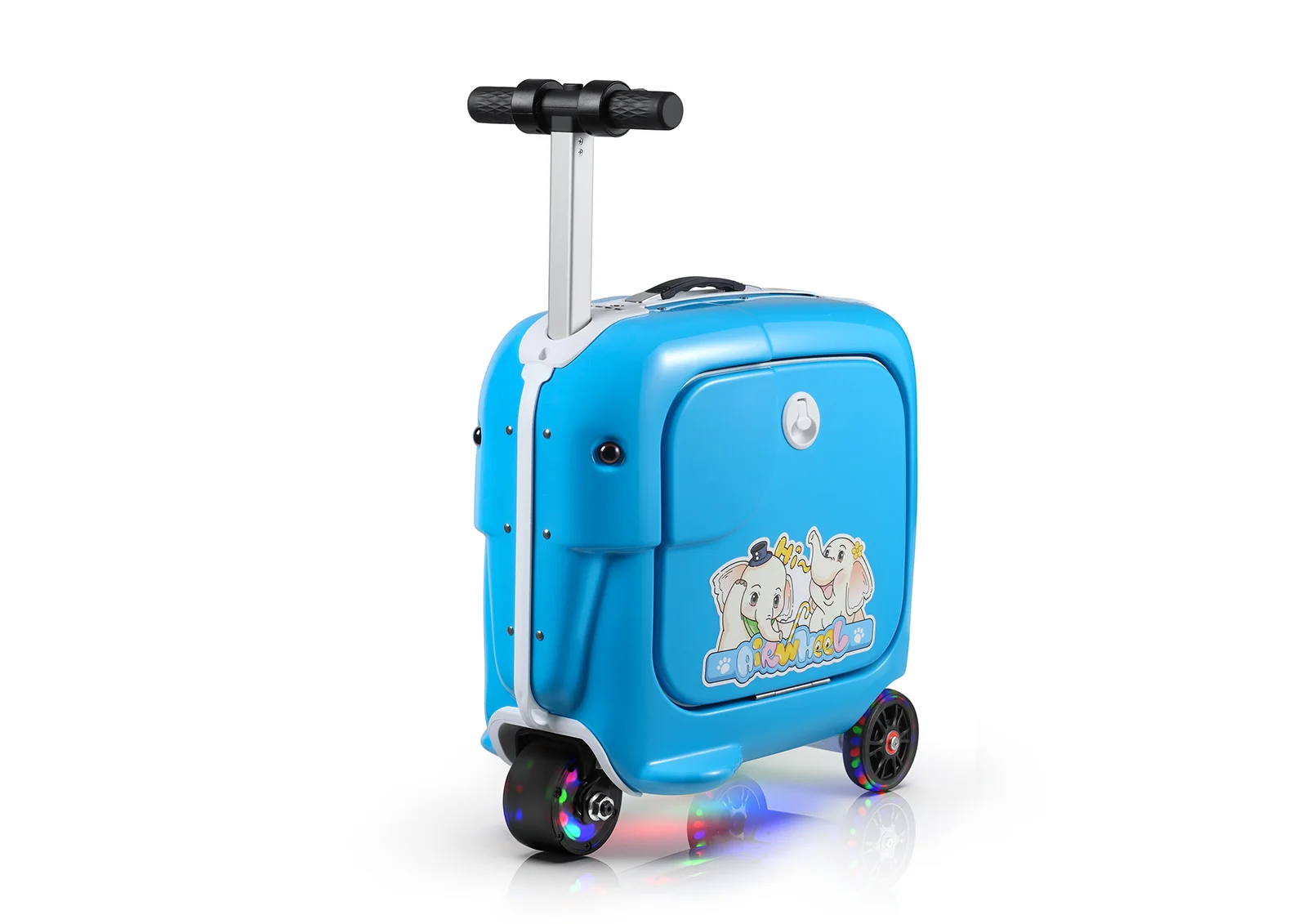
Ride-on suitcases (ages 2–5). For the youngest travelers, a bag they can scoot on or be towed on turns the longest part of the airport — the walk to the gate — from a tantrum into a game. These cases sit in the 12 to 16 inch range and double as a booster or a place to perch during boarding. A well-known example in this class, the Stokke JetKids BedBox, measures about 18 x 8 x 14 inches and is rated for a child up to 77 pounds. The tradeoff is weight: a ride-on is a small piece of furniture, so it carries less clothing than its footprint suggests.
Straight-wheel pull-behinds (ages 5–9). Once a child can reliably walk the airport, a two-wheel roller they tilt and pull is easier for small hands than a four-wheel spinner. Counterintuitively, 360-degree spinner wheels are harder for kids who are still building coordination, because the bag wanders sideways and tips. Straight-line rollers stay behind them where they belong.
Spinners and full carry-ons (ages 9–12+). By the tween years a child has the strength and balance for a four-wheel spinner and can manage a bag up to the 18 to 22 inch carry-on range. This is also when a backpack-plus-roller combo starts to mirror how an adult packs.
Backpack-only (any age, short trips). For a one- or two-night visit, skip wheels entirely. A backpack sized to the child — roughly 5 to 8 liters at ages 2 to 4, 12 to 18 liters at 6 to 8, and 18 to 24 liters by ages 8 to 11 — is lighter, cannot be left behind at a gate, and keeps both hands free on stairs and escalators.
Format by age, in one glance:
- Ages 2 to 5: ride-on cases in the 12 to 16 inch range they scoot or get towed on.
- Ages 5 to 9: straight two-wheel pull-behinds that track behind them instead of wandering sideways.
- Ages 9 to 12 and up: four-wheel spinners and full 18 to 22 inch carry-ons.
- Any age, short trips: a right-sized backpack — 5 to 8 liters at ages 2 to 4, up to 24 liters by ages 8 to 11.
How much weight a child can actually manage
This is the number that gets ignored, and it is the one that ruins airports. A bag can be the perfect size and still be too heavy the second it is full.
The American Academy of Pediatrics offers the clearest ceiling anyone has put a number on:
A loaded backpack should weigh no more than 10 to 15 percent of a child's body weight, with 10 percent being the safer target.
That is a spine-health rule for carrying on the back, but it is a useful ceiling for any bag a child lifts — into an overhead bin, up stairs, or over a curb. For an 80-pound child, 10 to 15 percent works out to no more than 8 to 12 pounds of packed weight.
Now factor in the trap: some children's suitcases weigh as much as 5 pounds while completely empty. Buy one of those for that same 80-pound child and more than half their entire weight budget is gone before a single sock goes in. Wheels change the equation for rolling on flat ground — a child can tow more than they can carry — but every airport has stairs, jet bridges, and the moment the bag has to come up into the bin. Weigh the empty bag before you fall in love with it.
The practical move is to check the empty weight on the spec sheet, then pack to the child's lift limit rather than the bag's volume. A half-full right-sized case beats a stuffed one every time. Our minimalist packing strategies are built for exactly this problem.
Hardside cases complicate this further. A rigid polycarbonate shell protects contents and looks great, but it usually weighs more empty than a soft-sided bag of the same length, and it cannot compress to hide a slightly over-packed load. For a young child chasing that 10-percent weight budget, a lighter softside upright often wins on the only metric that matters at the gate: how much of the total weight is clothes versus bag. Save the hardside spinner for the tween years, when a few extra pounds of shell no longer decides whether the child can lift it into the bin.
A useful field test before any trip: pack the bag the way you actually will, then hand it to the child at the bottom of a staircase and ask them to carry it up. If they can do it without a struggle, the size and weight are right. If they cannot, the bag is too heavy no matter how legal its dimensions are — take something out or move it to the adult's checked bag.
Two bags that fit the sizing math
Rather than a giant roundup, here are two cases that sit cleanly inside the age bands above — one for the ride-on years, one for the school-age carry-on years. Both are chosen on published specs, not personal testing.
For toddlers and preschoolers (ages 2–7): the Stokke JetKids BedBox is a ride-on that measures about 18 x 8 x 14 inches, holds roughly 23 liters, and is rated for a child up to 77 pounds. It lands right in the toddler size band and earns its keep on long connections because it doubles as something the child rides. The catch is the honest one for any ride-on: it weighs about 7 pounds empty, so treat it as a scooter with storage, not a maximum-capacity bag.
For school-age kids (roughly ages 6–11): the American Tourister Disney 18-inch Upright sits at the low end of the 16-to-18 inch band with packing dimensions of 18 x 12 x 7 inches and a listed empty weight of about 3.86 pounds. That lighter empty weight leaves more of a child's carry budget for actual clothes, and the 18-inch length is well under the 22-inch airline ceiling, so it never triggers a gate-check conversation.
The contrast between these two is the whole lesson in one line: the ride-on wins on the airport walk but spends about 7 pounds of its budget on itself, while the softside roller spends only about 3.86 pounds empty and hands the rest back to clothes. Pick the ride-on for the tantrum-prone toddler years, and the lighter upright the moment the walk stops being the problem and the packing list starts to be.
Checked-bag sizing for longer trips
Sometimes a week away or a full winter wardrobe simply will not fit a kid-sized carry-on, and that is fine — you just move up a class. The standard checked-bag limit on most U.S. airlines is 62 linear inches, which means the sum of length plus width plus depth, and the most common weight cap is 50 pounds per bag. Go over either and you are into oversize and overweight fees.
Here is the family-friendly trick: your child almost never needs their own checked bag. A single adult checked bag at 62 linear inches has enough room to absorb a kid's folded clothes, freeing the child to travel with only a light carry-on and a backpack they can fully manage themselves. One heavy bag the adult handles beats two medium bags where the child's is still too much for them. Reserve the child's own wheeled bag for the cabin, where the weight limit is really just what they can lift.
If you do check a bag with kids' clothes inside, remember the 50-pound line is per bag, not per person — it is easy to blow past it when one suitcase holds a whole family's worth of a cold-weather trip.
A five-minute pre-trip sizing check
Before you buy a bag — or before you pack the one you own — run this quick sequence. It catches almost every kids'-luggage mistake in about five minutes, using nothing but a tape measure and a bathroom scale.
- Measure the empty bag. Confirm it is at or under 22 x 14 x 9 inches for a carry-on, or under the roomier 24 x 16 x 10 inches if you are flying Southwest or Frontier. Note the empty weight from the scale — a case that already reads 5 pounds empty is a red flag for a small child.
- Match the length to the age. 12 to 16 inches for ages 2 to 4, 16 to 18 inches for ages 5 to 7, and 18 to 22 inches for ages 8 and older. When the child falls between two bands, size down.
- Set the weight budget. Multiply the child's body weight by 10 percent for the safe target, 15 percent for the absolute ceiling. An 80-pound child gets 8 to 12 pounds total, bag included.
- Pack it for real, then do the stair test. Load the bag the way the trip actually demands, then have the child carry it up a flight of stairs. If they struggle, remove items or shift them to the adult's bag.
- Add the personal item. A small backpack, kept under roughly 18 x 14 x 8 inches, carries the tablet, headphones, and snacks so the rolling case can stay closed until you land.
If the bag clears all five steps, it is the right size for that child. Legal dimensions alone were never the finish line — a bag the child can actually carry is.
Road trip vs. flight: the rules change
Every dimension above exists because an airline enforces it. Take the airline away and the entire calculation loosens — which is why a road trip is a different sizing problem than a flight.
In a car, the 22 x 14 x 9 inch carry-on ceiling is meaningless. Your only real limits are trunk space and the reach test: can your child carry their own bag from the car into a motel at 9 p.m. without you making two trips? For driving trips, soft-sided duffels and backpacks often beat hard rollers because they squish to fit around a cooler and a stroller, and there is no bin to lift them into. The pediatric weight rule still applies the moment the bag leaves the trunk, so keep the reach test honest.
The flip side: a road trip tempts you to over-pack precisely because the airline is not there to stop you. Discipline still pays off, because every extra bag is one more thing to haul into each stop. Our road trip essentials for kids guide leans into the car-specific version of this, where accessibility on the seat matters more than overhead-bin dimensions.
Common kids-luggage sizing mistakes
Most bad kid-luggage buys come from sizing to the wrong thing. Watch for these five:
- Buying for the trip, not the child. A week-long trip does not give a six-year-old the strength for a 22-inch bag. Size to the kid and check a bag if you must, rather than handing a child luggage they cannot move.
- Ignoring the empty weight. A 5-pound empty case erases half the packing budget of an 80-pound child before you start. The spec that matters most is often the one nobody reads.
- Choosing spinner wheels for a young child. Four-wheel spinners wander and tip under small hands. Straight two-wheel rollers track better for kids still building coordination.
- Buying a size up "to grow into." Luggage is cheap relative to a child hating travel because their bag is a boat anchor. Right-size it now; the age bands move up every couple of years anyway.
- Forgetting the personal item. The under-seat bag — commonly up to 18 x 14 x 8 inches — is free and does the heavy lifting for in-flight sanity. Skipping it means cramming a tablet and snacks into the rolling case and re-opening it at every gate.