What a 12V fridge actually buys you over a cooler
A 12V compressor fridge is not a fancier cooler. It is a small refrigerator that happens to run on your car's battery, holding a set temperature for days without ice, drain plugs, or the gray-water swamp a melted bag of ice leaves behind. That is the whole pitch, and for car camping it is a good one. If you are weighing the jump against a good ice chest, our 12V car cooler comparison covers the cheaper end of the same shelf.
The catch is that every model below does the same core job, so the buying decision is not “which one is good” — they are all competent compressor boxes. It is which set of trade-offs (capacity, weight, single vs dual zone, who made the compressor, price) fits how you actually travel.
Two honesty notes before the picks, because this guide has had to earn them.
First, every ranking below is spec-compared from each product's own listing data — the maker's own capacity, weight, temperature and power fields, and the listing's own bullets. It is not a bench test, and where that distinction matters (long-term reliability, real-world noise) the page says so plainly.
Second, on 10 August 2026 every product on this page was re-checked by loading its Amazon product page directly. The Dometic CFX3 35 that used to lead this guide is no longer on it. The listing it used to sit on now redirects into a Dometic CFX family page whose selected variant reads CFX3-100L, model name “CFX3 100”, 100 litres and 65.3 lb — a different, much bigger cooler at a different price. The only other CFX sizes that page offers are CFX5 models.
We could not find any Amazon listing that verifiably serves the CFX3 35, so rather than point you at a box that is not the box we described, we removed it. Four fridges remain, and each one was confirmed to be the product this page says it is on the day of writing.
Why read a guide at all: the cheapest box below costs roughly a quarter of what the dearest one does, for units that look almost identical on a spec sheet. That spread tracks compressor pedigree, insulation and cabinet build — the parts you cannot see in a product photo, and the ones that decide whether the fridge survives five summers or one.
The six specs that decide everything
Before the picks, here is what each row in the spec table means in practice. Get these six right and the model almost chooses itself.
- Capacity. Roughly one litre per can — most of these makers publish the can count, and it is the most useful number on the box. A 45L fridge suits two people over a long weekend; 50L+ if you are feeding a family or want a separate freezer. Our guide to choosing the right size 12V refrigerator works through it properly.
- Power draw. Across a full day and night this is the single number deciding how big a battery you need. All four makers publish something here — but each publishes a different kind of number, which is why this page gives power its own table below rather than a column in the spec grid.
- Compressor. Exactly one of the four fridges here names the compressor on its listing: the SECOP unit in the ICECO. The other three do not, which is itself information — a maker proud of the compressor tends to print its name.
- Single vs dual zone. Dual lets you run fridge on one side and freezer on the other. Useful, but it costs capacity, power and money — only worth it if you genuinely need frozen food on the trip. Only the BougeRV offers it here, via a removable divider.
- Weight. A full 50L fridge is awkward to lift alone, and the spread here is real: 32 lb to 53 lb empty. If you load and unload solo, weight is a daily-use spec, not an afterthought.
- Battery protection. A low-voltage cutoff that stops the fridge before it kills your starter battery. Two of the four publish selectable levels; the other two say less than that, and the paragraph after this list says exactly who says what. It is non-negotiable if you run off the vehicle — see how to keep a 12V fridge from draining your car battery.
What each maker actually publishes about power
This is the question that decides your battery, and it is the one most round-ups skip. All four listings state something — but no two state the same kind of measurement, so here is each one exactly as its own listing puts it, with the conditions the maker attaches to it.
| Model | What the listing publishes | Conditions the listing states |
|---|---|---|
| ARB Fridge Freezer Series II 50 Quart | Current draw 0.85 amps/hour average | Cabinet at 37.4°F, ambient 78.8–87.8°F, 66-hour test, 12 V DC supply |
| ICECO VL45 | Annual energy consumption 127 kWh per year | None stated — it is the listing's standard annual-consumption field |
| Alpicool CF55 | Annual energy consumption 174 kWh per year | None stated — same standard field |
| BougeRV Rocky V3.0 55QT | Up to 17 hours of runtime from the optional 240 Wh battery | “Under certain conditions” — the listing does not say which |
Computed: the four published figures, put into one unit. Nothing here is a new measurement — it is the four numbers in the table above converted to average watts so they can sit side by side. Watts = amps × 12 V, or = kWh per year × 1000 ÷ 8,760 hours, or = watt-hours ÷ hours of runtime
| Model | Published figure | Average watts | Rough amps at 12 V |
|---|---|---|---|
| ARB Series II 50 Quart | 0.85 A average | 10.2 W | 0.85 A |
| ICECO VL45 | 127 kWh/yr | 14.5 W | 1.21 A |
| BougeRV Rocky V3.0 55QT | 240 Wh over 17 h | 14.1 W | 1.18 A |
| Alpicool CF55 | 174 kWh/yr | 19.9 W | 1.66 A |
Read it as a band, not a ranking. These are four different measurements: ARB's is a 66-hour bench run at a stated ambient, the two annual figures come from a standard consumption field whose test conditions and supply (AC or DC) the listing never states, and BougeRV's is a battery-life claim under conditions it declines to name. So the column tells you the class draws somewhere around 10–20 W once cold — call it 20 to 40 amp-hours over a full day at 12 V — and it does not tell you the Alpicool draws twice the ARB. Size the battery on the top of that band, in the heat you actually park in.
Three of these trip up the most buyers, so they get a closer look.
On power draw, what drains your battery is the cycling draw once the box is cold, and that depends as much on ambient heat and lid-opening as on the model. ARB is the only one of the four that says what ambient its figure was measured at, and it is a mild 78.8–87.8°F. A fridge that sips at that ambient can pull far more parked in desert sun — plan for the worst case, not the bench.
On battery protection, the four listings are not equally forthcoming. ICECO publishes three selectable “gears”; Alpicool publishes three levels named Low, Med and High. ARB states an “integrated battery protection system” and does not say how many levels it has. BougeRV's listing does not mention battery protection at all — which is not evidence the fridge lacks one, but it is not a claim we will make for them. If the cutoff matters to your setup, ask the seller first.
On compressor pedigree, the practical split is a name-brand unit versus an unnamed one. Secop (formerly Danfoss) has a long parts-and-service track record, and ICECO backs its Secop with a five-year compressor warranty printed on the listing. The unnamed compressors in the other three are not necessarily bad — they are just harder to get serviced three years in, and nobody warranties them for five. That is the biggest reason the cheapest box here is not automatically the smartest buy.
Spec table: all four models, side by side
| Model | Capacity (as listed) | Zones | Compressor | Temperature range | Weight | Listed price |
|---|---|---|---|---|---|---|
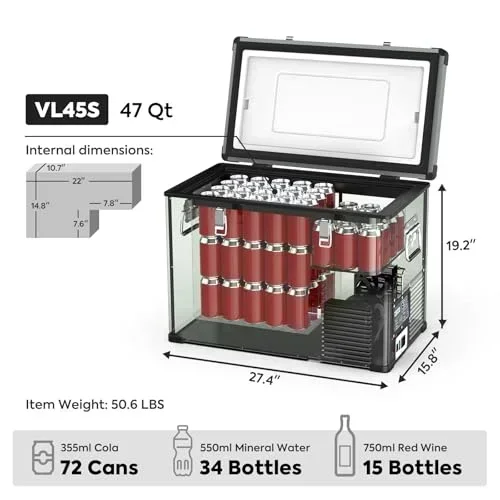
| ICECO VL45 | 45 L | Single | SECOP | 0°F to 50°F | 49.2 lb | $559.00 |
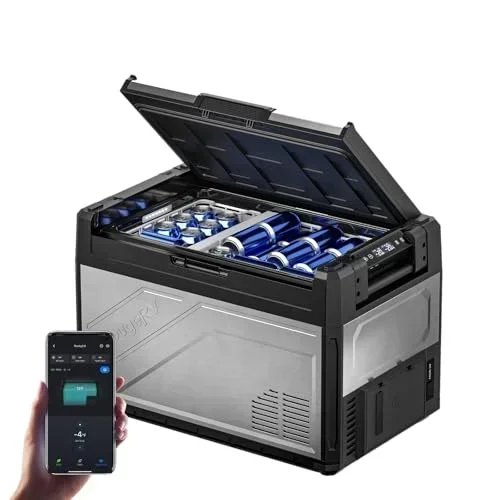
| BougeRV Rocky V3.0 55QT | 55 qt (76 × 355 ml cans) | Single or dual, via the removable divider | Not named on the listing | −4°F to 68°F | 44.3 lb | $499.99 |
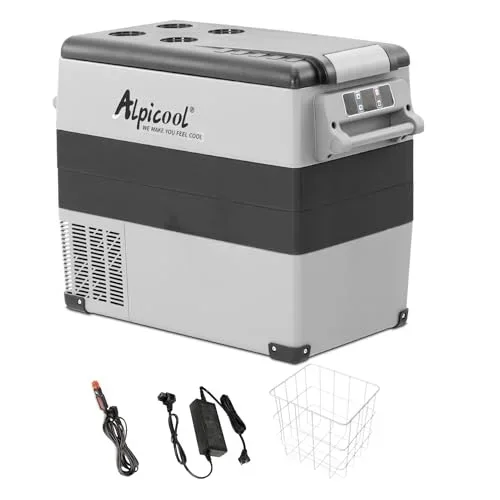
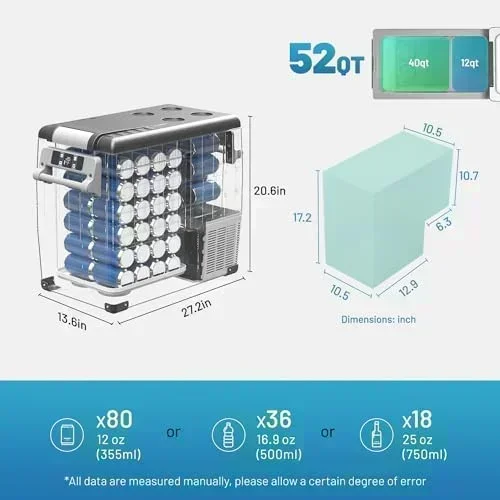
| Alpicool CF55 | 52 qt / 49.4 L (80 × 12 oz cans) | Single | Not named on the listing | −4°F to 68°F | 32.4 lb | $254.98 |
| ARB Fridge Freezer Series II 50 Quart | 50 qt (72 × 12 oz cans) | Single, plus a separate dairy/fruit compartment | Not named on the listing | 0°F to 50°F | 53.0 lb | $1,062.00 |
How to read this: every figure above was read off the product's own Amazon listing on 10 August 2026, and where the listing contradicts itself we print the more conservative number and say so. Alpicool is the live example: its typed capacity field reads 55 litres while its own product title and bullets read 52 quarts (49.4 litres), so 49.4 is what this table prints. Where a maker does not publish the compressor brand we print “not named on the listing” rather than guess. Power is not a column here because the four makers publish four different kinds of power figure; they get their own table above.
Prices move constantly. In the twelve days before this table was written the ICECO's listing rose by about a sixth and the Alpicool's fell by about a fifth — so treat the last column as a band rather than a quote, and let the link on each card show you the live number.
Computed: what a litre of cold storage costs on each box. Nothing here is a new fact — it is the listed price and the listed capacity from the table above, divided. Where a maker publishes quarts rather than litres we convert at the standard 1 US quart = 0.9464 litres and show the converted figure, so the column compares like with like. Cost per litre = listed price ÷ listed capacity in litres
| Model | Listed price | Capacity in litres | Cost per litre |
|---|---|---|---|
| Alpicool CF55 | $254.98 | 49.4 L (listed) | $5.16 |
| BougeRV Rocky V3.0 55QT | $499.99 | 52.0 L (55 qt converted) | $9.62 |
| ICECO VL45 | $559.00 | 45 L (listed) | $12.42 |
| ARB Fridge Freezer Series II 50 Quart | $1,062.00 | 47.3 L (50 qt converted) | $22.45 |
Read the last column before you read the price. The ARB costs more than four times per litre what the Alpicool does, and the ICECO sits mid-pack. That is the premium you are paying for build, brand and — on the ICECO — a named compressor: it buys you nothing extra in space. If cold litres per dollar is what you want, this column names the winner outright; if survivability is what you want, it tells you what that costs.
The picks, by who you are
Four fridges, four different buyers. None is wrong; they are aimed at different trips and budgets.
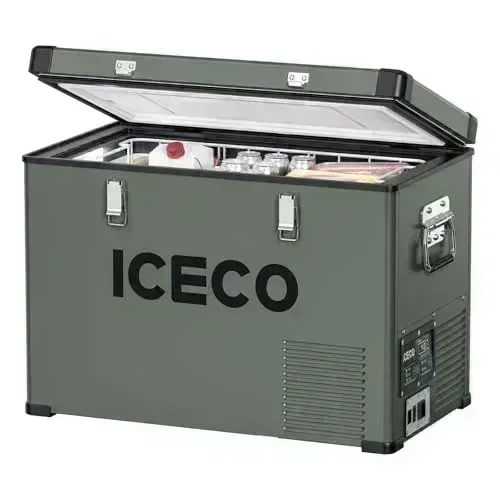
Best overall — ICECO VL45. This is the one we would buy with our own money, and the reason is the part you cannot photograph: a genuine SECOP compressor with a five-year compressor warranty behind it, wrapped in a metal shell with a thickened inner wall. 45 litres is the honest sweet spot for two people over a long weekend, the cabinet height is deliberately sized to clear a pickup tonneau cover, and the three-level battery cutoff and MAX/MIN cooling modes are on the box rather than behind an app.
The trade is weight: 49.2 lb for 45 litres is heavy for the class, and only the ARB carries worse per litre. Buy it if you want the fridge to outlast the vehicle.
Most fridge per dollar — BougeRV Rocky V3.0 55QT. The honest counter-argument to the pick above, and worth taking seriously: for less money than the ICECO you get more box (55 quarts, 76 cans), less weight (44.3 lb), a metal exterior, app control, and a divider that turns it into a fridge and a freezer at the same time. It also docks to BougeRV's optional 240Wh LiFePO4 battery on pogo pins, which is the cleanest answer here to “what runs it when the engine is off.”
What you do not get is a named compressor, or a five-year warranty on it. If you plan to replace the fridge before it wears out, this is the rational buy. If you are cross-shopping the value brands, our BougeRV vs Alpicool comparison goes deeper.
Best budget entry — Alpicool CF55. The cheapest way into a real compressor fridge, and at 32.4 lb the lightest box in this guide by a clear margin — the most litres per pound of anything here, which matters every single time you lift it into the tailgate alone. 52 quarts, temperature memory, three battery-protection levels, an LCD panel and an internal basket. Alpicool does not name the compressor, and the budget shows in the seals and insulation — which means it works that unnamed compressor harder in heat. For weekend trips in temperate weather, that is a trade plenty of people should take.
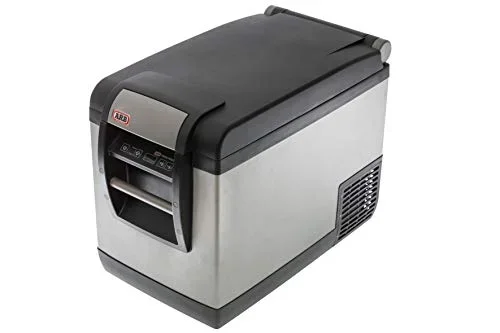
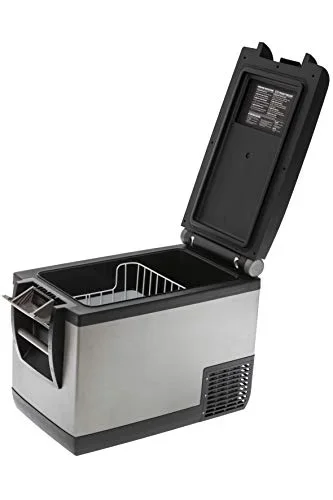
Best for hard overlanding — ARB Fridge Freezer Series II 50 Quart. Heaviest (53 lb) and priciest here by a wide margin, and ARB does not publish the compressor brand either — but you get 50 quarts (72 cans), a separate dairy-and-fruit compartment, a backlit dimmable control panel, an internal light on a magnetic switch and a Bluetooth app that pings you when someone leaves the lid open. External dimensions are 27.8 x 15 x 20 in, which is the number that matters when you are planning a drawer system around it. Buy it if your trips end where the pavement does and the fridge lives in a build, not a boot.
Head to head: ICECO VL45 vs BougeRV Rocky V3.0
These two are the sharpest fork on the page, because they land within sixty dollars of each other and answer the same question in opposite ways. If you can settle this one you can stop reading.
The BougeRV is the better box; the ICECO is the better bet. One gives you more litres, less weight and a second temperature zone for less money; the other puts a named Secop compressor and a five-year warranty on it in your truck.
The measurable gaps, straight off the two listings: the BougeRV is 55 quarts (52.0 L converted) and 44.3 lb; the ICECO is 45 litres and 49.2 lb. So the BougeRV gives you about a sixth more space and saves you five pounds — a real consideration if you lift it in and out alone. On power the two publish figures that land within half a watt of each other, so there is nothing to choose there.
The BougeRV also goes colder on paper (−4°F versus 0°F) and splits into two zones, which the ICECO cannot do at all. The BougeRV adds app control out to about 32 ft and a clip-on 240Wh battery sold separately; the ICECO's controls are on the box and its power comes from your vehicle.
The catch nobody mentions in the spec sheets: what you are really buying at the ICECO price is the compressor — the one component here whose maker is named, and the one that ends the fridge's life when it fails. What you are buying at the BougeRV price is capability now: more space, dual zone, a battery option, an app. Neither is a bad answer. If the fridge lives in a vehicle you will replace before the fridge wears out, take the capability. If it is going to get handed down, take the warranty. Our Alpicool vs ICECO breakdown runs the same logic one tier down.
What goes wrong (and how to avoid it)
Most 12V-fridge regret is not the fridge. It is the install. The four recurring failures, from the owner forums and reviews we read:
- The cigarette socket. Factory 12V sockets and their thin wiring cause voltage drop and nuisance shutdowns. Hardwire to the battery with appropriately gauged wire and an inline fuse.
- Killing the starter battery. Running the fridge off the vehicle without setting the low-voltage cutoff (or adding a second battery) leaves you stranded. ICECO, Alpicool and ARB all publish battery protection on their listings — find the setting and use it. BougeRV's listing does not mention one, so ask before you rely on it.
- No airflow. The compressor and condenser need clearance. Box it into a tight cubby and it runs hot, draws more, and cools worse.
- Loading it warm. A fridge cools slowly. Pre-chill the box and pre-chill the food at home; do not expect it to pull warm groceries down on the highway.
None of these are defects in the fridges themselves, which is exactly why they catch people out. Budget your install time and a bit of wiring the same way you budget the fridge, and most of the horror stories simply do not happen to you.
How to choose in one minute
Skip the agonising. Answer one question about your trips and the choice falls out:
Weekend car camping for two on a tight budget, and you carry it yourself? The Alpicool CF55 is enough, and it is the lightest box here. Want the fridge to outlive the truck, with a named compressor and a five-year warranty behind it? The ICECO VL45. Need a real freezer alongside the fridge, or simply the most space per dollar? The BougeRV Rocky V3.0 55QT. Going genuinely off-road with a drawer system to plan around? Pay up for the ARB Fridge Freezer Series II 50 Quart.
The verdict
The ICECO VL45 is the pick for most people: the only fridge here whose maker names the compressor, the only one with a five-year warranty on it, and a 45-litre metal-shelled box sized to slide under a tonneau cover for a little over five hundred dollars. It is neither the cheapest nor the biggest — it is the one with the fewest ways to disappoint you in year four.
If your trips push past that — serious off-road, a real need for frozen food, a rock-bottom budget, or simply a preference for more box over more warranty — one of the other three is genuinely the better buy, and the spec table above shows exactly why.
The basis for all of it is published listing data rather than a bench, and this page is not going to pretend otherwise. What it does stand behind is the check dated 10 August 2026: all four product pages were opened directly, and every one of them was live and was the product it is described as here. A fifth pick that failed that test was removed rather than quietly re-pointed at something else — which is the standard this page is held to.