Car Accessories

Understanding Air Compressor CFM: What You Need to Know for Tire Inflation

Casey - The Weekend Warrior
5 min read
Includes Video

CFM, or cubic feet per minute, is the measure of how much air an air compressor can push out. Think of it like the width of a hose - a wider hose lets more water through at once. When you're trying to air up tires after a trail run, CFM is way more important than just how much pressure it can crank out.

CFM, or cubic feet per minute, is the measure of how much air an air compressor can push out. Think of it like the width of a hose - a wider hose lets more water through at once. When you're trying to air up tires after a trail run, CFM is way more important than just how much pressure it can crank out.

I learned this the hard way trying to inflate my 35-inch tires after a muddy day at Rausch Creek. It took me 45 minutes per tire with a cheap 12v compressor that barely hit 2 CFM. Air Compressor CFMs simplified is a good place to start understanding this, but honestly, just knowing it's about volume is key. PSI is the pressure, CFM is the flow. You need both, but for speed, CFM wins the race.

Nobody wants to sit at the trailhead for an hour airing up.

The Core Answer

CFM is basically the volume of air your compressor can deliver every minute. It's the speed at which you can fill something up. For tire inflation, especially after airing down for off-road fun, you want a compressor with enough CFM to get the job done reasonably fast. I remember my first compressor, a tiny 12-volt thing I got for $30. It claimed 150 PSI, but its CFM was so low it felt like trying to fill a swimming pool with a eyedropper. CFM vs. PSI shows that as pressure goes up, CFM usually goes down. It's a trade-off. For airing up, you're usually looking for something that can deliver at least 3 to 5 CFM at the pressure you need. My current setup for my 37-inch tires aims for around 5 to 6 CFM, and it makes a world of difference. A compressor rated at 100 PSI but only 1 CFM is going to be agonizingly slow. You'll be sitting there, watching the gauge tick up like it's stuck in molasses. It's like trying to drink a milkshake through a coffee stirrer. The real move is to find a balance. Many portable compressors will list their CFM at 0 PSI and then a lower CFM at a higher PSI, like 90 PSI. You want to look at the flow rate at a pressure close to what you'll be using, typically around 30-40 PSI for most truck tires. Understanding CFM and PSI is crucial here. Don't just buy the one with the highest PSI number; check that CFM rating. It's the difference between getting back on the road in 10 minutes or 40. My buddy Kevin spent $150 on a compressor that boasted 200 PSI, but it took him 20 minutes to add just 5 PSI to one tire. Rookie mistake. He later upgraded to something with a better CFM rating and was amazed at the time saved. Master air power! Knowing this will save you a lot of waiting.
For those venturing off-road, understanding your compressor's CFM requirements can enhance your tire inflation experience, as detailed in this guide.
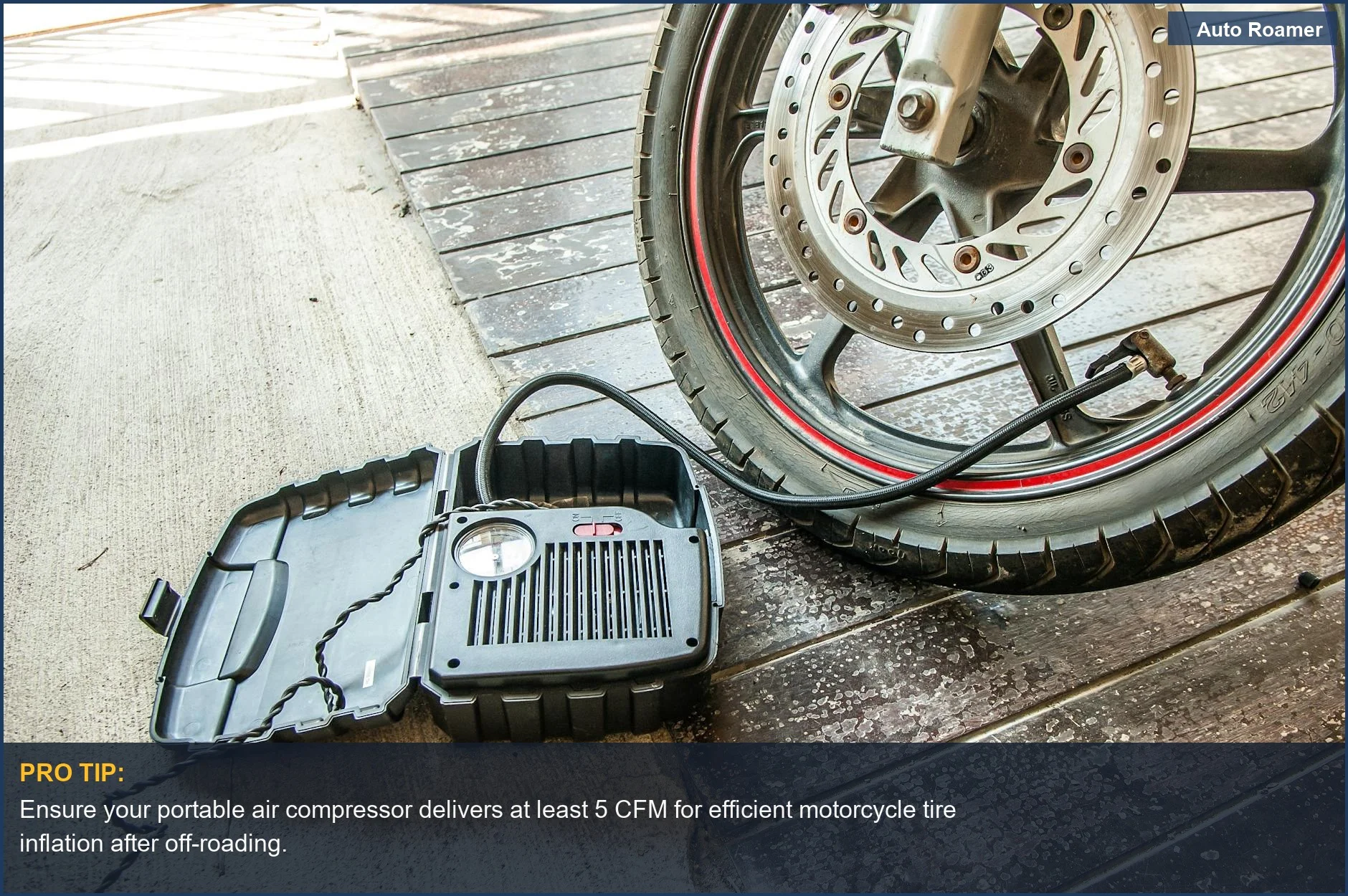
Ensure your portable air compressor delivers at least 5 CFM for efficient motorcycle tire inflation after off-roading.
A close-up shot shows a motorcycle tire being rapidly inflated, highlighting the importance of air flow rate for quick top-ups. Aim for 5+ CFM for speed. | Photo by Srattha Nualsate

Why This Matters for Your Setup

Why does this CFM nonsense even matter for your setup?
  • Speed: Higher CFM means faster tire inflation. My first trip trying to air up four 33-inch tires after a hike took me nearly an hour with a pathetic 1.5 CFM compressor. It was miserable.
  • Efficiency: You want to get back on the road, not spend your entire weekend waiting for air. A compressor with a decent CFM (think 3+ CFM at 30 PSI) will get you back to highway pressure in minutes, not an eternity.
  • Tire Size: Bigger tires need more air volume to fill. Trying to air up 37-inch tires with a compressor designed for bicycle tires is a recipe for frustration. My current setup needs at least 5 CFM to handle mine efficiently.
  • Number of Tires: Are you airing up just one tire, or all four? If it's all four, you definitely need more CFM. I saw a guy at Moab trying to air up his whole rig with a tiny portable unit; the line for air was longer than the trail.
  • Power Source: Most portable units are 12-volt, drawing power from your car's battery. Higher CFM often means higher amperage draw, so make sure your vehicle can handle it. My 6 CFM unit draws about 30 amps, which is fine for my truck, but might drain a small car battery pretty quick if left running too long. Ultimate Guide: Choosing the Right Compressor covers this well.
To ensure optimal tire performance, understanding the right air compressor PSI is essential for your setup.
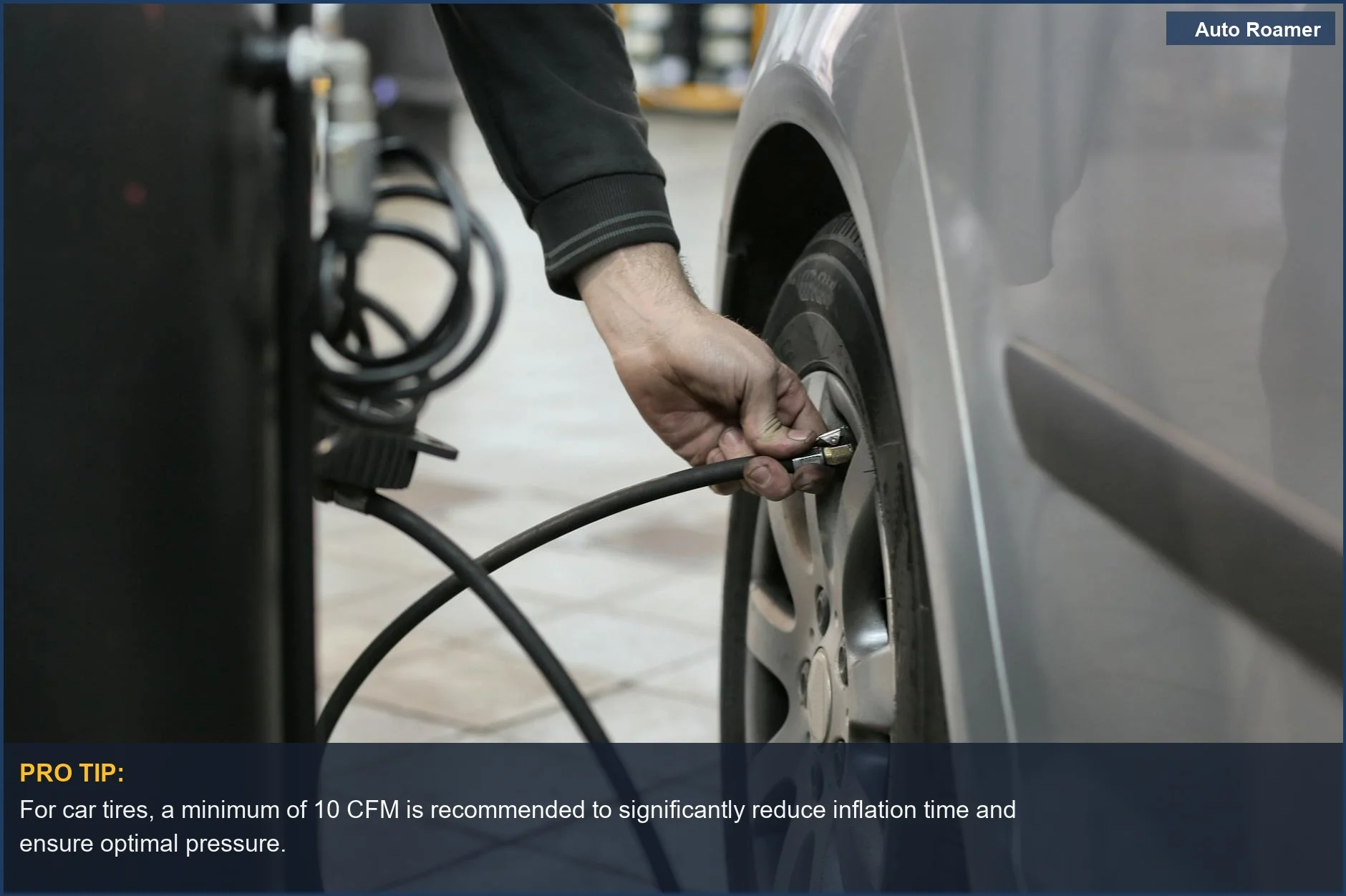
For car tires, a minimum of 10 CFM is recommended to significantly reduce inflation time and ensure optimal pressure.
Inside an auto shop, a mechanic meticulously inflates a car tire, underscoring how air flow rate impacts efficient tire inflation. 10 CFM makes a big difference. | Photo by Andrea Piacquadio

Making the Right Choice

Ultimately, understanding CFM is about making your life easier. Don't get caught with a slow compressor when you're ready to roll out.
  • Don't chase PSI alone: High PSI is useless if the air can't flow. Focus on CFM for speed.
  • Match your needs: Bigger tires and more tires mean you need a higher CFM rating. For general car tires, 1.5-2 CFM might be okay, but for off-road, aim for 3+ CFM at your target pressure.
  • Consider your power: Make sure your vehicle can handle the amperage draw of a higher CFM compressor.
  • The $50 version will cost you time: Cheap compressors might seem like a good deal, but the time you spend waiting is worth more than the money you save. How Much CFM Do I Need is a good read for context.
  • Test it out: If possible, see how quickly a compressor airs up a tire before you buy. My first compressor took 10 minutes to add 5 PSI. My current one does it in 2 minutes. Big difference. How to Fill Your Car Tires shows the process.
Understanding the right PSI can significantly enhance your experience, especially when choosing an air compressor for car camping; learn more about it here.
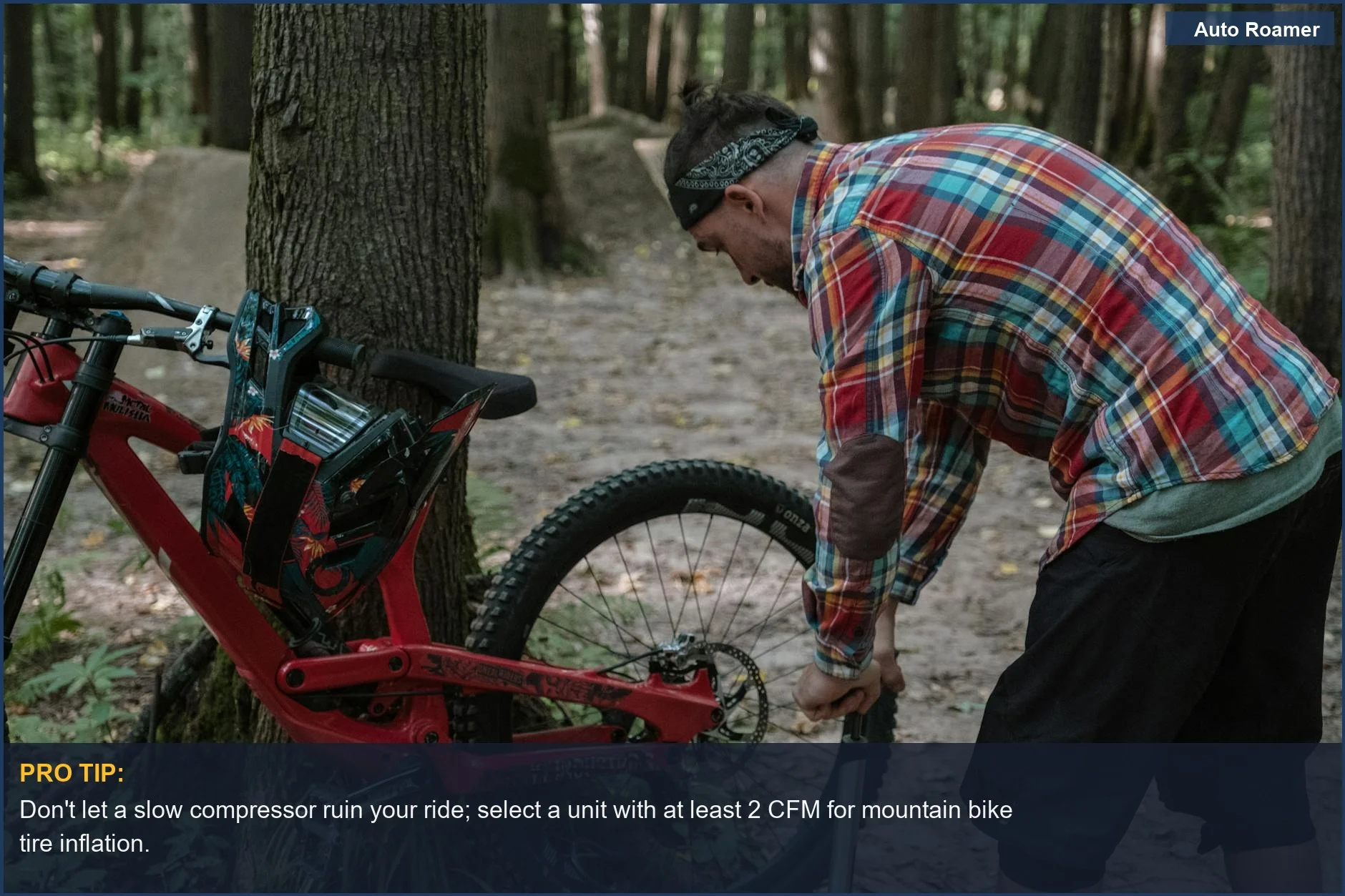
Don't let a slow compressor ruin your ride; select a unit with at least 2 CFM for mountain bike tire inflation.
A man pumps a mountain bike tire in a scenic wooded area, emphasizing that understanding compressor CFM ensures you're ready to ride. 2 CFM is a good start. | Photo by Anastasia Shuraeva

Frequently Asked Questions

If I can get a shop to air up my tires for $10, why would I ever buy my own compressor for $150?
Because you're not always going to be near a shop when you need air. I learned this the hard way at 10 PM on a deserted forest road with a flat. My $150 portable compressor, rated at 5.5 CFM, got me back up to 35 PSI in about 5 minutes per tire. That peace of mind and convenience is worth way more than $10. Air Compressor CFMs simplified highlights how much faster you can air up with a decent CFM unit.
Do I really need one of those fancy digital tire gauges, or will my old stick gauge do the trick?
Honestly, for just airing up, your old stick gauge is probably fine. The critical part is the compressor's CFM rating. If you're worried about super precise pressure readings, a digital gauge is nice, but don't let it distract you from the main event: getting enough airflow to fill those tires quickly. My stick gauge has been fine for years, and it cost me $5. Understanding CFM and PSI explains that PSI is pressure, but CFM is speed.
What if I buy a compressor with good CFM, but it still takes forever to air up my tires?
That's a rookie mistake waiting to happen. If your CFM is decent, say 4+ CFM, and it's still slow, check your hoses and fittings for leaks – even a small leak can kill your airflow. Also, make sure you're not trying to run it off a weak cigarette lighter adapter if it draws too much amperage. My first compressor came with a flimsy adapter that overheated and melted. The real move is to use direct battery clamps for anything over 15 amps. How Much CFM Do I Need has some good info on CFM requirements.
Can running a cheap, low-CFM compressor too long damage my car's battery?
Absolutely. Cheap 12-volt compressors often have less efficient motors and can draw more amperage than their ratings suggest. If you're running one for 30 minutes trying to air up a single tire, you're essentially draining your battery without enough time to recharge. I saw a guy once who completely killed his battery trying to air up his 37s with a unit that was barely putting out 1 CFM. He was stuck for hours. CFM vs. PSI explains how flow and pressure relate to power draw.
I heard that CFM doesn't really matter if the compressor can hit 150 PSI. Is that true?
That's a load of garbage. PSI is just the pressure, like how hard the air is pushing. CFM is how much air is actually getting *into* your tire per minute. Imagine trying to fill a bucket with a tiny trickle of water versus a fire hose. Both might eventually fill the bucket (reach pressure), but one is a whole lot faster. My first compressor could hit 150 PSI, but it took 20 minutes to add 5 PSI to one tire. It was useless. Air Compressor CFMs simplified is the place to go to understand why CFM is king for speed.
C

Casey - The Weekend Warrior

Weekend car camper and road trip enthusiast. Focuses on practical, budget-friendly solutions for families and first-time campers.

Sources

Related Articles