The Short Version
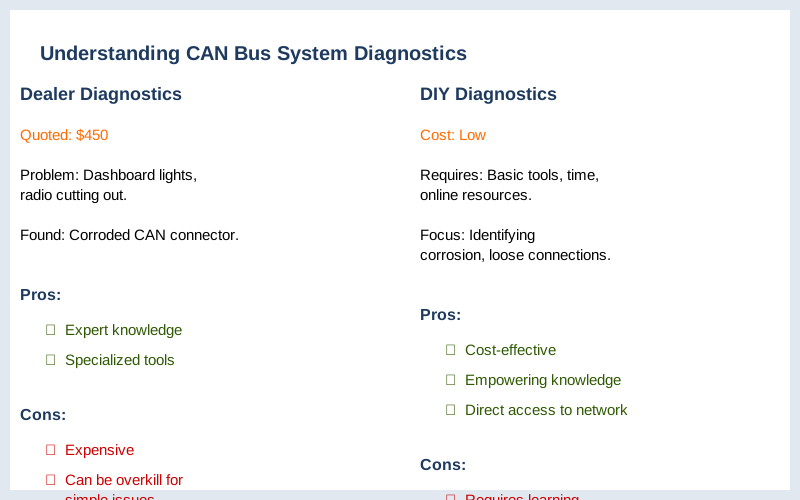
The dealer quoted me $450 to 'diagnose' a dashboard full of warning lights on a 2015 F-150. All because the radio was cutting out. Turns out, a single corroded connector on the CAN bus was throwing everything off. Modern vehicles are just a bunch of computers talking to each other, and when one goes silent, the whole network freaks out. It's a twisted pair of wires, not rocket science.
This isn't some black magic, despite what the service bay wants you to believe. You can poke around this yourself. I'll show you how.
The Short Answer
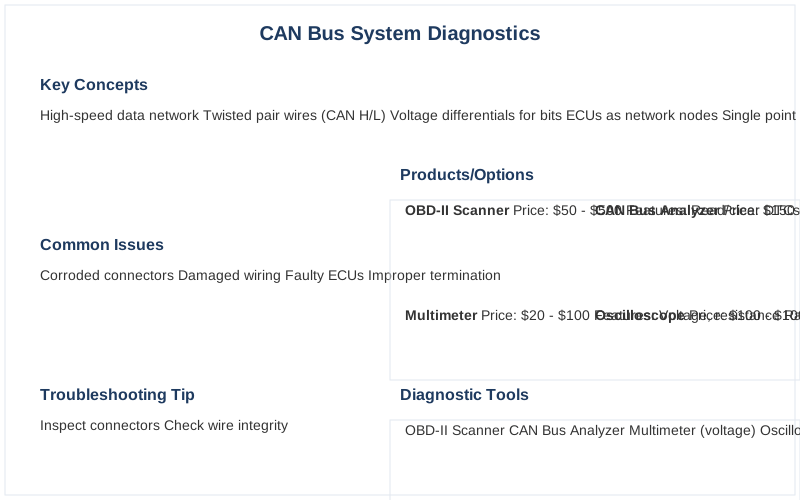
CAN (Controller Area Network) isn't some mystical force; it's just two wires - CAN High and CAN Low - twisted together to reduce electromagnetic interference. These wires carry voltage differentials, not just absolute voltages. A 'dominant' bit is a 2.5V differential (CAN High at 3.5V, CAN Low at 1.5V). A 'recessive' bit is 0V differential (both at 2.5V). The system relies on this precise voltage swing to transmit data packets.
Every Electronic Control Unit (ECU) in your car - engine, transmission, ABS, radio, even the door locks - is a 'node' on this network. They all listen to every message, but only process the ones addressed to them. This is efficient, but also means a single point of failure can disrupt the whole damn thing. One bad connection, and your climate control thinks the engine is overheating.
The critical components are the bus lines themselves, the ECUs, and the terminating resistors. High-speed CAN buses, like those found in powertrain systems, require two 120-ohm terminating resistors, one at each end of the bus. This creates a total bus resistance of 60 ohms. Without proper termination, the digital signals reflect back, causing data errors. It's like shouting into a canyon and hearing your echo before you finish.
Signal reflection corrupts the data frames, leading to 'bit errors'. The ECUs detect these errors, and if too many occur, they'll stop transmitting or even shut down. This is the underlying physics: a degradation of the electrical signal due to improper impedance or a physical break in the circuit. It's not magic, it's Ohm's Law and transmission line theory.
The Reality Check
Modern cars are wiring spaghetti, but a lot of it is just CAN bus. There are typically multiple CAN networks, each optimized for different speeds and criticality. The powertrain CAN (engine, transmission) is high-speed, often 500 kbit/s. Body control modules might run on a slower CAN, say 125 kbit/s. Each network has its own termination.
ECUs are basically tiny computers, each with a microcontroller and a CAN controller. They're designed to be robust, but physical damage, thermal cycling, or voltage spikes can fry them. A common failure is internal solder joint fatigue from vibration, causing intermittent connectivity. Sometimes the ECU itself is fine, but its power or ground connection is compromised.
Wiring harnesses are a prime failure point. Rodents love to chew through insulation, causing shorts or open circuits. Mechanical stress from vibration or improper routing can abrade insulation, leading to intermittent shorting to ground or shorting CAN High to CAN Low. This kills the differential signal and the network goes dark. It's a matter of dielectric strength and conductor integrity.
| Component | How It Fails | Symptoms | Fix Cost |
|---|---|---|---|
| CAN Bus Wires | Abrasion, rodent damage, corrosion at connectors. Loss of circuit integrity or short to ground/power. | Multiple, seemingly unrelated fault codes (U-codes), intermittent module communication, no-start. | $10-$20 (DIY wire repair) to $500+ (dealer harness replacement) |
| Terminating Resistor | Open circuit (broken component), corrosion at leads. Loss of impedance matching. | Intermittent communication, 'noise' on bus lines, specific module dropouts, communication errors. | $5-$15 (resistor replacement) to $200+ (if part of an ECU) |
| ECU (Controller) | Internal solder joint fatigue, voltage spike damage, water intrusion. Loss of internal circuit integrity. | Specific module completely dead, specific functions inoperative, no communication with scanner. | $300-$2000+ (new/remanufactured ECU, programming extra) |
| Connectors | Corrosion, bent pins, poor pin tension, vibration-induced fretting. Loss of tactile electrical contact. | Intermittent communication, fault codes appearing/disappearing with vehicle movement. | $0 (cleaning/re-seating) to $100+ (pigtail replacement) |
Your dealer will often just replace the most expensive ECU they can find that's throwing a code. They don't want to spend three hours tracing a harness for a $0.50 repair. Congratulations, you just paid for a new computer because of a 0.5mm gap in a pin.
How to Handle This
First, get a wiring diagram for your specific vehicle. Don't even start without it. Identify the CAN bus you're troubleshooting - often there are multiple, labeled by speed or function. Locate common access points like the OBD-II port, or specific ECU connectors. This is step one for any electrical diagnosis.
- Check for DTCs: Use a decent scan tool to pull all diagnostic trouble codes (DTCs). Pay attention to U-codes (network communication codes). These tell you which modules are offline or reporting errors. Don't just clear them; write them down. They're clues.
- Measure Bus Resistance (Key Off): Disconnect the battery. At the OBD-II port (pins 6 and 14 for high-speed CAN), measure resistance between CAN High and CAN Low. You should see approximately 60 ohms. If it's 120 ohms, one terminating resistor is open. If it's 0 ohms, you have a short. If it's infinity, you have an open circuit in both lines, or both resistors are gone. This is your first hard data point.
- Check for Shorts to Ground/Power (Key Off): With the battery still disconnected, measure resistance from CAN High to chassis ground, and CAN Low to chassis ground. Both should be open circuit (infinite resistance). If you read anything low, you have a short. Then check CAN High to battery positive, and CAN Low to battery positive. Again, open circuit. These tests are critical for circuit integrity.
- Inspect Connectors and Harnesses: Visually inspect all accessible CAN bus connectors for corrosion, bent pins, or signs of rodent damage. Look for chafing on the wiring harnesses where they pass through firewalls or over sharp edges. A simple pull test on wires at connectors can reveal poor pin tension. This is where mechanical stress bites you.
- Voltage Check (Key On): Reconnect the battery. With the key on (engine off), measure voltage at the OBD-II port. CAN High should be around 2.5-3.5V, and CAN Low around 1.5-2.5V. If one is stuck high or low, or both are at 0V or 12V, you've got a problem. This indicates an active fault in the circuit's electrical potential.
- Oscilloscope for Signal Integrity: For intermittent issues, you need an oscilloscope. Connect it to CAN High and CAN Low. Look for clean, square waveforms. Glitches, ringing (oscillations at the edges), or a flat line indicate signal integrity issues. A 'noisy' bus means data corruption, often from improper termination or external electromagnetic interference. This is the only way to see the actual data pulses.
What This Looks Like in Practice
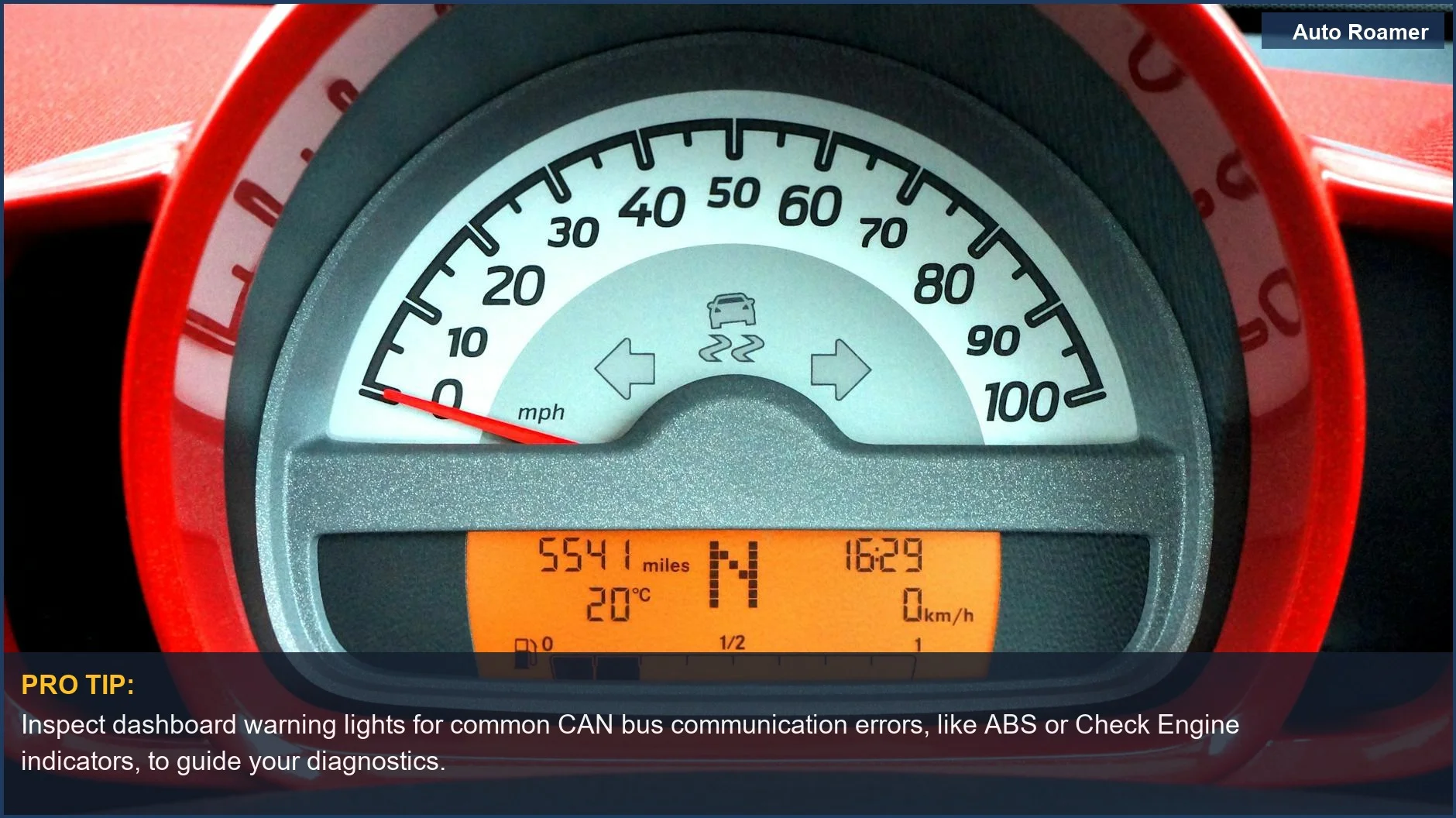
The check engine light is on, ABS light is on, and the speedometer reads 0 MPH on a 2017 Honda Civic. Scan tool shows 'U0121 - Lost Communication with Anti-Lock Brake System (ABS) Control Module' and 'U0100 - Lost Communication with Engine Control Module (ECM)'. The common denominator is the high-speed CAN bus. Measuring 120 ohms at the OBD-II port. Found one of the 120-ohm terminating resistors was corroded open in the ABS module. Replaced the module, problem solved.
That's a $700 module that could have been a $10 resistor if it was accessible.
A 2010 Ford F-150 has intermittent power steering assist. Sometimes it works, sometimes it doesn't. No specific DTCs for the power steering module, but general U-codes for network errors. Oscilloscope shows intermittent signal dropouts on the CAN bus lines, specifically when hitting a bump. Traced the harness under the battery tray; chafed insulation caused a temporary short to ground on CAN Low when the chassis flexed. A bit of electrical tape and a zip tie fixed it for $0.05.
The dealer wanted $1500 for a new steering rack. Brilliant engineering.
After a radio upgrade in a 2019 Subaru Outback, the climate control went haywire, and the car wouldn't go into reverse reliably. The aftermarket radio harness had accidentally shorted CAN High to CAN Low. The installer just twisted wires together without checking the spec sheet. This caused a permanent 0-ohm short across the bus, killing all communication. Unplugged the radio, everything worked. The problem was pure circuit integrity failure, not module failure.
A 2012 Chevy Cruze starts fine but occasionally won't shift out of park. Aftermarket alarm system was installed poorly, drawing parasitic current and intermittently messing with the CAN bus voltage levels. The alarm module was creating voltage dips that ECUs interpreted as data errors. Pulled the alarm fuse, problem disappeared. This is a common issue with added electrical loads that aren't properly integrated into the vehicle's electrical architecture.
Mistakes That Cost People
| Mistake | Why It's Wrong (Physics/Engineering) | Cost to Fix |
|---|---|---|
| Replacing ECUs without diagnosing the bus | Addresses symptoms, not root cause. If the bus is bad, new ECU will fail too. Ignores circuit integrity. | $500-$2000 (unnecessary ECU cost) |
| Ignoring U-codes | U-codes directly indicate communication issues. Ignoring them is ignoring the network's health. | Hours of chasing unrelated problems, potential for further damage. |
| Not checking bus resistance (60 ohms) | Without correct termination, signal reflections cause data corruption. Fundamental impedance mismatch. | Intermittent faults, 'ghost' problems that are hard to track. |
| Using only a multimeter for signal analysis | Multimeters show average voltage, not dynamic waveforms. You can't see glitches or ringing. You need an oscilloscope to see signal integrity. | Misdiagnosis of intermittent faults, replacing good components. |
| Not inspecting physical wiring | Rodent damage, chafing, corrosion are common physical failures. Mechanical stress on wires causes opens/shorts. | Missed simple, cheap fixes. Dealer will charge for full harness. |
| Assuming all CAN buses are the same speed | Different CAN buses have different speeds, termination requirements, and failure modes. Mixing them up leads to incorrect diagnostics. | Wasted time, incorrect parts, continued vehicle issues. |
People panic when they see a dashboard lit up like a Christmas tree and immediately think 'expensive computer failure.' Usually, it's a $0.50 wiring issue or a $10 resistor. The dealer loves this, of course. My favorite is when they replace an ECU because they 'couldn't communicate' with it, when the real issue was a corroded pin in the harness. That's a circuit integrity problem, not a module problem.
Paying for a new module is like replacing your brain because your phone cord is frayed. Dumb.
Key Takeaways
The CAN bus isn't some black box; it's a pair of wires moving data. Understanding its underlying physics - signal integrity, impedance, and mechanical stress on conductors - is key to diagnosing problems. Don't let a mechanic convince you it's too complex. It's all measurable.
- It's a Network, Not a Single Wire: Think of multiple computers talking. One silent node affects the whole conversation.
- Termination Matters (60 Ohms): Proper impedance matching prevents signal reflection.
Measure it first.
- Physical Damage is Common: Rodents, chafing, and corrosion are prime suspects for circuit integrity failures.
- U-Codes are Your Friends: These diagnostic trouble codes point directly to communication issues.
- Multimeter for Basics, Oscilloscope for Detail: You need to see the dynamic signal to truly diagnose intermittent issues.
- Don't Buy New ECUs Prematurely: Most CAN bus issues are wiring or resistor related, not dead computers. Replacing a good ECU is just lighting money on fire.