Setting the Scene
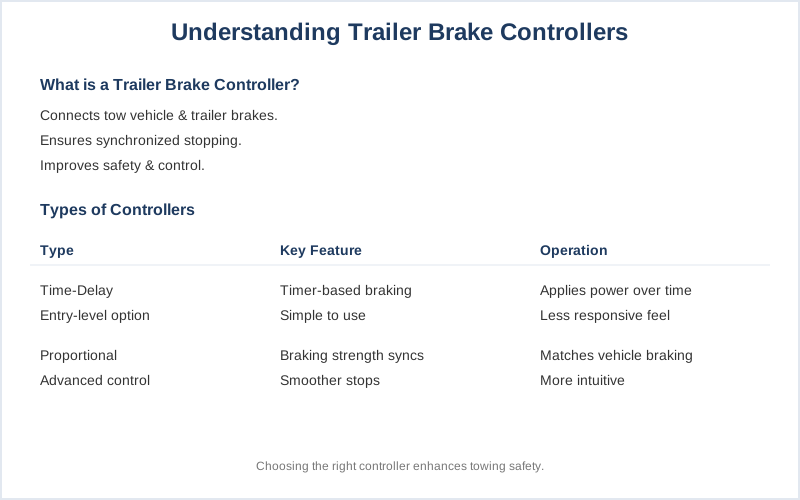
A trailer brake controller is the critical link between your tow vehicle and your trailer's electric brakes. Without one, you're basically asking your truck to do all the heavy lifting when it comes to stopping a heavy load, which is a rookie mistake that can lead to fishtailing or worse. Think of it like trying to push a shopping cart full of anvils uphill by yourself versus having a buddy help.
This little box makes sure your trailer brakes work in sync with yours, making stops smoother and safer. There are two main ways these controllers work: time-delay and proportional. Knowing the difference is key to not ending up with a trailer that either slams on its brakes too hard or doesn't brake enough, especially when you're just starting out with towing.Brake Controllers Explained
The Core Answer
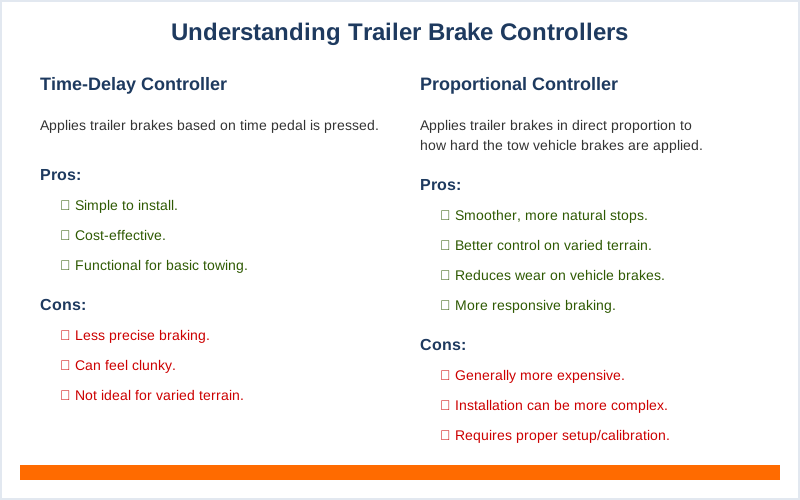
With a time-delay controller, when you hit the brakes in your truck, it sends a signal to the trailer brakes. But it's not about *how hard* you hit the pedal. It's about how long you've been pressing it. So, if you press the brake pedal for, say, 2 seconds, the trailer brakes will apply a set amount of power for 2 seconds. It's a bit like a timer. The harder you press, the longer the trailer brakes stay on, but not necessarily the *stronger* they apply at any given moment.Time-Delay Brake Controller
My first setup had a time-delay, and it was... functional. It got the job done, but it felt clunky. Imagine pushing a shopping cart and the wheels only decided to grab after you'd already rolled a bit. That's kind of what it felt like on hills. You learn to anticipate, which isn't ideal when you're just trying to merge onto the highway. It's the $50 version, and sometimes you get what you pay for.What is a Brake Controller
Now, proportional controllers are the next level. These guys use an internal sensor, usually an accelerometer, to detect how quickly your tow vehicle is slowing down. The harder you brake, the more the sensor registers, and the more power it sends to the trailer brakes. It's designed to mimic your truck's braking force. So, if you gently tap your brakes, the trailer brakes gently apply. If you slam on the brakes, the trailer brakes slam on too, but in a more controlled way than a time-delay might.Proportional Controllers
The real move here is that proportional controllers feel much more natural. It's like your trailer is actually part of your vehicle. I remember the first time I towed with a proportional controller on a windy mountain road in Colorado. It was game-time, and the difference was night and day. Stops were smooth, predictable, and I didn't feel like I was fighting the trailer. The tech isn't super complicated, but the difference in feel is massive.How do they work
Some controllers are even 'tri-axis' proportional, meaning they sense deceleration in all three directions: forward/back, side-to-side, and up/down. This makes them work even if your truck is parked on a slight incline or if you're braking while turning. Brilliant engineering, right? Most modern proportional controllers are tri-axis. You'll see them advertised with terms like 'inertia sensing' or 'accelerometer-based'.
The honest version: Time-delay is basic and functional. Proportional is smoother and more intuitive, especially for heavier loads or more challenging terrain. For most people towing anything more than a small utility trailer, a proportional controller is the way to go. It's worth the extra cash, which can be anywhere from $50 to $200 more than a basic time-delay unit.trailer brake controller
Why This Matters for Your Setup
- Smoother Stops with Heavy Loads: If you're towing a camper, a boat, or a car hauler, a proportional controller makes a huge difference. On my first trip with my 26-foot travel trailer, I had a time-delay unit. Every time I braked, the trailer brakes would grab a second late, then slam on. It felt like the trailer was trying to push me.
A proportional controller means the trailer brakes apply in sync with your truck's brakes, so you don't get that jarring sensation. It's the real move for peace of mind and preventing trailer sway.What you will be towing
- Better Control on Hills and Curves: Imagine you're coming down a steep mountain pass, like I did in Utah last fall. With a time-delay, you might have to manually adjust the power output to keep the trailer from running away from you.
A proportional controller automatically senses the deceleration and adjusts the trailer braking force accordingly. This means less work for you and a much safer descent. It's the difference between holding on for dear life and a controlled cruise.choosing a brake controller
- Reduced Wear and Tear: Consistent, proportional braking means less abrupt stops. This translates to less stress on your trailer's brakes, your tow vehicle's brakes, and even your trailer's suspension. Over time, this can save you money on maintenance.
My buddy Bob, who tows a horse trailer weekly, swears his proportional controller saved him from needing new brake drums after just a year. Apparently, jerky stops are hard on everything.long-term benefits
Making the Right Choice
- Know Your Towing Needs: If you're just hauling a small utility trailer occasionally, a basic time-delay controller might be fine. But if you're towing anything substantial, or you plan to do it often, a proportional controller is a no-brainer. Think of it like this: you wouldn't use a butter knife to chop steak, right? The same logic applies here.
The extra cost is minimal compared to the safety and comfort benefits.which one you need
- Installation Matters: While many controllers are plug-and-play with specific wiring harnesses, some require a bit more effort. If you're not comfortable running wires or tapping into your vehicle's electrical system, factor in the cost of professional installation. I once spent 3 hours trying to wire a controller in the freezing rain in my driveway in Ohio, only to realize I'd crossed a wire.
Cost me $150 for a shop to fix it the next day. Learn from my pain.install the controller
- Features to Consider: Beyond the basic time-delay vs. proportional, look at features like manual override controls, display types (LED vs. digital), and whether the unit requires leveling. Many modern proportional units don't need to be perfectly level, which is a huge plus. I remember trying to level my first controller in a campsite in Vermont.
Took me 10 minutes with a bubble level and a prayer. Auto-leveling is a game-changer.Compare CURT Trailer Brake Controllers