
Why cargo-net type matters
A cargo net sounds like a single, simple product, but ask any SUV owner who bought the wrong one and they will tell you otherwise. The net that keeps your grocery bags from tipping over is useless at stopping a cooler from flying into the back seats in a hard stop, and the net that lashes a load to your roof basket would just get in the way inside the cargo bay. The type is the whole decision.
There are four main kinds of SUV cargo net, and each solves a different problem. This guide walks through all four, floor (envelope) nets, vertical barrier nets, ceiling/headliner nets and exterior roof-rack nets, explaining how each mounts, what it is good and bad at, and which gear it suits. By the end you will know exactly which type, or which combination, matches your vehicle and what you actually haul.
The thread running through all of them is your factory anchor points. Almost every interior net clips to the D-rings, tie-down loops or hooks your SUV already has, so the practical first step is to look in your cargo area and count them. Once you know your anchors and your typical load, picking the right net type is straightforward.
Type 1: Floor (envelope) cargo nets
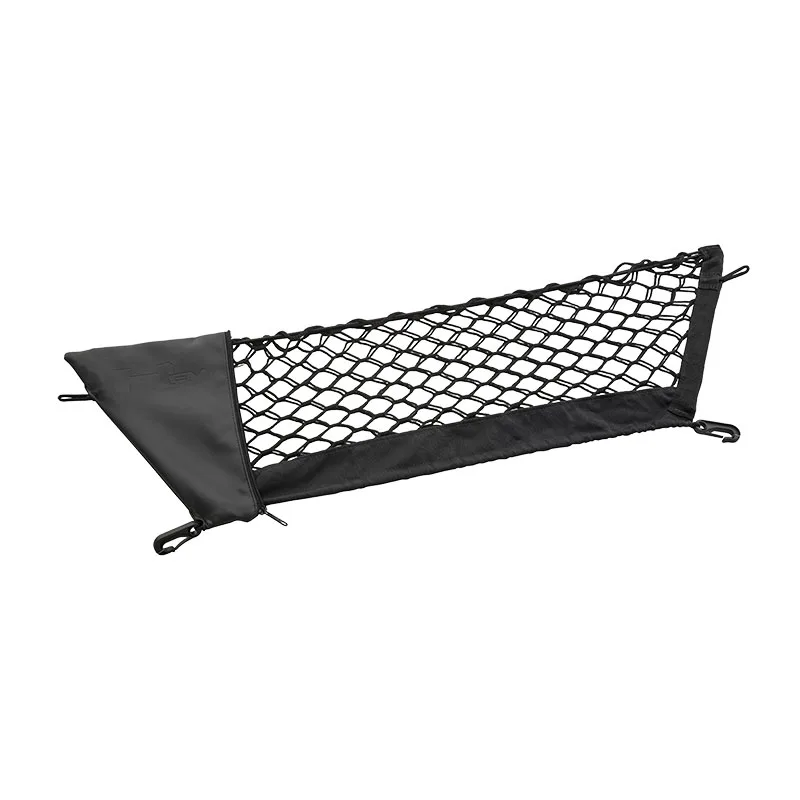
The floor net, often called an envelope net, is the most common type. It stretches flat across the cargo floor and clips to anchor points at the corners, using elastic tension to trap small, loose items underneath or within it. Slide a few grocery bags, a first-aid kit and a pair of jumper cables under it and they stop sliding into a heap every time you corner.
Floor nets shine for everyday small-item containment, groceries, tools, sports balls, anything that rolls or slides. Their weakness is that they do nothing for vertical safety: they will not stop a heavy item from flying forward in a crash, and they are not for large or tall loads. Think of the floor net as organization and anti-slide management, not crash protection. It is the net most SUV owners use most often, precisely because most daily cargo is small and loose.
Best for: groceries, loose tools, small gear that slides. Not for: heavy items you need restrained from flying forward.
Type 2: Vertical barrier nets
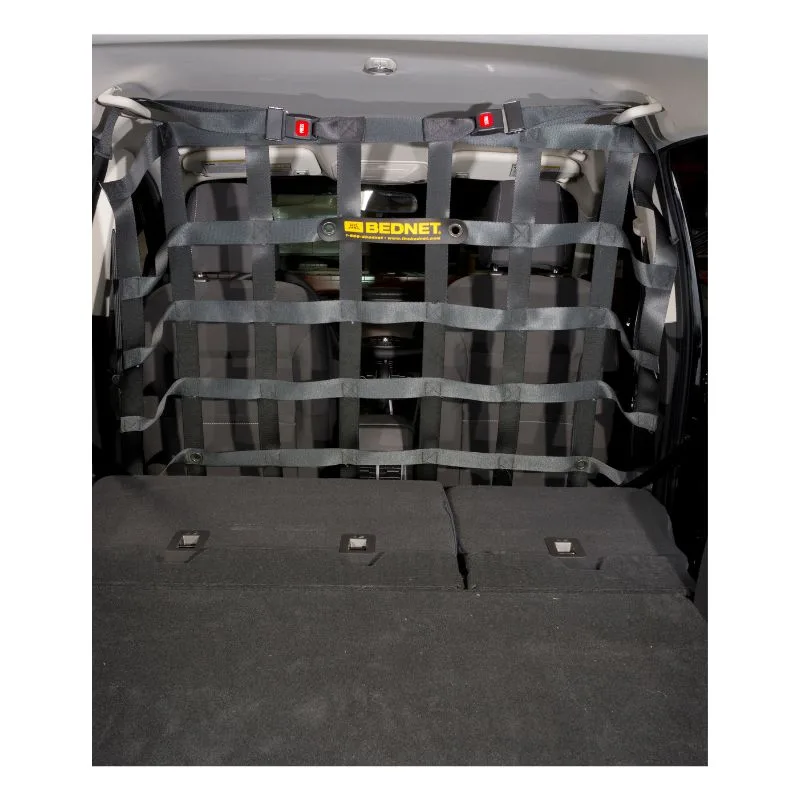
The vertical barrier net is the safety net of the group. It stretches upright between the cargo area and the rear seats, anchoring to the floor and to the ceiling or seatback mounts, forming a wall that keeps loose gear from launching forward into the cabin during hard braking or a collision. In an SUV with no fixed bulkhead, this is the closest thing to a cargo barrier you can add.
Barrier nets are essential if you regularly haul heavy loose items, a cooler, a toolbox, luggage, with passengers in the back seats, because an unrestrained heavy object becomes a dangerous projectile in a crash. The trade-offs are that they take more effort to install (they need upper and lower anchors), they block rear visibility somewhat, and they must be made of strong, low-stretch webbing to actually restrain a real load. A floppy elastic net here gives a false sense of security.
- Job: stop heavy loose gear flying into the cabin
- Needs: strong webbing + upper and lower anchors
- Trade-off: harder to fit, slightly blocks rear view
Type 3: Ceiling and headliner nets
The ceiling net, sometimes called a headliner or overhead net, stretches along the roof of the cargo area or cabin and holds light, bulky items up and out of the way. Jackets, sleeping bags, a folded tent, hats and other soft, low-density gear ride overhead, freeing the floor for heavier items and keeping the cabin tidy on a road trip.
These nets are almost always elastic, because they conform to soft bundles and the loads are light. Their limit is exactly that, light loads only. Never put anything heavy or hard in a ceiling net, since it can sag into the cabin or, worse, become an overhead projectile. For campers and families, a ceiling net is a clever way to reclaim floor space for bulky-but-light items; just keep the weight low and the contents soft.
Best for: jackets, sleeping bags, light bulky soft gear overhead. Not for: anything heavy or hard.
Type 4: Exterior roof-rack and basket nets
The fourth type lives outside the vehicle. A roof-rack net (or cargo-basket net) stretches over a load carried on a roof basket or rack and hooks to the rails, holding gear down against wind and bumps at highway speed. It is what keeps a stack of camping gear, firewood or a duffel from shifting or flying off the roof on the interstate.
Because the forces here are large, roof-rack nets use strong, weather-resistant low-stretch webbing rather than light bungee elastic, and they are sized to the basket. They are not a substitute for proper straps on very heavy or rigid items, think of the net as the secondary containment that keeps small and medium items from working loose, with ratchet or cam straps doing the primary heavy lifting. Always confirm the net fits your specific basket and that nothing can slip out the edges at speed.
How they mount: factory anchor points explained
The reason net type is so vehicle-specific is mounting. Interior nets rely on your SUV's factory cargo anchors, the metal D-rings, molded hooks or tie-down loops set into the cargo floor and walls, and barrier nets additionally use upper mounts on the ceiling, pillars or seatbacks. The elastic or webbing tensions between these points to hold the load.
Before buying any net, look in your cargo area and count the anchors: how many, where they sit, and whether they are loops, hooks or rings. A floor net needs four corner anchors; a barrier net needs both floor and upper anchors; a ceiling net needs overhead clips or grab-handle mounts. If your SUV is short on factory anchors, you can add bolt-in tie-down rings, but match the net's hardware to what you have. Exterior nets, by contrast, hook to the roof basket itself, so there the fit question is basket size, not interior anchors.
Elastic vs webbing: choosing the right material
Cut across the four types is a material choice that matters as much as the shape. Elastic (bungee-style) nets stretch to conform to odd shapes and hold small or light items snugly, which is why floor and ceiling nets are usually elastic. They are forgiving and easy to live with, but they deform under a big load and offer little crash restraint.
Low-stretch webbing nets resist far more force without deforming, which is exactly what a vertical barrier net or an exterior roof net needs to do its job at speed or in a collision. The practical rule: use elastic to contain small loose items and tidy the cabin, and use strong webbing to restrain heavy loads or secure anything on the roof. Matching material to the force involved is what separates a net that works from one that gives a false sense of safety.
Matching the net type to your gear
Putting it together, the right net follows from what you haul. If your cargo is mostly small and loose, groceries, tools, daily clutter, a floor (envelope) net is the everyday workhorse. If you carry heavy loose items with people in the back, add a vertical barrier net for genuine crash protection. If you road-trip with bulky soft gear, a ceiling net reclaims floor space. And if you carry gear on a roof basket, an exterior roof-rack net keeps it contained.
- Small loose daily items: floor / envelope net
- Heavy gear + rear passengers: vertical barrier net
- Bulky soft gear (jackets, bags): ceiling / headliner net
- Roof-basket loads: exterior roof-rack net
Many SUV owners end up with two: a floor net for daily use and either a barrier net for safety or a roof net for trips. There is no single best net, only the best net for a given load, so identify your most common cargo problem first and buy the type that solves it.
Common mistakes choosing an SUV cargo net
The recurring errors come from treating all nets as interchangeable. The first is buying a stretchy floor net and expecting it to restrain a heavy cooler in a hard stop, that is a barrier net's job, and it needs strong webbing. The second is buying a barrier net without checking for upper anchor points, then finding nowhere to mount the top and ending up with a useless net.
The third is overloading a ceiling net with hard or heavy items, creating an overhead hazard. The fourth is buying an interior net sized for a different vehicle whose anchor spacing does not match yours. Avoid all four by doing one thing first: identify the force you need to manage (sliding, flying forward, overhead, or external) and count your anchor points, then buy the net type and material that fits both.
Installing and adding anchor points safely
Most cargo nets install in minutes, but a few habits keep them doing their job. Hook the net to the strongest available anchors, the molded D-rings or threaded tie-down points engineered into the cargo structure, not flimsy trim clips or a plastic grab handle that will tear out under load. Tension the net evenly so it sits taut; a sagging net lets items migrate and, on a barrier net, defeats the whole point. Re-check the hooks after the first loaded drive, since elastic and webbing settle.
If your SUV is short on anchors, you can add them, but do it right. Bolt-in tie-down rings that thread into existing factory captive nuts in the cargo floor are the safe route; drilling into thin sheet metal or anchoring to trim is not, because a heavy load will simply rip a weak anchor free in a hard stop. For a barrier net especially, the upper mounting points must be structural, the body, pillars or proper manufacturer mounts, never the headliner alone. The net is only as strong as what it is tied to, so treat the anchor as part of the safety system, not an afterthought.
The bottom line
SUV cargo nets are not one product but four, floor (envelope) nets for small sliding items, vertical barrier nets for crash protection, ceiling nets for light bulky gear, and exterior roof-rack nets for roof-basket loads, and the right choice is the one that matches your gear and your factory anchor points. The most important distinction is horizontal containment versus vertical restraint, and the most important material choice is forgiving elastic versus strong low-stretch webbing.
Count your cargo-area anchors, identify your most common load problem, and buy the type that solves it, adding a second net if you have two distinct needs. Get the type and material right and a cargo net quietly makes your SUV safer and tidier; get them wrong and you have bought something that does not do the job you needed.