

The Spare You Can't Reach Is No Spare at All
A flat tire is an inconvenience at home and a real problem at a trailhead at dusk. The difference is whether you can get to the spare, and on a Toyota Highlander used for camping, that is not a given. The spare lives under the cargo floor, exactly where the mattress, cooler, and gear sit when the cargo bay becomes the bed. Knowing how to reach and use it before you need to is the whole point.
The good news is that the Highlander's spare system is straightforward once you know where everything is and how it comes out. There is a compact spare, a set of tools stored with it, and a specific procedure to lower and mount it. None of it is complicated, but all of it is easier to learn in the driveway than on the shoulder of a forest road.
There are also two numbers that matter more than people expect: the pressure the compact spare needs and the speed limit it imposes. Both are different from the regular tires, and both are easy to get wrong under stress, which is exactly when getting them right matters most.
This guide walks the Highlander's spare from where it hides to how it mounts, in the order a roadside change actually happens, with the camping wrinkle, reaching it when the cargo area is loaded, addressed head on.
Where the Spare Hides
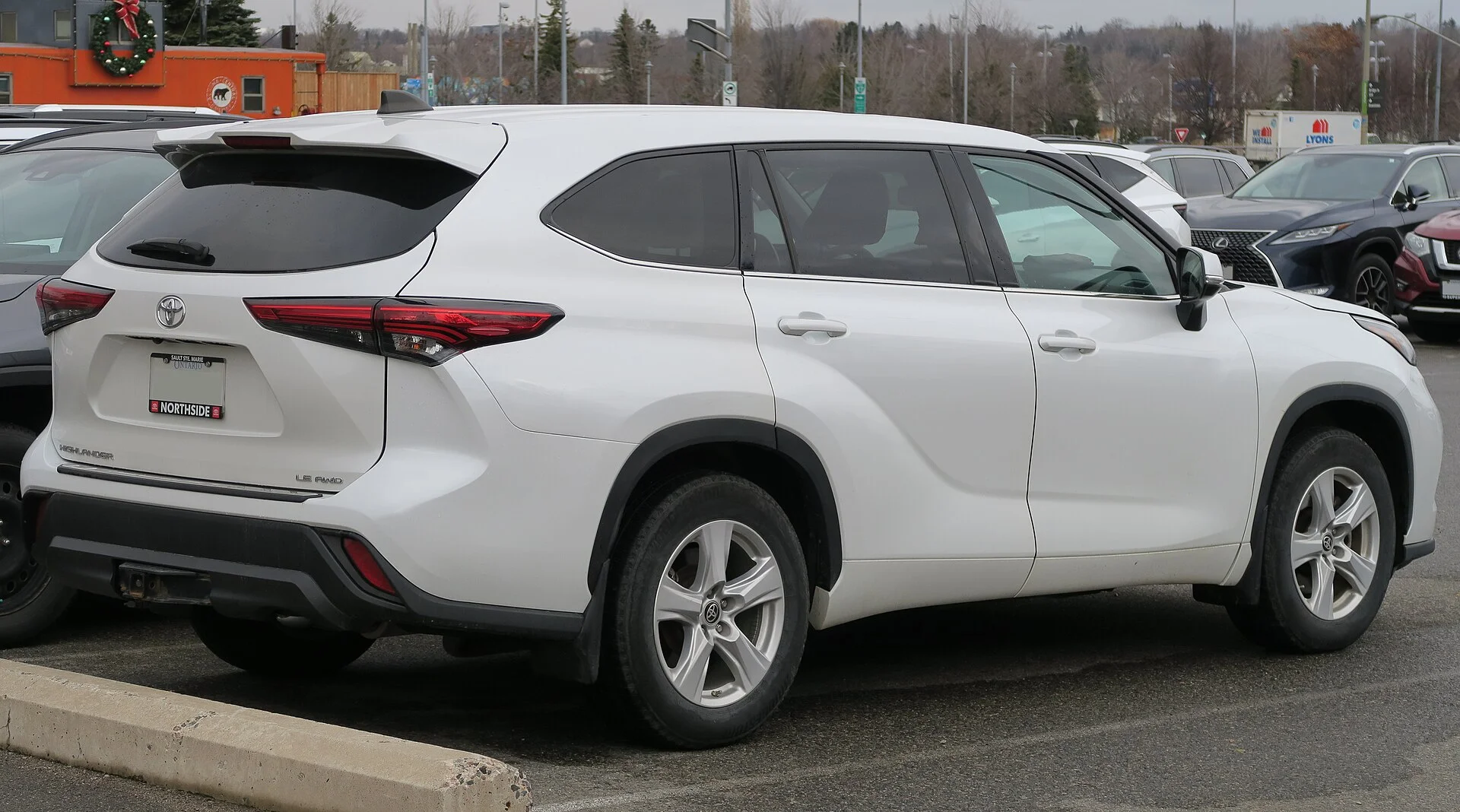
Start with location, because a spare you cannot find is a spare you do not have. The Highlander's spare tire is stowed under the cargo floor at the rear of the vehicle, accessed by lifting the cargo mat and deck board. It sits in a well beneath the load floor, out of sight and out of the way until it is needed.
Getting to it means clearing the cargo area first. The mat lifts, the deck board comes up, and the spare and its tools are revealed in the well below. On an empty Highlander that is a ten-second job; on a loaded camping Highlander it is the crux of the whole change, which is why the loaded-vehicle case gets its own treatment later.
The under-floor location is common to most Highlanders, but the exact well and cover can vary slightly by model year, so it is worth lifting the deck board once at home to see your specific truck's layout. Knowing whether the spare lies flat under a foam tray or in a molded well removes the guesswork on the road.
The practical habit is to locate the spare before the first trip, not during the first flat. Lift the cargo floor, confirm the spare is present and inflated, and note how the deck board comes up, so that when a flat happens the location is muscle memory rather than a discovery made in the dark.

What the Spare Actually Is
The Highlander's spare is not a full-size wheel, and knowing that shapes how it is used. The factory compact temporary spare is sized T165/90D18, a narrower donut spare intended for temporary use only. It is designed to get the vehicle to a tire shop, not to finish a trip or serve as a fifth road tire.
The compact size is a deliberate space-saving choice. A narrow T165/90D18 donut fits the under-floor well and keeps weight down, at the cost of the durability, grip, and speed rating of a full-size tire. That trade is why the manual is explicit that the spare is for temporary use, with limits that a full tire would not carry.
A compact temporary spare is a tool for getting home, not for carrying on. Treating the T165/90D18 donut like a normal tire, at road speed for long distances, is exactly what its temporary-use rating warns against.
For a camper, the temporary nature of the spare is worth internalizing before heading somewhere remote. The donut will get a Highlander off a trail and to a town, but it is not a tire to log highway miles on, which is why planning a real tire repair or replacement soon after a flat is part of using it correctly.
The Tools Stored With It
A spare is only useful with the tools to fit it, and Toyota stores them together. The owner's manual specifies the jack, jack handle, wheel nut wrench, and adapter socket are stored alongside the spare tire under the cargo floor. Everything needed for the change lives in the same well, which is why clearing the cargo area gets you the whole kit at once.
Each tool has a role in the sequence. The jack lifts the vehicle, the jack handle drives both the jack and, with the adapter socket, the spare's retaining hardware, and the wheel nut wrench loosens and tightens the lug nuts. Missing any one of them turns a routine change into a stranded wait, so confirming all are present is part of the pre-trip check.
The adapter socket is the piece most easily overlooked and the one that unlocks the spare itself, so it deserves particular attention. It is small, it lives with the other tools, and it is the key to lowering the spare, which the next step covers. Losing it means the spare cannot be freed without improvisation.
The takeaway for a camping Highlander is to verify the full tool kit before a trip, not just the spare. A present, inflated spare with a missing jack handle or adapter socket is as stranding as no spare at all, and the whole kit is right there under the floor to check in a minute.
How to Free the Spare
Removing the spare is where the adapter socket earns its place. To remove the spare, the adapter socket attaches to the spare tire clamp bolt so the jack handle can lower or free the tire from beneath the cargo area. It is a specific mechanism, not just lifting the donut out by hand, and knowing it prevents fumbling at the roadside.
The sequence is logical once seen. With the cargo floor cleared, the clamp bolt that holds the spare is accessed, the adapter socket is fitted to it, and the jack handle turns the socket to release the spare's retaining hardware. The donut then comes free from the well and is ready to mount.
The reason Toyota uses a clamp-bolt-and-socket system rather than a simple lift-out is security and packaging, keeping the spare firmly stowed in its well over rough roads. That is good for a camping Highlander that sees washboard and trails, but it means the removal procedure has to be known, because the spare will not simply lift out.
The practical move is to run the removal once at home. Fit the adapter socket to the clamp bolt, free the spare, and re-stow it, so the procedure is familiar. Doing it once in daylight in the driveway turns a potentially confusing roadside task into a known routine.
The 60 psi Rule Nobody Expects
Here is the number that catches people out: the compact spare needs far more air than a road tire. Toyota advises compact temporary spare tires be inflated to a minimum of 60 psi, which is 420 kPa, higher than the pressure used for the regular road tires. A donut aired to normal tire pressure is underinflated and unsafe.
The high pressure is a function of the compact tire's small size and narrow construction. To carry the vehicle's weight on a smaller contact patch, the donut runs at a much higher 60 psi than the road tires, and running it soft risks damaging the tire and losing control. The number is a requirement, not a suggestion.
This is why checking the spare's pressure periodically matters, since a spare that has slowly lost air over months is useless when finally needed. A donut found at half its 60 psi at the roadside cannot safely be driven on, turning a flat into a genuine stranding, so the spare's own pressure is part of the pre-trip check.
For a camper heading somewhere remote, the 60 psi rule is a reason to carry a way to inflate. A portable compressor lets a soft spare be brought up to its 60 psi in the field, which is exactly the situation, far from a gas station, where a Highlander is most likely to need it and least likely to have an air pump nearby.

The 50 mph Limit and What Follows
The second number the compact spare imposes is a speed limit. The owner's manual restricts driving on the compact spare to no faster than 50 mph, which is 80 km/h, and recommends replacing it with a full-size tire as soon as possible. Both halves of that instruction matter, the speed and the urgency.
The 50 mph limit exists because the donut is not built for sustained high-speed running. Its temporary construction and narrow footprint are stable at moderate speed but not rated for highway pace, and exceeding the 50 mph, 80 km/h ceiling risks the tire and the vehicle's handling. On a spare, patience is a safety feature.
The replace-as-soon-as-possible half is the part campers should plan around. The donut is a bridge to a real tire, not a destination, so a flat on a trip means routing to a tire shop sooner rather than continuing the itinerary on the spare. Building that detour into the plan is part of using the spare responsibly.
For remote travel, the 50 mph limit also reshapes the drive out. A Highlander limping to town on the donut is a slow, deliberate drive, which is worth factoring into timing, and a strong argument for addressing the flat at the first opportunity rather than pushing on to the next campsite on a temporary tire.
The TPMS Blind Spot
One more detail separates the spare from the road tires: the warning system may not watch it. The compact spare's inflation should be checked periodically since, unlike the road tires, it is not monitored by the tire pressure warning system on all model years. The dashboard that alerts you to a low road tire may say nothing about a flat spare.
That blind spot is why the spare can quietly lose air undetected. The road tires announce a low-pressure problem through the warning light, but a spare outside the monitoring system deflates silently in its well over months, and the first anyone knows of it is when the donut is pulled out soft at the roadside.
The fix is a manual check, since the automation does not cover it. Adding the spare to a periodic pressure check, confirming it holds its 60 psi, closes the gap the warning system leaves. It takes a minute with a gauge and a compressor and removes the worst spare-tire surprise there is.
For a camping Highlander, this makes the spare one more pre-trip item rather than a set-and-forget component. Because the truck will not warn about a soft spare, the owner has to, and a quick manual check before a remote trip is the difference between a spare that works and one that has quietly failed in storage.

Reaching the Spare When the Bed Is Loaded
Now the camping-specific problem: the spare is under the cargo floor, and on a Highlander set up for sleeping, that floor is buried under a mattress, bedding, and gear. The under-floor spare that is trivial to reach in an empty vehicle can be genuinely difficult to access mid-trip, which is the wrinkle a camper has to plan for.
The practical answer is to plan the load with the spare in mind. Keeping the heaviest, hardest-to-move gear off the exact section of cargo floor over the spare well, or packing so the sleeping platform lifts rather than requiring full unloading, means a flat does not force emptying the entire vehicle onto the roadside in the dark.
A flat at camp usually means a partial unload no matter what, so having a plan for where the gear goes helps. A tarp or ground sheet to stack bedding and boxes on keeps the unloaded gear organized and clean while the deck board comes up and the spare and tools come out, then everything reloads once the donut is mounted.
The honest point is that the Highlander's convenient under-floor spare becomes inconvenient exactly when it is needed most, under a full camp load. Anticipating that, by knowing the procedure cold and packing with access in mind, turns a potential ordeal into a manageable task. A compact portable tire inflator stored with the spare rounds out the kit for the 60 psi the donut needs.
The Verdict: Learn It Before You Need It
The Toyota Highlander's spare system is well designed and entirely manageable, but only for an owner who knows it before the flat happens. The spare and its full tool kit, jack, handle, wheel nut wrench, and adapter socket, live under the rear cargo floor, freed with the adapter socket on the clamp bolt, and that procedure is worth running once at home.
The two numbers are what people get wrong under pressure. The compact T165/90D18 donut needs a minimum of 60 psi, higher than the road tires, and it limits driving to no faster than 50 mph, 80 km/h, with replacement by a full-size tire as soon as possible. Both are safety limits, not suggestions.
The spare also sits outside the tire pressure warning system on some model years, so it can lose air unnoticed, making a manual pressure check part of every pre-trip routine. A soft spare discovered at the roadside is a stranding the truck never warned about, which a one-minute check prevents.
For a camping Highlander, the extra wrinkle is reaching the under-floor spare when the cargo bay is a loaded bed, which is solved by knowing the procedure cold and packing with access in mind. Learn the spare before the trip and a flat is a manageable delay; meet it for the first time on a dark forest road and the convenient under-floor spare becomes the hardest part of the night.