
The Highlander hides its bed behind two folded rows — and one step
The Toyota Highlander is a three-row midsize SUV, and that single fact governs everything about sleeping in one. It is not a boxy two-row wagon with a floor waiting for a pad; the flat space you sleep on simply does not exist until you fold BOTH the third row and the second row. Do that, and Toyota's published maximum is 84.3 cubic feet of cargo volume, per U.S. News' figures on the current Highlander — a genuinely large hold. But cubic feet is the wrong number to plan a bed around, and the Highlander is the clearest example of why.
What actually decides your night is floor LENGTH and floor FLATNESS, and here the Highlander asks for homework. With the third row up you get just 16 cubic feet behind it; fold the third row and you have 48.4 cubic feet behind the second row, per Toyota's numbers reported by U.S. News. Neither of those is a sleeping floor. Only the both-rows-folded 84.3-cubic-foot configuration gives you a stretch-out surface — and even then, the second-row seatbacks fold to sit a distinct step ABOVE the rear cargo floor rather than flush with it. That step, and the true flat length past it, are the whole story.
This guide gives every published Highlander figure, names the source for each, and is honest about the one number Toyota does not publish — the both-rows-folded floor length you must measure yourself. For the wider build once you know it fits, see our full Highlander camping setup. Hybrid or gas, the cargo hold is identical, so everything here applies to both powertrains.
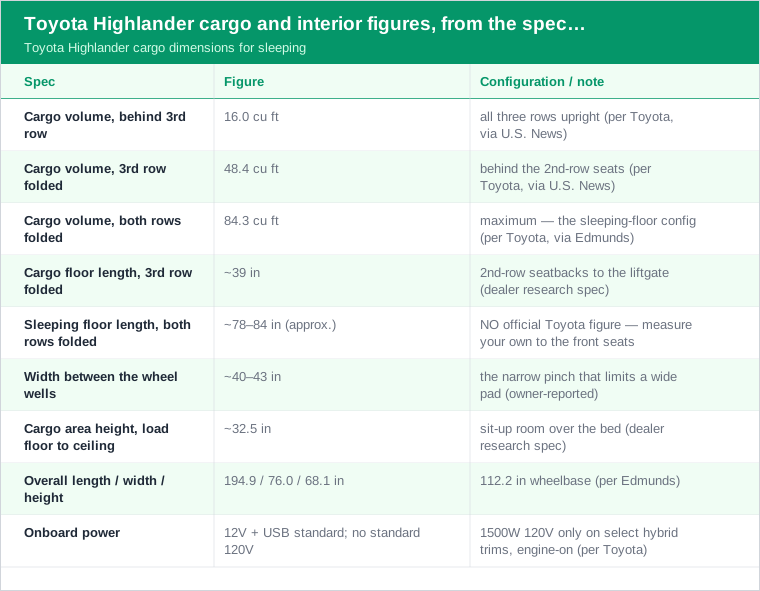
Toyota Highlander cargo and interior figures, from the spec sheet
Here is what Toyota and the major spec databases publish for the current Highlander, with the configuration spelled out beside each figure so you never compare the wrong floor. The both-rows-folded length is flagged as approximate because Toyota does not publish it — the honest number is the one off your own tape:
| Spec | Figure | Configuration / note |
|---|---|---|
| Cargo volume, behind 3rd row | 16.0 cu ft | all three rows upright (per Toyota, via U.S. News) |
| Cargo volume, 3rd row folded | 48.4 cu ft | behind the 2nd-row seats (per Toyota, via U.S. News) |
| Cargo volume, both rows folded | 84.3 cu ft | maximum — the sleeping-floor config (per Toyota, via Edmunds) |
| Cargo floor length, 3rd row folded | ~39 in | 2nd-row seatbacks to the liftgate (dealer research spec) |
| Sleeping floor length, both rows folded | ~78–84 in (approx.) | NO official Toyota figure — measure your own to the front seats |
| Width between the wheel wells | ~40–43 in | the narrow pinch that limits a wide pad (owner-reported) |
| Cargo area height, floor to ceiling | ~32.5 in | sit-up room over the bed (dealer research spec) |
| Overall length / width / height | 194.9 / 76.0 / 68.1 in | 112.2 in wheelbase (per Edmunds) |
| Onboard power | 12V + USB; no standard 120V | 1500W 120V only on select hybrid trims, engine-on (per Toyota) |
Two rows in that grid do the heavy lifting. The 84.3-cubic-foot maximum, per Edmunds' spec sheet, tells you the Highlander has plenty of VOLUME — but the ~78–84-inch sleeping length is marked approximate on purpose, because it is owner-reported, not a Toyota number, and it swings with how far forward you slide the front seats. Everything below unpacks those two lines.
The floor length Toyota won't give you — and why
Cargo brochures quote volume and, occasionally, the length behind the second-row seatbacks — dealer research pages list roughly 39 inches from the folded third row's seatbacks to the liftgate. That 39 inches is useless for sleeping; it is the cargo bay with the second row still standing. The number you care about — closed liftgate to the back of the front seats, with BOTH rows folded — is one Toyota simply does not publish, and no honest guide should invent it for you.
From the second-row seatbacks forward to the front seats runs roughly another three-and-a-half to four feet, which is why owners who camp in Highlanders report a usable stretch-out length somewhere in the neighborhood of 78 to 84 inches with the front seats slid well forward. Treat that as a planning range, not a promise: the Highlander's 112.2-inch wheelbase, per Edmunds, sets the ceiling on how long that floor can get, and the actual figure depends on your seat travel, your floor mats, and whether you own the seven- or eight-seat layout.
The practical takeaway is simple and it is the reason I do this for a living: on a Highlander, you do not buy a pad to a spec sheet. You fold both rows, slide the front seats where you'd actually drive them, run a tape from the closed liftgate to the front seatbacks, and buy to THAT number. A six-footer usually fits with the front seats forward; a taller sleeper should confirm before spending a dollar on a mattress.
The step where the second-row seatbacks meet the floor
Here is the fitment detail buyers miss on every three-row SUV, and the Highlander is textbook: the folded seatbacks do not lie flush with the rear cargo floor. They fold down onto the seat cushions, which leaves the top of the folded second row sitting as a raised, slightly angled shelf a few inches ABOVE the load floor behind it. You get length, but you get it in two levels with a step and a slope between them. Walk the problem in order:
- The rear cargo floor — from the liftgate forward to the second-row seatbacks — sits low and is the flattest part of the Highlander's bed. Dealer research lists roughly 39 inches of length here with the third row folded.
- The folded second-row seatbacks rise a few inches above that floor and tilt gently forward, forming the front half of the sleeping surface. This is the step you must bridge.
- The transition between the two is where an unprepared sleeper's hips land in a trough. Left alone, you sleep across a low-high-slope profile, not a flat bed.
- The fix is a leveling layer — a plywood platform, stacked foam, or purpose-built cushions — that spans the step so the whole surface reads as one plane. That layer, not the raw floor, is what you actually sleep on.
None of this makes the Highlander a bad place to sleep — plenty of great SUV beds start as a stepped floor. It just means the flat bed is something you BUILD on top of the folded seats, not something the Highlander hands you finished. Measure the height of that step (it is usually only a few inches) so your leveling layer is thick enough to erase it.
Does a mattress fit two adults in a Highlander?
This is the question that brings most people here, so let's run the real numbers against standard mattress sizes. A twin is 38 by 75 inches, a full (double) is 54 by 75, and a queen is 60 by 80. The Highlander's both-rows-folded floor is roughly 78 to 84 inches long by owner reports (measure yours), but the width pinches to about 40 to 43 inches between the rear wheel wells — and that pinch, not the length, is what decides how many people sleep flat.
That width math is unforgiving. A full at 54 inches wide and a queen at 60 inches wide are both far too wide for the ~40–43-inch usable pinch — force either in and it rides up the wheel housings into a taco. A twin at 38 inches wide clears the wheel wells and fits the length once both rows are folded, but a twin is a one-person bed. So the honest answer for two adults is NOT a rectangular mattress: it is a pair of narrow sleeping pads set side by side, or a foam mattress cut to the actual floor. Two 20-to-22-inch pads together land right around that 40–43-inch pinch and give two people a flat, even surface the Highlander's shape can genuinely support. For the full breakdown of pad sizes against SUV floors, see what mattress size actually fits an SUV.
One more honest caveat that trips people up: the length range assumes both rows folded AND the front seats slid forward. If you need a passenger riding up front, or you leave the front seats in a normal driving position, that ~78–84-inch floor shrinks fast. Two adults who both want to stretch out should plan on the front seats going all the way forward for the night.
Hybrid vs gas, and the power reality: plan for 12V
Toyota sells the current Highlander as both a gas V6-replacement turbo four and a hybrid, and here is the good news for campers: the cargo hold is identical between them. The hybrid's battery lives under the floor and the second-row area, so it does not steal the sleeping-floor length — both powertrains share the same 16 / 48.4 / 84.3-cubic-foot cargo figures per Toyota, and the same stepped bed. Choose hybrid or gas on fuel economy and price, not on how you'll sleep, because the back of the SUV does not know which engine is up front.
Power is where you need to set expectations correctly. The Highlander's standard camp power is 12V accessory sockets plus USB ports — that is what you can count on in the cabin and cargo area, per Toyota's owner's manual. There is NO 120V household outlet as standard equipment. Toyota has offered a 1500-watt 120V AC outlet on select higher hybrid trims, but per the owner's manual it is an "if equipped" feature that generally requires the engine running to deliver full output — which is not a car-camping power plan, since you should never idle a Highlander to make electricity while you sleep.
So treat the Highlander as a 12V vehicle and bring your own electricity: a LiFePO4 portable power station runs a 12V fridge, a fan, and lights for a night or two, then recharges off the 12V socket while you drive to the next site. Do not run a fridge off the Highlander's accessory socket overnight with the engine off — that is how you wake up to a dead starter battery. If you're weighing the bigger three-row sibling for more onboard power and floor, our GMC Yukon cargo measurements show where a larger body changes the math.
How to measure your own Highlander before you build a bed
Published specs get you close, but the Highlander you're actually buying has its own quirks — a cargo mat, a previous owner's liner, the exact seat travel of your trim — so the only numbers you should trust for a sleeping platform are the ones off your own tape. I do this on every fitment job and it takes five minutes. Here is the order that catches the gotchas:
- Fold BOTH rows first, then measure length. Drop the third row and the second row, slide the front seats where you'd actually sleep, and run the tape along the floor from the closed liftgate to the back of the front seats. Expect somewhere around 78 to 84 inches — but write down YOUR number, because that is the one your mattress has to fit.
- Measure width at the pinch, not the wide point. The limit is the gap between the rear wheel housings — about 40 to 43 inches by owner reports. Lay the tape across the floor right at the wheel wells; a pad wider than that rides up the arches.
- Measure the step height. Set a straightedge from the folded second-row seatbacks back toward the cargo floor and measure the drop. That figure tells you how thick your leveling layer has to be to erase the step.
- Check the ceiling height over the bed. Measure from the load floor straight up; dealer research lists roughly 32.5 inches of cargo-area height, which sets how much sit-up room you keep after you stack a platform and a pad.
Save those four numbers to your phone before you shop. A platform or pad bought to your measured floor beats one bought to a spec-sheet floor every time — especially on a three-row SUV, where the spec sheet never mentions the step you'll be sleeping across.
How the Highlander stacks up against other three-row SUVs
On raw volume the Highlander's 84.3-cubic-foot maximum, per Edmunds, sits mid-pack among midsize three-row SUVs — respectable, but not the class leader, and volume was never the right yardstick for a bed anyway. What separates a good three-row sleeper from an awkward one is floor LENGTH past the folded second row and how cleanly that seatback step levels out.
The Highlander is a build-it bed, not a hand-it-to-you bed. Both rows fold to 84.3 cubic feet per Toyota, but the second-row seatbacks sit a step above the cargo floor, so the flat surface is something you create with a leveling layer — not the raw floor. Judge any three-row SUV by that step, not by its cubic-foot headline.
If you're cross-shopping the bigger, boxier options, it's worth comparing floors directly rather than volumes. A larger three-row like the Kia Telluride gives up a longer, squarer load floor — see the Kia Telluride's sleeping measurements for how its numbers land against the Highlander's. The pattern holds across the segment: the SUV that sleeps best is rarely the one with the biggest brochure number, but the one whose folded floor comes closest to flat and long with the least leveling work. On that test the Highlander is solidly capable — provided you go in knowing about the step.
The accessories that turn the Highlander floor into a flat bed
A both-rows-folded Highlander floor is roomy but two-level, so the whole job is erasing the seatback step and the slope, then keeping the cabin dry and private overnight. It's cheap and it's mostly a one-time build. Work this checklist before your first night out:
- Level the seatback step. A low plywood platform or a thick foam layer spanning from the rear cargo floor up onto the folded second-row seatbacks turns the two-level surface into one plane. This is the single most important piece on a Highlander — without it you sleep in the trough where the levels meet.
- Match the pad to the pinch. Buy to the ~40–43-inch width between the wheel wells, not the wider point near the liftgate. For two adults, two narrow pads side by side beat one rectangular mattress that rides up the arches.
- Bring your own power. Because the Highlander is a 12V vehicle with no reliable 120V camping outlet, a LiFePO4 portable power station is the electrical plan — it runs a fridge, a fan, and lights without ever touching the starter battery.
- Black out and ventilate the glass. Reflective panels cut to the Highlander's large side and rear windows do triple duty as privacy, light-blocking, and insulation; crack two windows on opposite sides and run a small 12V fan to keep two sleepers' breath off the glass.
Weekenders can do this with a fold-flat platform and pads they stow by Monday; frequent campers build a permanent low deck sized to their measured floor and leave it in. Either way, the Highlander's roughly 32.5 inches of cargo-area height, per dealer research, leaves enough room to stack a leveling layer and still sit up to change or cook at the open liftgate.
The verdict: a big, capable bed you have to level yourself
The Toyota Highlander sleeps two adults well — but only with both rows folded, and only after you level the step. Toyota publishes 16 cubic feet behind the third row, 48.4 with it folded, and 84.3 cubic feet maximum with both rows down (per U.S. News and Edmunds); the sleeping floor exists only in that last configuration, runs an owner-reported 78 to 84 inches with the front seats forward, and pinches to about 40–43 inches between the wheel wells.
Plan around the two things the spec sheet won't tell you. First, the second-row seatbacks fold to a step ABOVE the cargo floor, so the flat bed is something you build with a plywood deck or stacked foam, not the raw floor. Second, Toyota does not publish the both-rows-folded length, so you must measure your own from the closed liftgate to the front seats. Hybrid and gas share the identical cargo hold, and power is 12V plus USB — there's no standard 120V household outlet, so a portable power station is mandatory, not optional.
Do those things — level the step, buy pads to the 40–43-inch pinch, bring your own electricity, and measure before you spend — and the Highlander turns into a genuinely comfortable two-person bed inside a vehicle that also hauls the family the other 360 days a year. It isn't a hand-it-to-you camper like a boxy two-row wagon. It's a capable three-row SUV that becomes a flat bed the moment you respect the step and the tape.