
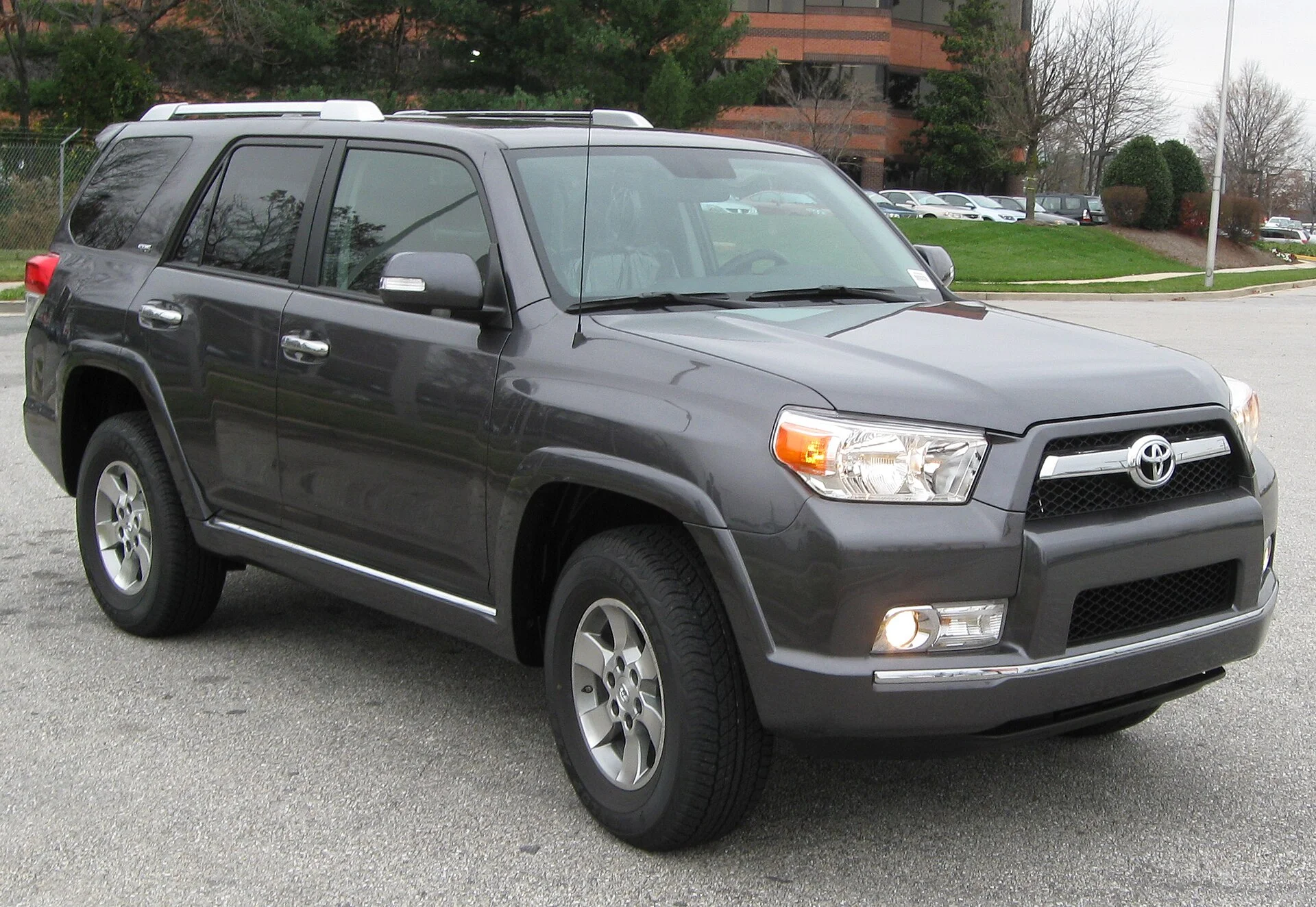
The Real Question Isn't Which Is More Capable
Ask which of these two overlands better and the internet will hand you a spec sheet and a fight. The honest answer is that the Jeep Wrangler Rubicon and the Toyota 4Runner are built to win different halves of the same trip, and the spec that decides it is not the one people argue about. The Wrangler wins the trail. The 4Runner wins the camp. Which matters more is a question about your trip, not about the trucks.
The 4-door Wrangler Unlimited Rubicon posts off-road geometry the 4Runner cannot touch: a 44-degree approach angle, 30 inches of factory-rated water fording, and 10.8 inches of ground clearance. The 5th-gen 4Runner answers with the numbers that matter once the sun goes down: 89.7 cubic feet of flat cargo behind a folded second row, a 5,000-pound tow rating on every trim, and roughly 1,710 pounds of payload for gear, water, and a fridge.
This comparison walks the geometry, the livability, and the honest trade in between, so you can match the truck to how you actually travel. The figures here are Toyota's and Jeep's published specs where they publish them, and clearly flagged owner measurements where they do not, because on both trucks a few of the numbers overlanders care about are not on any factory sheet.
Off-Road Geometry: The Wrangler's Home Turf
Start with the angles, because this is where the Wrangler simply wins. The 4-door Wrangler Unlimited Rubicon has a 44-degree approach angle on its standard 33-inch tires and a 37-degree departure angle, both published by Jeep. The 4Runner TRD Pro answers with a 33-degree approach and a 26-degree departure. Those are not close numbers; the Wrangler clears steeper obstacles at both ends of the truck without touching bumpers.
Ground clearance follows the same story: the Wrangler Rubicon sits at 10.8 inches, with certain newer tire configurations advertised up to 12.9 inches, against the 4Runner's 9.6 inches across its trims. And in water, the Wrangler Rubicon is factory-rated to ford up to 30 inches, with Jeep's explicit guidance not to attempt deeper. Toyota, notably, does not officially publish a 4Runner wading depth at all; owners commonly cite roughly 27.5 inches based on past Toyota correspondence, which is an owner-referenced figure, not an OEM rating.
There is one number that goes the 4Runner's way on paper: breakover. The 4-door Wrangler's long 118.4-inch wheelbase drops its breakover angle to 22.6 degrees, lower than the tighter 2-door Rubicon's 27.8 degrees, because a longer truck bridges crests less gracefully. The 4Runner's shorter 109.8-inch wheelbase helps it here. But that single edge does not overturn the Wrangler's commanding lead in approach, departure, clearance, and fording. If your overlanding involves genuinely technical terrain, the Wrangler is the more capable tool, full stop. The Wrangler fording-depth guide goes deeper on the water rating.

Livability: Where the 4Runner Pulls Ahead
Now flip to the half of overlanding that happens with the engine off. The 5th-gen 4Runner, in two-row form, offers 47.2 cubic feet of cargo behind the second row and 89.7 cubic feet with the second row folded. The 4-door Wrangler Unlimited offers 31.7 cubic feet behind the rear seats and 72.4 cubic feet folded. That is a large gap, and it is the gap that decides how much water, food, recovery gear, and sleep system you can carry.
The shape of that cargo matters as much as the volume. The 4Runner's flat load floor with the second row folded gives roughly 43 inches of width between the wheel wells, owner-measured since Toyota does not publish it, and owners note the fold-flat second row lets you roll out sleeping bags in back. The Wrangler's 72.4 cubic feet, by contrast, is tall and boxy rather than long and flat, so its interior sleeping length is short; Wrangler overlanders typically roof-tent or ground-tent rather than sleep inside.
Capacity ratings widen the livability gap. The 4Runner tows 5,000 pounds on every trim and carries about 1,710 pounds of payload. The Wrangler Rubicon with the 3.6L V6 tows 3,500 pounds and carries roughly 1,000 pounds of payload, though the broader Wrangler lineup reaches up to about 1,381 pounds and some non-Rubicon 4-door trims tow up to 5,000 pounds. For a build loaded with a rooftop tent, a fridge, water, and recovery gear, the 4Runner's higher payload is a real margin, not a rounding error. The 4Runner sleeping-platform dimensions show how that cargo bay turns into a bed.
Sleeping Inside vs Sleeping On Top
This is the practical fork most overlanders actually decide on. The 4Runner is a truck you can sleep inside. Fold the second row flat and the load floor is long enough to sleep diagonally, though owners report it needs seatback padding to level, since Toyota does not publish a flat sleeping length. With a simple platform or a thick pad, the 4Runner becomes a weatherproof bedroom you can use in a storm without leaving the vehicle.
The Wrangler pushes you outside. Its interior cargo is tall and short, so owners overwhelmingly sleep in a rooftop tent or a ground tent rather than inside. That is not a flaw, it is a different philosophy: a rooftop tent turns the Wrangler's excellent trail capability into a basecamp that sits above the ground, dry and level, wherever the trail ends. But it means your sleep system lives on the roof, adding height, weight, and a setup step every night.
The decision comes down to climate and style. If you overland where weather turns fast and you value being able to button up inside without pitching anything, the 4Runner's interior sleeping is a genuine advantage. If you prefer a tent's space and view and do not mind the nightly setup, the Wrangler's rooftop approach is proven and popular. Neither is wrong; they are answers to different questions about how you want to spend the night.
There is also a security and stealth angle some overlanders weigh. Sleeping inside the 4Runner leaves no exterior sign you are there and lets you move at a moment's notice without breaking down a tent, which matters on a roadside pullout or a marginal camp. The Wrangler's rooftop tent is unmistakable and takes minutes to strike, a fair trade for its comfort but a real difference when a quiet, low-profile night is what you want.
Range, Efficiency, and the Long Haul
Overlanding is as much about the highway miles between trails as the trails themselves, and here the two are closer than their images suggest. The 5th-gen 4Runner's 4.0L V6 is EPA-rated at 16 mpg city, 19 mpg highway, and 17 mpg combined. The 4-door Wrangler Unlimited Rubicon's 3.6L V6 automatic is rated at approximately 17 mpg city, 23 mpg highway, and 19 mpg combined. On paper the Wrangler is marginally more efficient, especially on the highway.
In the real world, both are thirsty trucks with boxy shapes and heavy drivetrains, and a loaded overland build with a rooftop tent and knobby tires erodes both figures. The takeaway is not that one sips fuel; it is that neither does, and your range planning should assume frequent fuel stops on a long remote route regardless of which you drive.
Wheelbase shapes the highway experience too. The Wrangler's longer 118.4-inch wheelbase gives it a slightly more settled ride at speed than its reputation suggests, while the 4Runner's 109.8-inch wheelbase is tidy and familiar. Both are trucks you tolerate on the interstate to enjoy off it, and both reward a build focused on comfort for the long transit days that bookend the good parts.
The efficiency gap also interacts with payload in a way worth planning around. The 4Runner's roughly 1,710-pound payload lets you carry more fuel and water without overloading, which partly offsets its slightly worse mileage on a long remote leg. The Wrangler's lower Rubicon payload means every extra gallon of carried fuel competes with your tent and gear for the same weight budget. On a trip measured in days between fuel stops, the truck that carries more can sometimes go further even while burning a touch more per mile.
Building Each One Out for Overlanding
Both trucks have deep aftermarket support, but they reward different builds. The Wrangler's strength is that its trail capability is mostly there from the factory in Rubicon form, so a build focuses on the camp: a rooftop tent, a rear storage system, and power. Its payload ceiling around 1,000 pounds on the Rubicon means you budget weight carefully, especially with a heavy rooftop tent and a full fridge.
The 4Runner's build leans the other way. Its livability is there from the factory, so a build tends toward protection and capability: skid plates, sliders, and tires to close some of the geometry gap with the Wrangler. Its higher roughly 1,710-pound payload gives you more room to add that armor plus a full interior sleep-and-storage system without running out of margin.
Weight discipline plays out differently on each too. On the Wrangler, a heavy rooftop tent lives high and eats into a modest payload, so builders lean toward lighter tents and minimal interior storage to stay under the roughly 1,000-pound Rubicon ceiling. On the 4Runner, the same rooftop tent leaves more headroom, and many owners skip it entirely in favor of an interior sleep platform that keeps weight low and the center of gravity planted, which the 4Runner's taller payload comfortably allows.
Whichever you choose, plan the recovery kit early, because the truck that goes further off pavement needs the gear to get itself back. A set of traction recovery boards and a proper kinetic strap belong in either build before the fancy accessories, since a stuck truck a long way from help is the one problem no amount of cargo volume solves.
The Honest Reality-Check on the Numbers
Overlanding forums quote these two trucks' specs with more confidence than the manufacturers do, so it is worth being straight about what is published and what is not. Jeep publishes the Wrangler's approach, departure, breakover, clearance, and 30-inch fording figures outright. Toyota publishes the 4Runner's clearance, cargo, tow, and payload, but does not publish a wading depth or a flat sleeping length at all.
That means the 4Runner's commonly cited roughly 27.5-inch fording number is owner-referenced, not a Toyota rating, and its interior sleeping dimensions are owner-measured. Treat those as directional, not gospel, and never push a 4Runner to a water crossing on the strength of a forum number the way you can trust the Wrangler's factory 30-inch rating. When the maker declines to publish a limit, the honest move is caution, not confidence.
The livability numbers, happily, are all OEM-published on both trucks, so the 89.7-versus-72.4-cubic-foot cargo gap and the 5,000-versus-3,500-pound tow gap are solid ground to plan on. Build your decision on the published figures, and treat the unpublished ones as the reason to leave a margin.
This distinction matters most at a water crossing, where the difference between a published rating and a forum number is the difference between a calculated risk and a gamble. Jeep tells you the Wrangler handles 30 inches and to stop there, so you can plan a crossing against a real limit. Toyota's silence on the 4Runner means the responsible ceiling is lower and fuzzier, and a hydrolocked engine is not a mistake you get to undo. When in doubt, walk the crossing first and let the deepest verified number, not the boldest forum claim, set your line.
Who Should Buy the Wrangler
Buy the Wrangler Rubicon if the terrain is the point. If your overlanding routinely involves rock crawling, deep water, steep approaches, and obstacles that punish a lesser truck, the Wrangler's 44-degree approach, 37-degree departure, 30-inch fording, and 10.8-inch clearance are capability you will actually use, not bragging numbers. It gets you places the 4Runner has to turn around at.
The Wrangler also suits the overlander who has made peace with sleeping on the roof or in a tent and wants a basecamp vehicle rather than a mobile bedroom. Paired with a good rooftop tent, it is one of the most capable and iconic overland platforms sold, and its removable doors and roof add an open-air dimension no 4Runner offers.
Accept its trade-offs going in: a modest roughly 1,000-pound Rubicon payload that demands weight discipline, a 3,500-pound tow rating that limits trailers, and interior cargo too tall and short to sleep in. None of those matter if the trail is why you are out there. If it is, the Wrangler is the right truck.

Who Should Buy the 4Runner
Buy the 4Runner if the camp is the point. If your overlanding is more about reaching remote places, carrying a lot of gear, and sleeping comfortably than about conquering technical obstacles, the 4Runner's 89.7 cubic feet of flat cargo, 5,000-pound tow rating, and roughly 1,710-pound payload are the specs you will lean on every single trip. It is a truck built to live out of.
The 4Runner especially suits overlanders who want to sleep inside. Its fold-flat second row and long load floor make a weatherproof interior bed with a simple platform, which is a real advantage in fast-changing weather or when you would rather not pitch a tent after a long day. Its higher payload leaves room for the armor and tires that narrow the off-road gap with the Wrangler.
Accept that it will turn around where the Wrangler presses on, because 9.6 inches of clearance and an unpublished wading depth are real limits on hard terrain. For the vast majority of overland travel, which is dirt roads and remote camps rather than rock gardens, those limits rarely bite, and the 4Runner's livability pays off every night. Compare their water limits directly in the 4Runner fording-depth guide.
The Verdict: Match the Truck to the Trip
There is no overall winner here, only a right answer for your trip. The Wrangler Rubicon is the more capable off-road truck by a clear margin: a 44-degree approach, 30-inch fording, and 10.8-inch clearance are real, published advantages that let it go where the 4Runner cannot. If technical terrain is your overlanding, it is the truck.
The 4Runner is the more livable overland vehicle by an equally clear margin: 89.7 cubic feet of flat, sleepable cargo, 5,000 pounds of towing, and roughly 1,710 pounds of payload make it a mobile basecamp you can load heavy and sleep inside. If reaching remote camps and living well once you are there is your overlanding, it is the truck.
Decide honestly which half of the trip you spend more of yourself on. The specs that feel exciting in a showroom, the approach angles and fording depths, matter on a fraction of most overland miles; the specs that feel boring, the cargo volume and payload, matter on all of them. Choose the truck that wins the half you live in, and you will not second-guess it on the trail or in the tent.