
Understanding Dash Cam Features Crucial for RV Travel
A dash cam for your RV is your silent co-pilot, recording every mile of your journey. It's not just for catching epic sunsets, though it can do that. This little gadget is your digital witness, ready to back you up when things get dicey on the road.
A dash cam for your RV is your silent co-pilot, recording every mile of your journey. It's not just for catching epic sunsets, though it can do that. This little gadget is your digital witness, ready to back you up when things get dicey on the road.
I learned this the hard way after a fender bender in a dusty Nevada campground that could have cost me a fortune if I didn't have the footage.Dash Cams for RVs: Your Trusted Witness. It captures high-definition video, often with wide-angle views and even front and rear cameras, ensuring you don't miss a thing. Think of it as your RV's black box, but way cooler.Things to Consider When Buying an RV Dash Cam.
The Core Answer
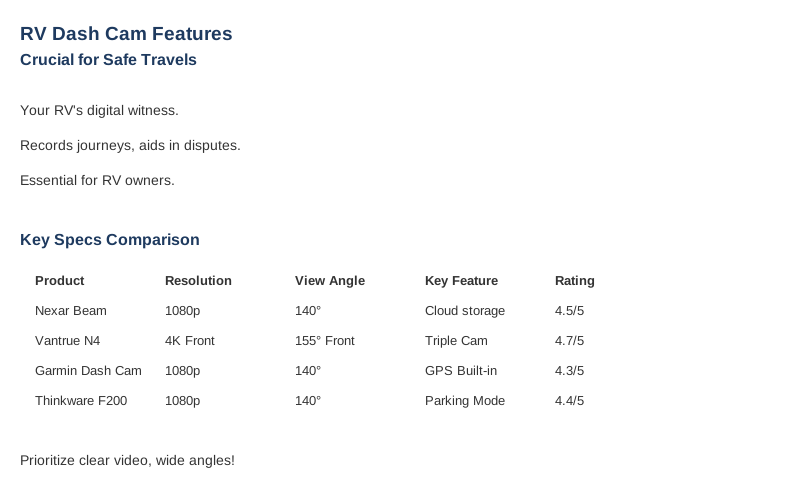
When you're looking at dash cams, the most important thing is video quality. I mean, what's the point if you can't even read the license plate of the guy who cut you off?Things to Consider When Buying an RV Dash Cam. You want something that records clearly, even when the sun is blinding you or it's pitch black outside.Resolution is the jargon for that. For an RV, you're probably going to want at least 1080p, which is Full HD. Some go up to 4K, which is super sharp, but honestly, for most situations, 1080p is plenty. I learned that the hard way trying to save a buck on a cheap camera that looked like it was filmed on a potato.
Then there's the viewing angle. Your RV is a big rig, right? You need a camera that sees a wide swath of the road, not just a tiny tunnel vision view. Think 140 degrees or more. Anything less and you're just asking for trouble, like missing that motorcycle weaving through traffic.
Night vision is another big one. Driving at night is always a gamble, and if something happens, you need that footage to be usable. Look for cameras with good low-light performance or specific night vision modes. My first attempt at night driving with a cheap dash cam was basically a grainy mess that proved nothing.
Parking mode is also a game-changer. If someone bumps your RV while it's parked, the camera can detect the impact and start recording. This is crucial when you're at a campsite or parked on the street. I once had a shopping cart roll into my RV at a rest stop, and the camera caught it all, saving me a repair bill.
A G-sensor is basically a shock sensor. If the camera detects a sudden jolt, like during a crash, it automatically saves the current recording so it doesn't get overwritten. This is non-negotiable. It's like having an automatic emergency save button.
GPS tracking is pretty neat too. It embeds your location and speed into the video footage. This can be super helpful for proving where an incident occurred or even just for reliving a scenic drive later. I found myself checking my speed after a ticket once, and the GPS data was the only thing that cleared me.Things to Consider When Buying an RV Dash Cam.
Finally, consider if you need multiple cameras. Some systems come with a front and rear camera, which gives you a much more complete picture. For an RV, a rear camera can be incredibly useful, especially when backing up or dealing with traffic behind you.Dash Cams for RVs: Your Trusted Witness.
Why This Matters for Your Setup
- Video Quality: You need to be able to see details, like who's driving the car that just tailgated you for 10 miles. I once had a camera that made everything look like a blurry watercolor painting. Rookie mistake.
- Viewing Angles: Your RV is big. You need a camera that sees wide, like 140 degrees or more, so you don't miss anything happening on the sides. It's like trying to watch a football game from the nosebleed seats if the angle is too narrow.
- Night Vision: Driving after dark is a whole different ballgame. If something happens, you need that footage to be clear enough to see what's going on. My first night recording looked like a grainy horror movie, not helpful at all.
- Parking Mode: This is clutch. If someone dings your RV while you're inside watching TV, the camera can kick on and record it. I've heard horror stories of people waking up to damage and no idea who did it.
- G-Sensor: This is the camera's built-in 'uh oh' detector. If it senses a crash, it locks the recording so you don't lose that crucial evidence. It's like an automatic save for your most important footage.Things to Consider When Buying an RV Dash Cam.
- GPS Tracking: This embeds your location and speed into the video. It's super helpful for proving where you were or just for remembering that amazing scenic route you took.
- Multiple Cameras: Some systems offer front and rear cameras. For an RV, a rear camera is a lifesaver for parking and avoiding those unexpected cyclists.
Making the Right Choice
- Don't skimp on resolution. You need clear footage, especially for RVs where details are crucial. Think 1080p minimum.
- A wide viewing angle is non-negotiable for capturing everything around your large vehicle. Aim for 140 degrees or more.
- Make sure it has good night vision and parking mode. These features are essential for catching incidents at any time.
- A G-sensor is your best friend for automatically saving critical accident footage. Don't overlook this safety net.
- GPS tracking adds valuable context to your recordings, proving location and speed. It's a small detail that can make a big difference.
- Consider if a dual-camera system (front and rear) is worth it for your RV setup. It offers a more complete view of your surroundings.
Frequently Asked Questions
If I get a cheap dash cam for under $50, will it really be useless for my RV?
Do I really need a fancy dash cam with GPS, or can I just check my phone's map history?
What if my dash cam records crystal clear video, but the sound is all garbled and useless?
Can a dash cam permanently damage my RV's electrical system if I wire it incorrectly?
I heard that dash cams are only good for catching accidents, but my RV is mostly for scenic drives. Is that true?
🏅 Looking for Gear Recommendations?
Check out our tested gear guides for products that work with this setup: