Where to Start
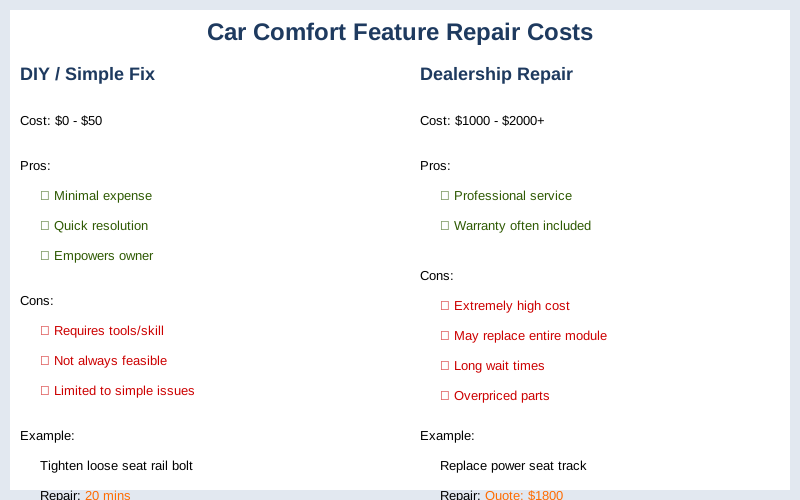
The dealer quoted me $1800 to fix a power seat on a 2017 F-150. The motor was fine. The problem was a 10mm bolt that vibrated loose from the seat rail, allowing 2mm of lateral play. This caused the nylon gear to bind under load. I found the loose bolt in 20 minutes with a flashlight and a socket wrench. They wanted to replace the entire seat track assembly. Absolute garbage.
Car comfort features, like power seats, heated steering wheels, or infotainment screens, are often designed with a specific service life, and that life rarely aligns with the rest of the vehicle. When they fail, the repair costs can skyrocket. It's not always about a complex electrical failure; sometimes it's a simple mechanical stress point that was overlooked in the CAD model.
I've seen infotainment screens die from a single thermal cycle crack in a solder joint, costing over $1200 to replace the whole head unit. The actual component failure might be a 5-cent capacitor, but the manufacturer designed it as a sealed, non-serviceable module. Brilliant engineering, if your goal is selling parts.
These comfort features are often expensive because they integrate multiple systems. A heated seat isn't just a heating element; it's a sensor, a thermostat, a wiring harness, and a control module, all designed to fail as one expensive unit. The average car repair cost can easily jump over $900 per year, and a significant chunk of that is often for these 'non-essential' items.
California, Hawaii, and New Jersey are some of the priciest places for repairs, so expect those numbers to climb even higher there.
My approach? Diagnose the actual failure mode. Is it a broken wire, a seized motor, or a thermal fatigue crack? Then, figure out the cheapest, most mechanically sound way to fix it, even if it means bypassing a 'smart' module with a simple relay. Don't pay for an entire assembly when only one component failed.
Understanding repair costs for damaged car comfort features
You're looking at an average of $838 to fix your car, according to Kelley Blue Book data. A good chunk of that isn't for critical drivetrain components, but for comfort features. Think about it: a broken power window motor, a dead heated seat, or a glitchy infotainment screen. These aren't just annoyances; they're often complex electromechanical systems with their own failure modes.
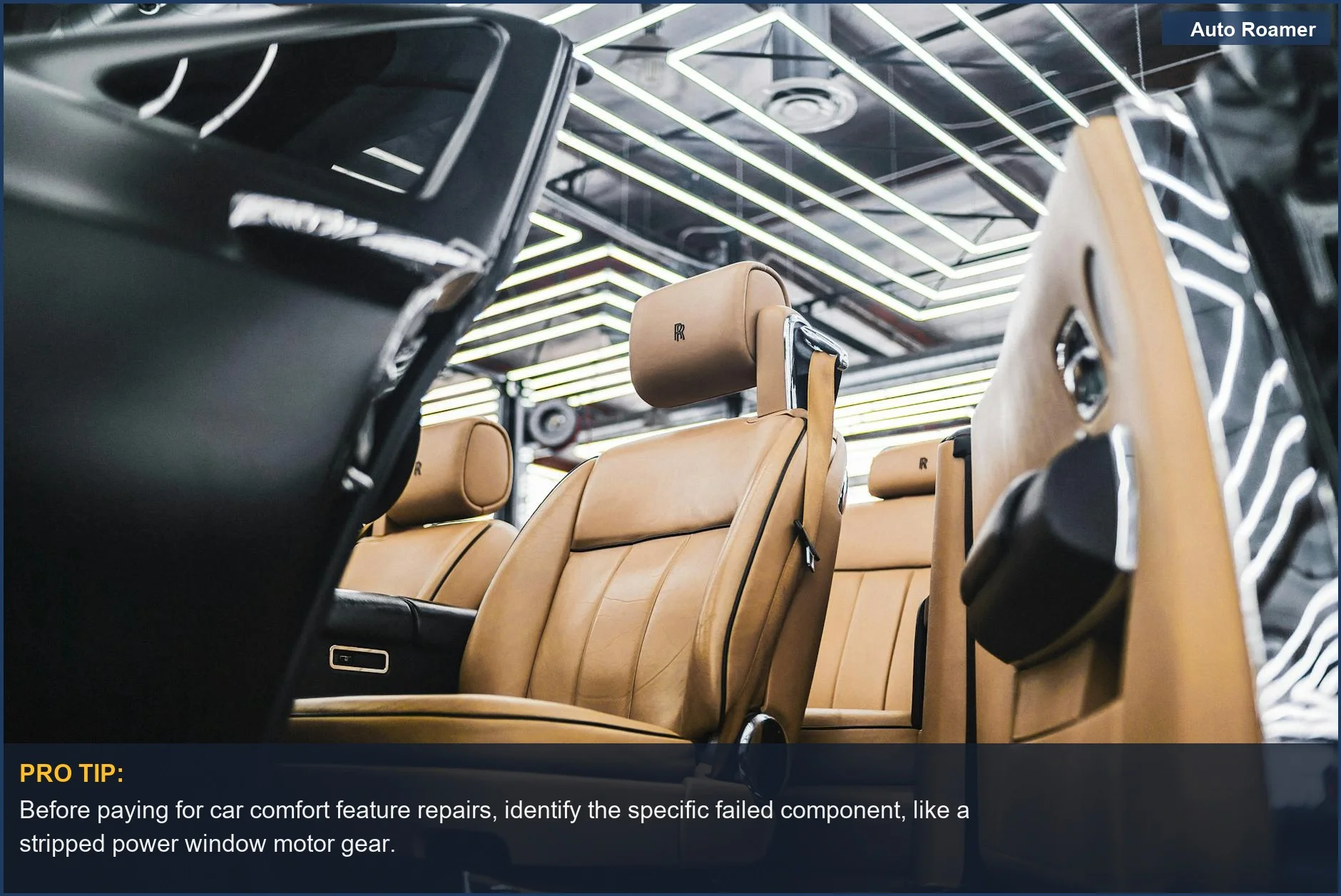
Take a power window, for instance. It's not just a switch. You've got a DC motor, a gear reduction unit, a cable or scissor mechanism, and a control module. The motor itself might seize from bearing failure due to water ingress, or the plastic gear teeth could shear off from repeated high-load cycles. The cable can fray and bind, or the glass regulator itself can bend. Each failure requires a different approach.
Heated seats often fail due to thermal cycling. The resistive heating element, usually a thin wire, expands and contracts. This causes mechanical stress on its attachment points and insulation. Eventually, a micro-fracture develops, leading to an open circuit. The dealer wants to replace the entire seat bottom for $500. You might find the break with a multimeter and solder it for $5, if you can access it without destroying the upholstery.
Infotainment systems are a different beast. These are miniature computers with touchscreens. They fail from thermal stress on solder joints, power fluctuations, or outright software glitches. The screen itself can crack from impact or internal stress. A replacement head unit can run you $1200-$2000, and that's before labor. Consumer Affairs reports annual repair costs over $900, which includes these types of issues.
The key is understanding the root cause. Is it electrical, mechanical, or thermal? A wiring harness can chafe through insulation, leading to a short circuit. A plastic gear can strip its teeth from excessive torque. A sensor can fail due to outgassing from nearby plastics contaminating its surface.
Don't just accept the dealer's diagnosis. Their solution is usually 'replace the most expensive module.' My solution is 'find the actual broken part and fix it.' This often involves a $15 multimeter and 30 minutes of diagnostic work, not $500 in new parts.
Even simple things like a faulty climate control blend door actuator can cost $400 to fix. The plastic gears inside often strip. It's a $20 part, but accessing it requires half the dashboard to come out. Labor is the killer here, not the component itself. It's all about cost-per-fix.
Your average annual maintenance budget of $800, as Chime suggests, quickly gets eaten by one luxury feature repair. Budget for these annoyances. They will happen.
repair costs for damaged car comfort features in Detail
Let's break down the actual failure modes and repair costs for common comfort features. Don't just pay up. Figure out what actually broke.
- Power Window Regulator/Motor:
- Failure Mode: The plastic gear teeth inside the motor assembly can strip from repeated high-load operation, especially if the window glass binds in the track. Alternatively, the steel cables can fray, or the guide rollers can seize. Water ingress can corrode the motor windings or seize the bearings.
- Cost: A new motor/regulator assembly typically runs $150-$400 for parts.
Labor is another $100-$300 because it requires removing the door panel, which often involves breaking plastic clips. Collision repair shops often quote higher, combining it with bodywork.
- Dirtbag Fix: If it's just a stripped gear, sometimes you can find aftermarket gear kits for $20 and replace only the gear. If the motor is seized, hit it with a hammer (lightly) and see if it frees up. This is a temporary fix, obviously.
- Heated/Cooled Seats:
- Failure Mode: The heating element, a resistive wire woven into the seat fabric, fails from thermal cycling. Repeated expansion and contraction creates micro-fractures, leading to an open circuit. Cooling elements (Peltier devices) are more robust but can fail from power fluctuations or fan bearing seizure.
- Cost: Replacement heating pads are $100-$300. Labor can be $200-$500 because it involves removing the seat and disassembling the upholstery.
Consumer Reports highlights these as high-cost repairs.
- Dirtbag Fix: If you can locate the open circuit with a multimeter, a small splice with high-temp solder and heat shrink tubing can bring it back. The mechanical stress will be localized, so it might fail again.
- Infotainment System/Head Unit:
- Failure Mode: These are complex. Common failures include thermal fatigue of solder joints on the main circuit board, especially under the CPU or power regulators. The touchscreen digitizer can fail from impact or liquid ingress. Software corruption can also brick the unit.
- Cost: A new OEM head unit is $800-$2500. Labor is usually an hour or two at $100-$200.
Aftermarket units are cheaper, $300-$800, but integration can be a nightmare.
- Dirtbag Fix: If it's a software issue, a hard reset (disconnect battery for 10 minutes) sometimes works. If it's a thermal issue, reflowing solder joints with a heat gun is a risky, temporary fix. High failure-rate, but zero cost.
- Power Door Locks:
- Failure Mode: The solenoid or small DC motor inside the door lock actuator fails. Plastic gears can strip, or the electrical contacts can corrode. The mechanical linkage can also bind.
- Cost: A new actuator is $70-$200. Labor is similar to a window regulator, $100-$250.
- Dirtbag Fix: Sometimes the internal motor is a standard $5 hobby motor. If you're patient enough to crack open the sealed plastic case, you can swap it.
This requires careful plastic welding or epoxy to reseal.
To get an estimate for your specific vehicle, look up the component on an OEM parts site like CarBuzz or RockAuto. Then, call a local independent mechanic, not the dealer, and ask for a labor quote for replacing that specific part. Give them the part number if you have it. Always get two quotes. And remember, the dealer charges for the 'experience' of walking into their fancy showroom, not just the actual wrench time.
Common Questions About repair costs for damaged car comfort features
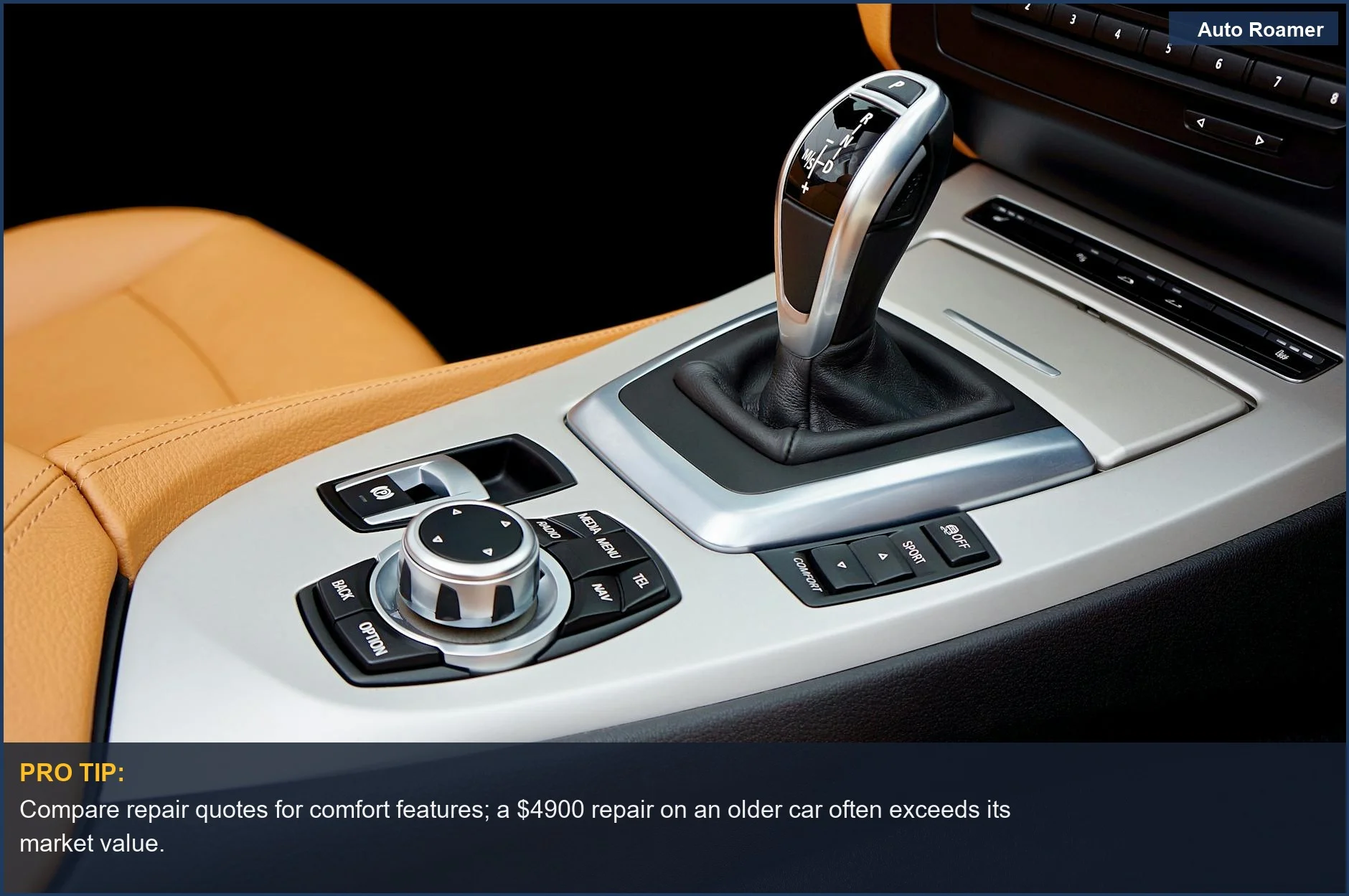
The dealer wanted $4900 for repairs on a 2012 Honda Civic, which is about what the car was worth. This is the point where you question everything. Reddit threads are full of people facing this dilemma.
My heated steering wheel stopped working, but the horn still works. Is it just a fuse?
Probably not. The heating element circuit is separate from the horn. If it was just a fuse, nothing would work. The most common failure mode for a heated steering wheel is a broken clock spring, which is a coiled ribbon cable that carries electrical signals and power from the steering column to the wheel.
Repeated rotation causes fatigue in the conductors, leading to an open circuit. The clock spring itself is about $100-$200. Labor is another $100-$200.
My power seat moves forward but not backward. Is the motor shot?
Not necessarily. Power seats use multiple motors and limit switches. If only one direction fails, it often points to a worn-out limit switch contact or a specific winding in the motor failing under load. Test the motor directly by applying 12V in both polarities. If it still only moves one way, then yes, the motor is likely failing due to internal mechanical wear or a partial winding short.
The motor assembly is $150-$300.
The buttons on my steering wheel don't light up. Is this a comfort feature repair?
Yes, this falls under comfort/convenience. This is often a failed LED on the circuit board behind the buttons, or a cracked trace on the flexible circuit board itself. Thermal cycling and tactile wear on the buttons can cause these failures. You can try to replace individual LEDs if you have soldering skills, but it's fiddly. A replacement button cluster is usually $50-$150.
My car's internal lights randomly dim and brighten. Is this a comfort feature failure or something more serious?
This sounds like a voltage regulation issue, not a comfort feature failure. It indicates unstable power delivery, possibly from a failing alternator diode or a bad ground connection. Check your battery voltage with the engine running; it should be consistently around 14.2V. If it fluctuates significantly, you've got a problem with your charging system that needs immediate attention.
This isn't a 'comfort' repair; it's a 'don't get stranded' repair.
My car's automatic climate control only blows cold air, even when set to hot. Is this a big deal?
This is usually a blend door actuator failure. A small plastic gear inside the actuator strips, or the motor seizes, preventing the blend door from moving to direct air over the heater core. The actuator itself is $30-$70. The labor can be $200-$600, depending on its location behind the dash. Access is the problem, not the part.
Budgeting for unexpected repairs is key for these kinds of issues.
Tips and Best Practices
Don't let the dealer fleece you. These comfort feature repairs are often ripe for DIY or a competent independent shop. CarBuzz points out how complex modern cars are, but that doesn't mean you're helpless.
- Diagnose the Actual Failure: Before you even think about costs, figure out what broke. Is the power window motor dead, or is the switch bad? Use a $15 multimeter. Check for continuity. Check for voltage. Is there power getting to the component? Is the component drawing current? This takes 10 minutes and saves hundreds.
- Source Parts Independently: Don't buy parts from the dealership unless absolutely necessary. For components like window regulators, seat motors, or even infotainment screens, aftermarket parts from RockAuto or eBay are often 50-70% cheaper. Just make sure the fitment is exact. Facebook groups are full of people sharing part numbers.
- Consider Used/Salvaged Parts: For expensive modules like infotainment head units or complex control modules, a reputable salvage yard is your friend. You can often find OEM parts for 20-30% of new cost. Verify compatibility meticulously - VIN numbers, part numbers, and software versions.
- Find a Specialist Independent Mechanic: If it's beyond your wrenching skills, seek out an independent shop that specializes in electrical or interior work. They often have lower labor rates ($80-$120/hour) compared to dealers ($150-$200/hour) and are more willing to install customer-supplied parts.
- Understand Mechanical Stress Points: Many comfort features fail due to mechanical stress. Power seats have plastic gears that strip. Window regulators have cables that fray. Look for wear patterns, binding, or excessive play. Sometimes a simple shim or lubrication can extend the life of a component that's just barely out of tolerance.
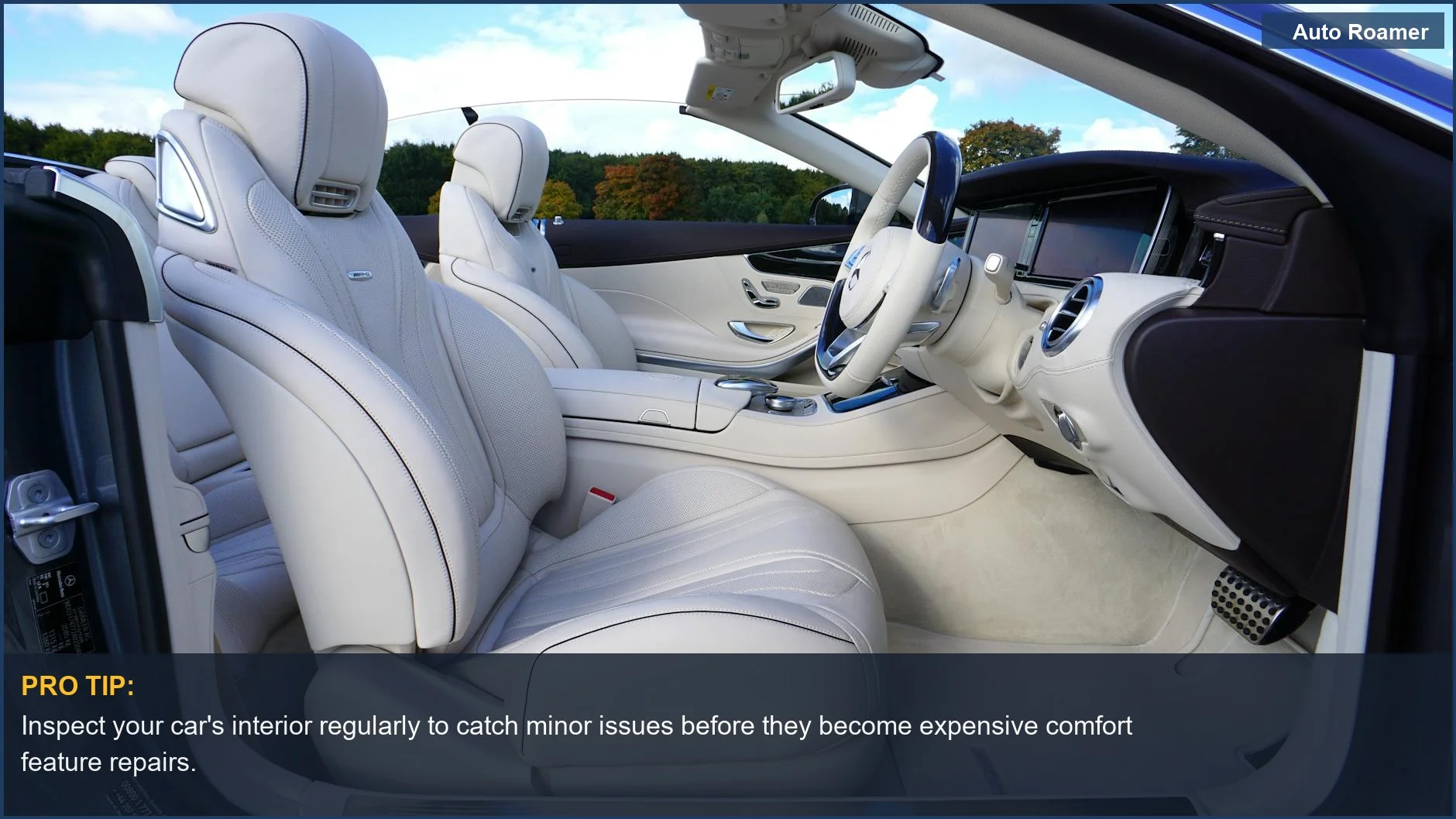
- Preventative Maintenance (Where Possible): For power windows, keep the tracks clean and lubricated with silicone spray. This reduces friction and mechanical stress on the motor. For heated seats, avoid putting heavy, pointed objects on them that can stress the heating elements. Don't slam doors - the shock load can damage electronics. Basic physics.
- Know When to Walk Away: If a repair quote for a comfort feature exceeds 50% of your vehicle's value, it's time to seriously consider if that feature is worth it. A 2010 Civic with a dead heated seat isn't worth a $500 repair. Live without it. Your wallet will thank you.
Don't be afraid to get your hands dirty. A $5 torx bit set and an hour of your time can save you hundreds.
Real-World Examples
I had a 2015 Jeep Cherokee with a passenger side power seat that wouldn't recline. The dealer quoted $950 for a new seat track assembly.
Cost of Repair: $950 (dealer quote) vs. $20 (my fix)
Failure Mode: A small plastic bushing, 5mm in diameter, had disintegrated from thermal cycling and mechanical wear, causing a connecting rod to pop out of its socket. The motor was fine, just disconnected.
Dirtbag Fix: I fabricated a new bushing from a piece of high-density nylon scrap, secured the rod, and used a zip-tie as a fail-safe. It's ugly, but it works. The mechanical bond is solid.
My buddy's 2018 Subaru Outback had a dead rear heated seat. Dealer wanted $600 for a new seat bottom.
Cost of Repair: $600 (dealer quote) vs. $10 (my fix)
Failure Mode: The heating element wire, accessible under the seat cushion, had a clear open circuit where a kid's car seat base had compressed it. The resistance reading was infinite across the break.
Dirtbag Fix: I stripped back the insulation, twisted the broken wires together, soldered them, and used high-temp heat shrink. The electrical conductivity is restored.
The mechanical stress point is still there, so I told him to put a piece of plywood under the car seat.
A 2016 Ford Escape came in with a non-functional driver's side power lumbar support. Dealer said $750 for a new seat frame.
Cost of Repair: $750 (dealer quote) vs. $80 (my fix)
Failure Mode: The air bladder itself had a slow leak around the hose fitting, losing air pressure over an hour. The pump and valve were fine.
Dirtbag Fix: I found a universal air bladder repair kit online for $80, which included a new bladder and hose clamps. I bypassed the leaky factory fitting with a direct connection and a liberal amount of RTV silicone.
The seal is now robust; the system holds 20 PSI for days. Insurify reports average maintenance costs of $792 per year, so these kinds of fixes keep you under budget.
My own 2019 Toyota Tacoma developed a rattling passenger window. Dealer wanted $400 for a new regulator.
Cost of Repair: $400 (dealer quote) vs. $0 (my fix)
Failure Mode: The glass had 1mm of lateral play in its lower channel, causing a vibration frequency at highway speeds.
Dirtbag Fix: I wedged a thin piece of rubber weatherstripping into the channel. The shim eliminated the play, stopping the rattle. Zero cost, 5 minutes of work. It's all about finding the actual point of failure.
Key Takeaways
Don't let the 'comfort' in comfort features fool you into thinking the repairs are soft on your wallet. They're often complex electromechanical systems with their own specific failure modes.
- Pinpoint the Physics: Is it a broken wire (circuit integrity), stripped gear (mechanical stress), or cooked solder joint (thermal cycling)? Understand the why behind the failure.
- Dealer Markup is Real: Expect to pay 2-3x more at a dealership for parts and labor. They replace entire assemblies, even for a 5-cent component failure.
- DIY or Independent: Many comfort feature repairs are accessible for a competent DIYer with basic tools and a multimeter.
If not, find a reputable independent mechanic.
- Parts Sourcing: Aftermarket or quality used OEM parts can save hundreds, if not thousands, on expensive components like infotainment systems or seat assemblies.
- Cost vs. Value: Weigh the repair cost against the vehicle's actual market value. Sometimes, living without a heated seat is the financially smarter move.
These systems are designed for convenience, not necessarily durability or ease of repair. Your job is to bypass their over-engineered solutions with common sense and a wrench. Some cars are just too expensive to repair these days, so know when to cut your losses.