Car Safety

How to Parallel Park Without Hitting the Curb (2026 Complete Guide)

Auto Roamer
12 min read
Prices verified February 2026
Includes Video

You're inching along a busy street, the car behind you is getting impatient, and the only open spot is a tight one next to a curb. Your stomach tightens. The last thing you need is that sickening scrape or, worse, a jarring thud as your tire meets concrete.

You're inching along a busy street, the car behind you is getting impatient, and the only open spot is a tight one next to a curb. Your stomach tightens. The last thing you need is that sickening scrape or, worse, a jarring thud as your tire meets concrete. Hitting the curb isn't just embarrassing; even at 5-10 mph, it can damage your car's alignment, potentially causing your steering to pull to one side Step-by-Step Guide for Parallel Parking with Cones in 2026. This is precisely why mastering how to parallel park without hitting the curb is a non-negotiable skill for any driver. Forget the anxiety; with the right technique, you can slide into that spot with confidence. This guide breaks down the process, focusing on the precise movements and visual cues that prevent curb collisions, turning a stressful maneuver into a smooth operation You Don't Need to Sweat Parallel Parking - Car and Driver. We're going to tackle the common pitfalls that lead to curb contact and equip you with practical tips for perfect parallel parking every time.

The Short Answer

Parallel parking without hitting the curb hinges on a precise spatial awareness and a deliberate, controlled approach. The core mental model is to treat the maneuver as a series of controlled arcs, rather than a single, rushed action.

The fundamental principle is to use the car's pivot points to your advantage. Instead of trying to force the car into the space, you guide it. Imagine your car as a pendulum; understanding its swing will help you avoid that dreaded scrape against the curb.

Begin by aligning your vehicle alongside the car you intend to park behind. Aim to have your front bumper roughly even with their rear bumper, and ensure your vehicle is parallel to the curb. This initial alignment is crucial for setting up the subsequent steps correctly. Turn on your right turn signal to alert other drivers of your intentions.

When reversing, the key is the angle. Start by turning your steering wheel sharply towards the curb. As you begin to back up, watch your side mirrors. You want to create a path that allows your rear bumper to clear the car in front, while your front end swings inward. The goal is to get your car into a position where you can see your passenger side mirror align with the rear bumper of the car in front of you. From this vantage point, you're ready for the next crucial adjustment.

Once you've reached this intermediate angle, begin to straighten your wheels while continuing to reverse slowly. This action will bring the front of your car closer to the curb. Continue backing until your vehicle is parallel to the curb and the correct distance away. If you find yourself too close, you can always pull forward slightly and make minor steering adjustments to reposition.

Remember, even a gentle impact with the curb can cause damage, potentially affecting your car's alignment Step-by-Step Guide for Parallel Parking with Cones in 2026. Practicing in a low-traffic area, perhaps with cones as markers, can build the muscle memory needed to execute these steps smoothly. The more you practice, the more intuitive understanding your car's dimensions and turning radius becomes, making parallel parking feel significantly less daunting.

Once you've mastered backing into a spot, you might want to refine your skills by learning how to parallel park effectively.
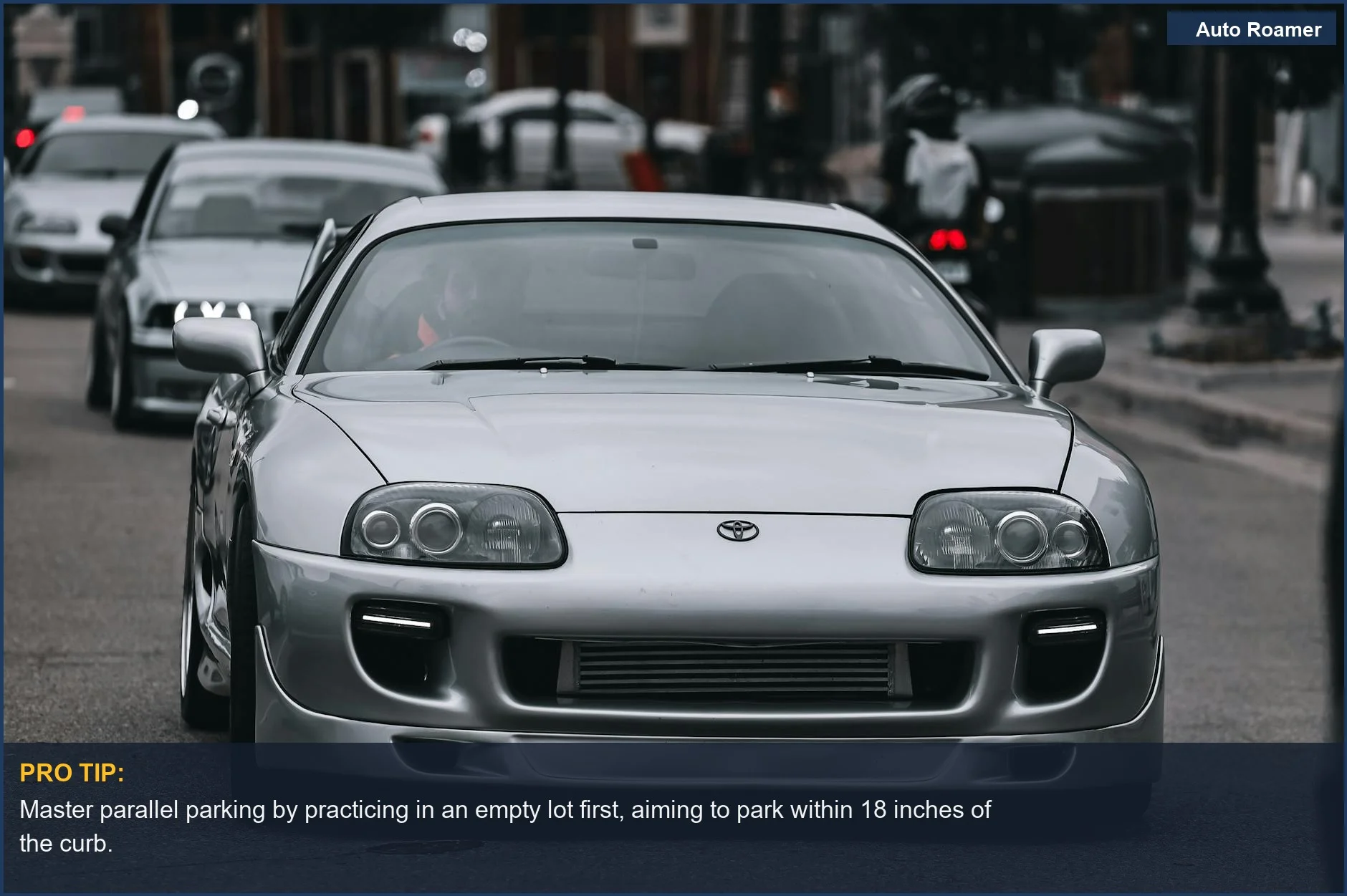
Master parallel parking by practicing in an empty lot first, aiming to park within 18 inches of the curb.
A silver Toyota Supra glides through city streets, a perfect example of urban driving. Learning how to parallel park efficiently makes city navigation seamless. | Photo by WAVYVISUALS

What You Need to Know

1
Line up with the car ahead - Pull up alongside the vehicle you intend to park behind. Your front bumper should align roughly with their rear bumper.
2
Check mirrors and signal - Before reversing, check rearview and side mirrors for approaching traffic. Signal your intention to park. Allstate emphasizes signaling early.
3
Begin reversing and turn the wheel - Shift into reverse and back up slowly. As your rear bumper clears the front car's bumper, turn your steering wheel clockwise (towards the curb). Aligning side mirrors with the car ahead can help, especially with similar-sized vehicles, as noted on Reddit.
4
Straighten and continue reversing - When your vehicle is at approximately a 45-degree angle to the curb, straighten your steering wheel. Continue reversing straight back. Watch your passenger-side mirror; when you can see the entire front of the car behind you, or your rear tire is close to the curb, adjust. This YouTube video discusses common issues with curb proximity.
5
Turn the wheel the other way - Turn your steering wheel fully counter-clockwise (away from the curb). Continue to reverse slowly, allowing the front of your car to swing into the space. Aim to get your vehicle parallel to the curb.
6
Adjust and center your vehicle - Once parallel to the curb, pull forward slightly and make small steering adjustments to center your car. Ensure you are not too close to the curb, as hitting it can damage alignment. Driver ITENY mentions hitting a curb can lead to point deductions on a driving test.

Mastering parallel parking enhances driving confidence, especially in urban environments. Avoiding contact with the curb is key.

Vehicle size influences the process. Larger vehicles may require a larger spot and more precise adjustments.

Practice is effective. Using cones or markers in an empty lot helps develop a feel for your car's turning radius and steering timing. This controlled environment reduces pressure. Driver ITENY highlights the benefit of using cones for practice.

Pay attention to parallel park tips. Many drivers struggle with timing their steering or straightening the wheel. Observing your car's position relative to the curb and surrounding vehicles in your mirrors is crucial. Car and Driver suggests starting with less traffic.
Once you've mastered parallel parking, you might also want to learn how to back into a parking spot for added convenience—check out our article on backing into a parking spot.
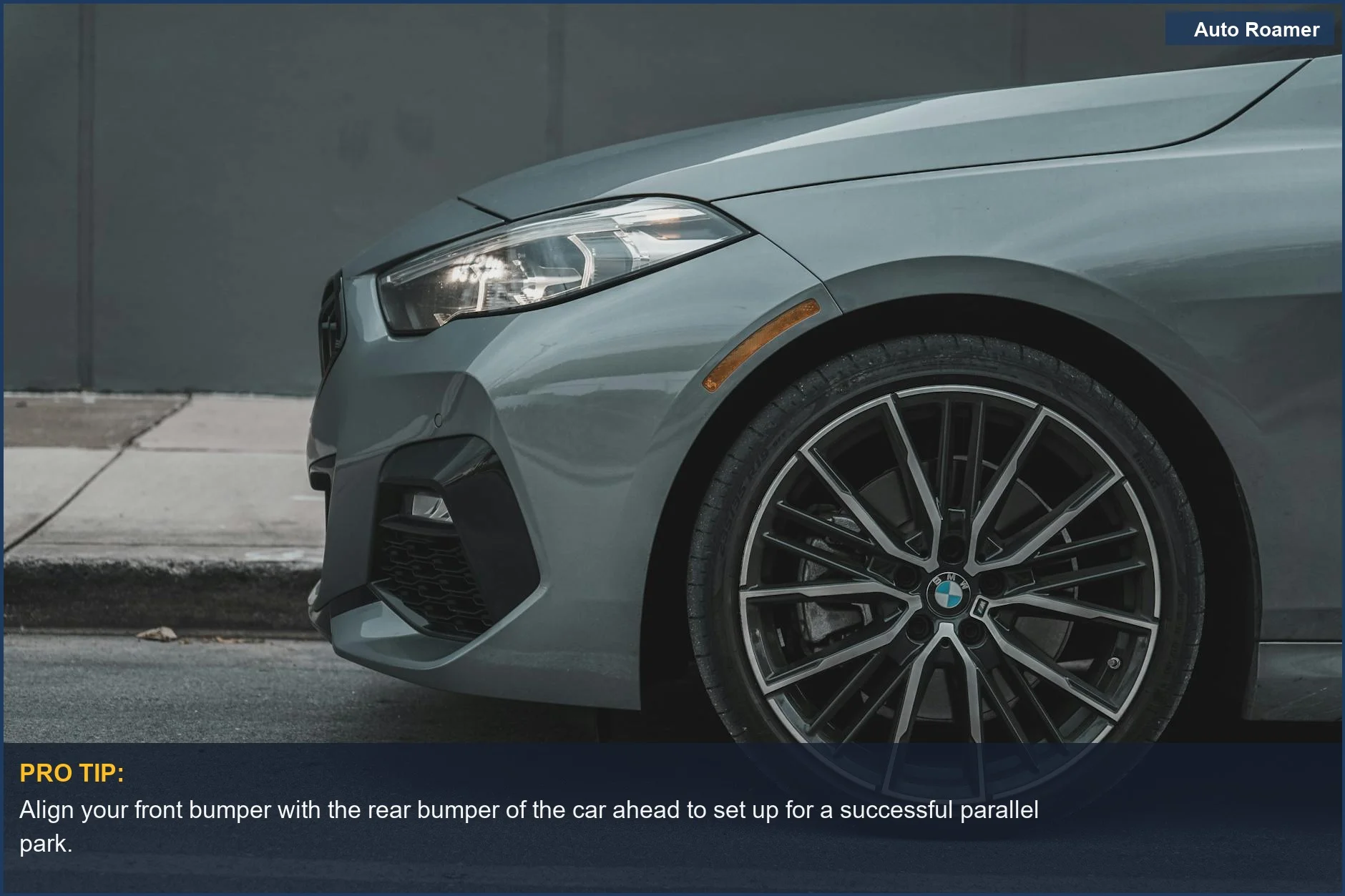
Align your front bumper with the rear bumper of the car ahead to set up for a successful parallel park.
Close-up on a grey luxury car's wheel, highlighting the precise positioning needed. Understanding this alignment is key to mastering parallel parking tips. | Photo by Eduardo Valdes

How to Handle This

1
Align parallel to the vehicle ahead - Pull up alongside the car you intend to park behind, aligning your front bumper with their rear bumper. This positioning is crucial for creating enough space to maneuver. Allstate.
2
Initiate your reverse with a sharp turn - Shift into reverse and turn your steering wheel sharply towards the curb. Back up slowly, watching your side mirrors to angle your vehicle into the parking space.
3
Straighten and continue reversing - As your car angles into the spot, straighten your steering wheel. Continue reversing slowly to move further back into the space without the rear end swinging wide. Fresh 25 - YouTube.
4
Adjust to avoid the curb - Once mostly in the space and parallel to the curb, turn your wheel away from the curb to bring the front of your car closer. Aim to be close to the curb without touching it. Hitting the curb can damage your car's alignment. If too far from the curb, pull forward and repeat reversing with more aggressive turning. Drive Rite Academy.
5
Final positioning and checks - Straighten your wheels when parallel to the curb and at a safe distance from other vehicles. Be close enough to be considered properly parked, but not so close that your tires scrape it. Car and Driver.
In case you encounter a situation where you can't change a tire, knowing how to safely tow a car can be invaluable.
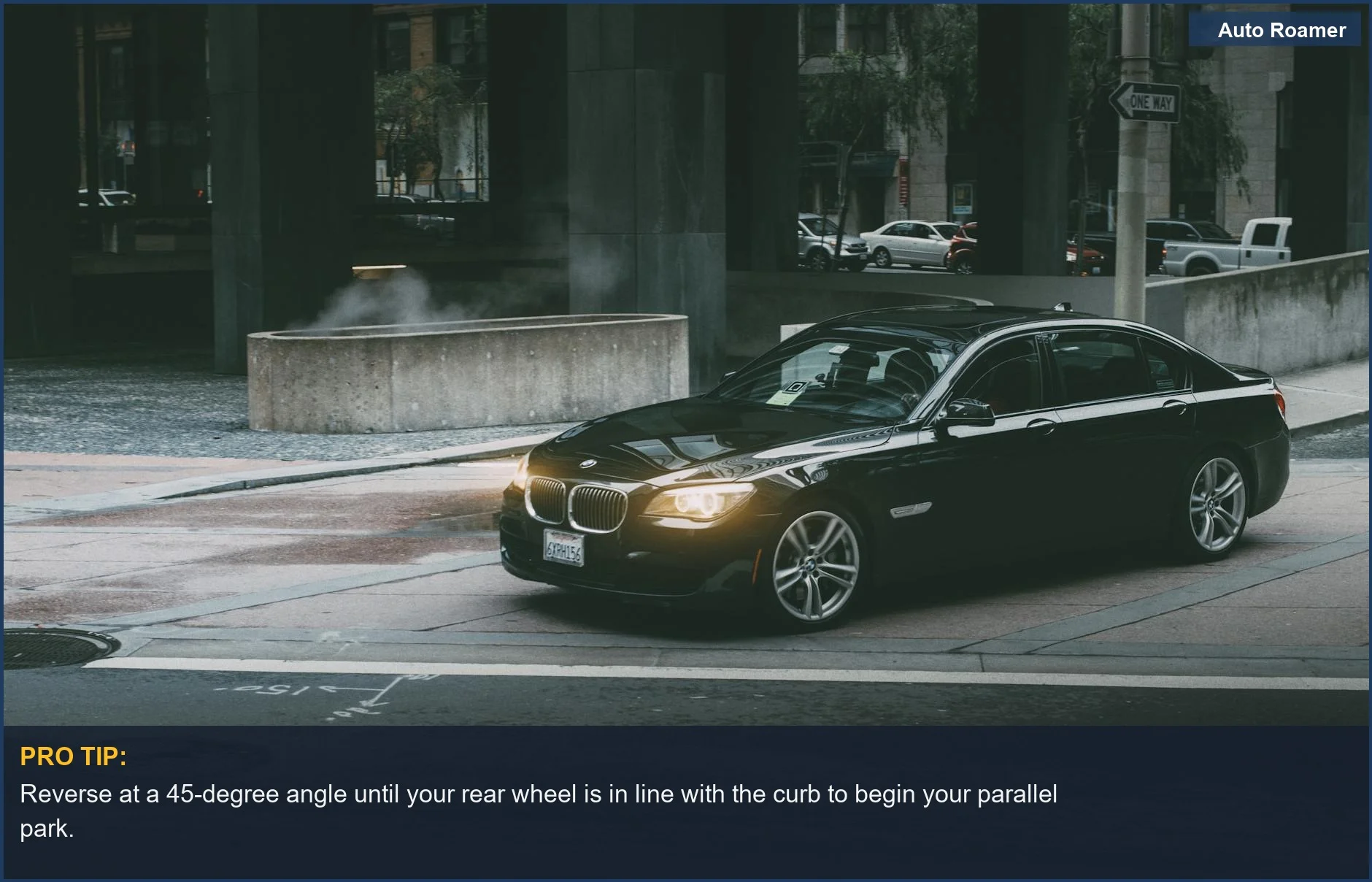
Reverse at a 45-degree angle until your rear wheel is in line with the curb to begin your parallel park.
A stylish black car navigates twilight city streets, showcasing modern design. This scene emphasizes the importance of good visibility when learning how to parallel park. | Photo by Quintin Gellar

What This Looks Like in Practice

  • Rainy Evening, Ford F-150, Narrow Residential Road. A driver struggled to parallel park a large pickup truck on a slick, narrow street, finding it difficult to gauge distance from the curb due to low visibility and wet conditions. Multiple attempts were needed. By carefully inching back and using the side mirror, they eventually parked without scraping, but it required considerable time and focus. This scenario highlights the challenge of parallel parking larger vehicles in adverse weather, demanding extra caution and precise steering. How to Park Without Hitting the Curb - YouTube
  • Sunny Afternoon, Honda Civic, Busy Urban Street. A compact car driver, anxious about hitting the curb due to traffic pressure, overcompensated by leaving too much initial space. Several adjustments were needed, reversing and turning the wheel carefully to bring the car closer without contact. This experience underscored the importance of accurate initial alignment and small, controlled steering inputs during the reverse phase for proper parallel parking. How to Parallel Park: 7-Step Helpful Guide
  • Dusk, Older Model Sedan, Street with Uneven Pavement. Parking on a street with an uneven curb presented a challenge due to varying heights. The driver found relying on the visual cue of the rear tire nearing the curb, rather than a fixed distance, was more effective. Slow, steady reversing with constant observation of the tire's proximity avoided damage, even with inconsistent road surfaces. Parallel Parking: Too far or too close to the curb? Here's how to fix it
  • Bright Morning, Compact SUV, Residential Street with Parked Cars. A driver in a compact SUV misjudged the space between parked cars, angling in too sharply and bringing the rear too close to the curb. They had to pull out slightly and re-attempt, focusing on a smoother arc and straightening the wheels at the correct moment to avoid scraping. This situation demonstrated the crucial role of understanding your vehicle's turning radius in confined parallel parking areas. How to NOT Hit a Curb While Parallel Parking | Fresh 25 - YouTube
Once you've mastered roundabouts, you'll want to feel equally confident when it's time to merge onto the highway.
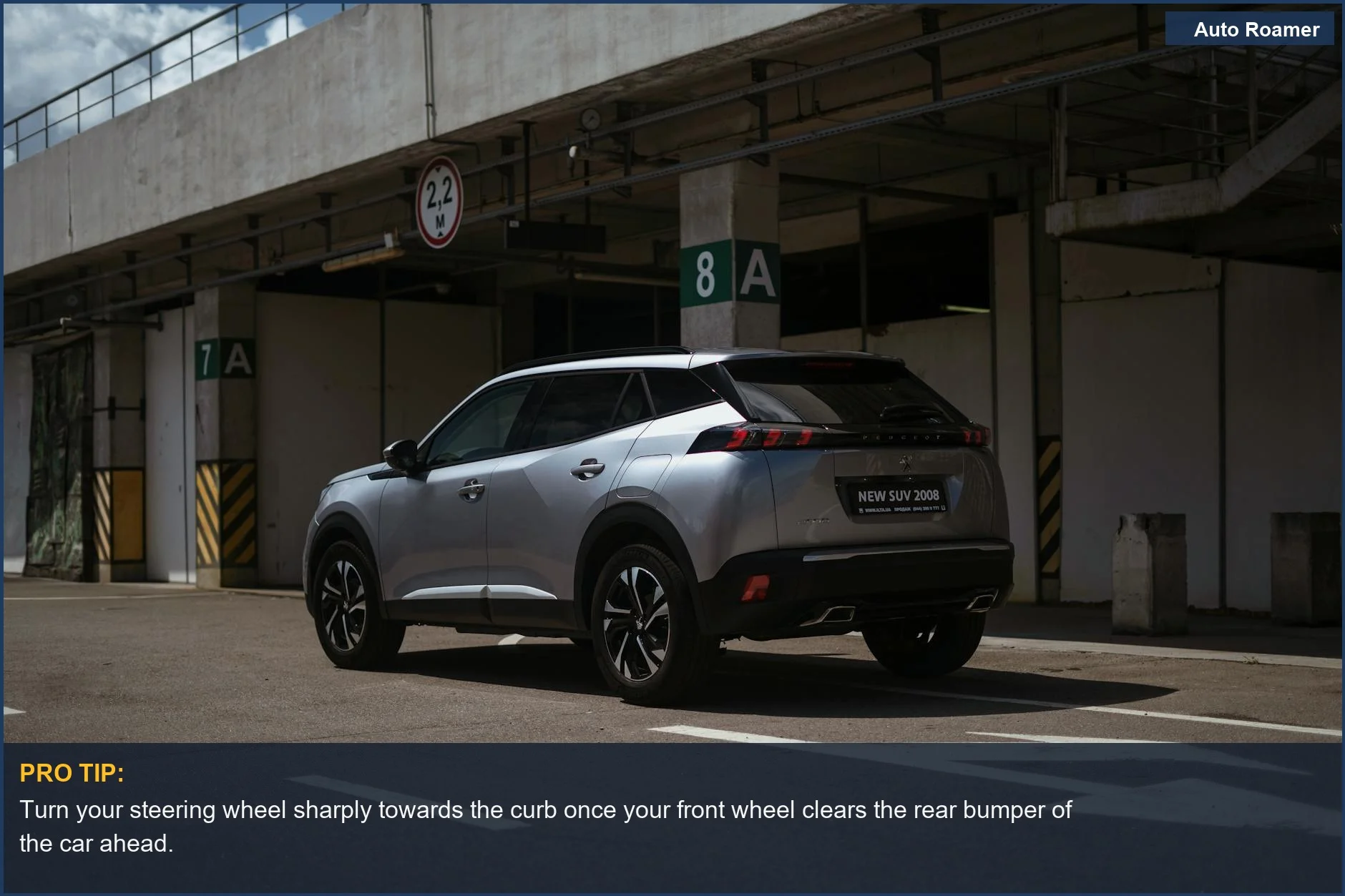
Turn your steering wheel sharply towards the curb once your front wheel clears the rear bumper of the car ahead.
A silver SUV sits neatly in an urban car park, a testament to good parking skills. This visual reinforces the benefits of mastering parallel parking techniques. | Photo by Olena Bohovyk

Mistakes That Cost People

Here are common mistakes people make when trying to parallel park without hitting the curb:

Mistake Over-reliance on visual cues without understanding car dynamics.
Why people make it Beginners often eyeball distance and angle, focusing on other cars rather than their own trajectory.
What actually happens This leads to hitting the curb, leaving too large a gap, or ending at a bad angle requiring multiple adjustments.
The fix Understand your vehicle's pivot points and practice with a consistent reference. Line up your rear bumper with the rear bumper of the car in front, then begin your turn before reversing. Learn to judge your car's angle relative to the curb.
Mistake Turning the wheel too early or too late when reversing.
Why people make it Misjudging the timing to initiate or straighten the turn.
What actually happens Turning too early swings the car too wide. Turning too late causes the front to hit the car ahead or prevents getting close to the curb.
The fix Practice the sequence: pull up parallel, turn the wheel sharply toward the curb, and reverse. Gradually straighten your steering wheel as your car angles into the space. Watch your side mirror to gauge distance from the curb to avoid contact.
Mistake Not straightening the wheels enough after the initial turn.
Why people make it Forgetting to correct steering once the car is angled.
What actually happens The car continues angling inward, causing the rear wheel to hit the curb, potentially damaging tires and resulting in an uneven park.
The fix As your car moves backward into the space, actively straighten your steering wheel. Your car should move straight back, parallel to the curb. This avoids scraping the curb and achieves a good park.
Mistake Focusing only on the rear of the car.
Why people make it The goal is to get the rear into the space, so focus naturally shifts there, ignoring the front's swing.
What actually happens The front can swing too far into the street, blocking traffic, or hit the car ahead of your target space. You might miss the space entirely.
The fix Be aware of both ends of your vehicle. As you reverse and turn, monitor the front of your car to ensure it doesn't hit the car ahead. Stop reversing when your car is angled and the front bumper is clear of the car in front of the space before straightening.
Mistake Not leaving enough space between your vehicle and the curb.
Why people make it A consequence of other mistakes, like not turning or straightening the wheel enough. Drivers may focus too much on avoiding the curb.
What actually happens Your car sticks out into the traffic lane, obstructing passing vehicles. This can lead to failing a driving test or tickets.
The fix Once at the correct angle, reverse straight back while watching your side mirror to gauge distance from the curb. Aim for a few inches. If too far, pull forward slightly and readjust to get closer.
Mistake Panicking and over-correcting.
Why people make it Pressure from traffic and fear of hitting the curb lead to jerky steering inputs.
What actually happens Over-correcting worsens the situation, potentially leading to hitting the curb harder, bumping other cars, or ending up outside the space.
The fix Take a breath; practice makes perfect. If you make a mistake, stop, assess, and restart by pulling forward and repositioning. Make small, deliberate adjustments. Hitting a curb hard, even at low speeds, can damage alignment if you scrape it hard.
Mastering parallel parking can enhance your driving skills, which is crucial when learning to navigate challenges like hydroplaning risks.
Infographic: Pros/cons of parallel parking techniques.
Product comparison for How to Parallel Park Without Hitting the Curb

Key Takeaways

Understanding how long you can run the car's AC while parked can further enhance your camping experience; learn more in our article on running car AC.

Frequently Asked Questions

How do I know when to turn the wheel to avoid hitting the curb when parallel parking?
A good rule of thumb is to start turning your steering wheel clockwise rapidly when your front bumper is about even with the front wheel of the car you're parking behind. Continue to reverse slowly, and watch your side mirror for your car's rear tire to get close to the curb. This technique helps you gauge the right moment to adjust your steering to avoid contact.
What's the best way to judge the distance from the curb when I'm reversing during a parallel park?
When reversing, try to keep your passenger side mirror at a proper angle so you can see your rear tire. As you back up, aim to have your rear tire get close to the curb without touching it. Some drivers find it helpful to use the reflection in their mirror to judge this distance, aiming for a specific visual cue that indicates they are close enough but not too close.
I always scrape the curb when I parallel park. What am I doing wrong?
Scraping the curb often happens when you turn the wheel too late or don't straighten it out quickly enough as you reverse. After completing the initial turn to angle into the spot, you'll need to straighten your wheel and continue reversing to bring your car parallel to the curb. If your front tire touches the curb, it's a sign you may need to adjust your timing or the amount you turn the wheel.
What's a reliable method for parallel parking without bumping into the curb?
A common method involves lining up your car parallel to the car in front of the space, then reversing while turning your wheel sharply towards the curb. Once your rear tire is close to the curb, you'll straighten your wheel and continue to reverse slowly. Finally, you'll turn the wheel away from the curb to bring the front of your car in and adjust your position.
Are there any visual cues I can use to make sure I don't hit the curb when I'm parallel parking?
Yes, using your side mirrors is key. As you back into the space, watch your passenger side mirror to see your rear tire approaching the curb. Some drivers also find it helpful to line up their rear bumper with the rear bumper of the car in front, or to keep an eye on the angle of their car relative to the curb in their mirrors. The goal is to see the curb in your mirror and know when to stop turning the wheel.

Sources

Related Articles