
Why there is no single answer
'How long will a 12V cooler run on a car battery?' is one of the most common car-camping questions, and the honest answer is that there is no single number — it depends on three variables that vary enormously from setup to setup. Anyone who gives you a flat 'about X hours' is guessing, because the real answer is a short calculation, not a fixed figure.
The three variables are how many amps your cooler draws, how much usable capacity your battery actually has, and — crucially — how far you can safely discharge that battery before it cannot start your engine. Get any one of those wrong and you either underestimate your runtime or, worse, wake up to a car that will not start.
This guide walks through the simple math, explains why thermoelectric and compressor coolers behave so differently, covers the safe-discharge limit that protects your starting battery, and lays out the practical ways to run a cooler off-grid without a no-start. By the end you will be able to estimate your own runtime and, more importantly, run your cooler safely.
The three numbers that decide runtime
Estimating runtime comes down to three figures. First, the cooler's current draw in amps — how much power it pulls while running, found in its specs or on its label. Second, the battery's capacity in amp-hours (Ah), which tells you how much charge it stores. Third, and most overlooked, the safe usable fraction of that capacity, because you cannot use all of it without harming the battery or stranding yourself.
The basic estimate is: usable amp-hours divided by the cooler's average amp draw equals approximate hours of runtime. The catch is that 'usable' is much less than the rating for a starting battery, and 'average draw' is very different for the two cooler types. Nail down those two adjustments and the math gets honest.
- Cooler amp draw: from the spec sheet or label
- Battery capacity: rated amp-hours (Ah)
- Usable fraction: only ~half for a starting battery
Cooler type: thermoelectric vs compressor
The single biggest factor in how long your cooler runs is which kind of cooler it is, because the two types use power in completely different ways. A thermoelectric (Peltier) cooler runs a constant electrical current through a solid-state element to pump heat, so it draws several amps continuously the entire time it is on — whether the contents are warm or already cool. That constant draw is why a thermoelectric cooler can flatten a starting battery in only a handful of hours.
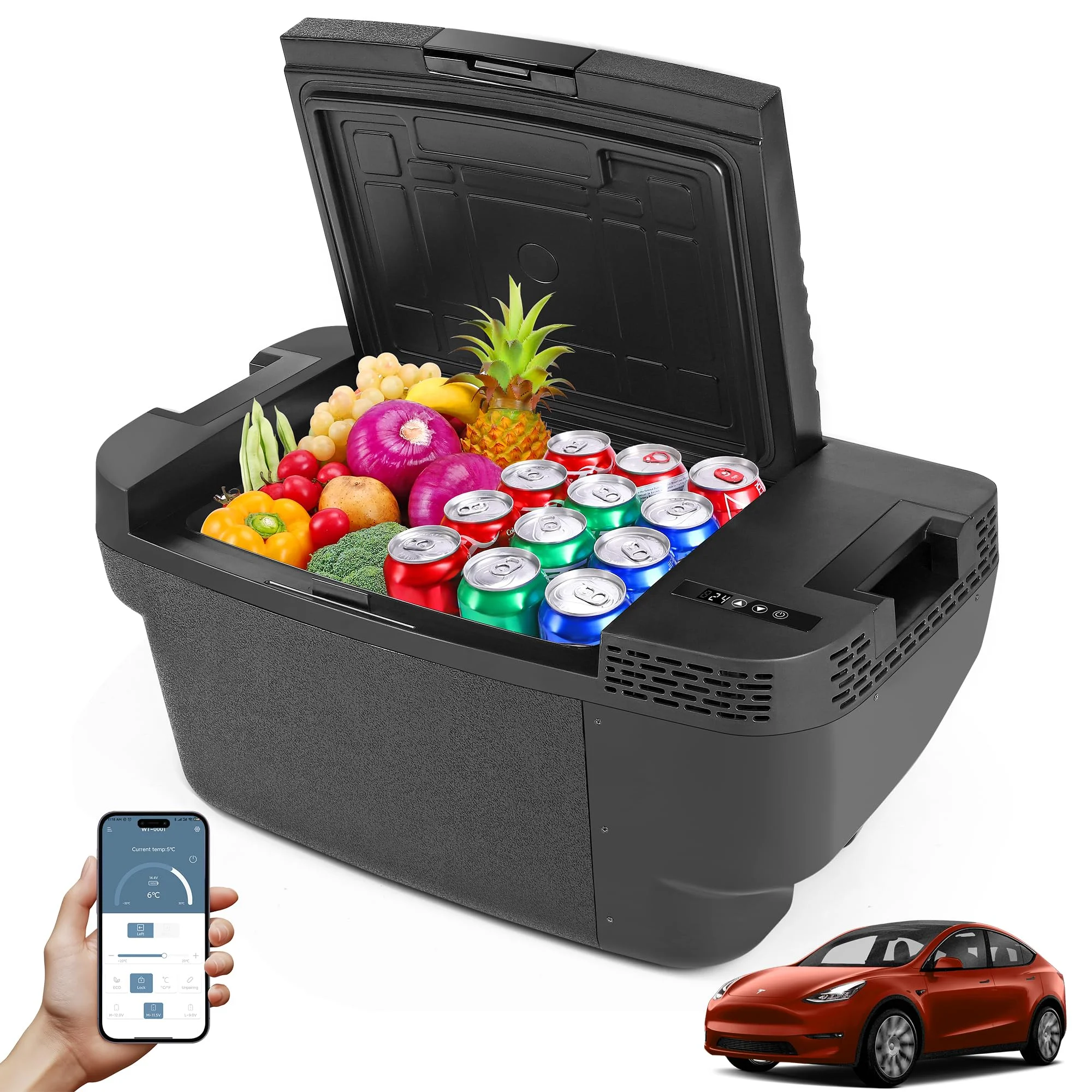
A compressor cooler — a true 12V fridge — works like your home refrigerator. It runs the compressor only until it hits the set temperature, then cycles off until it warms up again, so its average draw over time is far lower than its peak. That cycling lets a compressor fridge run many times longer than a thermoelectric cooler on the same battery, hold much colder temperatures, and work better in hot weather. If long battery runtime matters to you, the cooler type is the most important choice you make — efficiency is built in, not added.
The key insight: a thermoelectric cooler draws power constantly; a compressor fridge cycles on and off. That difference, more than anything else, decides how long your battery lasts.
A worked example you can adapt
Numbers make this concrete, so here is a method you can apply to your own gear. Suppose a starting battery is rated around 50 amp-hours. Because it is a starting battery, treat only about half — roughly 25 amp-hours — as safely usable before you risk a no-start.
Now divide by the cooler's average draw. A thermoelectric cooler pulling, say, 4 to 5 amps continuously would consume that usable 25 amp-hours in roughly 5 to 6 hours — and that is before accounting for the battery's age, the cold, and other parasitic draws. A compressor fridge whose compressor cycles might average only 1 amp or so over time, stretching the same usable capacity to a day or more.
These figures are illustrative, not promises — your cooler's real draw, your battery's true condition and the ambient temperature all shift them — but the method is sound: usable amp-hours divided by average amp draw. Run that calculation for your own cooler and battery and you will have a far better estimate than any generic number.
The safe-discharge limit that protects your starting battery
This is the part most people miss, and it is the one that actually leaves them stranded. A standard lead-acid starting battery is engineered to deliver a huge burst of current for a few seconds to crank the engine — not to be slowly and deeply discharged. Repeatedly drawing it down below roughly half its capacity damages it and risks leaving you unable to start the car.
So the safe rule is to treat only about half of a starting battery's rated capacity as usable for accessories like a cooler, and to stop well before it gets too low to crank. Deep-cycle batteries are different: they are built to be discharged much further (often 50 to 80 percent) again and again, which is exactly why they, or a portable power station, are the right tool for running a cooler off the grid. Knowing this limit is what separates 'my cooler ran all night' from 'my car would not start in the morning.' Respect the half-capacity ceiling on a starting battery and you avoid the most common — and most avoidable — camping mistake.
Engine running vs parked: where the power comes from
Where your cooler draws its power changes the runtime answer completely. With the engine running, the alternator powers the cooler and simultaneously keeps the battery charged, so runtime is effectively unlimited — this is why a cooler is happy to run all day on a long drive. The draw simply does not threaten the battery while the engine feeds it.
With the engine off, everything changes: the cooler now draws from the battery alone, and the safe-discharge limit becomes the hard ceiling on how long you can run it. This is the scenario that strands people — parked at a campsite or trailhead overnight, running a thermoelectric cooler off the starting battery, and finding a dead battery at dawn. The practical takeaway is to lean on the engine while you drive (which also recharges the battery) and to have a separate power source for when you are parked, rather than quietly draining the battery you need to get home.
The safe way to run a cooler off-grid
If you want to run a cooler while parked or camping without risking a no-start, there are three reliable approaches. The first is a dedicated deep-cycle or auxiliary battery, isolated from your starting battery, often paired with a DC-DC charger that tops it up while you drive — your engine battery is never touched, and the deep-cycle can be discharged far further.
The second is a portable power station, a self-contained battery you recharge from solar, the car, or a wall outlet, which powers the cooler independently and is renter-friendly and movable. The third, complementing either, is a low-voltage cutoff — built into many compressor fridges — that automatically shuts the cooler off before the battery drops dangerously low. Whichever route you choose, the principle is the same: keep the cooler's draw off your starting battery, or protect that battery with a cutoff, so the thing that runs your food never costs you the thing that runs your engine.
- Deep-cycle / auxiliary battery: isolated, deeply dischargeable
- Portable power station: self-contained, recharge by solar/car/AC
- Low-voltage cutoff: shuts the cooler off before a no-start
How to stretch your runtime further
Whatever battery you use, a few habits dramatically extend how long it lasts. Pre-chill the contents before you leave — a cooler that starts cold has far less work to do than one cooling warm drinks from scratch, which matters most for a compressor fridge whose compressor runs less when the load is already cold. Manage the heat load: park in shade, keep the cooler out of direct sun, and do not set the temperature colder than you need.
Open it as little as possible, because every lid opening lets cold out and warm in, forcing the compressor to run again, and keep it reasonably full, since cold mass holds temperature better than empty air. Good insulation is the foundation under all of it. None of these change a thermoelectric cooler's constant draw much, but for a compressor fridge they can extend runtime substantially. Combine smart habits with the right battery and you turn a marginal setup into one that comfortably lasts the night.
How battery age, temperature and chemistry change the answer
The clean amp-hour math assumes a healthy battery in mild conditions, but the real world rarely cooperates, and three factors quietly shrink your runtime. The first is battery age and health: a battery loses usable capacity as it ages, so a five-year-old battery rated for 50 amp-hours may deliver far less, and it sags faster under load — which means your real runtime is shorter than the spec sheet suggests, sometimes much shorter.
The second is temperature. Cold weather reduces a lead-acid battery's effective capacity significantly, so a cooler running off a battery on a cold night drains it faster than the same setup in summer, even before you account for the cooler working harder in heat. The third is chemistry: a lithium (LiFePO4) deep-cycle battery or power station delivers more of its rated capacity usefully, holds voltage better under load, and tolerates deep discharge far better than a lead-acid starting battery — a major reason power stations have become the popular off-grid cooler solution.
The practical takeaway is to treat your amp-hour estimate as a best case, build in a generous margin for an aging battery and cold weather, and lean toward a dedicated deep-cycle or lithium source if reliable runtime matters.
- Battery age: an older battery holds less than its rating
- Cold weather: shrinks effective capacity, shortening runtime
- Chemistry: lithium/deep-cycle delivers far more usable capacity
Common mistakes running a 12V cooler off a battery
The recurring errors all end the same way — a dead battery or a warm cooler. The first and most serious is running a thermoelectric cooler off the starting battery overnight, then finding the car will not start; that cooler's constant draw is simply too much for a starting battery. The second is ignoring the safe-discharge limit and assuming all of a battery's rated amp-hours are usable, when only about half of a starting battery's capacity safely is.
The third is expecting fridge-like runtime from a thermoelectric cooler (or vice versa) without understanding the difference in how they draw power. The fourth is having no off-grid power plan — no deep-cycle battery, no power station, no cutoff — and relying on the engine battery alone. Avoid all four by knowing your cooler's draw, respecting the half-capacity limit on a starting battery, matching expectations to your cooler type, and using a dedicated power source when parked. Do that and the cooler runs as long as you need without ever threatening your drive home.
The bottom line
How long a 12V cooler runs on a car battery is a calculation, not a fixed number: take the battery's usable capacity — only about half its rating for a starting battery — and divide by the cooler's average amp draw. The cooler type dominates that draw: a thermoelectric cooler pulls power constantly and can flatten a starting battery in hours, while a compressor fridge cycles on and off and runs far longer.
The safe, reliable way to run a cooler off-grid is never to lean on your starting battery — use a dedicated deep-cycle or auxiliary battery, or a portable power station, and let a low-voltage cutoff guard against a deep discharge. Run the math for your own gear, respect the half-capacity ceiling, and plan your off-grid power, and your cooler will keep your food cold for as long as you need without ever costing you the ability to start the car.