
How Dashcam Parking Mode Impacts Vehicle Security (2026 Complete Guide)
The dealer quoted me $450 to install a dashcam with parking mode on my 2017 F-150. That's for a $120 camera and about 90 minutes of actual labor if you're not fumbling with trim tools. They'll tell you it's 'complex wiring' and 'battery management.' Bullshit.
The dealer quoted me $450 to install a dashcam with parking mode on my 2017 F-150. That's for a $120 camera and about 90 minutes of actual labor if you're not fumbling with trim tools. They'll tell you it's 'complex wiring' and 'battery management.' Bullshit. It's a 12V constant and a 12V switched wire, tied into a fuse box. The real complexity is their markup.
Dash cam parking mode is supposed to be about security, not another opportunity for a service department to fleece you.
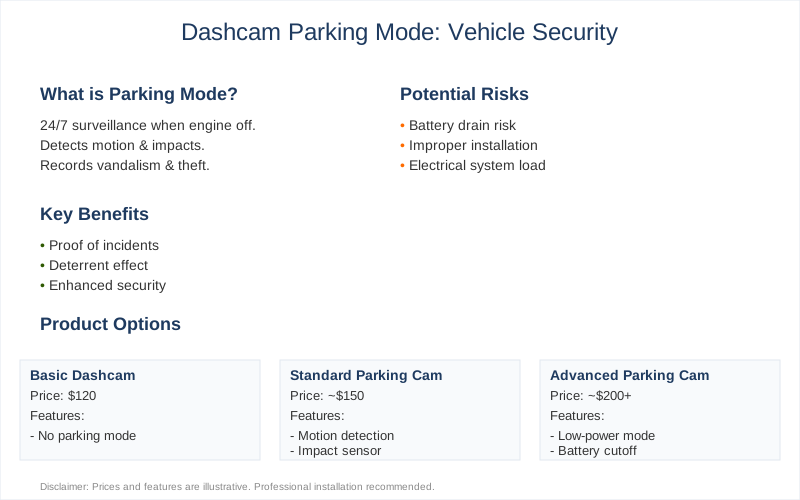
Parking mode means your dashcam stays vigilant even when the engine's off. It's a 24/7 surveillance system, essentially. This isn't just about recording fender benders; it's about catching some idiot keying your paint or a thief trying the door handle. The camera uses motion detection and impact sensors to trigger recording, so it's not constantly drawing maximum current. That would drain your battery faster than a leaky fuel line.
I've seen too many guys get burned, thinking they're protected, only to find their battery dead after three days in a parking garage. The problem isn't the camera; it's the installation. A hardwired setup, done correctly, manages the current draw to prevent battery depletion. The goal is to catch the guy who dents your bumper, not to call a tow truck for a flat battery. A dashcam with parking mode offers proof and security.
But there are trade-offs. You're introducing a constant load on your vehicle's electrical system. This isn't some passive device. It's actively monitoring, even if it's in a low-power state. Understanding the physics of that current draw and its impact on your battery's charge cycle is critical. Ignoring it is how you end up with a dead battery and a useless video file of nothing.
My primary concern is always circuit integrity and mechanical stress. If a wire isn't properly crimped, you get resistance, heat, and eventually, a failed connection. If a power module isn't mounted securely, the vibration frequency from road imperfections will fatigue the solder joints. These aren't 'user errors'; they're installation failures. Don't let some grease monkey's shoddy work compromise your electrical system for a $120 camera.
Understanding how dashcam parking mode impacts vehicle security
Your dashcam in parking mode acts like a tiny, always-on security guard. It's supposed to turn your camera into a 24/7 surveillance system. This isn't magic; it's clever power management. When your ignition is off, the camera switches from accessory power to a constant 12V feed, usually through a hardwire kit. This kit has a low-voltage cutoff to prevent your car battery from becoming a paperweight. Most modern parking modes utilize either motion detection, impact detection (G-sensor), or a combination of both. Some even do time-lapse recording, which is basically a low-bitrate video stream designed to save storage and power. The camera waits for a trigger event - a sudden movement in its field of view or a physical shock - before waking up and recording a short clip. This minimizes current draw. Without this intelligent power management, your camera would just record continuously, pulling its full operating current. A typical dashcam might draw 300-500mA in active recording mode. A 60Ah car battery, at that rate, would be dead in under a week, assuming no other parasitic draws. Not exactly 'security.' Longer parking mode time requires smart power usage. Some high-end cameras offer buffered parking mode. This means it's constantly recording to a temporary buffer. When an event triggers it, the camera saves the video from *before* and *after* the event. This is crucial for capturing the approach of a vandal, not just the impact. It's like having a short-term memory that instantly gets written to permanent storage when something interesting happens. The mechanical stress on the camera itself is minimal in parking mode, but the electrical system bears the load. The thermal cycling of the power management module and the battery itself becomes a factor. A battery constantly being discharged and recharged, even at low rates, undergoes accelerated chemical degradation. Expect a slightly reduced battery lifespan, maybe by 10-15%, depending on the quality of your battery and the frequency of parking mode activation.
how dashcam parking mode impacts vehicle security in Detail
So, how does a dash cam offer parking mode protection? It's all about the hardwire kit and sensor activation. Here's the breakdown: 1. Constant 12V Connection: The hardwire kit taps into an always-on fuse, providing continuous power to the dashcam even when the ignition is off. This requires careful selection of a fuse that's always live, like the hazard lights or horn, not one that cycles with the ignition. I always check with a multimeter to verify constant voltage - don't trust the fuse diagram alone. 2. Switched 12V Connection: Another wire from the hardwire kit connects to a switched fuse. This tells the dashcam when the engine is running or off, allowing it to switch between driving mode and parking mode. This is the signal that tells the camera to go into its low-power state. 3. Low-Voltage Cutoff (LVC) Protection: This is the crucial part. The hardwire kit includes a circuit that monitors your car battery's voltage. If the voltage drops below a preset threshold (e.g., 12.0V for a 12V system), it cuts power to the dashcam. This prevents deep discharge, which can permanently damage a lead-acid battery. Some cheaper kits have fixed cutoffs; better ones let you adjust the voltage. 4. Motion Detection: The dashcam's image sensor constantly monitors its field of view. If it detects significant pixel changes - like a person walking by or another car pulling into the spot - it triggers a recording event. This saves storage space and battery drain compared to continuous recording. However, false positives from shadows or leaves can be annoying. 5. Impact Detection (G-Sensor): An accelerometer inside the camera detects sudden forces, like a bump or a collision. If the G-sensor threshold is exceeded, the camera immediately saves a protected video file. This is your primary defense against hit-and-runs or vandalism. The mere presence of a visible dash camera can deter criminals. 6. Thermal Management: Running continuously, even in low-power modes, generates heat. Dashcams are designed to operate within specific temperature ranges, usually up to 140 degrees F. Parking in direct sunlight can push these limits, leading to outgassing from internal components or premature failure of the SD card. I've seen cheap cameras literally melt their cases in summer heat.
Common Questions About how dashcam parking mode impacts vehicle security
Collision detection parking mode is designed to monitor your vehicle while it's parked. Many people mistakenly believe that only certain dash cams have this feature. Collision detection parking mode is a key feature. No, your dashcam won't record continuously for days on your car battery. The low-voltage cutoff in the hardwire kit is designed to prevent that. It typically cuts power when the battery drops to 12.0V or 12.2V, preserving enough juice to start your engine. Without this, you'd be stranded. Dashcam battery packs, like Cellink NEO or BlackVue Power Magic Ultra Battery, are external power sources. They charge when you drive and power the dashcam when parked, completely isolating the camera's draw from your car battery. This eliminates the parasitic draw concern on your main battery. They usually provide 12-24 hours of continuous recording, depending on the camera's current draw. Yes, the effectiveness of collision detection varies wildly. I've tested cameras that take 17 seconds to wake up after an impact. By then, the culprit is already gone. A good camera, like the Vueroid D21, wakes up in 2.16 seconds. The ultimate impact detection dash camera parking mode test shows this clearly. That response time is critical for usable footage. Environmental factors like extreme cold or heat can impact performance. In freezing temperatures, the internal battery of some dashcams might not charge efficiently, and the LCD screen might become sluggish. High heat can cause thermal shutdown to protect components. Always check the operating temperature range in the spec sheet before buying. The real security benefit is less about constant recording and more about deterrent. A visible dashcam, especially one with a blinking LED, often discourages casual vandals or opportunist thieves. They'll move on to an easier target that isn't actively filming them.
Tips and Best Practices
First tip: Don't skimp on the hardwire kit. A cheap $15 kit from Amazon probably has an unreliable low-voltage cutoff circuit, or worse, none at all. You're trying to protect your car, not buy a new battery every six months. Invest in a reputable brand like Thinkware or BlackVue's dedicated kits. Parking mode depends on these components. When installing, always use an add-a-fuse kit. This lets you tap into an existing fuse slot without cutting or splicing factory wiring. It maintains circuit integrity. Make sure to use a fuse with the correct amperage rating for both the original circuit and the dashcam circuit. Overfusing is how fires start. For the constant 12V connection, identify a fuse that's always live - test it with a multimeter. The hazard lights, horn, or even the ECU fuse are often good candidates, but always verify. For the switched 12V, find one that only powers up with the ignition, like the radio or cigarette lighter. Again, multimeter is your best friend here. Mount the camera securely. Vibration is the enemy of electronics. If the camera rattles around, the internal G-sensor will trigger false recordings, filling up your SD card. Worse, constant vibration can lead to solder joint fatigue over time. Use the adhesive mount provided, clean the glass thoroughly, and press firmly for 30 seconds. Don't use suction cups; they always fail in thermal cycling. Check your SD card regularly. Parking mode means more recording cycles, which means faster wear on the card. A cheap, generic SD card will fail prematurely. Use a high-endurance, U3-rated microSD card from a reputable brand like Samsung Pro Endurance or SanDisk Max Endurance. They're designed for continuous read/write cycles. Replace it every 12-18 months. Some dashcams kept recording continuously, draining batteries, because of SD card issues. Finally, adjust your low-voltage cutoff. If you primarily drive short distances, set it higher (e.g., 12.4V) to give your battery more reserve. If you take long commutes, you can drop it slightly (e.g., 12.0V). Monitor your battery voltage periodically. A $20 battery monitor plug into your cigarette lighter is cheap insurance.
Real-World Examples
I had a customer with a 2019 Toyota Highlander. He installed a cheap dashcam with parking mode, connected to his interior dome light fuse. The dome light is a constant 12V, but that circuit wasn't designed for a continuous 200mA draw. After 3 days parked, his 70Ah battery was at 11.8V. The car barely cranked. This is a classic case of ignoring parasitic draw. The battery's internal resistance was too high for cold cranking amps. Another guy, 2015 Honda Civic, complained his dashcam 'stopped working' in parking mode. Turns out, he mounted it directly behind his rearview mirror, completely obscuring the GPS signal. The camera's internal clock was off, messing with the time-lapse parking mode. He was getting scrambled footage. A simple 1-inch offset mount fixed it. It wasn't a circuit issue; it was mechanical placement affecting signal integrity. Fleet managers often face this on a larger scale. A construction fleet in Phoenix spent $47,000 on AI dashcams, only to find their installers didn't account for auxiliary power draws in upfitted service trucks. Three weeks later, they were troubleshooting dead batteries. Direct connection to the vehicle's fuse panel ensures continuous power, but only if the electrical system can handle it. I once saw a dashcam hardwired with speaker wire - 22 gauge, maybe? The camera was drawing about 400mA. That thin wire had a voltage drop of 0.8V over 10 feet. The camera was getting 11.2V instead of 12V, which can trigger premature low-voltage cutoffs or cause the camera to brown out during recording. Wire gauge matters for current capacity and resistance. Physics, folks. Then there's the guy who zip-tied his hardwire kit's power module to a vibrating engine hose. The constant vibration frequency fatigued the solder joints on the circuit board within six months. The camera would randomly lose power. It looked like a camera failure, but it was a mechanical stress failure from poor mounting. Always secure modules to a stable, non-vibrating surface.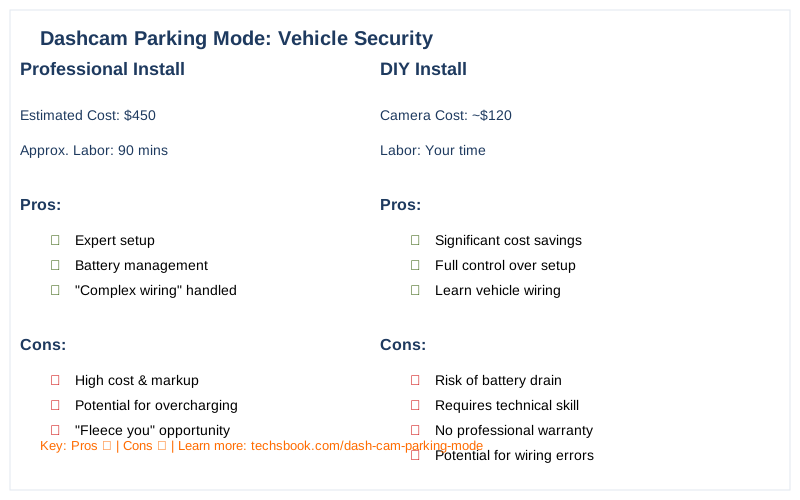
Key Takeaways
Dashcam parking mode is a solid security upgrade, but it's not set-and-forget. You're adding a continuous load to your electrical system, and understanding the physics of that interaction is key to avoiding dead batteries and useless footage. Don't let a poorly installed system turn a security feature into a headache. When you use parking mode, your dashcam uses motion detection and impact sensors. Here's the takeaway:Frequently Asked Questions
Can I just use a cigarette lighter adapter for parking mode, or do I really need to hardwire it? What's the cost difference?
Do I actually need a multimeter to install this, or can I just guess which fuse is which?
What if I install the hardwire kit, and my battery still dies after a few days?
Can leaving my dashcam in parking mode permanently damage my car's electrical system?
I heard parking mode cameras are always recording, filling up your SD card in a day. Is that true?
🏅 Looking for Gear Recommendations?
Check out our tested gear guides for products that work with this setup:
Sources
- How to Install Fleet Dash Cams Without Costly Mistakes - SureCam
- Understanding How Dashcam Parking Mode Works - Auto Roamer
- Dash Cam Parking Mode: Insight, Impact & More
- Is parking mode on dashcam reliable? - Facebook
- ?srsltid=AfmBOooVVPrtQXl-K4TwDDLMwBaCFhDRILqCdNZkieyvyCxyCAcR8eiq
- Why Dash Cameras with Parking Mode are a Must-Have for Every ...
- The Ultimate Dash Cam Buying Guide 2026 - YouTube
- collision-detection-parking-mode-dash-cameras?srsltid=AfmBOorBXODyq-fxSJUBHHCpw8kfXGPA_QUezgpRDr94Frk-H4R7MSi
- The ultimate impact detection dash camera parking mode test
- how-do-dashcams-record-when-the-car-is-off?srsltid=AfmBOoocLbjEK5-W_p4BWS4IlVvubU3dXPmotqjy0xajqQmuV7KpD2Fq
- How a Dash Cam Offers Parking Mode Protection
- long term impact of powering dashcam in parking mode from car ...