

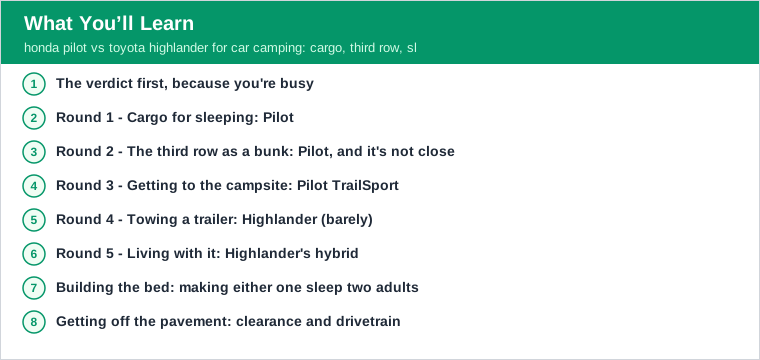
The verdict first, because you're busy
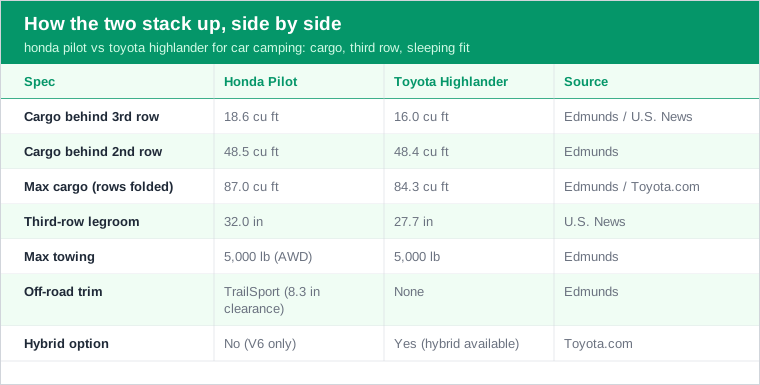
I'll skip the throat-clearing. For car camping, the Honda Pilot wins the fight on two numbers: 87.0 cubic feet of max cargo to the Highlander's 84.3, and 32.0 inches of third-row legroom to the Highlander's 27.7 - the two figures that decide where and how well you sleep. The Toyota Highlander is the better BUY for a lot of families - hybrid economy, Toyota resale, standard towing - but if your question is specifically 'which one is the better vehicle to camp OUT of,' the Pilot takes it. That's the honest headline; the rounds below show the work.
Both are three-row midsize SUVs in the same price bracket, and on a spec sheet they look like twins. The camping differences hide in the details a dealer won't walk you through: how long the folded floor is, whether the third row can serve as a kid's bunk, whether either one can actually get down a rutted campground road. So I scored it the only way that's fair - five rounds, each on a number that changes a real trip.
If you already own one, don't panic - both sleep two adults in back with the seats folded, and the gap is margins, not chasms. But if you're choosing, read the rounds. The Pilot's wins are the kind you feel at 2 a.m.; the Highlander's are the kind you feel at the gas pump.
Round 1 - Cargo for sleeping: Pilot
The bed IS the cargo floor, so this round matters most. The Pilot gives you 18.6 cubic feet behind the third row, 48.5 with the third row folded, and a maximum 87.0 cubic feet with both rows down, per Edmunds. The Highlander counters with 16.0, 48.4, and 84.3 cubic feet, per Edmunds and Toyota. Behind every row, the Pilot holds more.
Why the gap matters for a camper:
- Max cargo (87 vs 84.3): the Pilot's near-3-cubic-foot edge is real floor length and width - the difference between a six-footer stretching flat and tucking their knees.
- Behind the third row (18.6 vs 16.0): if you camp with the third row UP for passengers, the Pilot swallows noticeably more gear behind it.
- Boxier body: the Pilot's more upright shape turns its cubic feet into usable rectangle, not sloped-roof volume you can't sleep in.
Cubic feet are a proxy; flat-floor length and width are the real currency. The Pilot's edge is small on the spec sheet and slightly larger where it counts - the rectangle you actually lie down in.
It's a clear if modest win. For the full picture of what the Pilot's floor does for sleeping, our Honda Pilot camping gear guide breaks down the fit; the Highlander cargo-dimensions guide does the same for the Toyota. Round to the Pilot.
Round 2 - The third row as a bunk: Pilot, and it's not close
Here's the round nobody scores until they've tried to put a kid to bed in the way-back. The Pilot has 32.0 inches of third-row legroom; the Highlander has 27.7, per U.S. News. That 4.3-inch gap is the difference between a third row a child can actually sleep across and one that's a penalty box. Reviewers are blunt that the Highlander's third row is 'better suited for children only,' while the Pilot's roomier way-back and 50/50-split seats flex to swallow gear or a small sleeper.
For a family that camps, the third row isn't a seat - it's a second bunk or a gear garage. Four inches of legroom decides which. The Pilot gives you a usable one; the Highlander gives you a jump seat.
Practical upshot on a family trip:
- Adults sleep flat in the folded cargo bay; a small kid sleeps across the Pilot's third row - a layout the Highlander's 27.7 inches fights.
- The Pilot's split third row lets you drop half for length and keep half for a booster - more configurations for a real family.
This is the Pilot's biggest, most decisive win. Round to the Pilot.
Round 3 - Getting to the campsite: Pilot TrailSport
A camping SUV has to reach the camp, and this round exposes a real difference in intent. Honda sells a Pilot TrailSport with genuine off-road hardware: 8.3 inches of ground clearance, steel skid plates, all-terrain tires, and a trail-tuned suspension, per Edmunds. The Highlander has no equivalent adventure trim - it's a road SUV, full stop.
What that buys a camper:
- Rutted forest-service roads: the TrailSport's clearance and AT tires reach dispersed sites a stock Highlander would scrape or slip getting to.
- Skid protection: steel plates mean a high-centered rock is a scrape, not a punctured oil pan a hundred miles from a shop.
- The catch: if you only ever camp at paved or graded-gravel campgrounds, this round is a tie - you'll never use the clearance, and the Highlander's road manners are just as good.
For campers who venture past the paved loop, the TrailSport is a meaningful edge. Round to the Pilot, with an asterisk for pavement-only campers.
Round 4 - Towing a trailer: Highlander (barely)
Now the Highlander lands one. Toyota's Highlander tows 5,000 pounds in EITHER front- or all-wheel drive; the Pilot can only match 5,000 pounds with all-wheel drive and drops to 3,500 with front-wheel drive, per Edmunds. If you're pulling a small camper, a boat, or a utility trailer of gear, the Highlander gives you the full tow rating without paying for AWD.
The tow number only matters if you actually tow. If you do, the Highlander's drivetrain-independent 5,000 pounds is the cleaner answer - you don't have to buy AWD to get the capacity.
The honest scope of this win:
- At the TOP end (5,000 lb) with AWD, they tie - both pull a small trailer fine.
- The Highlander's edge is the FWD buyer who still wants full towing - a narrower case, but a real one.
Round to the Highlander, on a technicality that matters to trailer campers and nobody else.

Round 5 - Living with it: Highlander's hybrid
The last round is the one you feel every mile between campsites. The Highlander offers a hybrid powertrain; the Pilot is V6-only, per Toyota and Honda's lineups. On the long highway hauls that bookend every camping trip - and on the idling and short hops around camp - the hybrid's economy is a genuine, recurring advantage, and it pairs with Toyota's resale reputation.
Why this round counts more than it looks:
- Fuel between camps: a hybrid Highlander stretches the miles between fill-ups on a road trip, which matters most exactly where campgrounds are remote.
- Resale: Toyota's residual values mean the Highlander often costs less to OWN over years of trips.
- The counter: none of this helps you SLEEP better - it helps you afford the trips. Different kind of win than Rounds 1-3.
This is the round you feel every mile, not every night - and for a lot of buyers, miles outnumber nights by a hundred to one.
Round to the Highlander. Which sets up the only question that matters: what are you optimizing for?
Building the bed: making either one sleep two adults
Whichever badge you land on, the sleeping build is nearly identical, because both fold to a similar two-adult floor - the Pilot just gives you a few more inches to work with. The single most important purchase is the mattress, and for a folded three-row SUV floor you want a back-seat-style SUV air mattress sized for mid- and full-size vehicles, like the Onirii SUV air mattress, which fills the folded bay and levels any small step where the seatbacks meet the load floor.
The rest of the overnight kit is the same in both trucks:
- Power: keep the overnight loads - a fan, phone charging, a 12V cooler - off the starter battery with a portable power station you charge off the 12V socket while driving between camps.
- Ventilation: crack a screened front window and the tailgate for cross-flow; both cabins fog by morning with two people breathing inside.
- Privacy and insulation: reflective covers on the glass do double duty at a trailhead in either SUV.
The build doesn't decide the Pilot-versus-Highlander question - it's a wash. But it's worth knowing that the winner you pick sleeps two adults with the same short shopping list, and the Pilot's extra floor length just makes the taller sleeper's night a little easier.
Getting off the pavement: clearance and drivetrain
Round 3 gave the trail nod to the Pilot TrailSport, but it's worth widening the lens, because most buyers won't spec the TrailSport and the base drivetrains matter too. In standard trim, both are car-based crossovers with modest clearance - fine for graded gravel and washboard forest roads, out of their depth on anything rocky. Neither base model is a rock crawler, and pretending otherwise strands you.
The realistic off-pavement picture:
- Pilot TrailSport: the only genuine dirt-road upgrade of the two - 8.3 inches of clearance, skid plates, all-terrain tires - reaching dispersed sites the standard cars can't.
- Both with AWD: the available all-wheel-drive systems handle rain, mud, and shoulder-season snow on the way to established campgrounds - the traction most campers actually need.
- Neither for serious trails: if your camping involves true off-road, both are the wrong tool - you want a body-on-frame SUV or truck, not a three-row crossover.
Buy the clearance you'll actually use. A TrailSport that never leaves pavement is wasted money; a base Highlander on a rutted forest road is a scraped underbody. Honesty about where you camp saves you both mistakes.
So the honest read: for pavement and light gravel they tie; for washed-out forest roads the Pilot TrailSport is the only one of the pair built for it. Match your ambitions to the clearance before you buy.
Reliability and the long game
There's a reason both of these badges inspire loyalty, and it's worth saying plainly before you agonize over 2.7 cubic feet: both the Pilot and the Highlander are among the most dependable three-row family SUVs you can buy, and either one will carry a family through a decade of camping trips without drama. That shared reliability is the quiet foundation under this whole comparison - you are choosing between two genuinely good vehicles, not dodging a lemon.
Toyota's reputation for long-haul durability is the stuff of legend, and the Highlander inherits it directly; a well-kept one shrugs off high mileage and holds together far from a dealer, which is exactly the reassurance you want when a campsite is a hundred miles from the nearest service bay. Honda answers with its own long track record and, in the Pilot, a naturally aspirated V6 that runs unstressed and simple - fewer moving parts to worry about than a turbocharged rival, and an engine that tends to age gracefully. Neither brand is where you'll find a weak link.
What that means for a camper is freedom to decide on the CAMPING merits above without a nagging reliability asterisk. Pick the Pilot for its floor and third row or the Highlander for its efficiency and resale, and trust that whichever you choose will still be starting on a cold morning at the trailhead ten years from now. When two vehicles are this close on dependability, the tiebreaker rightly moves back to how you actually camp.
The money: price, resale, and cost to own
A camping vehicle is a years-long purchase, so the dollars matter as much as the cubic feet, and this is where the Highlander's case gets strongest - it's the round most spec comparisons skip. Toyota's resale values sit among the best in the segment, and the available hybrid powertrain quietly lowers running costs on exactly the long highway hauls that bookend every camping trip. Those two advantages don't show up on a cargo chart, but they compound over a decade of ownership into real money.
The fuel saving lands hardest where it matters most to a camper: on the remote stretches between fill-ups, where campgrounds are far from gas stations and a hybrid's range buys peace of mind as much as dollars. The resale advantage lands at the other end - strong Toyota residuals mean the Highlander often costs less to OWN across years of trips, even when the two start at a similar sticker price. The Pilot's honest counter is that Honda's V6 is a proven, unstressed engine, and that a family who genuinely uses the extra cargo and third-row room may find that space worth more than the fuel difference.
If total cost of ownership is your deciding lens, the Highlander's efficiency and resale tilt it - which is precisely why it can be the smarter BUY even when the Pilot is the better CAMPER.
Who each one is NOT for
The most useful part of any comparison is the honest disqualifier, so here's who should walk away from each. Buying against your real use is how people end up with the wrong three-row SUV in the driveway.
- Skip the Pilot if you rarely fill the third row or the cargo bay, tow little, and drive far more than you camp - you're paying for capability and fuel you won't use, and the Highlander hybrid will cost you less.
- Skip the Highlander if you regularly sleep two adults plus a kid in the vehicle, pack it to the roof, or reach camps down rough roads - the tighter cargo, cramped third row, and lack of an off-road trim will nag you every trip.
- Skip both if you need a true off-road basecamp or want to sleep two adults flat with room to spare - a body-on-frame SUV, a truck with a bed build, or a minivan will serve you better.
Rule out the wrong answer first and the right one is usually obvious. Both of these are excellent three-row family SUVs; the mistake is buying the one that doesn't match how you actually camp and drive.
Who should buy which
Tally the rounds and the split is clean, not lopsided: the Pilot wins the CAMPING rounds (cargo, third-row bunk, trail access), the Highlander wins the OWNERSHIP rounds (towing flexibility, hybrid economy). So the right pick is really a question about how you camp and how you drive.
- Buy the Honda Pilot if the vehicle is your camp: you want the longest folded floor, a third row a kid can sleep in, and - in TrailSport form - the clearance to reach dispersed sites. It's the better CAMPER.
- Buy the Toyota Highlander if the vehicle mostly gets you THERE: you tow, you want a hybrid's range and economy on long hauls, and you value Toyota resale. It's the better ROAD-TRIPPER, and it still sleeps two adults in back.
Both are excellent; neither is a mistake. Match the winner to the way you actually camp - our Highlander camping guide and Pilot camping accessories guides take whichever you choose the rest of the way.