
Two legends, one honest question: which one do you sleep in?
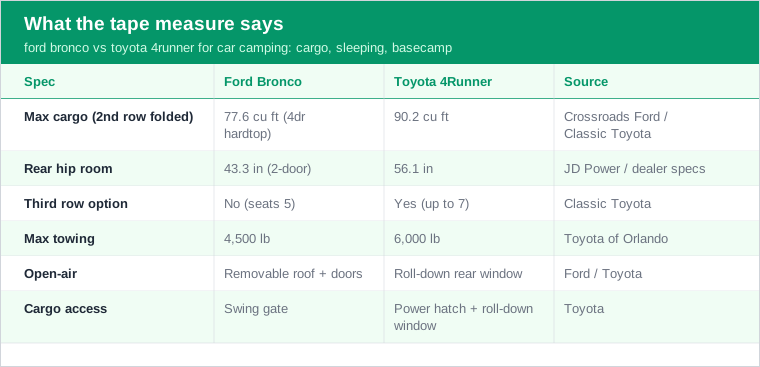
The Toyota 4Runner gives you 90.2 cubic feet folded and 56.1 inches of rear hip room; the four-door hardtop Ford Bronco gives you 77.6 and, in two-door form, 43.3 inches. Those four numbers decide a night's sleep, yet the two rigs get compared to death on rock-crawling and almost never on the thing a lot of buyers actually do with them: sleep in them at a trailhead. That's the question I care about after 140,000 overland miles - not which one looks cooler on a fire road, but which one is the better BASECAMP when the sun goes down and you need a dry, flat place to lie down.
The short answer is that the 4Runner wins the numbers that decide a night's sleep, and the Bronco wins the one thing numbers can't capture: the ability to take the roof and doors off and turn camp into an open-air room. So I'm not going to score this on a spreadsheet. I'm going to walk it through a real trip - the drive in, setting up camp, the night's sleep, hauling gear or a trailer, and living with it over years of hard miles - because that's where the difference actually shows up.
Both are genuinely capable; neither is a bad camper. But they camp DIFFERENTLY, and by the end you'll know which difference is yours.
The drive in: both get there, the 4Runner brings the third row
Getting to a dispersed site is table stakes for both - this is the one comparison where you truly can't go wrong on capability. Both have the clearance, the four-wheel-drive systems, and the tires (in the right trims) to reach places a crossover can't. The Bronco leans on removable panels and a clever adaptable interior; the 4Runner leans on its boxy practicality and a signature roll-down rear window plus a power hatch, per Toyota.
The one drive-in difference that matters for a group:
- 4Runner: an optional third row lets it carry up to seven, per Classic Toyota - haul more people to the trailhead, or fold that row into more sleeping and gear length.
- Bronco: seats five, no third row - but the roof-and-door flexibility means the cabin reconfigures in ways the 4Runner's can't.
- Access at camp: the 4Runner's roll-down rear window is a genuinely useful camp feature - open the glass without opening the whole hatch for airflow and reaching gear.
One more drive-in note that matters on long approaches: fuel and range. Neither of these is an economy car - body-on-frame boxes with off-road tires never are - so plan fuel stops around the trailhead, not after it, and carry the extra gallon on multi-day dispersed trips where the nearest pump can sit 50 miles from camp. The 4Runner's bigger cargo bay makes stashing a jerry can easier; the Bronco answers with clever door and tailgate storage for the small stuff. Call the drive in a tie on capability, a slight 4Runner edge on people-hauling and cargo access. The real separation comes at camp.

Setting up camp: the Bronco's party trick vs the 4Runner's box
This is where the two philosophies split hardest. The Bronco's signature move is that the roof and doors come OFF - you can turn your basecamp into an open-air pavilion, sleep with the stars overhead, and roll the whole cabin into the outdoors, per Ford. Nothing the 4Runner does matches the feeling of a doors-off camp on a warm night. It's a real, distinctive advantage for fair-weather campers who want the vehicle to disappear into the site.
The trade-off is honest: removable panels are magic in good weather and a chore in bad. Taking a hardtop off is a two-person job you won't want to do in the rain, and the open-air life ends the moment the weather turns. The 4Runner's sealed box is less romantic and more dependable.
The 4Runner counters with usable-space discipline:
- Its angular, boxy body means more usable cargo volume and easier loading of bulky gear - a flat, square bay, not a styled one.
- The sealed cabin plus roll-down rear window gives controlled ventilation without committing to a full open-air setup.
Bronco for the open-air romance; 4Runner for the dependable, weatherproof box. Your climate and your temperament decide this round.
The night's sleep: the 4Runner is simply wider and bigger
Now the numbers that decide whether you sleep well, and they favor the 4Runner clearly. Max cargo with the second row folded is 90.2 cubic feet in the 4Runner versus 77.6 in the four-door hardtop Bronco (up to about 83 in a soft-top), per Classic Toyota and Crossroads Ford. And sleeping WIDTH - rear hip room - is 56.1 inches in the 4Runner against just 43.3 in the two-door Bronco, per JD Power and dealer specs. That's nearly 13 inches, the difference between two adults side by side and one person with gear.
What those numbers mean unrolling a pad at night:
- Cargo (90.2 vs 77.6): the 4Runner's boxier bay is a longer, more usable flat rectangle for a full-length sleeper plus gear.
- Width (56.1 vs 43.3): the 4Runner genuinely sleeps two adults across; the two-door Bronco is a comfortable solo platform, tight for two.
- Fold the 4Runner's third row (if equipped) for even more length - a lever the Bronco doesn't have.
For sleeping inside, this is a decisive 4Runner win. If two people need to sleep in the vehicle, the geometry isn't close. Our sleeping in a 4Runner guide has the full fit; the Bronco camping guide covers the doors-off setup.
Hauling and the long haul: towing and reliability
Two last things separate a weekend toy from a trip machine: how much it pulls and how it holds up. On towing, the 4Runner leads - 6,000 pounds properly equipped versus the Bronco's 4,500, per Toyota of Orlando. That 1,500-pound gap is real if you tow a small camper, a boat, or a trailer of gear to basecamp.
And on the long haul:
- Towing: the 4Runner's higher rating gives more margin for a loaded trailer on grades - the safer number when you're heavy and remote.
- Durability: the 4Runner's long reputation for go-anywhere reliability is exactly what you want a hundred miles from a dealer - the boring virtue that matters most on a real overland trip.
- Bronco's counter: modern conveniences and the removable-panel flexibility give it a personality the 4Runner lacks - worth real money to the right buyer.
For the person who tows to camp and keeps a rig for a decade of hard trips, the 4Runner's numbers and reputation carry the long haul.
Three sleepers, three layouts: fitting real bodies in each
Numbers become furniture when you actually lie down, so map the three common sleeper profiles onto these two floors and watch the recommendation sort itself.
The solo camper under six feet. Both rigs are generous for you. The two-door Bronco's 43.3 inches of hip room is plenty wide for one, and the shorter bay still takes a full pad with gear at your feet; the 4Runner just adds margin you'll happily fill with a wider mattress and looser packing. For a solo camper the sleeping fit genuinely shouldn't decide this purchase - buy on weather, towing, and taste.
The couple. This is where the geometry gets decisive. Two adults side by side want somewhere around 48 inches of width as a practical minimum, and only the 4Runner's 56.1 inches of hip room clears it with comfort to spare - two full pads, two sleepers, no negotiation. The two-door Bronco's 43.3 inches forces an overlap or a very friendly arrangement; even the four-door asks the second sleeper to compromise. Couples should treat the 4Runner as the default and the Bronco as the vehicle one of you sleeps in while the other takes a ground tent.
The tall camper. Both bays run shorter than a 6-foot-plus frame wants, so the tall sleeper's real comparison is diagonal length - and the 4Runner's wider floor buys a longer diagonal by simple geometry. Fold its optional third row flat and the load floor stretches further still, a lever the five-seat Bronco simply doesn't have. Tall campers: run the tape measure at the dealer with the seats folded before you commit to either, and check the diagonal, not just the straight run.
Kitting out a body-on-frame bedroom
Whichever rig wins your driveway, the interior build is the same problem: a body-on-frame SUV floor is high, ribbed, and honest about its cargo-hauling day job, so the sleeping kit has to level and soften it. On my own rig the order of operations has settled after years of hard miles, and it starts with the pad. A back-seat-style SUV air mattress like the Onirii fills the folded bay of either truck and bridges the seatback step; in the wider 4Runner it leaves gear lanes on both sides, in the Bronco it IS the floor.
The rest of the build, in the order it earns its space:
- Overnight power: a compact power station runs the fan, the lights, and the phone charging so the starting battery stays sacred - non-negotiable a long way from a jump.
- Window mesh: screened openings at opposite ends for cross-flow; the 4Runner's roll-down rear glass takes a hatch screen brilliantly.
- Up top: both rigs take a roof rack that moves bulky, light gear out of the sleeping bay - the cheapest square footage you can add to either.
Budget a weekend to dial the kit in the driveway before the first real trip. The rigs differ; the discipline doesn't.
Weather changes the answer: seasons and the open-air trade
Here's the part of the Bronco-versus-4Runner question that a spec table can't hold: the answer changes with the forecast, and you should buy for the weather you actually camp in. The Bronco's open-air magic is a summer phenomenon. Doors off, roof off, warm night, no bugs - there is nothing in the mainstream market that touches it, and if your camping calendar is June through September in a dry climate, that experience is a legitimate reason to accept the smaller, narrower sleeping bay.
Now run the same two rigs through October. Cold rain, early dark, wind. The Bronco's party trick is stowed - nobody is pulling a hardtop panel in a downpour - and what remains is a shorter, narrower box with more seams than a fixed-roof body. The 4Runner doesn't change at all: the same sealed steel room it was in July, warmed by your body heat, with the rear glass cracked exactly 1 inch for airflow. Shoulder-season and winter campers live in that consistency.
The honest question isn't 'which is better' - it's 'what month is it when you camp?' A June camper can buy the Bronco's magic with a clear conscience. An October camper should buy the box that doesn't care about the forecast.
Split the difference if your season runs long: the Bronco with the roof ON is a competent, slightly smaller 4Runner-style box - you just paid for a capability you're not using that month. The 4Runner never makes you feel that; it does the same job every month of the year, which is exactly the personality difference the next section prices out.
Holding value while you use it hard
Both of these trucks have something rare in the vehicle market: they're wanted USED. The 4Runner's resale reputation borders on folklore - Toyota's body-on-frame SUVs hold their value about as well as anything sold in America, and a well-kept one sheds price so slowly that owners joke the miles are free. That matters directly to a camper, because a rig you're not afraid to depreciate is a rig you actually take down the rough road; the resale floor underwrites the hard use.
The Bronco's market is younger and more personality-driven. Demand runs strong for well-specced examples, and the enthusiast aftermarket keeps interest high, but the value curve is less proven than Toyota's decades of data - and open-air hardware adds wear points a fixed roof never has. Seals, latches, and panels that come off are panels that can leak or rattle at year eight, and a used buyer checks every one of them.
For a camper keeping the truck a decade, the calculus lands where the rest of this comparison keeps landing: the 4Runner is the safer long bet, the Bronco the more vivid one. Neither will strand your wallet - these are two of the strongest-value nameplates in their class - but the Toyota's combination of durability folklore and slow depreciation is exactly what you want under a vehicle that sleeps a hundred nights in the dirt.
The verdict: 4Runner is the better basecamp, Bronco the better toy
Walk the whole trip and it comes out consistent: the Toyota 4Runner is the better BASECAMP. It sleeps two adults across (56.1 in hip room vs 43.3), carries more (90.2 vs 77.6 cu ft), tows more (6,000 vs 4,500 lb), offers a third row, and brings the go-forever reliability you want when you're far from help. If the vehicle is where you sleep and how you haul, it's the pick.
Buy the 4Runner if the vehicle is your camp - two-adult sleeping, more gear, more towing, more dependability. Buy the Bronco if the EXPERIENCE is the point - a fair-weather, doors-off, roof-off open-air camp no 4Runner can give you, for one or two people.
The Bronco isn't the loser here; it's the better answer to a different question. For open-air magic in good weather, nothing mainstream touches it. But if you asked which one to actually SLEEP in, night after night, in any weather, with a partner and a full load - it's the 4Runner, and the width and cargo numbers say so plainly. Fit the kit from the build list above, screen the roll-down rear window, and the Toyota becomes the rare vehicle that works as hard at midnight as it does on the trail. And if the Bronco's open-air summer still calls to you after all this - that's not a wrong answer, it's a different trip. Just walk in knowing you chose the experience over the floor plan, because at the trailhead at 10 p.m., the floor plan is what you're living in.