
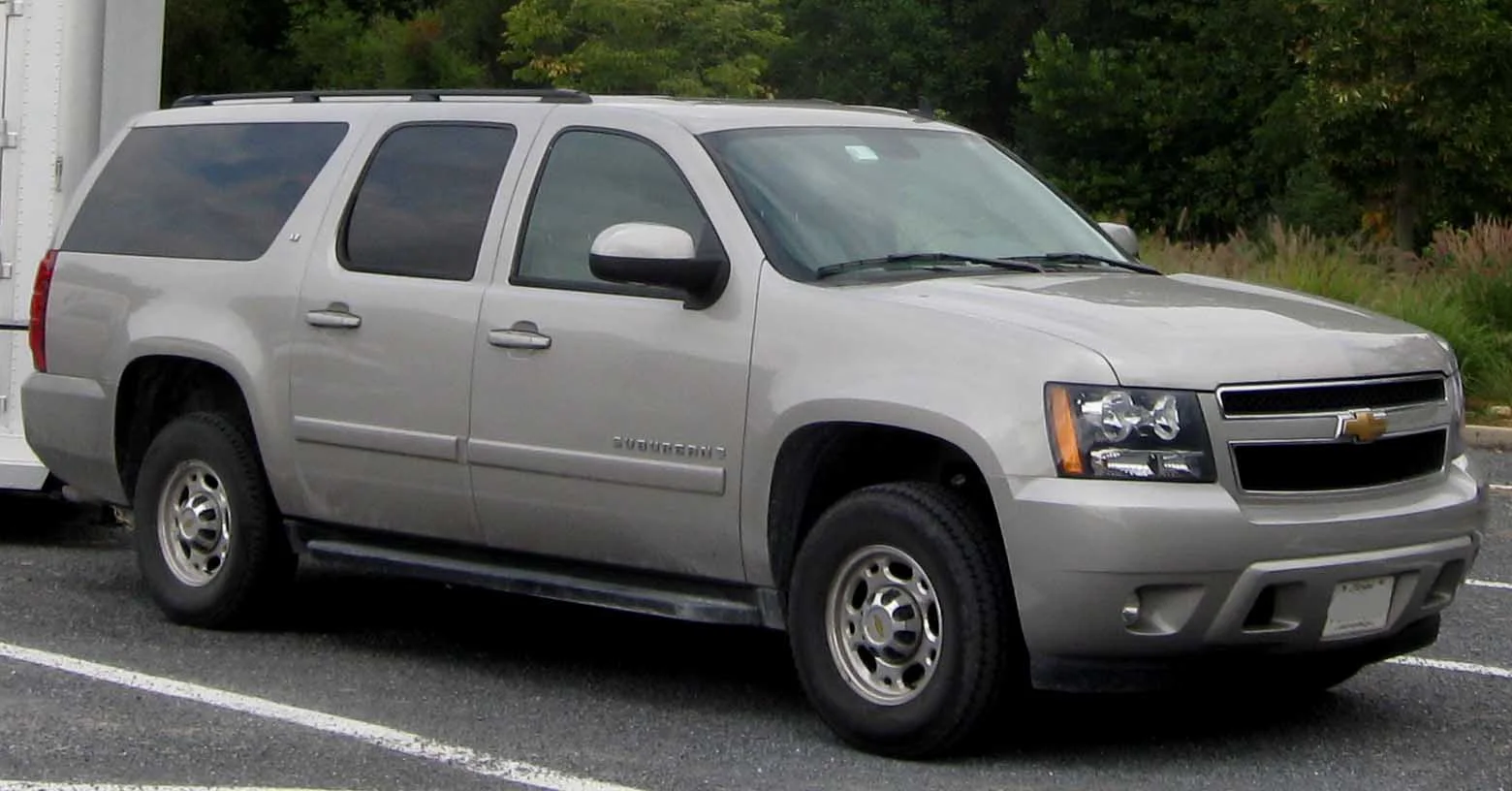
The honest verdict: two full-size twins, split by length
The GMC Yukon and Chevrolet Suburban are corporate twins — same platform, same engines, same cavernous approach to space — and both are, frankly, among the best gas vehicles you can sleep in. Their load floors are so long and wide that two adults lie flat with room for gear, something the midsize three-rows can only approximate. The real question is not whether they camp well, but how much vehicle you want.
The short version: buy the Suburban (or the matching Yukon XL) for the longest, roomiest floor — 144.7 cubic feet; buy the standard Yukon for nearly-as-cavernous space that is easier to park. All three are thirsty, huge, and can't run climate all night.
The key nuance: the Suburban is the long-body SUV, and its true GMC equivalent is the Yukon XL, not the standard Yukon. The standard Yukon is the shorter twin — still enormous at 122.9 cubic feet, but giving up the most maximum cargo of the three in exchange for being easier to live with in a garage or a parking lot.
What follows: the cargo numbers, how each sleeps, the flat-floor reality, power and weather for an overnight, the honest costs of going full-size, and a clear buy recommendation — grounded in published specs rather than a single drive.
Cargo dimensions: cavernous, and then some
These are the biggest floors in this whole comparison. The published figures:
- Chevy Suburban: 41.5 cu ft behind row three, 98.8 cu ft behind row two, 144.7 cu ft with both rear rows folded.
- GMC Yukon (standard): 25.5 cu ft behind row three, 72.6 cu ft with row three folded, 122.9 cu ft maximum.
- GMC Yukon XL: the long twin — roughly 144.5 cu ft maximum, matching the Suburban.
For sleeping, even the standard Yukon's 122.9 cubic feet is more than enough to lie two adults flat; the Suburban and Yukon XL simply add margin — a longer floor, more headroom to sit up, and space to keep a cooler, bins, and gear inside without touching the bed. The behind-third-row numbers (41.5 for the Suburban) mean you can even carry a loaded family and still have a trunk.
These floors fold much flatter than a midsize SUV's, but still benefit from a thick pad to smooth the seams. Our guide on how to choose a car camping mattress size helps you size a pad — and in these SUVs you can genuinely fit a car air mattress for SUV camping shaped for a full-size cargo bay, or even a low platform.
Sleeping in the Suburban: the closest thing to a room on wheels
The Suburban is the pick when you want the most bed. Its 144.7-cubic-foot floor is long enough that two tall adults lie flat without sliding the front seats all the way forward, and wide enough that neither person hangs off an edge. There is headroom to sit fully upright, change clothes, and organize gear — it genuinely feels like a small room once the rows are down.
That space unlocks setups the smaller SUVs can't. A permanent low sleeping platform with drawers underneath fits and still leaves sitting height; a full-size air mattress drops in; a family can sleep two inside and two in a connected ground tent off the tailgate. Available 110-volt and 12-volt outlets run a fan, lights, and charging, and the sheer sealed volume of air makes the cabin slow to overheat or chill.
The honest costs are size and thirst. The Suburban is long to park, and its V8 returns mid-to-high teens mpg (a diesel helps). But if your priority is the most comfortable in-vehicle sleeping short of a van, the Suburban delivers it, and the Yukon XL matches it if you prefer the GMC.
There is a psychological benefit to that space, too. Because you are not wedged into a tight box, a night in the Suburban feels less like camping in a car and more like camping in a small cabin — you can keep boots and a bag by your feet, sit up to read, and move around without disturbing a sleeping partner. For families easing into car camping, that roominess is often what turns a tolerated trip into one the kids ask to repeat.
Sleeping in the Yukon: cavernous but easier to live with
The standard Yukon offers nearly the same camping experience in a slightly more manageable package. Its 122.9 cubic feet still fold into a floor big enough for two adults to sleep flat — you may slide the front seats forward for the tallest sleepers, but the room is abundant. For most couples and small families, the standard Yukon is already more space than they will use.
The payoff for choosing the shorter twin is everyday livability. The standard Yukon is easier to park, fits more garages, and maneuvers better on tight forest roads and crowded trailhead lots than the long Suburban or Yukon XL. If your camping involves narrow access roads or you daily-drive the SUV in a city, that shorter length is a real, repeated benefit.
The trade is simply maximum room. Against the Suburban and Yukon XL, the standard Yukon gives up the most cargo and a bit of flat sleeping length. If you want the biggest possible bed and gear space, step up to the long body; if you want cavernous-enough space that is easier to park, the standard Yukon is the smart middle.
The flat-floor reality: why these beat midsize SUVs for sleeping
The reason full-size SUVs are the best gas vehicles here for sleeping is geometry. Their load floors are not only longer but flatter and more uniform in width than a midsize three-row, so the usable sleeping rectangle is closer to what the cubic-foot number implies. Two adults genuinely fit side by side, and a six-footer can often lie flat without the front-seat gymnastics a smaller SUV demands.
They are not perfectly flat — the folded seatbacks still create mild seams and a slight step — so a thick pad or a platform is still the move to get a truly level surface. But the imperfections are smaller relative to the vast floor, so leveling is easier and the payoff is a bed that rivals a purpose-built camper for a fraction of the effort.
Leveling the vehicle still matters: park on flat ground, or use the technique in our guide on how to level your car for sleeping with ramps or blocks. In a heavy full-size SUV a slight slope is very noticeable overnight, so getting the vehicle level does as much for comfort as the pad on top of it.
Getting to camp: capability, clearance, and thirst
Both twins are body-on-frame with available four-wheel drive, so reaching a dispersed site down a rough forest road is well within their comfort zone. Ground clearance is generous, the four-wheel-drive systems handle mud, sand, and snow, and the AT4 trims add skid plates, a slight lift, and all-terrain tires for campers who leave the pavement often. This capability is a genuine advantage over the car-based midsize SUVs, which run out of clearance sooner.
Towing is another shared strength. Both can pull sizeable trailers — well past what a midsize crossover manages — so you can haul a boat, a utility trailer, or a larger camper and still sleep inside the SUV at the destination. For families who tow and camp in the same trip, that combination is hard to beat at any price.
The offsetting reality is size and fuel. The long Suburban and Yukon XL are genuinely awkward on tight, twisting forest roads and in cramped campground loops, where the shorter standard Yukon threads through more easily. And the V8's mid-to-high-teens economy means a remote trip burns real fuel, so plan your gas stops on the way to and from the backcountry — the diesel option eases this if your driving skews toward long highway hauls to distant trailheads.
Power and climate: what these big SUVs can and can't do
Despite their size, the Yukon and Suburban share the same overnight limit as every gas vehicle: they should not idle to run heat or air conditioning all night because of fuel waste, noise, and carbon-monoxide risk. Their advantage is not climate runtime but volume — a huge sealed cabin changes temperature slowly, buying you comfort a small car can't.
For gear, both offer 12-volt sources and available 110-volt household outlets, enough for a fan, lights, and charging. For a 12-volt fridge or heavier loads, a portable power station for car camping is still the right approach — though their vast interiors easily swallow a large battery and a full camp kitchen without crowding the bed.
Climate comfort comes from your setup: reflective shades over that big glass area, a battery fan, and good bedding. The large air volume means the cabin is slow to overheat in evening sun and slow to chill at dawn, so these SUVs are forgiving — but the engine still stays off, and your gear does the climate work.
Weather and the honest costs of going full-size
Condensation behaves the same as in any sealed cabin: two people breathing overnight fog the glass, so crack a window and run a vent, following the same habits from our guide on how to reduce condensation when sleeping in a car. The big upside is that the enormous cabin volume dilutes moisture and temperature swings better than a small vehicle, making both SUVs comfortable across seasons with basic bedding and a fan.
The honest costs are real, though. Both are thirsty — expect mid-to-high teens mpg from the V8, better with the available diesel — so a long trip to camp costs meaningfully more fuel than a midsize SUV or a hybrid truck. They are also large to park, and the long Suburban and Yukon XL can be genuinely awkward on narrow forest roads or in tight campground loops.
Weigh that against how you camp. If you want the best in-vehicle bed and regularly carry people and gear, the space justifies the fuel and size. If your trips are solo or you camp on tight roads, a smaller SUV or a truck may fit your life better despite sleeping a little less grandly.
Spec snapshot: the camping numbers at a glance
Keep these attributed figures handy as you plan a bed and a power setup:
- Suburban cargo: 41.5 / 98.8 / 144.7 cu ft — the longest floor here.
- Yukon (standard) cargo: 25.5 / 72.6 / 122.9 cu ft — cavernous but shorter.
- Yukon XL: ~144.5 cu ft max, the long twin of the Suburban.
- Sleeping fit: both fit two adults flat; the long bodies do it without sliding the front seats forward.
- Fuel economy: mid-to-high teens mpg on the V8; a diesel improves it — neither is efficient.
- Power: 12V plus available 110V outlets; add a power station for a fridge.
The deciding factor is length: the Suburban (or Yukon XL) gives the biggest bed and most gear space, while the standard Yukon trades some maximum room for easier parking. All three are the best flat-sleeping gas SUVs in this comparison — the choice is how much vehicle you want to own and fuel.
Five setup mistakes that ruin the first night
Even in these cavernous SUVs, the same avoidable errors spoil a first night. Solve them and the space does the rest:
- A thin pad on the folded floor. The floor is big but not perfectly flat — use a thick, insulated pad or a platform.
- Parking on a grade. A heavy full-size SUV on a slope slides noticeably; level it with blocks or find flat ground.
- Sealing the cabin tight. Crack a window so breath moisture escapes — the big glass area fogs fast otherwise.
- Counting on the engine for climate. It won't and shouldn't run overnight — use shades, a fan, and a season-rated bag.
- Underestimating parking and fuel. Plan for the size and thirst before you commit to a tight, remote site far from a gas station.
None of these depend on which twin you buy. A Yukon or a Suburban with a thick pad, level ground, a cracked window, and the right bag both deliver the most spacious night in this comparison — leaving the real decision at length and livability.
Which SUV should you buy?
Buy the Suburban (or Yukon XL) if you want the biggest possible bed and gear space. Its 144.7 cubic feet let two tall adults lie flat without front-seat gymnastics, fit a platform or full-size mattress, and keep a full camp kitchen inside. For families and couples who prioritize in-vehicle sleeping comfort above all, the long body is the pick.
Buy the standard Yukon if you want cavernous-enough space that is easier to park and maneuver. Its 122.9 cubic feet still sleep two adults flat, and the shorter body is friendlier on narrow access roads, in tight campground loops, and in a home garage. It is the smart middle for most full-size shoppers.
Either way, equip the same kit — a thick pad or platform, shades, a fan, and a power station for the fridge — and accept the shared costs of going full-size: fuel and parking. Do that, and both twins deliver the roomiest, most comfortable in-vehicle bed here.
The bottom line
The Yukon and Suburban are the best gas SUVs in this comparison for genuinely sleeping inside, because their cavernous, flat-ish floors fit two adults with room for gear. The choice is length: the Suburban and matching Yukon XL give the biggest bed at 144.7 cubic feet, while the standard Yukon trades some maximum room for easier parking at 122.9.
Pick the long body for maximum sleeping and storage; pick the standard Yukon for cavernous space that lives easier day to day. Equip either with a thick pad or platform, shades, a fan, and a power station, manage climate with your gear, and accept the fuel and size — and you get the closest thing to a room on wheels short of buying a van.