Where to Start
Picking the right size mattress for your car isn't just about comfort; it's about maximizing that precious cargo space without feeling like you're wrestling an octopus every night. My first attempt involved a queen-sized air mattress I crammed into the back of my old Subaru Outback. It fit, technically, but left zero room for anything else. Zero.
So, learning to measure your vehicle's sleeping area before you buy is the real move, and it'll save you a lot of headaches and awkward packing jobs. It's not rocket science, but it does require a tape measure and a clear head, which, let's be honest, I didn't always have at 7 AM after sleeping on the floor of my car. This is how you avoid that rookie mistake.
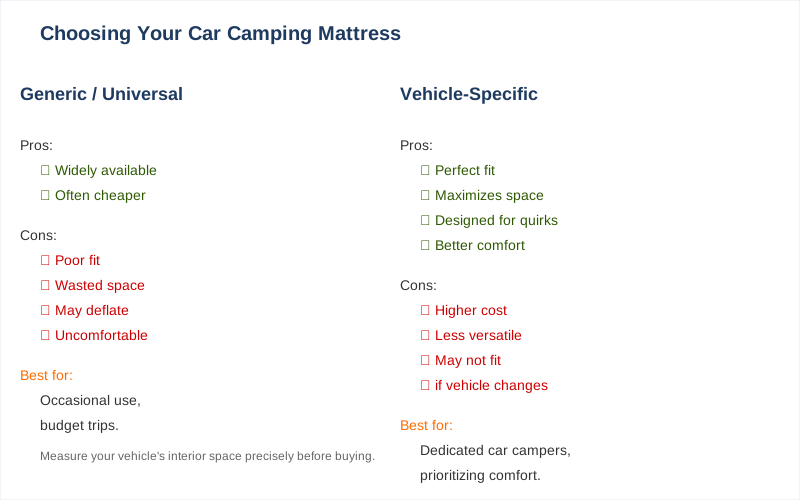
Luno breaks down vehicle-specific fits, which is a smart way to start thinking about it. Seriously, don't skip this step. People are out there using custom foam setups, so there's definitely a right size for everyone.
The Core Answer
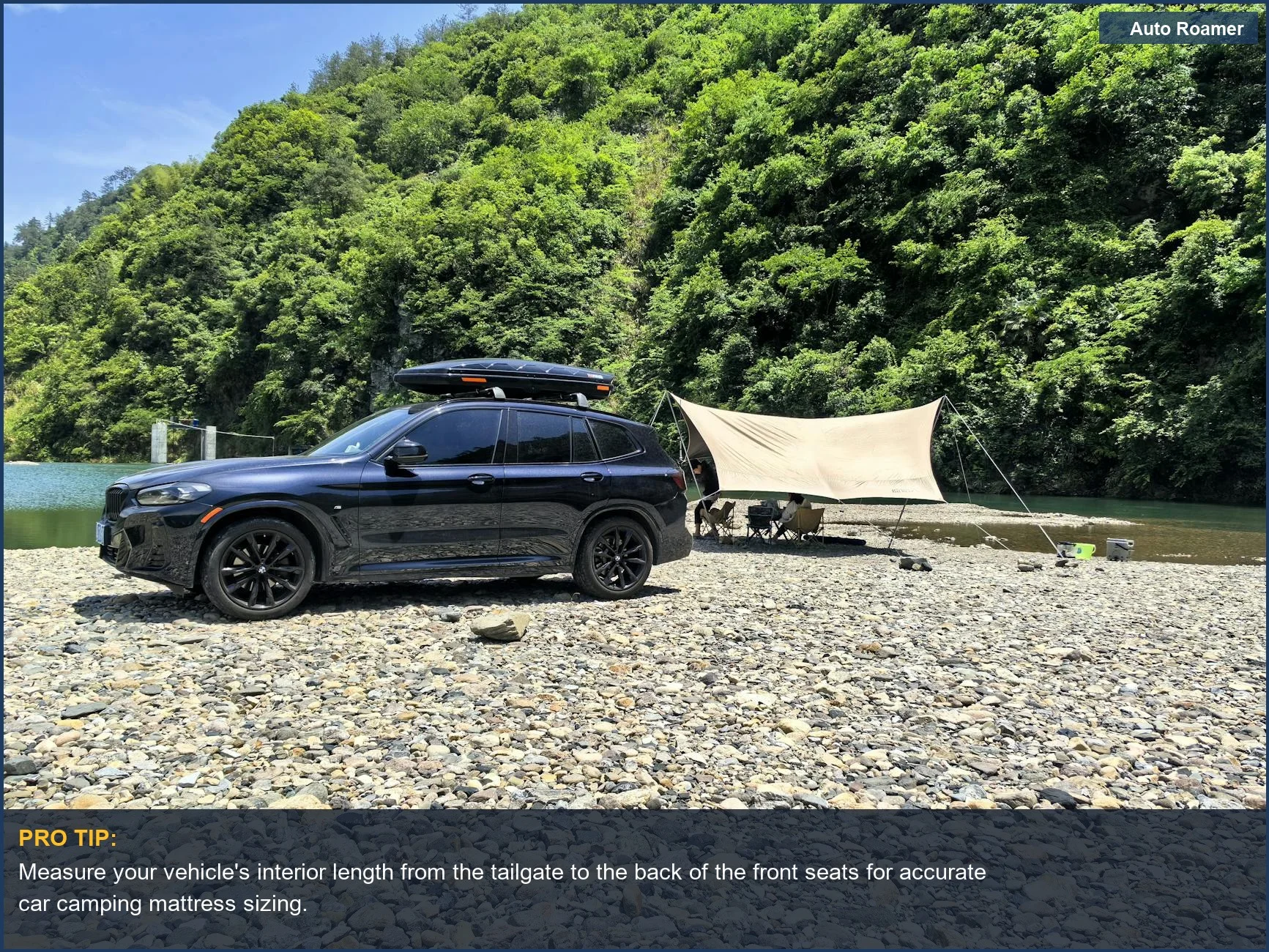
The core answer is simple: measure your vehicle's sleeping footprint. Don't just guess. My first car camping mattress was a standard twin-size foam pad I bought on a whim. It was too long, so my feet dangled out the back of my hatchback. Not exactly conducive to a good night's sleep. The real move is to fold down your rear seats and measure the usable length and width.
Think about how you'll sleep - curled up like a burrito or stretched out like a starfish. HEST talks about matching your rig to the mattress, and that starts with knowing your rig's dimensions. For most SUVs and hatchbacks, you're looking at dimensions somewhere in the twin or full-size range, but often with irregular shapes due to wheel wells or slanted rear windows. This YouTube video shows how to measure, and it's surprisingly straightforward.
You're not building a custom yacht interior here, you're just trying to sleep comfortably. Consider whether you need a mattress that fits perfectly edge-to-edge or if some gaps are acceptable. I learned the hard way that a perfectly flat surface is way better than a mattress that leaves you with a sore hip from a wheel well bump. The honest version: you need to account for those weird nooks and crannies your car has.
If you're in a truck bed, the dimensions are even more critical, and you'll want something designed specifically for that space. A 4Runner, for example, has a specific cargo area size to consider. Don't just buy the first mattress you see online; measure first, buy second. It's the $50 version of buying the right tool for the job, and it pays off in comfort. I once tried to make a full-size mattress work in a compact SUV.
It was a disaster. I woke up feeling like I'd slept in a pretzel. The real move is to be honest about your vehicle's interior space. This is where your tape measure becomes your best friend. It's not about the fanciest mattress; it's about the one that actually fits your car and your body. Videos like this can give you visual cues on how mattresses fit different vehicles.
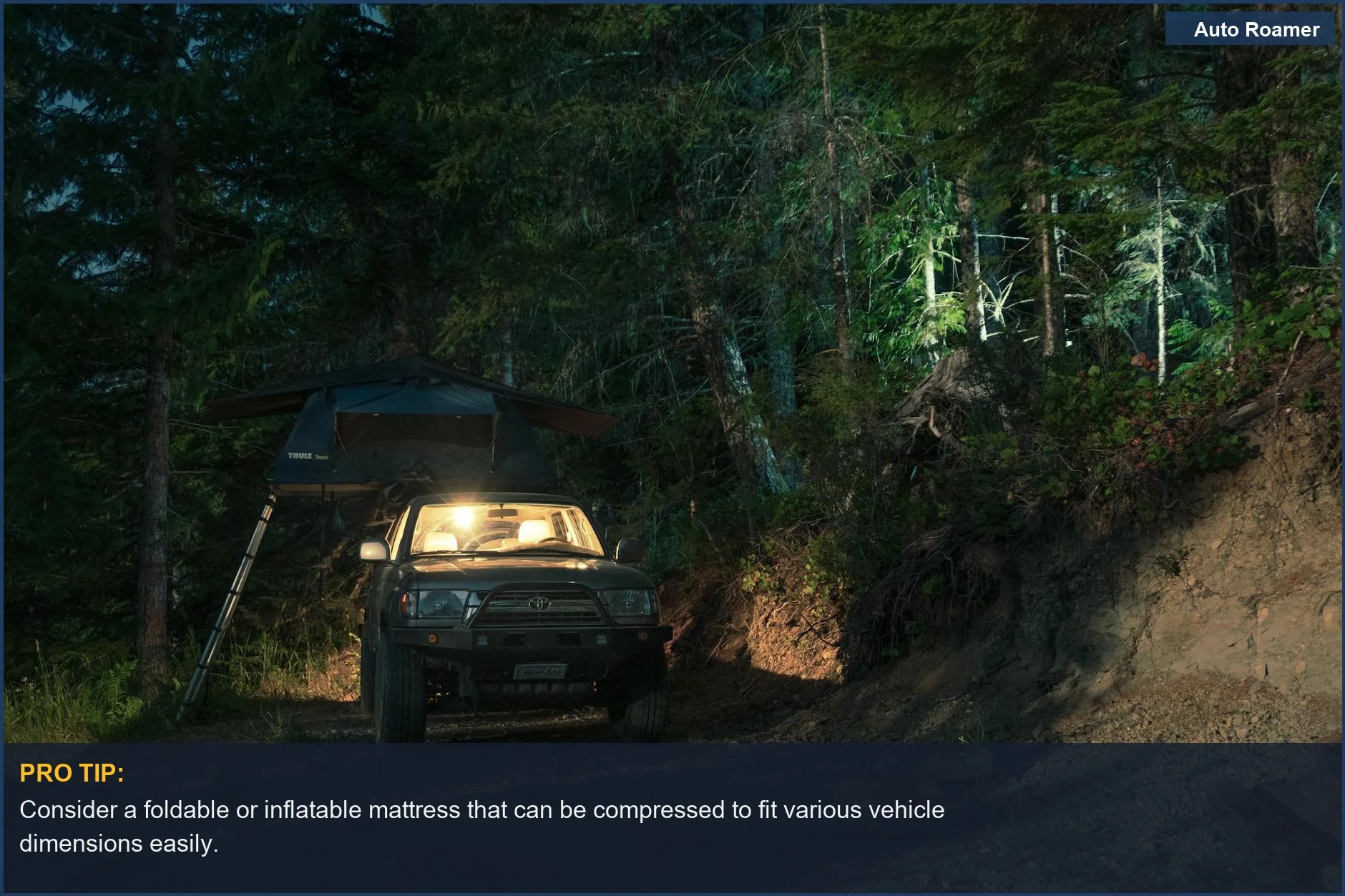
Think about whether you'll need a mattress that inflates and deflates, or a solid foam pad. Both have size implications. A deflated air mattress is small, but an inflated one can be bulky. Foam pads are usually more rigid. The goal is to have a mattress that fills the usable space without being so large it buckles or bunches up. My buddy tried to squeeze a king-size inflatable into his Honda Civic.
He said it was like sleeping inside a balloon. Brilliant engineering, that. The key is to match the mattress dimensions to your measured interior space, accounting for any curves or obstacles. This ensures you get a snug fit, maximizing comfort and minimizing wasted space. Remember, a mattress that's too big is just as bad as one that's too small. It leads to awkward sleeping positions and a general feeling of 'what was I thinking?'

Why This Matters for Your Setup
Why does this matter? Because waking up with your head on the door panel and your feet in the glove compartment is not the vibe. I learned this lesson at a campsite in Utah when my air mattress, which seemed big enough in my garage, decided to expand and press against the car doors all night. Every time I moved, the whole car creaked. It was like sleeping inside a giant, noisy bag of chips.
Understanding your vehicle's specific dimensions is crucial for a good night's sleep. It's not just about length and width; it's about how the mattress conforms to the space. Some vehicles have wheel wells that intrude into the sleeping area, and a mattress that doesn't account for this will leave you with an uneven surface. A mattress designed for a specific SUV model will often have cutouts or contours to fit around these obstacles.
My first trip, I used a generic foam pad that didn't account for my Honda CR-V's rear seat angles, leaving a significant gap that swallowed my pillow. The real move: measure the actual sleeping surface once your seats are down. This means measuring from the back of the front seats to the tailgate, and side-to-side at the widest points. Don't forget to factor in any sloped windows or dashboard intrusion. HEST emphasizes measuring your rig, and for good reason.
A mattress that's too short means cold air seeping in and uncomfortable dangling limbs. Too wide, and it bunches up, making it impossible to lie flat. It's a game-time decision that impacts your entire trip. My second trip, I used a mattress that fit like a glove, and it was a completely different experience. Game-changing, even. You want a mattress that fills the space efficiently, providing a stable and comfortable platform.
This isn't just about looking neat; it's about preventing you from rolling into the driver's seat or having your gear spill onto the floor.
Making the Right Choice
Making the right choice starts with a tape measure and a realistic look at your car's interior. My first few trips were a comedy of errors, trying to cram ill-fitting mattresses into my vehicle. The honest version: it's worth the 10 minutes of measuring. People on Reddit are constantly asking about fit, and the common theme is 'measure your space.' Think about whether you need a mattress that folds, rolls, or inflates. Each has different packing dimensions and fits.
HEST also points out the importance of insulation, which is tied to how well the mattress fills the space and prevents drafts. A mattress that leaves large gaps is basically a giant air vent. The real move is to find a mattress that complements your vehicle's shape, not fights against it. This ensures you're not just sleeping in your car, but sleeping well in your car.
Consider the thickness too; too thick and you'll be bumping your head on the roof when you sit up. Too thin, and you'll feel every bump in the road. It's a balancing act, but getting the size right is the first, most critical step. Your back will thank you.