
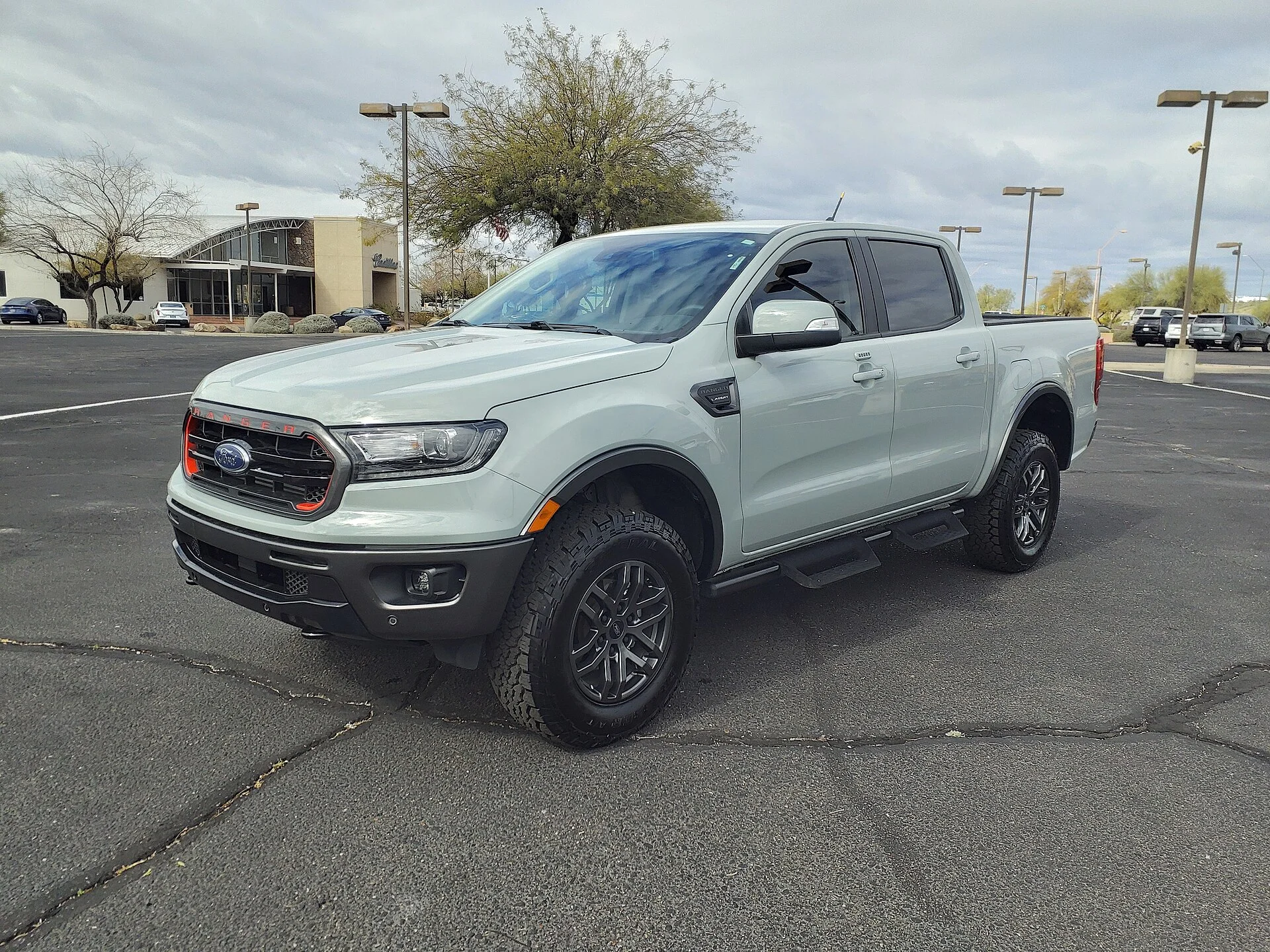
The Short Answer: Four Points, One Weak Outlet
Open up the Ranger's power layout and the truth is right there: it is generously wired for 12V and stingy on AC. The P375 Ranger, the 2019-2023 trucks, carries four factory 12V power points, and every one of them runs on a healthy 20A fuse. That is more 12V access than most compact trucks give you, and it is genuinely useful for camp gear.
The AC side is the opposite story. The factory 110V household outlet is rated only 150 watts, not the 400 watts a lot of owners assume, and it enters a fault mode and shuts off if you exceed that. So the tinkerer's first correction is to stop planning camp power around an outlet that cannot run a compressor fridge or a power tool.
The other thing worth knowing before a trip is switching: the console sockets are generally always-on, but a battery-saver timeout cuts some feeds after about two hours. There is a configuration trick to change that, which this guide covers. First, the full map of where every power point lives and which fuse feeds it.
The Four 12V Power Points and Their Fuses
Here is the part that rewards a look at the diagram. The Ranger has four 12V auxiliary power points, and interestingly all four fuses live in the engine-compartment power distribution box, not the cabin panel. The front instrument-panel 12V point is fuse number 10. A second instrument-panel point, Auxiliary Power Point 2, is fuse number 16.
The console-rear 12V point, Auxiliary Power Point 3, is fuse number 5. And a rear cargo-area 12V point is fuse number 17 - notably, that circuit is present as wiring even on trucks that did not come with the factory bed outlet installed, which means the feed may already be there waiting for a socket. For a camper wanting bed power, that is a useful discovery.
So you have up to four sockets: two up front, one at the console rear, and one in the cargo area. The two fuse boxes are the passenger-compartment panel below and outboard of the steering column behind an access cover, and the engine-compartment box on the driver's side. The 12V point fuses are all in that engine-bay box, so that is where you look when a socket goes dead.
Every Socket Is a 20A Circuit
One clean thing about the Ranger's design is consistency: every factory 12V socket is fed by a 20A fuse. That means each outlet can theoretically pass up to 20 amps at 12 volts, about 240 watts, before the fuse blows. It is a tidy, uniform scheme - no hunting for which socket is the weak one, because they are all fused the same.
That said, the fuse rating is the protection limit, not a target. Device-side draw should stay well under it. The practical rule for the Ranger is to keep any single 12V socket load under about 15 amps to stay safely below the 20A fuse, which leaves comfortable margin for real camp gear rather than pushing the circuit to its edge.
For the most common camp load, that is no constraint at all. A 12V compressor fridge pulls only about 4 to 5 amps, roughly 48 to 60 watts, which sits comfortably inside a single 20A circuit and is safe for continuous use off the console socket. Run the fridge on one point and a charger on another and you are nowhere near the limits - the uniform 20A wiring gives a camper real flexibility.
USB: Smart vs Non-Smart Ports
The USB ports are on their own circuit, separate from the 12V sockets, protected by fuse number 29 at 7.5A in the engine-compartment box. That separation means a USB fault will not take down your 12V fridge socket, which is exactly the kind of thoughtful wiring split you notice when you trace the diagram.
Not all the USB ports are equal, though, and this trips people up. A smart-charging port outputs up to 2 amps, while a non-smart-charging port outputs only about 0.5 amps. That is a big difference for a hungry device - a tablet crawls on a 0.5-amp port and charges properly on the 2-amp smart one. If your device seems to be barely keeping up, you are probably on the wrong port.
One more detail from opening it up: the rear-seat USB ports are power-only, meaning charging with no data transfer, so they will not run Android Auto or Apple CarPlay. For a camper that is irrelevant - you want them for charging - but it is the sort of built-in limitation worth knowing so you are not troubleshooting a data connection that was never wired to exist.
The 150W AC Outlet: Know Its Limits
Now the outlet people overestimate. The factory 110V AC household outlet on the P375 Ranger is rated 150 watts, and it lives on the rear of the center console. It works only when the ignition is on, and it has an indicator light showing when it is active. As AC outlets go, it is a modest one, and its rating is a hard wall, not a suggestion.
The design proves it means the limit: the 150-watt outlet enters a fault mode and temporarily shuts off if the plugged-in device exceeds 150 watts. Ford specifically warns against motor and compressor loads - vacuums, power tools, and compressor-driven refrigerators - because those draw a startup surge that trips the outlet even if their running wattage looks close.
The numbers explain why it is limited. At 110 volts, 150 watts is only about 1.36 amps on the AC side, which pulls roughly 12.5 amps from the 12V system through the inverter. It is fine for a laptop, a phone charger, or small lights, and nothing more. Plan your AC camp devices to stay under 150 watts and treat this outlet as a small-electronics convenience, not a real power source.
Busting the 400W Bed-Outlet Myth
Here is the myth this tinkerer wants dead. Search the Ranger forums and you will find endless talk of a 400-watt 110V bed outlet, and people plan builds around it. The factory Ranger outlet is only 150 watts, and it cannot run a 400-watt load. The widely-discussed 400-watt outlet is an F150-sourced part that some owners swap in as a DIY upgrade - it is not a factory Ranger bed option.
That distinction matters because it changes what you can and cannot do out of the box. If you bought a Ranger expecting the F150's 400-watt outlet, you got the 150-watt console unit instead, and it will fault out the moment you plug in anything hungry. Believing the myth is exactly how you end up with a dead outlet and a confused evening at camp.
If you genuinely want more AC power, the honest path is the deliberate F150-part swap that experienced owners document, or a separate battery pack, not an assumption that the truck already has capacity it does not. A tinkerer respects what the internals actually are. The Ranger's factory AC ceiling is 150 watts; anything above that is a project you take on knowingly, not a spec you inherit.
Always-On, With a 2-Hour Catch
Switching on the Ranger is friendlier than on many trucks, with one asterisk. The console 12V power points are generally always-on, or constant, which is a good start for overnight camping - unlike trucks whose sockets die the instant the key comes out. But there is a battery-saver timeout that cuts certain 12V feeds after about two hours to prevent draining the battery.
The rear and bumper-area 12V feed is among those that shut off on that timer. So a fridge plugged into an affected socket runs for roughly two hours after you shut the truck off, then the truck cuts it to protect the starting battery. That is better than an instantly-switched outlet, but two hours is nowhere near a full night, so it is not the overnight solution on its own.
This is the sort of behavior you only discover by testing or reading the fine print, because the socket appears to work fine when you plug in - it just quietly quits later. Know which feeds are on the timer, and do not assume a socket that is live at bedtime will still be live at dawn. The next section covers how to change that behavior outright.
The Config Trick: Make Them Constant
Here is the clever bit hiding in the truck's electronics. Switched-versus-constant behavior on the Ranger is configurable. Disabling the Body Control Module Powerpoint feature setting makes the 12V power points always-on once the ignition has been cycled, changing them from switched to constant. It is a software change to the truck's own configuration, not a rewire.
For a camper that is the ideal fix, because it turns the factory sockets into genuine overnight feeds without adding a single wire or fuse tap. Set the configuration, cycle the ignition, and your 12V points stay hot for the fridge all night. It is exactly the kind of built-in capability the tinkerer loves - the hardware was always there, the manufacturer just gated it behind a setting.
The trade-off is the one you would expect: a truly constant socket will drain the starting battery if you forget a load running, because you have removed the battery-saver that was protecting you. So use the constant configuration deliberately, watch your battery on a multi-day stay without driving, and enjoy having factory sockets that behave the way a camper actually wants. That beats a fuse tap when the truck can simply be told to do it.
Adding a Bed 12V Socket
If you want a dedicated 12V socket in the bed, the Ranger gives you two honest paths. The tidiest is the Ford accessory kit - a factory-style 12V bed power outlet that installs as a proper part. Note that it is a 12V DC socket, not a 110V AC outlet, and it shares the same 20A auxiliary-power-point fusing scheme as the other sockets, so it drops cleanly into the truck's existing design.
The other path uses that rear cargo-area circuit on fuse number 17, which is present as wiring even on trucks without the factory bed outlet. If your truck has that feed already run, adding a socket to it is a modest job. Either way, you are working within the Ranger's uniform 20A scheme, so a fridge at 4 to 5 amps has ample headroom. A simple 12V accessory socket panel is the standard part for a clean bed install.
Whatever route you choose, match the fuse to the load and confirm whether the feed is constant or on the battery-saver timer before you rely on it overnight. The bed circuit may be one of the timed feeds, in which case the Powerpoint config change or a constant-hot tap is what keeps it alive all night. Build it knowing the behavior, not hoping for it.
The Verdict: Well-Wired, Honest AC Cap
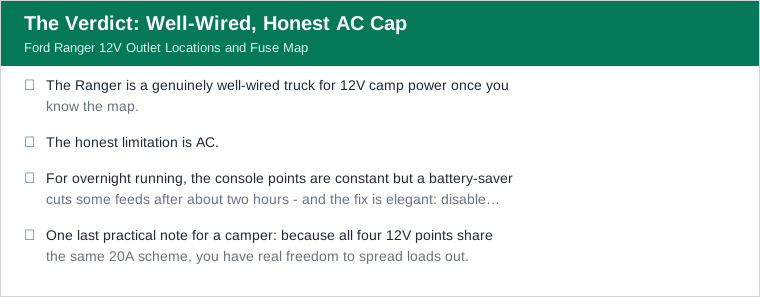
The Ranger is a genuinely well-wired truck for 12V camp power once you know the map. Four factory power points - front, second dash, console rear, and cargo - all fed by uniform 20A fuses out of the engine-bay box, give a camper real flexibility. A fridge at 4 to 5 amps fits any of them with huge margin, and USB runs on its own 7.5A circuit with a 2-amp smart port for hungry devices.
The honest limitation is AC. The factory 110V outlet is 150 watts, not the 400-watt F150 part people confuse it with, and it faults out on compressor or motor loads. Treat it as a laptop-and-charger outlet, and if you need more, do the deliberate part swap or carry a battery pack rather than believing the myth.
For overnight running, the console points are constant but a battery-saver cuts some feeds after about two hours - and the fix is elegant: disable the Powerpoint setting to make them truly always-on, used with an eye on your battery. Trace your fuses, know which feeds are timed, and the Ranger becomes exactly what it is under the panels: a 12V-generous truck with a small, honest AC cap.
One last practical note for a camper: because all four 12V points share the same 20A scheme, you have real freedom to spread loads out. Put the fridge on one point, a charger on another, a light on a third, and no single circuit is ever near its limit. That distribution is easier and safer than stacking everything on one socket with a splitter, and it is a genuine advantage of the Ranger's uniform, generous 12V wiring. Trace the four points once, decide which is your constant overnight feed, and the rest of the truck's power falls into place.