
The Short Answer: Bigger Bed, Smaller Bed, One Shared Catch
Both of these Fords make a fine bed-camping platform, and the choice between them is less complicated than the forums make it. The Ford Ranger has the bigger, better bed for sleeping, at 61.0 inches long, 43.5 cubic feet, and available 400-watt Pro Power Onboard. The Ford Maverick has the smaller, cheaper, more efficient package, at 54.4 inches and 33.3 cubic feet, that favors gear hauling with tailgate-down sleeping. That is the whole story in one line.
But there is a catch that applies to both, and it is the one that catches new bed campers every time: neither truck fits a 6-foot adult stretched flat with the tailgate up. The Maverick's bed is only 54.4 inches and the Ranger's only 61.0 inches, both well short of a 72-inch body. Sleeping flat in either one means dropping the tailgate or running a bed extender, full stop.
This comparison walks the bed dimensions, the power, the payload, and the real lie-flat math, so you pick the right truck and set it up correctly. The figures are Ford's published bed specs plus clearly flagged owner measurements for the tailgate-down sleeping lengths, because that last number is the one that decides your night and the one Ford does not print.
Bed Length: The Ranger's 6.6-Inch Edge
Start with the number that matters most for sleeping: length. The Maverick has a 54.4-inch bed, a 4.5-foot box that is the shortest in Ford's truck lineup. The Ranger has a 61.0-inch bed, a full 5-foot box, about 6.6 inches longer than the Maverick's. In a segment where every inch counts toward lying flat, that is a meaningful gap, not a rounding difference.
Neither number gets you to a flat 6-foot sleep on its own, but the Ranger's extra length changes the math once the tailgate drops. With the tailgate down, owners measure the Maverick reaching roughly 72-plus inches and the Ranger roughly 79-plus inches of usable length, since a tailgate adds about 17 to 18 inches. That puts the Ranger comfortably past a 6-foot adult with room to spare and the Maverick right at the edge.
The practical read: if you are tall, or you want to sleep flat without any gear bridging the tailgate gap, the Ranger's length is the safer bet. The Maverick can absolutely be slept in flat, but it leans harder on the tailgate-down setup and rewards a shorter camper or a diagonal layout. The Ranger bed-dimensions guide and the Maverick bed-dimensions guide lay out both boxes in full.
It is worth stressing that bed length is the one dimension you cannot really engineer around cheaply. You can add power, you can add tie-downs, you can add a topper, but you cannot make a 54.4-inch bed into a 61.0-inch bed. If flat-inside sleeping is your priority, start with the length and let everything else follow.
Bed Width: Busting the 'Just Longer' Myth
Here is where the internet gets it wrong. A common claim is that the Ranger is merely longer than the Maverick while the beds are otherwise similar. The measurements say otherwise: the Ranger is genuinely the wider bed too, not just the longer one. It measures 44.8 inches between the wheel wells and 62.4 inches of maximum width, against the Maverick's 42.6 inches between the wheel wells and 53.3 inches of maximum width.
That is a wide margin at maximum width and a clear one even at the critical wheel-well pinch point. For a single sleeper it hardly matters, since a standard 25-inch-wide sleeping pad fits between the wheel wells in both trucks. For two people, or for anyone building a platform, the Ranger's extra width is the difference between a snug fit and a comfortable one.
The plywood test makes it concrete. A 48-inch-wide sheet of plywood clears neither truck's wheel wells, so both require a platform that sits above the wells or notches around them. But that sheet sits flatter and with less overhang in the Ranger thanks to its wider box, which makes a bed platform easier to build and more stable once it is in. The Ranger is not just a longer Maverick; it is a bigger bed in every direction.
Depth completes the picture and, for once, it is close. The Maverick bed is 20.3 inches deep and the Ranger bed approximately 20.8 inches, roughly a half-inch deeper. That similarity means both trucks hold about the same height of loose gear below the rail line, so the width and length, not the depth, are what separate them for camping.
The Lie-Flat Reality Nobody Wants to Hear
Let us be blunt about the number that ends more bed-camping plans than any other. Neither the Maverick nor the Ranger fits a 6-foot adult lying flat with the tailgate up. The Maverick's 54.4-inch bed and the Ranger's 61.0-inch bed are both far short of a 72-inch body, so anyone who buys either truck expecting to close the tailgate and stretch out is in for a cramped surprise.
The fix is the tailgate. Dropped, it adds roughly 17 to 18 inches, extending the Maverick to about 72-plus inches and the Ranger to about 79-plus inches of usable flat length. That is enough to sleep flat in both, but it means your feet, or a padded section, extend over the open tailgate, which changes how you weatherproof and secure the setup. A topper or a canopy becomes close to mandatory to keep rain and critters out of an open-ended bed.
The alternative to tailgate-down sleeping is a diagonal layout or a bed extender that bridges the tailgate gap into a solid platform. A hitch-mounted bed extender turns the open tailgate into usable structure and is a common fix for exactly this problem, especially in the shorter Maverick. Either way, plan for the truck's real length, not the length you wish it had.
None of this makes bed camping a bad idea in these trucks; it makes it a planned one. Bed campers who accept the tailgate-down reality and build for it sleep fine in both. The ones who get frustrated are the ones who expected a factory-flat 6-foot bed that neither midsize nor compact truck actually provides.
Power in the Bed: FLEXBED vs Pro Power Onboard
Camp power is where the two Fords take genuinely different approaches. The Maverick's FLEXBED system includes available 12V and 110V power outlets in the bed, plus integrated tie-downs, storage slots, and a multiposition tailgate. It is a clever, modular system built around the idea that owners will customize the bed, and the power outlets are part of that kit.
The Ranger counters with available Pro Power Onboard, providing up to 400 watts of output through in-bed 110V outlets for running camp devices. That 400-watt figure is the headline advantage: it is enough to charge laptops, run lights, and power small appliances that the Maverick's more modest outlets cannot handle. For a powered camp, the Ranger's inverter is the stronger tool.
Both systems share the caveat every factory truck outlet carries: they draw from the vehicle's electrical system, so sustained high-wattage use overnight needs the engine running or an auxiliary source. The Ranger's 400 watts is a real convenience while driving or idling and not an all-night house supply. For the full picture of the Ranger's bed wiring, the Ranger 12V outlet and fuse-map guide traces every circuit.
The takeaway on power: if running 110V camp devices matters, the Ranger's 400-watt Pro Power Onboard is a clear step up. If you mostly charge phones and run a 12V fridge, the Maverick's FLEXBED outlets cover it, and the modular tie-downs and storage slots are arguably more useful day to day than raw watts.
Payload and Hauling: The Ranger's Bigger Margin
Payload decides how much you can pile in before the truck is overloaded, and the Ranger has the clear edge. It carries a maximum payload of 1,805 pounds, against the Maverick's 1,500 pounds, roughly 300 pounds more. For a camper hauling water, a fridge, a platform, and gear for a family, that 300-pound margin is real breathing room.
The volume difference reinforces it. The Ranger offers 43.5 cubic feet of bed cargo volume against the Maverick's 33.3 cubic feet, about 10 cubic feet more. Combined with the higher payload, the Ranger simply swallows and carries more, which suits longer trips, more people, or a heavier build. The Maverick's smaller bed is easier to reach into and lighter to live with, but it fills up faster.
Load height factors in too. The Ranger's tailgate sits about 36.1 inches high in the down position, per Ford's body-builder guide, a manageable height for sliding gear in. Ford does not prominently publish a Maverick tailgate load height, but its car-based unibody sits lower than the Ranger's body-on-frame bed, so the lift-over is lower and easier on your back. That is a small but daily advantage for the Maverick.
Put together, the hauling story mirrors the sleeping story: the Ranger carries more and sleeps longer because it is the bigger truck, while the Maverick trades capacity for a lower, lighter, easier-to-live-with package. Neither is wrong; they are sized for different loads.
Sleeping Setups That Work in Each
In the Ranger, the straightforward setup is a tailgate-down flat platform or pad reaching that roughly 79-plus inches, under a topper or canopy to weatherproof the open end. With 44.8 inches between the wheel wells, a single sleeper has room to spare and two pads fit using the full width above the wells. The Ranger's size lets you build a genuinely comfortable bed without much compromise.
In the Maverick, the setup leans on the tailgate-down length of about 72-plus inches, which puts an average adult right at the edge of flat. Shorter campers fit fine straight; taller ones do better on a diagonal or with a bed extender bridging the tailgate. A 25-inch pad fits between the 42.6-inch wheel wells cleanly for one, and the FLEXBED tie-downs make anchoring a platform easy.
For two people, the Ranger is the honest choice. Its extra width and length give two sleepers room the Maverick cannot match, and its higher payload carries the heavier gear two campers bring. The Maverick works for two only with careful staggering or a head-to-toe layout, and even then it is cozy.
Whichever truck, a topper transforms the experience by turning an open bed into an enclosed, weatherproof room and letting you leave the tailgate down for length without exposing your setup to rain. Bed campers in both trucks who invest in a canopy early rarely regret it; it is the single upgrade that makes tailgate-down sleeping practical in any season.
Cost, Efficiency, and the Everyday Trade
The Maverick's case is not really about the bed at all; it is about everything around it. It is Ford's smallest, most efficient, most affordable truck, and it drives like the car-based unibody it is. For a camper who uses the truck as a daily driver most of the year and a bed-camping platform on weekends, that everyday livability is a large part of the value, and the smaller 54.4-inch bed is the price of it.
The Ranger's case is that it is a real midsize truck with a real 61.0-inch bed, more payload, and more power, at the cost of size, thirst, and price. If bed camping is a core reason you are buying the truck, paying for the bigger bed and the 400-watt inverter is money spent exactly where it matters. If camping is occasional, that capability may sit unused most of the time.
Neither truck is trying to be the other. The Maverick optimizes for the 95 percent of days you are not camping and asks you to plan a little harder for the 5 percent you are. The Ranger optimizes for the camping and asks you to live with a bigger, thirstier truck the rest of the time. Your split between those two lives is the real decision.
That framing cuts through the spec argument. Do not choose on the bed numbers alone; choose on which truck you want in your driveway every morning, then set up whichever one you pick to camp well. Both can be made into good bed-camping rigs; only one of them is the truck you actually want to own.
Who Should Buy Which
Buy the Ranger if bed camping is a priority and you want the least compromise. Its 61.0-inch bed, 44.8-inch width, 43.5 cubic feet, 400-watt Pro Power Onboard, and 1,805-pound payload make it the better sleeping and hauling platform in every dimension. It is the right pick for tall campers, for couples, and for anyone building a serious bed setup who does not want to fight the truck's size.
Buy the Maverick if efficiency, price, and everyday ease lead your list and you are willing to plan around a shorter bed. Its 54.4-inch box sleeps flat only with the tailgate down or a bed extender, but its FLEXBED outlets, tie-downs, low load height, and car-like drive make it a genuinely pleasant truck to own and a capable weekend camper for one, especially a shorter sleeper.
The one buyer who should think hardest is the tall solo camper on a budget. The Maverick's price and efficiency are tempting, but its 54.4-inch bed reaching only about 72-plus inches tailgate-down puts you right at the edge, so budget for a bed extender and a topper from day one, or stretch to the Ranger for the length. Going in with clear eyes on the lie-flat math is what keeps either truck from disappointing you.
The Verdict: Size the Truck to the Sleep
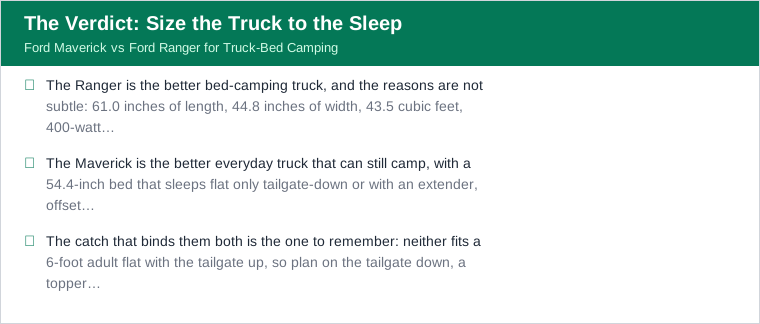
The Ranger is the better bed-camping truck, and the reasons are not subtle: 61.0 inches of length, 44.8 inches of width, 43.5 cubic feet, 400-watt Pro Power Onboard, and 1,805 pounds of payload beat the Maverick in every camping dimension. If sleeping in the bed is a real priority, especially for two people or a tall camper, the Ranger is the honest answer.
The Maverick is the better everyday truck that can still camp, with a 54.4-inch bed that sleeps flat only tailgate-down or with an extender, offset by efficiency, price, a low load height, and a clever FLEXBED. For a shorter solo camper who values the daily drive, it is a smart, affordable platform that rewards a little setup planning.
The catch that binds them both is the one to remember: neither fits a 6-foot adult flat with the tailgate up, so plan on the tailgate down, a topper, and possibly an extender in either truck. Get that right, size the bed to your body and your usual number of sleepers, and both Fords make a comfortable, capable bed-camping rig. Choose on the length you need and the truck you want to drive, not on the argument online.