
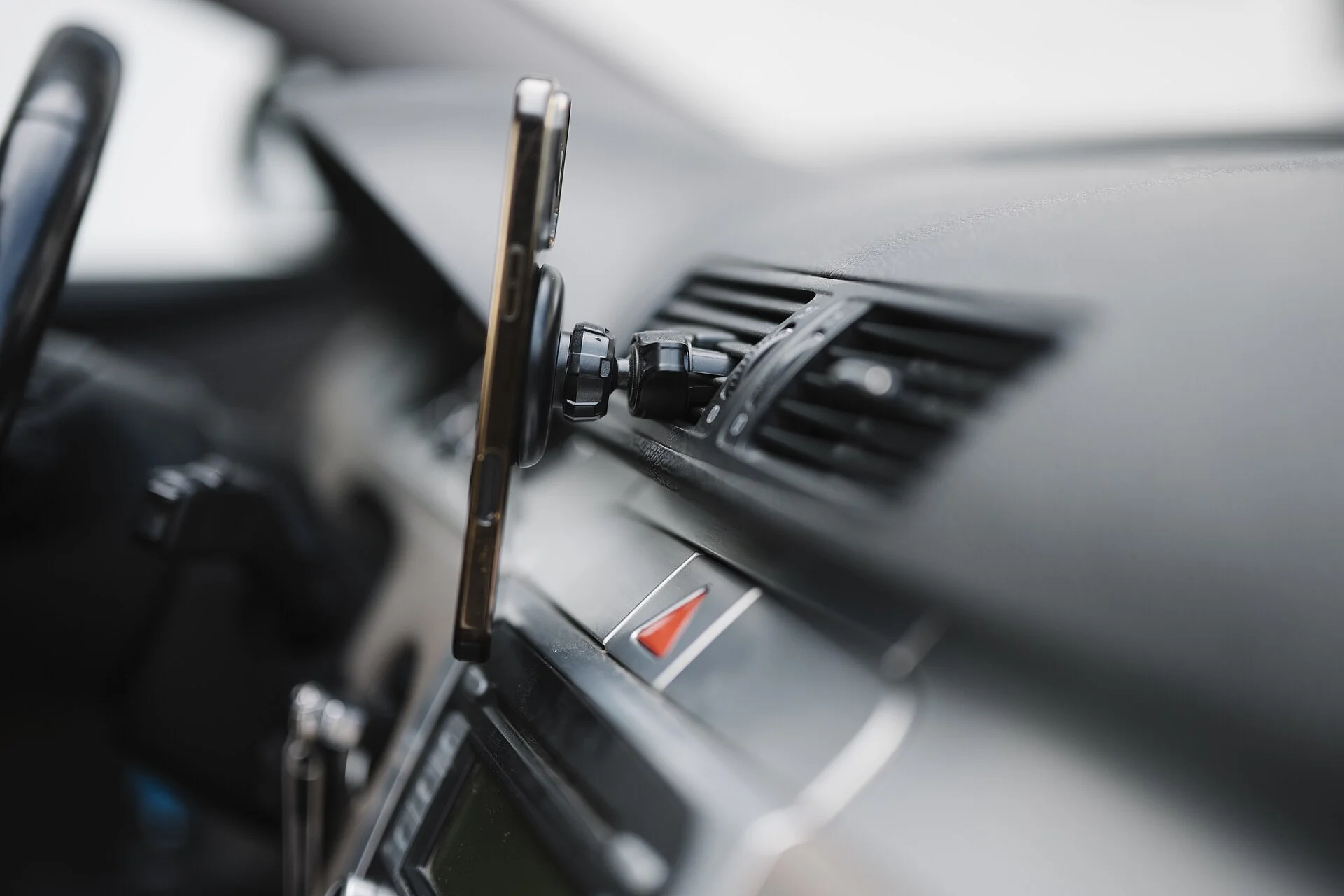
The Short Answer: No, But Three Real Catches Exist
It is one of the most-repeated worries about car phone holders: stick a powerful magnet to the back of a $1,000 phone every single day, and surely something gets quietly destroyed — the battery, the photos, the screen. It is a reasonable instinct. It is also, for the phone itself, almost entirely a myth.
A magnetic phone mount will not erase your data, drain your battery, discolor your screen, or shorten your phone's life. The small magnets in a mount are simply not strong enough to touch the components people fear for, and the parts that magnets used to threaten — spinning hard drives, magnetic tape — do not exist inside a modern phone. Your phone keeps its data on flash memory, which a magnet cannot scramble.
So where does the worry come from, and is there anything to it? Yes — three real catches, none of which is a reason to avoid magnetic mounts, only to use the right kind and store a couple of things sensibly. The first is wireless charging: a cheap mount's metal plate can block it. The second is magnetic-stripe cards tucked behind the phone. The third is implanted medical devices like pacemakers. This guide walks through what is genuine and what is folklore, component by component, so you can stop worrying about the wrong things and manage the few that actually matter.
What a Magnetic Mount Actually Does to Your Phone
Before judging whether a magnetic mount is harmful, it helps to know how it grabs the phone, because there are two very different designs and they behave differently.
- The cheap, universal kind sticks a thin steel plate to the back of your phone or case; the mount holds the magnet, and the plate is just ferrous metal it can grip.
- The MagSafe or Qi2 kind builds the magnets into a ring inside the phone or case, with a matching ring on the mount.
The cheap, universal kind works by sticking a thin steel plate — usually a circular or rectangular disc with adhesive on one side — to the back of your phone or case. The mount itself holds the magnet; the plate is just ferrous metal the magnet can grip. The plate is what does the sticking, and as you will see later, it is also the part that causes the one real headache: blocking wireless charging.
The second kind is the MagSafe or Qi2 design, where the magnets live inside the phone or an attached case in a ring shape, and the mount has a matching ring. Here the magnet is engineered into the phone's ecosystem on purpose — it is meant to be there. A modern iPhone, and a growing number of Android phones, are literally built to snap onto magnets every day, which tells you most of what you need to know about whether daily magnetic mounting is dangerous: the manufacturers designed for it.
In both cases, the magnetic field involved is static and modest. It is strong enough to hold a phone against bumps in the road, but its reach falls off sharply with distance, so the field deep inside the phone — where the battery, processor, and storage live — is far weaker than the grip you feel at the surface. That distance is the whole reason the scary-sounding components are, in practice, safe.
The Myth That Won't Die: Magnets and Your Data
The single most common fear — that a magnet will wipe your phone's photos, contacts, or apps — is the easiest one to put to rest, and the most important to understand, because the myth has a real origin. Magnets genuinely could destroy data on older storage: floppy disks, cassette tapes, VHS, and the spinning hard-disk drives in old computers all recorded information as patterns of magnetic orientation on a surface. Bring a strong enough magnet close, re-arrange those patterns, and the data is gone. That memory is where the fear comes from, and it was once justified.
Modern phones do not work that way at all. Every smartphone stores its data on flash memory — the same technology in SSDs and SD cards — which holds each bit as a tiny trapped electrical charge inside an insulated cell, not as a magnetic direction. There is no magnetic surface to scramble. A magnet, no matter how strong a phone mount's, does not act on trapped charge, so it cannot flip your bits, corrupt your files, or erase your photos.
This is not a 'probably fine' situation; it is a difference in physics.
The accessory and repair community is unanimous on the point: a magnetic mount poses no risk to your stored data. If you have ever hesitated to use one because you pictured your camera roll vanishing, you can let that worry go entirely — it belongs to an era of technology your phone left behind.
Your Battery, Screen, and Processor Are Safe Too
Data is the headline fear, but people also quietly worry about the battery, the display, and the brains of the phone. None of them is meaningfully at risk from a mount magnet, and again the reasons are physical, not optimistic.
- The battery stores energy chemically, so a static magnet cannot charge, drain, or wear it.
- The screen lights pixels electronically and has no electron beam for a magnet to bend.
- The processor and circuitry run on current along fixed pathways, untouched by a magnet of this strength.
Take the battery. A lithium-ion cell stores energy chemically — in the movement of lithium ions between electrodes — not magnetically. A static magnetic field does not add energy to that reaction or pull energy out of it, so a magnet cannot charge, drain, or wear out the battery. (Heat is what actually ages a phone battery, which is a different problem entirely — one tied to sun and fast charging, not to magnets.) The magnet sitting against the back of your phone all day is, as far as the cell is concerned, simply not happening.
The screen is just as safe. The fear here is borrowed from old CRT televisions and monitors, which used magnetic fields to steer an electron beam onto the glass — wave a magnet near one and you would get swirling rainbow distortion. A phone screen, whether IPS LCD, AMOLED, or OLED, has no electron beam to deflect; it lights pixels electronically. There is nothing for the magnet to bend. As for the processor and the rest of the circuitry, integrated chips are not disrupted by static magnetic fields of this strength — they run on electric current along fixed pathways, untouched by the magnet holding the phone in place.
The Compass: the One Part a Magnet Can Actually Confuse
If everything is so safe, why do some people swear their phone 'acts weird' on a magnetic mount? Almost always, they have run into the one component that a magnet genuinely affects: the magnetometer, better known as the phone's electronic compass. This is the sensor behind the Compass app and the little arrow that orients your position in a maps app.
The magnetometer works by measuring the Earth's magnetic field, which is extremely weak. To detect something that faint, the sensor has to be very sensitive — and that sensitivity is exactly why a nearby mount magnet overwhelms it. The magnet's field is thousands of times stronger than the Earth's at that distance, so the compass reads the magnet instead of the planet and gives wrong or jumpy headings. People notice this as a map that points the wrong way, or a 'compass needs calibration' warning.
Here is the crucial part: this is interference, not damage. The moment the phone comes off the magnet, the sensor reads correctly again. If a heading stays off, the standard fix is the figure-eight motion — hold the phone and trace a figure eight in the air, rotating it through all three axes so it re-samples the Earth's field and recalibrates. Better still, modern phones increasingly run algorithms that detect abnormal magnetic readings and compensate automatically, which is why many people never see a compass problem at all even with a magnet on the back. The magnetometer is the one real soft spot, and even it bounces back on its own.
Real Catch #1: Magnetic Mounts and Wireless Charging
Now we leave the myths behind and reach the first thing that is genuinely worth your attention — though notice it is not 'damage' so much as a compatibility trap. If you charge your phone wirelessly, a cheap magnetic mount can quietly cripple it.
The problem is that steel plate. Wireless charging (the Qi standard) works by passing a magnetic field from a coil in the charger to a coil inside your phone, and that field has to reach the phone's coil cleanly. A ferromagnetic metal plate stuck to the back of the phone sits right in the path and diverts the flux, starving the coil. The numbers are stark:
The Wireless Power Consortium found that a half-millimeter steel plate placed over a Qi receiver cut charging efficiency from about 74 percent to 41 percent, and stacking a second metal layer can push it below 20 percent.
The energy that does not make it into the battery turns into heat, which can trigger throttling, slow charging to a crawl, or stop it entirely.
The good news is that this is fully solvable. A MagSafe or Qi2 magnetic mount is built specifically to avoid the problem: its magnets form a ring around the charging coil instead of a plate over it, so the phone snaps on and charges through the connection — the magnets are part of the charging design. If you prefer a plate-style mount, you can usually position the plate low on the phone, away from the centered charging coil, or simply use a cable. The takeaway: a metal-plate magnetic mount and wireless charging fight each other, while a properly designed MagSafe-style system does both at once.
Real Catch #2: Credit Cards, Hotel Keys, and Magnetic Strips
The second real catch has nothing to do with the phone's electronics and everything to do with what you keep against it. Apple states plainly that you should not place credit cards, security badges, passports, or key fobs between an iPhone and a MagSafe charger, because the magnets can damage the magnetic stripe or the RFID chip inside those items. The same caution applies to any strong magnetic mount.
It is worth being precise about what is actually at risk, because the fear is often broader than the reality. A modern chip-and-tap card is generally fine — the data lives on an embedded chip that magnets do not affect. The vulnerable items store information as magnetic patterns on a stripe, exactly the kind of storage a strong magnet can scramble:
- old magnetic-stripe-only credit cards
- hotel room key cards
- gym passes
- some transit cards
A magnet held against that stripe can erase it, sometimes even through a thin wallet or case.
The practical rule is simple: never sandwich a magnetic-stripe card between your phone and the magnet. If you use a wallet case or a stick-on cardholder, keep magnetic-stripe cards out of the slot nearest the magnet, or carry them separately. This is a storage habit, not a phone defect — the magnet is not hurting your phone, it is hurting the card you tucked behind it. Manage where your cards live and this catch disappears.
Real Catch #3: Pacemakers and Other Medical Devices
The third catch is the one to take most seriously, even though it again is not about harming the phone. Both the U.S. Food and Drug Administration and Apple warn that the magnets in phones and magnetic accessories can interfere with implanted medical devices such as pacemakers and defibrillators, which may contain sensors that respond to magnets.
This is backed by real research, not just caution. A study published in the Journal of the American Heart Association found that an iPhone 12 Pro Max could trigger a 'magnet reversion mode' in nearly 80 percent — 11 of 14 — of the cardiac implants tested when held close. In that mode, a defibrillator might fail to detect a dangerous rhythm, or a pacemaker might switch its operating behavior. The FDA still characterizes the overall risk to patients as low and is not aware of injuries from the issue, but the consequence if it did happen is serious enough that the guidance is firm.
The recommendation is concrete: keep your phone and any magnetic accessory at least 6 inches (about 15 cm) away from an implanted device, and at least 12 inches (30 cm) when the phone is wireless charging. In car-mount terms that is easy — a phone clamped to the dashboard is well clear of your chest. The caution mainly matters for carrying the phone in a breast pocket over the implant. If you or a passenger has a pacemaker, this is the one item on this list worth a real habit, and anyone with an implant should follow their cardiologist's specific advice.
The Adhesive Plate Problem and MagSafe vs. Cheap Mounts
Set aside the three real catches and there is still one more thing people genuinely dislike about magnetic mounts — but it is cosmetic and practical, not a matter of frying your electronics. On a plate-style mount, that adhesive steel disc has to go somewhere, and stuck directly to a phone's glass back or a nice case it can look ugly, peel at the edges, or leave sticky residue when you eventually remove it. It also, as covered above, blocks wireless charging. This is the 'damage' a lot of people actually experience: a gummy mark on the back of the phone, not a dead component.
The cleaner alternatives are straightforward. You can tuck the metal plate inside a case, between the case and the phone, so nothing sticks to the device and the case hides the disc. Better yet, you can skip the plate entirely with a MagSafe-compatible phone or case, where the magnets are built in and there is nothing to glue on at all. That choice neatly sidesteps both the residue complaint and the wireless-charging block in one move.
This is really the heart of the 'are magnetic mounts safe' question: the design you pick matters more than the magnets themselves. A well-made MagSafe or Qi2 system is engineered to coexist with your phone's charging and finish, while a bargain plate mount works fine mechanically but forces the wireless-charging and adhesive trade-offs. Neither one threatens the phone's data, battery, or screen — the difference is convenience and tidiness, which is a far better thing to be deciding on than fear.
Does Years of Daily Use Cause Any Cumulative Harm?
A fair follow-up question is whether the verdict changes over the long haul. It is one thing for a magnet to be harmless in a single afternoon; people reasonably wonder whether snapping the same phone onto the same magnet twice a day for three or four years adds up to something. For the phone's electronics, the answer is still no — and the reason is that there is no wear mechanism for a magnet to exploit.
Cumulative harm requires a process that slowly degrades with each exposure. Heat does that to a battery; charge cycles do it to capacity; repeated bending does it to a cable. A static magnetic field does none of those things to flash memory, a chemical battery, or solid-state circuitry, because it is not depositing energy or stress into them in the first place. The thousandth time you mount the phone is physically identical to the first. There is no slow accumulation because there is no single-event effect to accumulate. This is exactly why manufacturers were comfortable building magnets into the phone itself with MagSafe — a design that assumes daily, lifelong magnetic attachment.
The things that genuinely change over years are the practical ones already covered. A plate-style mount's adhesive can age, yellow, and leave a mark; a metal plate keeps blocking wireless charging for as long as it is stuck on; and if you habitually carry magnetic-stripe cards against the phone, you will eventually wipe one. Those are maintenance and habit issues, not phone damage. Address the design and the storage habits and there is no long-term penalty to using a magnetic mount for the entire life of the phone.
The Bottom Line: Use a Magnetic Mount Without Worry
So, do magnetic phone mounts damage your phone? For the phone itself — its data, battery, screen, and processor — the honest answer is no. The fears that circulate are inherited from a vanished era of magnetic tapes and spinning hard drives. Your phone stores data on flash memory a magnet cannot touch, its battery is chemical, its screen has no electron beam to bend, and the magnets in a mount are simply too weak and too far from the internals to matter. Modern phones, especially MagSafe ones, are built to be magnetically mounted every day, year after year.
What is real is narrower and easy to manage. Keep a quick checklist in mind:
- If you charge wirelessly, choose a MagSafe or Qi2 mount rather than a cheap metal-plate one, or accept that the plate means cable charging.
- Never sandwich an old magnetic-stripe card — a credit card, hotel key, or transit pass — between your phone and the magnet.
- Keep the phone at least 6 inches from an implanted pacemaker or defibrillator, which a dashboard mount does automatically.
- If you hate adhesive residue, put the plate inside a case or go plate-free with MagSafe.
Handle those three or four things and a magnetic car mount is one of the most convenient, secure ways to hold a phone while you drive — one snap on, one tug off, no clamps to wrestle, and it holds firm over rough roads and hard braking. The magnets are not the enemy, and they are not quietly degrading anything inside the phone while you are not looking. The only real decisions are which mount design fits how you charge, and where you keep your cards. Get those right and you can use a magnetic mount for the full life of the phone with nothing to worry about.