
The Short Answer: Yes, and It's the Cheapest Insurance You'll Buy
If you sleep in a vehicle and there is any chance a flame or an engine will be running near you, the honest answer is yes — you should carry a carbon monoxide detector, and a good portable one costs less than a tank of gas. Carbon monoxide is colorless, odorless, and tasteless, which means your senses give you no warning at all. A detector is the only thing in your setup that can tell you the air has turned dangerous before it puts you to sleep for good. For a piece of gear in the twenty-to-forty-dollar range, that is an extraordinarily good trade.
There is a narrow case where you could argue you don't strictly need one: if you never run the engine while parked, never use any fuel-burning heater or stove inside, never cook in the vehicle, and always sleep with real cross-ventilation. But that is a lot of nevers to bet your life on, and people break their own rules when it is cold, raining, or they are exhausted. The detector exists precisely for the night your plan slips. This guide explains where the gas actually comes from, why your house alarm is the wrong tool, which kind to buy, and where to put it.
One honesty note up front, because safety writing should be held to a higher bar: this is a research-based explainer built from public health guidance on carbon monoxide symptoms, the published alarm-certification standards that define when detectors are required to sound, and how the different alarm types are documented to work — not a hands-on test where I gassed a vehicle to see what tripped. Where a figure is a standard's threshold or a manufacturer's stated spec rather than something measured here, I say so plainly.
Where Carbon Monoxide Actually Comes From in a Sleeping Vehicle
Carbon monoxide is a product of incomplete combustion — any time a fuel burns without enough oxygen, it makes CO instead of harmless carbon dioxide. In a car camping setup there are more sources than most people realize, and the gas does not care whether the source is yours or your neighbor's.
- The vehicle's own engine — exhaust seeping back through a worn door seal, a rusted floor pan, a leaking exhaust system, or a tailpipe buried in snow or mud.
- Fuel-burning heaters — a propane radiant heater, or a gasoline or diesel parking heater whose exhaust can recirculate through a cracked pipe.
- Camp stoves, alcohol or canister burners, and candles used inside a closed vehicle.
- A neighbor's idling vehicle or a generator running a few feet away.
The biggest one is the vehicle's own engine. Running it for heat or air conditioning while you sleep is the classic killer: exhaust can seep back into the cabin through a worn door seal, a rusted floor pan, a leaking exhaust system, or — the scenario that claims lives every winter — a tailpipe buried in snow, a snowbank, or mud that forces the exhaust back under and into the car. This is why the safest practice is to never idle the engine overnight as your heat source, and a detector is the backstop for the times you do run it briefly.
Then there are the things you bring inside. Any fuel-burning heater — a propane radiant heater, a gasoline or diesel parking heater — produces carbon monoxide; the diesel and gasoline air heaters vent exhaust outside, but a cracked exhaust pipe or an intake mounted too close to the outlet can recirculate it into the cabin. Camp stoves and tiny alcohol or canister burners used to cook inside a closed vehicle generate CO too, as do candles and even a generator running too close to the vehicle outside. The takeaway is simple: if it burns, it can make carbon monoxide, and a small sealed cabin concentrates it fast.
It is worth sitting with the neighbor problem for a second, because it is the source you can do the least about. At a crowded trailhead lot, a rest area, or a packed campground, the vehicle idling beside you — or a generator someone runs through the night a few feet away — can push exhaust toward your open window or under your car regardless of how careful you have been. You cannot control their choices, and you may be asleep before they even arrive. That is the purest argument for a detector: it is the one safeguard that works even when the danger comes from outside your own setup and outside your knowledge.
Why a Propane Heater's Safety Shutoff Is Not a CO Detector
This is the single most dangerous misunderstanding in the car camping world, so it gets its own section. Many popular portable propane heaters advertise an automatic low-oxygen shutoff, often called an ODS (oxygen depletion sensor). People reasonably assume this means the heater is watching the air for danger and will protect them. It will not protect them from carbon monoxide.
An oxygen depletion sensor measures exactly what its name says: the oxygen level in the room. When oxygen drops below a set threshold, it cuts the gas. That is a useful feature, but oxygen depletion and carbon monoxide buildup are two different problems, and they do not track each other reliably. A heater that is burning slightly incompletely can pump out rising carbon monoxide while the oxygen level is still high enough that the ODS stays perfectly happy. The shutoff was never designed to sense CO, and it does not.
So if your warmth plan involves a portable heater of any kind, the ODS is not your safety device — a real CO alarm is. Treat the two as completely separate systems: one watches for too little oxygen, the other watches for the poison that actually does the killing. Relying on the heater's built-in feature to cover both jobs is exactly the gap that catches people who thought they had done everything right.
What Carbon Monoxide Does to You, and Why Sleep Is the Trap
To understand why a detector matters so much, you have to understand how the gas hurts you. When you breathe carbon monoxide, it binds to the hemoglobin in your blood far more eagerly than oxygen does — by a wide margin — and once it is attached, that hemoglobin can no longer carry oxygen to your tissues. You effectively suffocate from the inside while still breathing normally. Your organs, especially the brain and heart, are starved of the oxygen they need.
The early symptoms are notoriously easy to dismiss because they mimic the flu without a fever: headache, dizziness, weakness, nausea, shortness of breath, and confusion. Public health agencies describe this flu-like pattern precisely because so many people write it off as being tired or coming down with something. As exposure continues, confusion deepens, coordination fails, and the person loses consciousness. Recognizing the signs early is the difference described in any guide to carbon monoxide poisoning between walking away and not waking up.
Here is the cruel part, and the reason a detector is non-negotiable for sleeping: when you are asleep, you cannot notice the headache, you cannot feel the confusion, and you cannot decide to open a door. A person who is awake might recognize something is wrong and get out.
A sleeping person gets quietly deeper into trouble until they never wake.
Carbon monoxide is sometimes called the silent killer for this exact reason, and an alarm that screams at you is the only thing in the vehicle capable of waking you in time.
Why Your Home CO Alarm Is the Wrong Tool for the Job
A natural thought is to just grab the carbon monoxide alarm off your hallway ceiling and toss it in the car. It is better than nothing, but it is genuinely not the right tool, and the reason is buried in how home alarms are certified to behave.
Residential CO alarms in North America are built to a safety standard (commonly UL 2034) that is deliberately tuned to avoid nuisance alarms in a house. Under that standard an alarm is required to sound within a set time at higher concentrations — for example sounding within roughly 60 to 240 minutes at about 70 parts per million, and faster as levels climb — but it is also specifically designed not to alarm at low sustained levels (commonly below about 30 ppm) so that ordinary household sources don't set it off constantly. In a large, drafty house that tuning is sensible.
In a tiny, sealed sleeping space it is a liability. A concentration that a home alarm is engineered to ignore can still be giving you headaches and slowly poisoning you over a night in a space the size of a vehicle interior, and the levels can climb much faster than in a house. This is why dedicated low-level monitors exist: they alarm at single-digit ppm readings and show you the actual number, hours before a home alarm would make a sound. For sleeping in a small enclosed cabin, that earlier warning is the entire point.
Which Type to Buy: Portable, Low-Level, or RV Alarm
There are three broad options, and the right one depends on how you camp. None of them is expensive, so the decision is about fit, not cost.
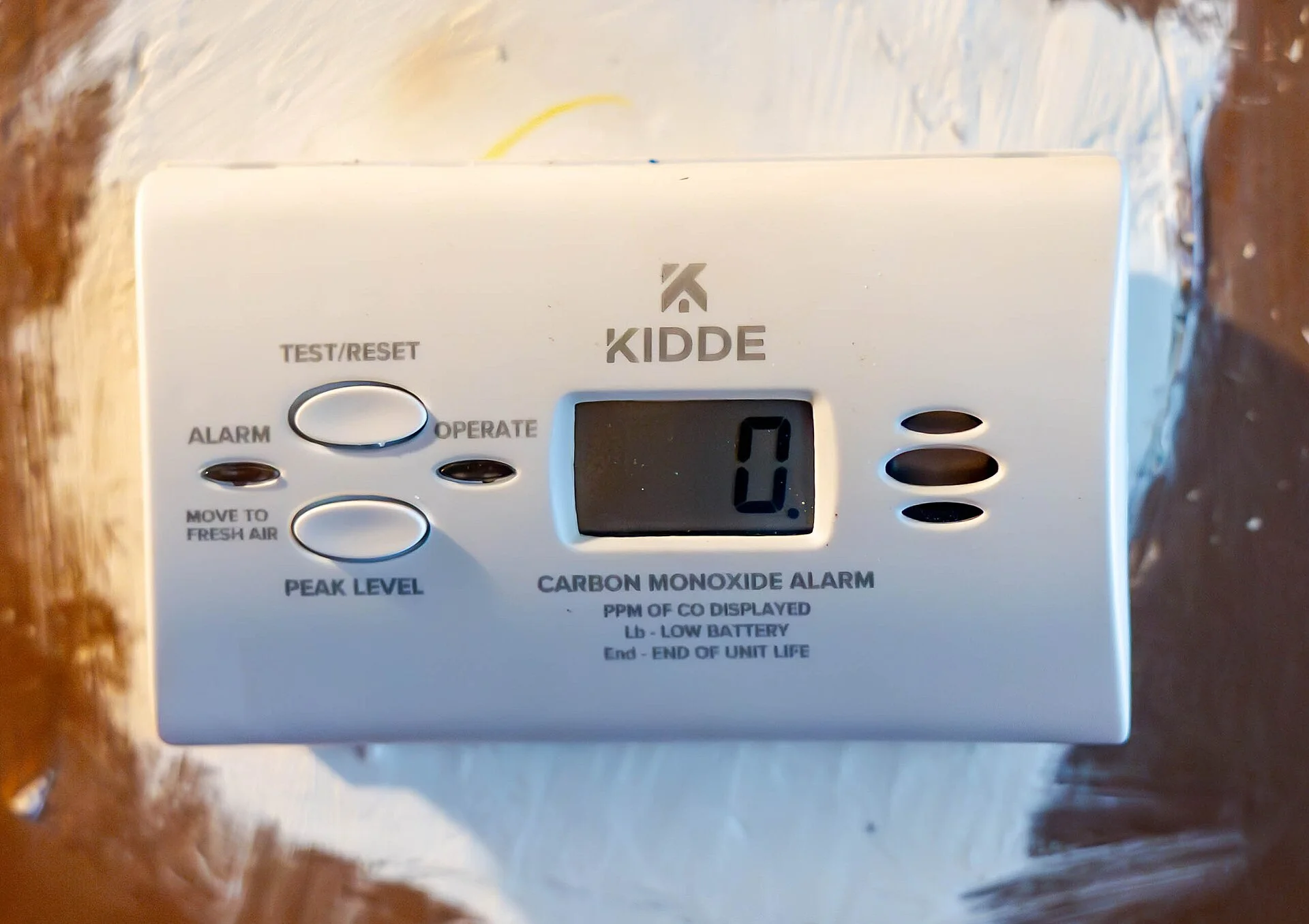
A battery-powered portable CO alarm is the default for most car campers. Look for a sealed long-life lithium battery (many are rated to last around ten years), a digital display that shows the current ppm reading rather than just a light, and a peak-level memory so you can see the highest reading overnight. The display matters: a number lets you catch a slow rise and ventilate before the full alarm ever triggers. Portability matters too, because you want to move it with you between vehicles or into a tent.
A dedicated low-level monitor is the upgrade for anyone running a heater or sleeping in a van regularly. These are designed to alarm at much lower concentrations than a standard home unit and to display readings in the single digits, giving you the earliest possible warning. An RV carbon monoxide alarm is the choice for a built-out van or camper with 12-volt wiring; RV-specific alarms are built to run off the house battery and to tolerate the vibration, temperature swings, and humidity of vehicle life, conditions that can shorten the life of a unit meant for a living room. Whatever you choose, buy one that carries a recognized safety certification rather than an uncertified bargain unit — the certification is the only evidence the sensor actually meets a tested threshold.
Where to Mount It (and the Placement Myth to Ignore)
Placement gets botched constantly because people apply the rule for the wrong gas. Propane is heavier than air and pools low, so propane detectors go near the floor. Carbon monoxide is almost exactly the same weight as air — very slightly lighter — so it does not sink to the floor or pile up on the ceiling; it mixes fairly evenly throughout the space, drifting with whatever warm air currents are moving.
What that means in a vehicle is simple and practical: mount or place the CO alarm near your breathing zone while you sleep — roughly at head height where you lie down. The whole job of the device is to measure the air you are actually breathing, so put it where your face will be, not tucked in a far corner of the cargo area or buried under bedding where it can't sample the cabin air. If you run a heater, keep the alarm out of the direct hot airflow from the vent, which can affect the reading, but still within the sleeping area.
Avoid the dead spots:
- Don't wedge it inside a closed cabinet or behind gear.
- Don't let a blanket cover the sensor vents.
- Make sure you can actually hear it — a screaming alarm in a sealed storage bin two feet from your head can still be muffled enough to lose its whole purpose.
The right spot is open, near your head, and where the sound will reach a sleeping person instantly.
A Two-Minute Decision Check: How Much Detector Do You Need?
If you want a quick way to place yourself on the risk scale, answer these honestly. Do you ever run the engine while parked for heat or cooling? Do you use any fuel-burning heater inside? Do you cook or burn a candle in the cabin? Do you sleep with the windows fully closed? Do you park where exhaust could be trapped — a garage, deep snow, a tight pull-in against a wall? Every yes moves you up the scale, and almost everyone who sleeps in a vehicle answers yes to at least one.
If you answered no to all of them — you never burn anything, never idle, and always sleep with real cross-ventilation — a basic certified portable alarm is still worth having as cheap insurance against the night your routine changes. If you answered yes to running a heater or sleeping in a closed van, you are squarely in the group that should own a dedicated low-level monitor, because the early single-digit warning is exactly what your situation calls for. And if you have a 12-volt camper build, wire in an RV-rated alarm so the detection is permanent rather than something you might forget to pack.
The reason this check matters is that people consistently underestimate which bucket they are in. 'I only run the heater for a little while before bed' is still running a combustion source in a sealed space; 'I crack a window' is not the same as real airflow if both gaps are on the same side. When in doubt, assume you are higher on the scale than you feel, and let the cheapness of the device make the decision easy.
The Detector Is the Backstop, Not the Plan
A detector is essential, but it is the last line of defense, not the strategy. The strategy is to not let carbon monoxide build up in the first place, and the alarm is there to catch the night your prevention fails. Treat it that way and you stack two independent layers of safety instead of leaning everything on a single gadget.
Prevention layer one is ventilation. Even a small amount of genuine cross-flow — two windows cracked on opposite sides, a roof vent open, a vent fan running — dramatically lowers the ceiling on how high CO can climb, while also helping with the condensation that plagues vehicle sleeping. Prevention layer two is your heat and cooking choices: the safest way to stay warm is without combustion inside the cabin at all — good sleeping insulation, the right bag, and warm layers beat any flame you have to babysit. Cook outside the vehicle whenever you can.
If you do use a portable heater or briefly run the engine, treat those as deliberate, supervised, ventilated acts — never something you fall asleep next to. The detector earns its keep in the gap between your best intentions and reality: the window you forgot to crack, the wind that shifted exhaust back toward the car, the heater that started burning dirty. Layered correctly, the alarm should almost never go off — and that is exactly why you want it there for the one time it does.
Limits: What a CO Alarm Won't Do for You
Buying the detector is not the end of the responsibility, because the device has real limits and a finite life. Knowing them keeps you from trusting a unit that has quietly stopped protecting you.
First, the sensor wears out. The electrochemical sensors in CO alarms have a limited service life — commonly in the range of five to ten years depending on the model — after which the unit should be replaced even if it still powers on. Quality alarms signal their end of life with a distinct chirp pattern that is easy to confuse with a low battery, so learn the difference for your specific model and note the manufacture or replace-by date. A ten-year-old alarm rattling around in a glovebox is not a safety device; it is a piece of plastic.
Second, a CO alarm only detects carbon monoxide. It will not warn you about propane or other fuel leaks, it will not sense smoke or fire, and it does nothing about oxygen depletion. It also needs a working power source — test it before every trip and respect the low-battery warning. And it is a warning device, not a cure: if it sounds, the correct response is to get everyone into fresh air immediately, ventilate fully, and not return until levels have cleared. The alarm buys you the seconds to act; acting is still on you.
The Bottom Line
So do you need a carbon monoxide detector for car camping? For anyone who runs an engine, burns a fuel for heat or cooking, or sleeps in an enclosed vehicle — which is very nearly everyone — yes, and it belongs on the short list of gear you never leave home without. It is one of the few safety items where the cost is trivial and the downside of skipping it is fatal and irreversible. There is no version of this math that favors going without.
Get a certified, battery-powered alarm with a digital display, or a dedicated low-level monitor if you sleep in a van or run a heater regularly; an RV-rated unit if you have a 12-volt build. Mount it near your head at sleeping height, because carbon monoxide mixes with the air rather than sinking or rising. Replace it before the sensor expires, test it before every trip, and remember it is the backstop — ventilation and combustion-free warmth are the real plan. Do that, and the silent killer loses the one advantage it has always relied on: that no one was listening.