Smart Car Tech

What Dashcam Resolution is Best for Capturing License Plates at Night?

Casey - The Weekend Warrior
4 min read
Includes Video

For catching license plates at night, the resolution on your dashcam is a big deal. It's not just about having a fancy 4K camera; you need to understand what actually makes those tiny numbers on a car in front of you readable when the streetlights are doing their best to blind everyone.

For catching license plates at night, the resolution on your dashcam is a big deal. It's not just about having a fancy 4K camera; you need to understand what actually makes those tiny numbers on a car in front of you readable when the streetlights are doing their best to blind everyone. My first dashcam was a cheap $50 thing that promised 1080p but looked like it was filmed on a potato.

I learned fast that resolution numbers mean squat if the picture is garbage. This whole game is about pixels, and how they're used. You need enough of them to make out details, especially when everything else is dark. It's like trying to read a tiny label on a medicine bottle in a dimly lit room; you need good light and sharp focus. The real move is understanding how those pixels translate to actual visibility.

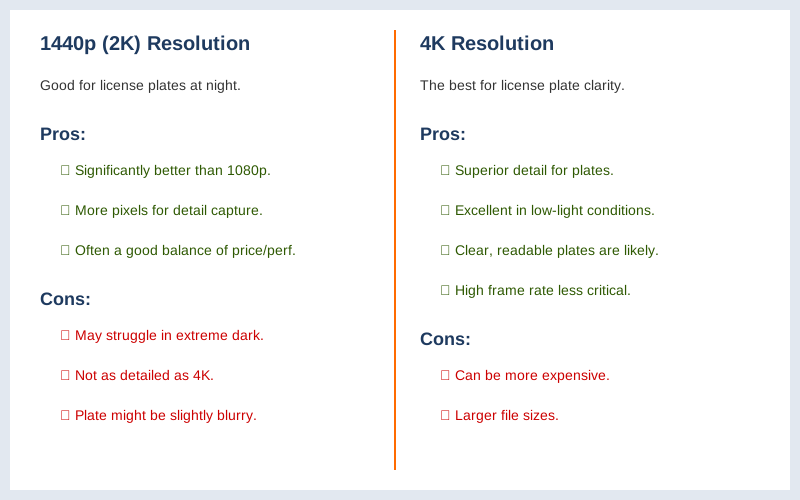
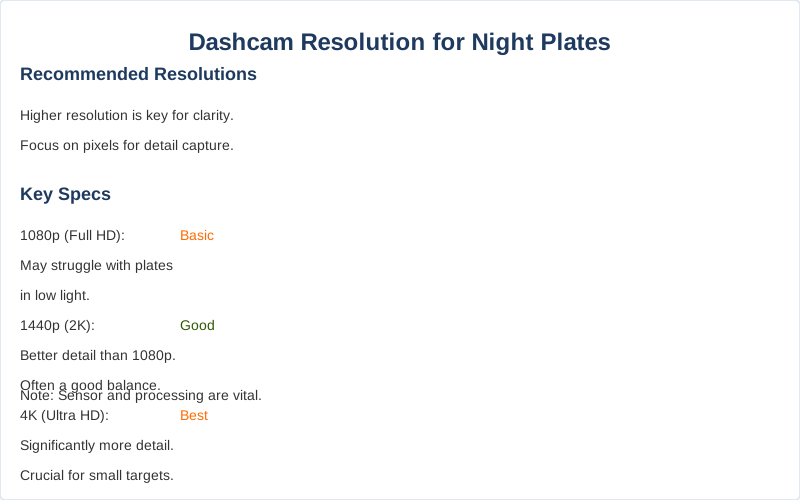
What Dashcam Resolution is Best for Capturing License Plates at Night? — Key Specifications Compared
Key specifications for What Dashcam Resolution is Best for Capturing License Plates at Night?

The Core Answer

Here's the honest version: for catching license plates at night, you want a dashcam that can handle at least 1440p (often called 2K) resolution, but 4K is where you really start to see a difference. Think of it like this: more pixels mean more detail. My buddy Dave tried to save $30 by getting a 1080p camera for his truck, and when he got sideswiped, the police couldn't even make out the plate of the guy who bolted. Brilliant engineering, Dave. Higher resolutions pack in more information, which is crucial when you're trying to zoom in on a tiny, fast-moving target like a license plate in the dark. Some folks swear by 4K even at a lower frame rate because, honestly, all it takes is one clear frame to catch a plate. That's the real move. You don't need 60 frames per second if the image looks like a blurry mess. What nobody tells beginners is that the sensor and the camera's processing are just as important as the megapixel count. A cheap 4K camera might perform worse than a well-built 1440p one. It's a rookie mistake to just look at the biggest number. You need a camera that can actually use those pixels effectively, especially with HDR (High Dynamic Range) to balance out bright headlights and dark shadows. Those extra pixels in higher resolutions give you more digital 'room' to zoom in without turning the plate into abstract art. It's the difference between seeing a smudge and seeing actual numbers. My second dashcam was a 1440p unit, and the improvement over my old 1080p was night and day. I could finally make out details I'd completely missed before.
To ensure clarity in various conditions, consider reading about dash cam resolution for day and night.
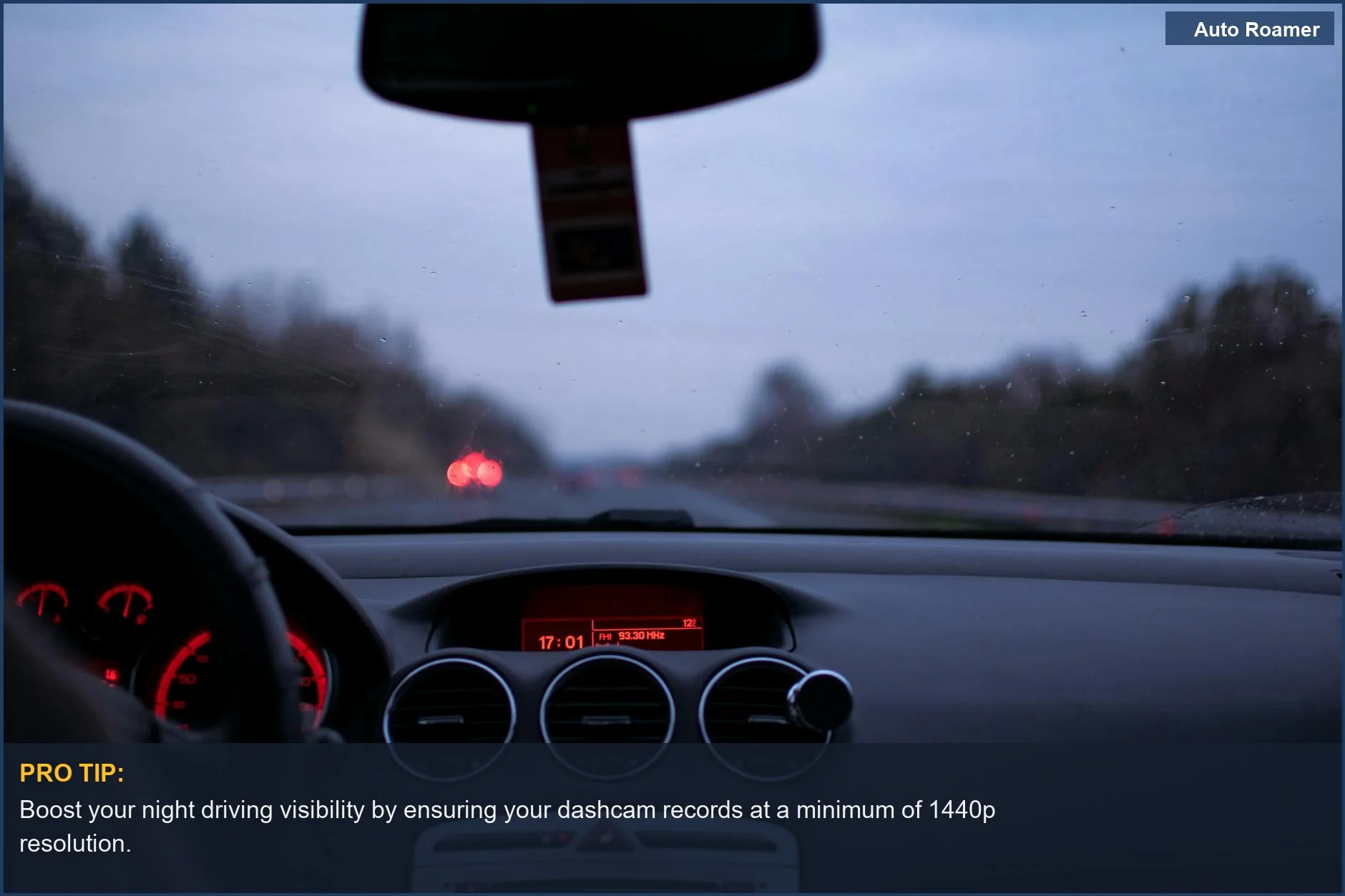
Boost your night driving visibility by ensuring your dashcam records at a minimum of 1440p resolution.
Capturing the road ahead is crucial, especially with low light. Higher dashcam resolution, like 1440p, is key for clear footage at twilight. | Photo by Stergios Pliampas

Why This Matters for Your Setup

Why does this matter for your setup? Because when you're stuck in a fender bender or witness something sketchy, clear evidence is everything. I once spent 3 hours at a campsite in the Poconos trying to enhance a blurry license plate from my old dashcam. Total waste of time. You need enough detail to satisfy the fuzz or your insurance company. Here's the breakdown:
  • Nighttime Clarity: Higher resolutions, especially 1440p and 4K, are significantly better at capturing details like license plates in low light. They have more pixels to work with, meaning less 'noise' and more distinct edges on letters and numbers.
  • Zoom Capability: Even if the plate isn't crystal clear in the live feed, a higher resolution video file gives you more room to zoom in during playback without losing too much quality. My $50 dashcam's 'zoom' feature was basically just enlarging a pixelated mess.
  • Frame Rate Trade-offs: While higher resolution is great, sometimes you have to choose between 4K at 30 frames per second (FPS) or 1440p at 60 FPS. For license plates at night, the detail from 4K at 30 FPS is usually the better bet. All it takes is one good frame. You're not filming a sports highlight reel, you're documenting reality.
  • Sensor Quality Matters: Don't forget the sensor. A good sensor, often paired with technologies like HDR, helps balance out bright lights and dark shadows, making it easier to see details that would otherwise be blown out or lost in the dark.
For those using RVs, understanding dash cam resolution is equally important for capturing clear evidence on the road; learn more about it here.
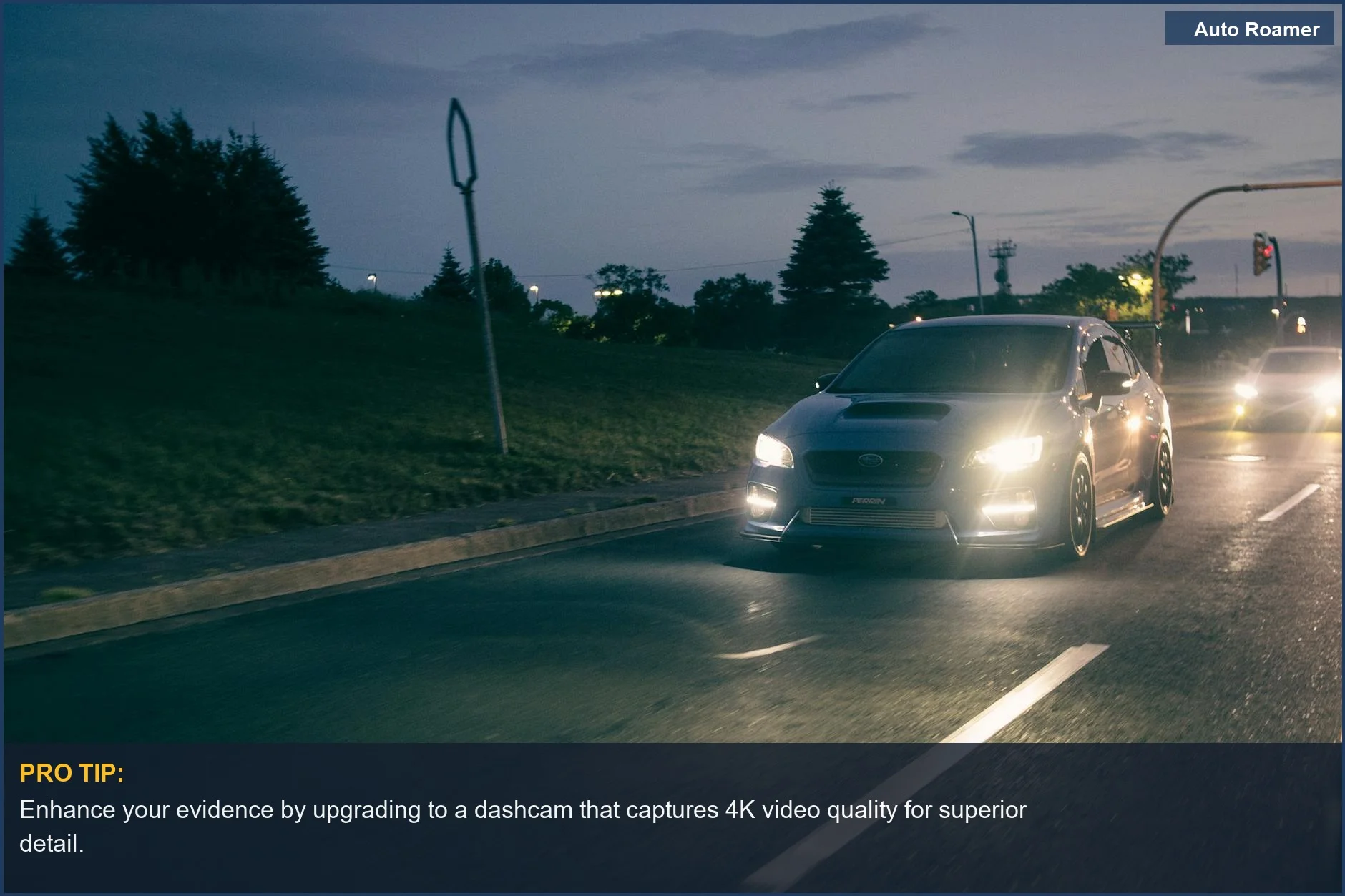
Enhance your evidence by upgrading to a dashcam that captures 4K video quality for superior detail.
Night travel demands excellent video quality. This Subaru WRX highlights the importance of a dashcam that can clearly record during dusk and dark conditions. | Photo by Erik Mclean

Making the Right Choice

So, what's the verdict when you're out there trying to capture the road? Don't cheap out on resolution. Aim for at least 1440p (2K), but seriously consider 4K if your budget allows. It's the difference between having a fuzzy blob and a usable piece of evidence. Think of it as an investment in your peace of mind and your ability to prove your side of the story. My first trip with a proper 4K dashcam felt like I'd upgraded from a flip phone to a smartphone for my car. It's that kind of leap. You don't need the absolute top-of-the-line, but avoid the bargain bin if license plate capture is your priority. It's the real move for night driving.
To ensure clear footage while towing, consider exploring our insights on dash cam resolution for towing.
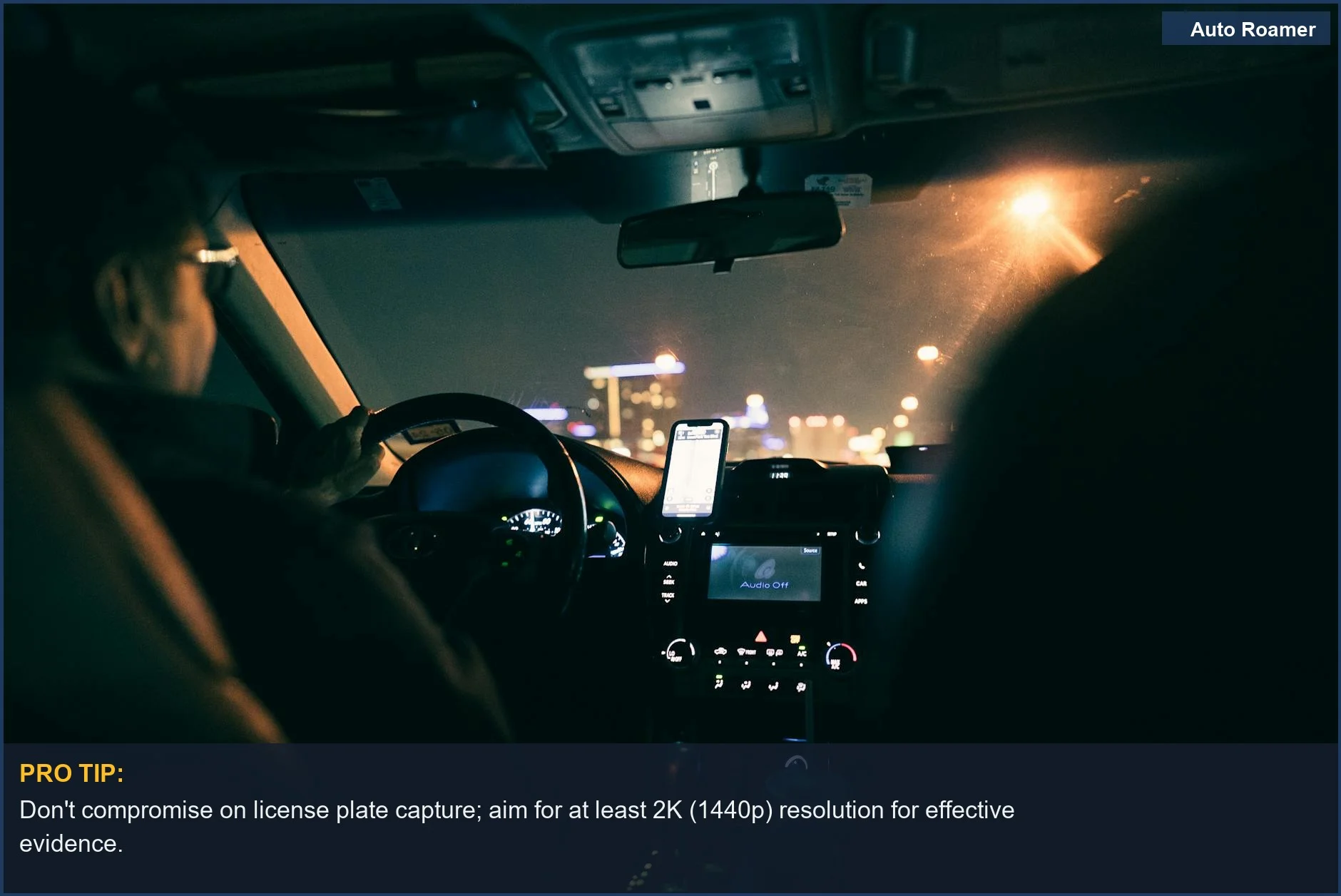
Don't compromise on license plate capture; aim for at least 2K (1440p) resolution for effective evidence.
Navigating city streets at night requires a dashcam focused on clear license plate capture. This view emphasizes the need for detailed recordings. | Photo by Erik Mclean

Frequently Asked Questions

If I get a 4K dashcam, does that mean I can just zoom in infinitely on any license plate, no matter how far away?
Hold up there, Speedy Gonzales. While 4K resolution gives you a lot more detail than your old 1080p camera, it's not magic. Think of it like trying to read a book from across a football field. Even with super-sharp eyes, there's a limit. My 4K dashcam can zoom in and still read a plate that's about 40-5 car lengths away reasonably well, but if it's 20 car lengths away at night, you're probably out of luck. It's not infinite zoom; it's just better zoom.
I saw a dashcam that said it has 'night vision.' Does that mean I don't need high resolution for license plates at night?
That's a common misconception, and frankly, a bit of marketing fluff. 'Night vision' on dashcams usually refers to better low-light sensors or infrared (IR) LEDs. While it helps illuminate the immediate area, it doesn't magically create detail where there isn't any. You still need enough resolution, like 1440p or 4K, to actually *read* the plate. Think of night vision as a flashlight for the camera; high resolution is the sharpness of the lens. You need both for a clear picture.
What if my dashcam only records in 1080p? Can I do anything to make license plates clearer at night, or am I just stuck?
You're not completely out of luck, but it's tough. First, make sure your camera's software is up-to-date, as some manufacturers release patches that improve image processing. Second, try to ensure your camera is positioned correctly and isn't obstructed. On my old 1080p camera, I found that ensuring the lens was spotless made a small, but noticeable, difference. For truly critical situations, though, you're often better off upgrading. My 1080p camera was basically useless for plates beyond 15 feet at night.
Will using a higher resolution dashcam drain my car battery faster, especially when it's parked and in 'parking mode'?
Yes, using a higher resolution, especially 4K, will generally consume more power than 1080p. If you rely solely on the car battery for parking mode, a 4K camera could drain it faster than you'd like. I learned this the hard way after my battery died overnight in 20-degree weather with my 4K dashcam running parking mode. Most people use a dedicated dashcam battery pack or a hardwire kit with a voltage cutoff to prevent this. A 4K camera might draw an extra 0.5 amps compared to a 1080p one.
I heard that frame rate (FPS) is more important than resolution for catching license plates. Is that true?
That's a myth, or at least a massive oversimplification. While frame rate *is* important for capturing motion smoothly, for license plates at night, resolution is king. You need enough pixels to define the characters on the plate. A high frame rate with low resolution is like having a super-fast camera that takes blurry pictures. You're better off with a slightly lower frame rate (like 30 FPS) and a higher resolution (1440p or 4K) to get a clear, readable image. All it takes is one good frame, and that frame needs detail.

🏅 Looking for Gear Recommendations?

Check out our tested gear guides for products that work with this setup:

C

Casey - The Weekend Warrior

Weekend car camper and road trip enthusiast. Focuses on practical, budget-friendly solutions for families and first-time campers.

Sources

Related Articles