Where to Start
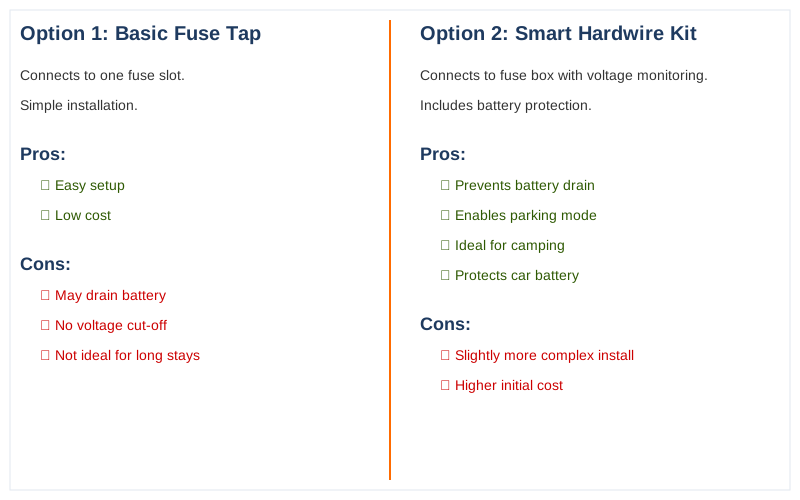
Choosing the right dashcam hardwire kit for extended car camping means figuring out how to keep your camera powered without draining your car battery. This isn't about fancy gadgets; it's about making sure your little eye-on-the-road doesn't go dark when you're miles from anywhere. A simple plug-in adapter might work for a quick trip, but for overnight stays or multi-day adventures, you need something more robust.
We're talking about tapping into your car's fuse box to provide a consistent, reliable power source, even when the engine's off. It's the difference between a dashcam that records your drive and one that watches your back while you sleep in your tent. Think of it as giving your dashcam its own little umbilical cord to the car's power grid.
This setup is crucial for utilizing parking mode features, which are a lifesaver for catching any bumps or curious critters around your vehicle. Getting this part right means peace of mind, whether you're in a remote campsite or just parked downtown. hardwired vs plug-in setups are fundamentally different in how they approach power delivery.
The core concept is ensuring your dashcam has uninterrupted power, especially when your car is turned off, which is often the most critical time for surveillance. car fuse box installation is the common method for achieving this continuous power.
The Core Answer
The real move for long-term car camping power is a hardwire kit that connects directly to your car's fuse box. Forget those cigarette lighter adapters that only work when your car is running. For any kind of extended stay, you need a kit that allows for parking mode recording, meaning it keeps your dashcam powered even when the ignition is off. This is where the magic happens for overnight security.
The Power Magic Pro is one I've seen mentioned as a decent starting point, offering a selectable voltage cutoff. This feature is non-negotiable because it prevents your dashcam from completely draining your car battery. Imagine waking up at a remote campsite in the Sierras, ready to hit the trail, only to find your car won't start because your dashcam sucked it dry overnight. Rookie mistake.
Most kits come with what's called a "fuse tap." This little doodad lets you piggyback off an existing fuse in your car's fuse box. What nobody tells beginners is that you need to pick the right kind of fuse to tap into. You want a fuse that's only powered when the ignition is on for basic recording, or one that's always powered for parking mode. My first attempt, I just jammed it into the first empty slot I found.
The dashcam only worked when the car was on, defeating the whole purpose of parking mode. I learned the hard way at Mammoth Lakes campground during a chilly October night; I missed a raccoon trying to get into my cooler because my camera was off. Brilliant engineering.
There are generally two types of hardwire kits: 2-wire and 3-wire. The 2-wire kits are simpler; they usually connect to a fuse that's only powered when the car is on. The 3-wire kits are the ones you want for parking mode. They have a constant power wire, an ignition wire, and a ground wire.
The constant power is what keeps the camera alive when the car is off, and the ignition wire tells the camera to switch to regular recording mode when you start the car. Viofo cams, for example, often perform best with their specific hardwire kits because they can draw more power than standard kits provide. This is crucial if you have a higher-end dashcam that uses more juice, especially in parking mode.
Don't skimp here; a weak kit means a dead dashcam when you need it most. installing a dash cam without proper power management is a recipe for frustration.
Why This Matters for Your Setup
For long car camping trips, especially those involving overnight stays where you want continuous monitoring, a hardwire kit is the game-changer. It's not just about recording your drives; it's about having eyes on your vehicle when you're asleep in your tent or exploring a trail. My first time trying to leave my dashcam plugged into the cigarette lighter overnight at Redwood National Park ended with a dead battery.
The honest version is that the adapter drew too much power even when the car was off.
- Parking Mode: This is the big one. A proper hardwire kit allows your dashcam to enter a low-power "parking mode" when the ignition is off. It then wakes up to record if it detects motion or impact. This is invaluable for catching hit-and-runs or vandalism while you're away from your vehicle. I learned this the hard way when someone dinged my bumper at a remote trailhead and I had no footage.
The fix was a 3-wire hardwire kit that constantly fed power to the camera.
- Battery Protection: The fear of a dead car battery is real. Good hardwire kits have a built-in voltage cutoff. This means the kit will automatically shut off power to the dashcam if your car's battery voltage drops too low. You don't want to be stranded miles from civilization. I've seen people use those cheap kits that don't have this feature and end up calling for a tow. It's not worth the $10 savings.
fuse box wiring is the key to this protection.
- Clean Installation: While not strictly about power, a hardwire kit usually involves routing the wires more discreetly than a dangling cigarette lighter cable. This means fewer wires cluttering your dashboard and less chance of them getting snagged. My initial setup looked like a spiderweb of wires in my Subaru Outback, and it drove me nuts. A well-routed hardwire setup makes your car look cleaner and more professional. proper installation is crucial for both function and aesthetics.
Making the Right Choice
When you're heading out for extended car camping, think about your dashcam's power needs. A basic plug-in adapter will likely leave you in the dark when your engine's off. For continuous recording and parking mode security, a dedicated hardwire kit is the way to go. It's an investment that pays off in peace of mind and captured evidence. quality kits are designed to protect your car's battery.
- Voltage Cutoff is Key: Always look for a kit with a low-voltage cutoff feature. This is the most critical component for preventing a dead car battery. My first camping trip where I forgot this feature resulted in a $150 tow bill from a desolate spot in Joshua Tree. It was a hard lesson learned.
- 3-Wire for Parking: If parking mode is a priority for you (and it should be for car camping), you need a 3-wire kit. This allows for constant power while the car is off. My buddy tried to get away with a 2-wire kit for his camping rig and was annoyed his camera shut off every time he parked. dashcam parking mode relies on this constant power feed.
- Consider Your Camera: Some dashcams, especially higher-end ones with advanced features, draw more power. Check if your specific dashcam has any power requirements that might necessitate a more robust hardwire kit. some cameras have unique power needs. My VIOFO dashcam definitely ran better with its manufacturer-specific kit.