Car Accessories

Car Accessory Installation Mistakes That Lead to Electrical Failure (2026 Complete Guide)

Jake - The Dirtbag Engineer
11 min read
Includes Video

I've seen more fried wiring harnesses than I care to count, all because some yahoo thought a $10 accessory could be jammed into a factory circuit without consequence. A buddy of mine just paid $900 to fix a short on his F-150 after a cheap LED light bar melted a ground wire.

I've seen more fried wiring harnesses than I care to count, all because some yahoo thought a $10 accessory could be jammed into a factory circuit without consequence. A buddy of mine just paid $900 to fix a short on his F-150 after a cheap LED light bar melted a ground wire. It's not the accessory that fails; it's the installer's ignorance of current draw and thermal limits that turns a simple upgrade into a fire hazard.

Erratic performance, flickering lights, or worse, can start with a single improper connection. You're dealing with a complex electrical system, not a Lego set.
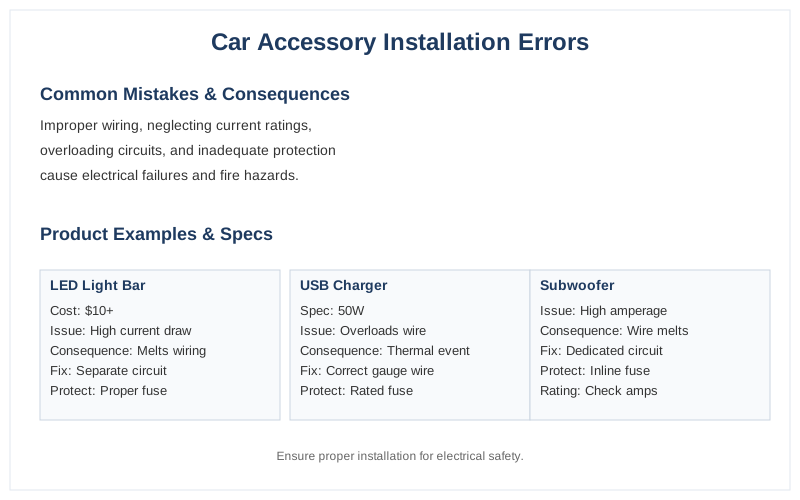
Car Accessory Installation Mistakes That Lead to Electrical Failure (2026 Complete Guide) — Key Spec
Key specifications for car accessory installation mistakes that lead to electrical failure

The Short Answer

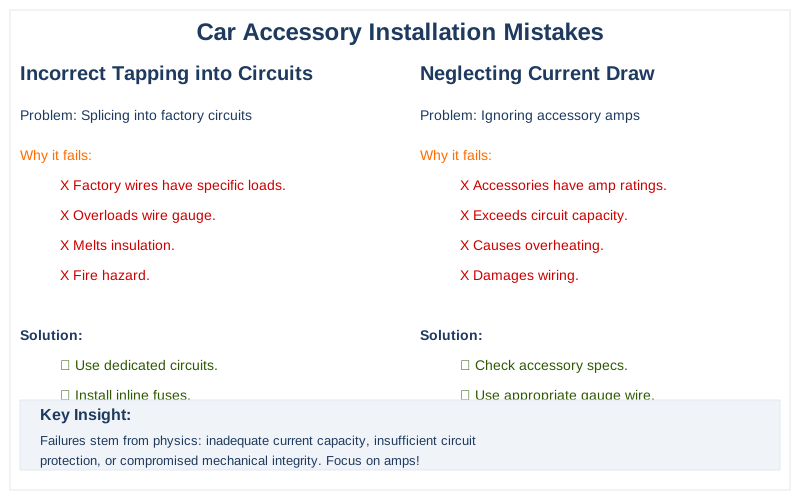
Aftermarket accessory installation failures almost always boil down to a few fundamental physics problems: inadequate current capacity, insufficient circuit protection, or compromised mechanical integrity. Forget the 'experience' of your new subwoofer; focus on the amps it's pulling.
Most folks treat car wiring like a string of Christmas lights. They splice into whatever 12V line is handy, assuming it'll just work. The factory harness, however, is engineered with specific wire gauges and fuse ratings for precise loads. Overload that 18AWG wire designed for a 5-watt dome light with a 50-watt USB charger, and you're creating a localized thermal event. That wire insulation will outgas and then melt. Common mistakes include improper wiring and neglecting current ratings. Circuit protection is another big one. Every factory circuit has a fuse sized to protect the wire itself, not just the component. If you tap into an existing circuit without adding a properly rated fuse for your new accessory, the weakest link becomes the wire. This means if your accessory shorts, the wire gets hot enough to cause thermal degradation before the factory fuse blows. Congratulations, you've just turned your wiring into a heating element. Then there's the mechanical stress aspect. Splices, crimps, and connections need to withstand constant vibration, thermal cycling, and occasional tugs. A cheap crimp connector, poorly applied, will develop high resistance over time. This generates heat, further degrading the connection until it fails completely, often opening the circuit or creating an intermittent fault. Blown fuses, drained batteries, or complete electrical system failures are common consequences. Modern vehicles are also incredibly sensitive to voltage fluctuations and electromagnetic interference. Tapping into CAN bus wires or sensitive sensor lines can introduce noise, causing everything from intermittent check engine lights to complete module communication failures. This isn't just about power; it's about signal integrity across the entire network. The ECM is the vehicle's brain, and you're essentially giving it a lobotomy with bad wiring. I've seen people cut into ABS sensor wires to power an underglow kit. That's not just stupid; it's dangerous. The underlying physics are simple: electricity flows along the path of least resistance, generating heat proportional to current and resistance. Interrupt that flow or exceed capacity, and something's going to burn or stop working. It's not magic, it's Ohm's Law.
Understanding these common mistakes can help prevent costly repairs, so be sure to explore common installation errors.
Double-check wire gauge; use at least 14-gauge wire for accessories drawing over 10 amps to prevent overheating.
When installing car accessories, understanding current capacity is crucial. Inadequate wiring can lead to electrical failures, as seen with a female engineer reviewing complex schematics. | Photo by ThisIsEngineering

The Reality Check

The factory electrical system is a finely tuned machine, designed to deliver specific currents to specific loads. When you start adding aftermarket components, you're introducing variables the engineers never accounted for. This is where the 'plug and play' dream turns into a 'smoke and pray' reality. Improper wiring is a major culprit behind electrical shorts. Take the example of tapping into a headlight circuit for an auxiliary light. A standard H11 bulb might pull 4.6A. Your new LED light bar pulls 10A. Now your 16AWG wire, designed for 5A max, is trying to carry 14.6A. That wire's resistance will cause a voltage drop, and more importantly, it'll get hot enough to soften the insulation at 180 degrees F, leading to a short. The factory fuse might not even blow if the overload isn't severe enough, just let the wire cook. Modern Body Control Modules (BCMs) are particularly sensitive. They monitor current draw on every circuit for bulb-out detection or short-circuit protection. Introduce an unexpected load, and the BCM can throw a fault code, shut down the circuit, or even go into a limp mode. Aftermarket accessories can cause powertrain issues and communication faults.
Component How It Fails Symptoms Fix Cost
Wire Splice High resistance due to poor crimp/solder, leading to thermal degradation. Intermittent accessory function, localized heat, melted insulation. $150 - $400 (splice repair, possibly harness section)
Inline Fuse Holder Low quality plastic, poor terminal contact, corrosion. Blown fuses, intermittent power, voltage drop to accessory. $80 - $250 (holder replacement, diagnosis for underlying short)
Ground Connection Insufficient surface area, paint under terminal, loose bolt, corrosion. Accessory hum, dimming lights, erratic behavior, parasitic draw. $100 - $300 (cleaning, proper terminal, re-grounding)
CAN Bus Tap Introduces signal noise, impedance mismatch, or shorts data lines. Warning lights, module communication failure, vehicle no-start. $500 - $2000+ (module replacement, harness repair, reprogramming)
I've seen a cheap LED light bar pull 15A on startup, then settle to 8A. If you tapped that into a 10A circuit, the initial inrush current alone could pop a fuse or stress a wire. The spec sheet for your accessory is not just a suggestion; it's a warning label. Ignoring it means you're gambling with your vehicle's electrical integrity. The tolerance for error in modern systems is razor-thin. This isn't your grandpa's '68 Impala.
To avoid similar issues with your DIY projects, explore common pitfalls in DIY road trip gear installs.
Always use a properly rated fuse, ideally within 18 inches of the power source, to protect circuits from surges.
Factory electrical systems are precise; adding aftermarket parts without proper planning can cause issues. These engineers' collaboration underscores the complexity of avoiding installation mistakes. | Photo by ThisIsEngineering

How to Handle This

When you're staring down a fried harness or an accessory that just won't behave, you've got choices. First, you need to understand the scope of the damage. Is it just a blown fuse, or did a poorly executed splice melt a section of the main loom? Amateur efforts can lead to a cascade of issues, from faulty wiring to electrical fires. 1. Isolate the Faulty Accessory: Disconnect the aftermarket accessory entirely. If the original electrical issue (e.g., a constant fuse blowing, a parasitic draw) resolves, you've found your culprit. This is step one for any diagnosis. Don't waste time tracing wires with the problem still connected. 2. Visual Inspection for Thermal Damage: Look for melted insulation, discolored wires (brown or black usually means heat), or burned components near your installation points. Pay close attention to any splices or crimps you made. If you see signs of heat, that's a mechanical stress point that failed. 3. Check Fuses and Relays: Replace any blown fuses with the correct amperage rating. If a fuse blows immediately after replacement, you have a direct short. This requires tracing the circuit with a multimeter set to continuity or resistance. Electrical problems after radio installation can cause gauges to go wild. 4. Confirm Ground Integrity: A poor ground connection is a common failure point. Ensure any ground wires are securely fastened to clean, bare metal. Paint, rust, or loose bolts introduce resistance, causing voltage drop and heat. Check continuity between the accessory's ground point and the battery negative terminal; it should be less than 0.5 ohms. 5. Assess Harness Damage: If the factory wiring harness is damaged beyond a simple splice repair, you're looking at a larger job. Small sections can be repaired with proper soldering, heat shrink, and OEM-spec wire. However, if multiple wires are cooked together, a section replacement might be necessary. This is where costs skyrocket. 6. Seek Professional Help (If Necessary): If you're out of your depth, find a reputable automotive electrical specialist, not just a general mechanic. They'll have diagnostic tools like oscilloscopes to check for signal integrity issues and thermal cameras to pinpoint hot spots. Expect to pay $120-$180 per hour for diagnosis. A simple harness repair could be $300-$700. A full module replacement or extensive harness work can run $1500-$3000+. Ask about their experience with aftermarket accessory troubleshooting and if they guarantee their electrical work for at least 12 months. Any shop that quotes a fixed price without diagnosing is selling you a fantasy.


When troubleshooting electrical issues, it’s also important to be aware of common dashcam installation errors that can arise.
Secure all splices with heat-shrink tubing and electrical tape for over 50% overlap to prevent shorts.
Experiencing car trouble under the hood often stems from installation errors. This mechanic's struggle highlights how poor wiring can lead to significant electrical system failures. | Photo by Tim Samuel

What This Looks Like in Practice

I've seen some real masterpieces of bad wiring. It's not always a dead component; sometimes it's an insidious, slow-motion failure that drives owners nuts. Damaging internal circuit boards during installation leads to instant failure.
  • Scenario 1: The Phantom Battery Drain. A guy installed a cheap alarm system on his 2017 Tacoma. After a week, the 60Ah battery was dead. Turns out, the alarm's 'always-on' circuit had a 400mA parasitic draw. Coupled with the normal 25mA BCM draw, the battery was flat in 6 days. The alarm's internal relay was stuck, pulling current even when disarmed. He spent $250 on a new battery before I found the 400mA draw with a $20 clamp meter.
  • Scenario 2: The Flickering Headlights. A customer installed aftermarket HID headlights on his 2014 Civic. He tapped into the factory low-beam circuit for power. The HIDs pulled 35W each, but their ballasts generated significant electromagnetic interference (EMI). This noise bled into the BCM's headlight control circuit, causing the factory LEDs to flicker at 20Hz. The BCM was confused, trying to correct a non-existent fault. A relay harness with direct battery power fixed the EMI issue.
  • Scenario 3: The Dead Radio, Live Hazards. Someone wired an aftermarket head unit into a 2008 Ford Focus. They shorted the constant 12V and accessory 12V wires together. This backfed power into the accessory circuit, causing the hazard lights to come on every time the key was turned off. The radio itself was fine, but the BCM was detecting a constant short. Avoiding common auto part install errors can save you headaches.
  • Scenario 4: The Rusty Ground. A DIY truck bed light kit was installed on a 2019 Ram 1500. The installer used a self-tapping screw into the bed frame for ground, but didn't scrape away the paint. Within 6 months, rust formed, creating a high-resistance ground. The lights worked intermittently, dimming with vibration. Eventually, the voltage drop was so severe the LEDs barely glowed. A proper ground to bare metal with a star washer would've prevented it.
  • Scenario 5: The Stalled Engine. A dashcam was hardwired to a fuse box in a 2020 Subaru Forester, tapping into a circuit that included the ECM. The cheap add-a-fuse kit had loose terminals, creating intermittent contact. This caused voltage fluctuations on the ECM's power supply, leading to random engine stalls at idle. The ECM would momentarily lose power, then reboot. A solid connection from a dedicated fuse slot fixed the 'stalling' issue, which was actually a power integrity problem.
  • To avoid wiring disasters, consider clever DIY car accessory hacks that utilize common household items.
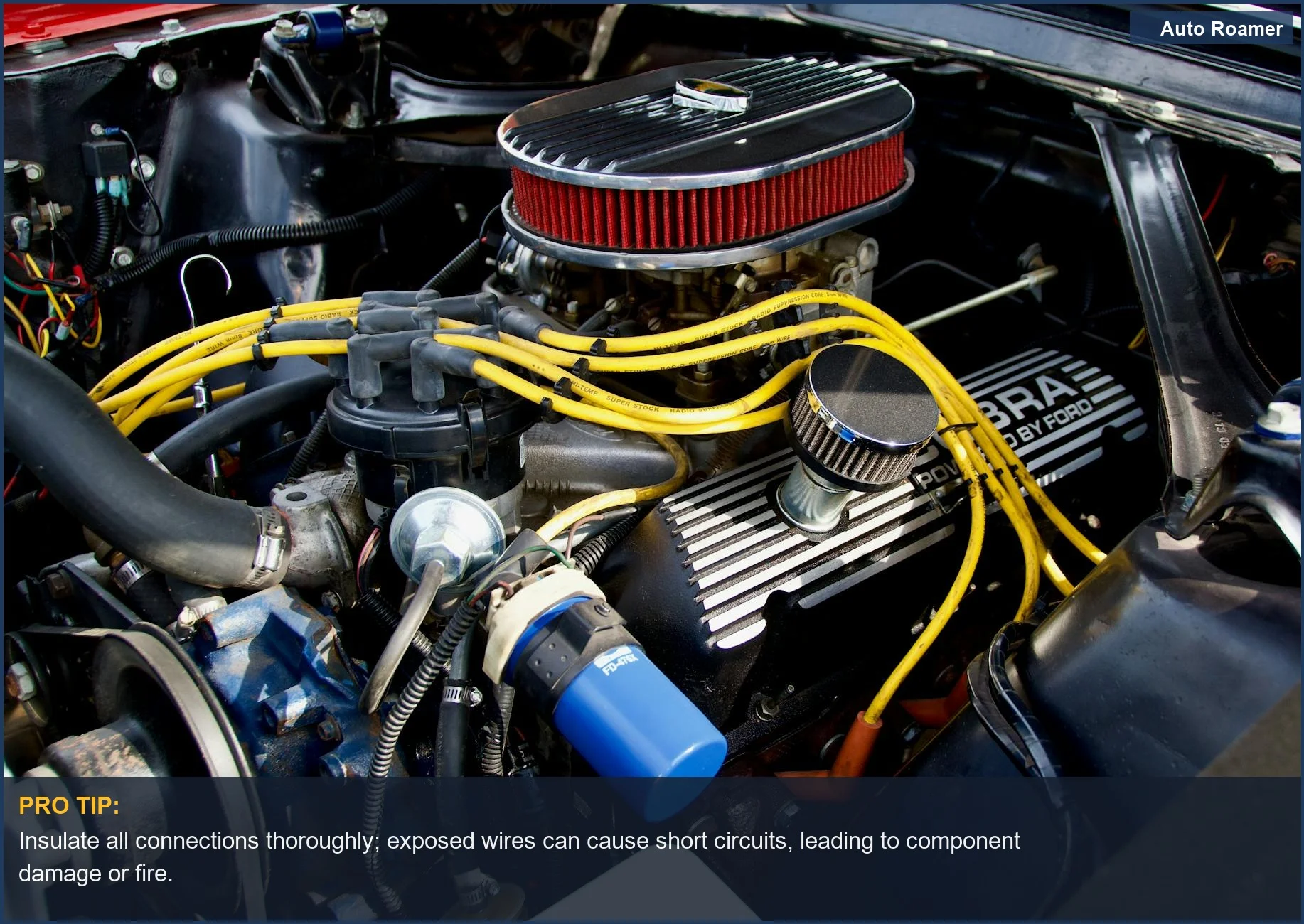
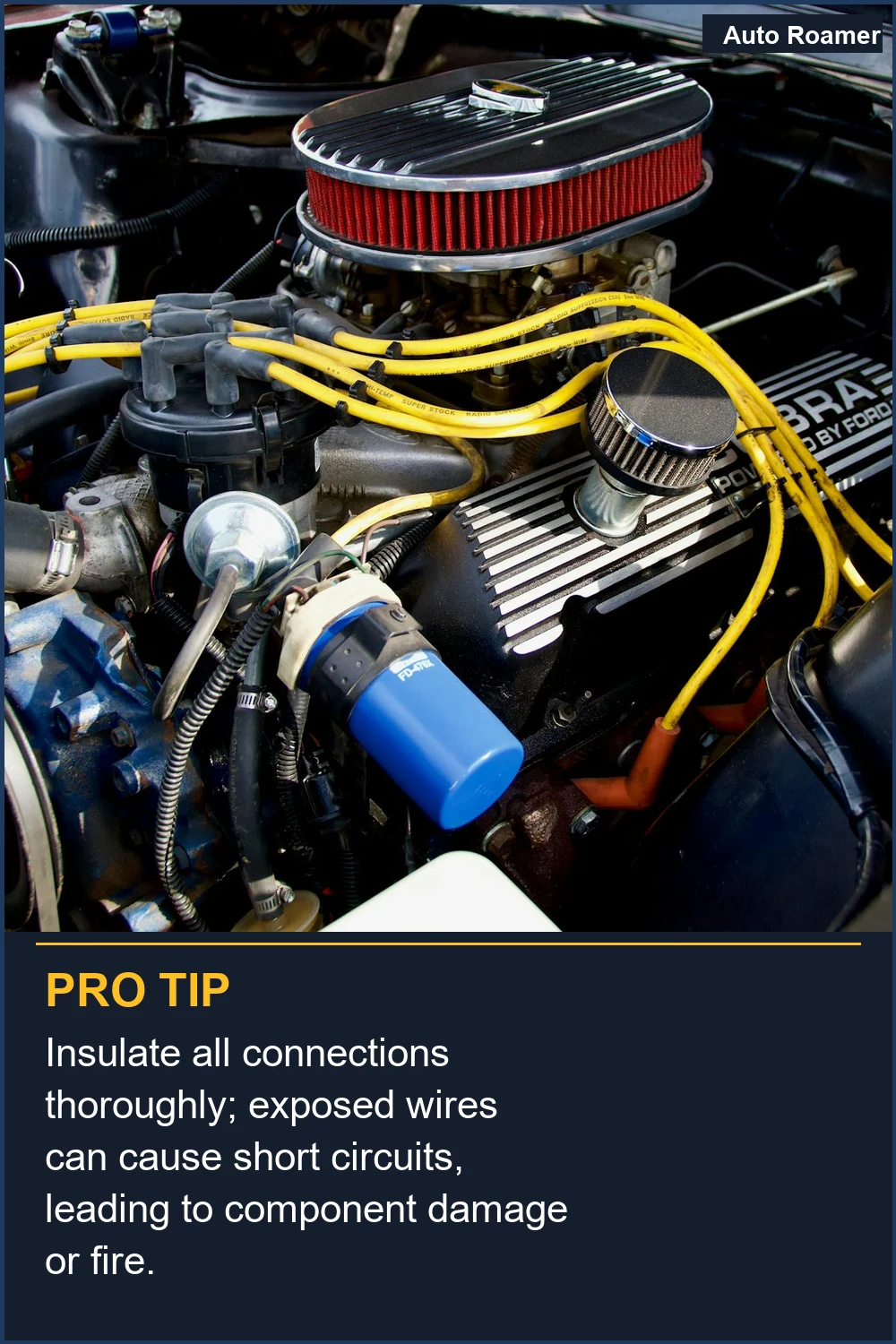
    Insulate all connections thoroughly; exposed wires can cause short circuits, leading to component damage or fire.
    Intricate engine wiring demands precision. A close-up reveals the complexity, emphasizing how minor car accessory installation mistakes can trigger cascading electrical failures. | Photo by Tom Kowalsky

    Mistakes That Cost People

    People make the same mistakes over and over, then wonder why their vehicle is acting possessed. It's not ghosts; it's bad physics. Wiring and connection issues are common electrical problems.
    Mistake Why It Fails (Physics) Consequence
    Using Scotch-Loks/T-Taps Pierces wire insulation, poor mechanical bond, high resistance, corrosion ingress. Intermittent connection, voltage drop, heat generation, eventual open circuit.
    Incorrect Wire Gauge Wire's current capacity exceeded, I^2R heating. Melted insulation, short circuits, fire risk.
    No Inline Fusing Accessory short bypasses protection, wire becomes the fuse. Damaged factory harness, potential fire, expensive repairs.
    Poor Ground Connection High resistance path to chassis, voltage drop, signal noise. Dimming lights, accessory malfunction, parasitic draw, BCM errors.
    Tapping CAN Bus/Sensitive Signals Introduces impedance mismatch, signal noise, or shorts data lines. Module communication failure, warning lights, vehicle no-start, limp mode.
    Leaving Wires Unsecured Vibration causes insulation abrasion, eventual short to chassis or metal components. Intermittent shorts, blown fuses, exposed conductors.
    Improper Solder/Crimp Cold solder joint, insufficient crimp pressure, creates high resistance. Intermittent power, heat generation, eventual mechanical failure.
    I've seen people twist wires together and wrap them in electrical tape. That's not a connection; that's a thermal event waiting to happen. The mechanical stress from vibration will break those strands, leading to a high-resistance point and heat. The tape will eventually unwrap, and you'll have bare wires shorting out. Improperly installed accessories can cause electrical shorts. Another gem: using a fuse tap to power a 20A accessory from a 5A circuit. That 5A circuit has 22AWG wire. Now you've got 20A trying to pull through wire designed for a quarter of that. The fuse in the tap might protect the accessory, but the factory wire is still going to cook. It's not about the fuse; it's about the wire's ampacity. This stuff isn't rocket science, but it does require basic understanding of electrical load.
    Just like improper car accessory installations can cause issues, many parents also overlook key errors with their child's car seat installation.
    Car Accessory Installation Mistakes That Lead to Electrical Failure (2026 Complete Guide) — Pros and
    Comparison overview for car accessory installation mistakes that lead to electrical failure

    Key Takeaways

    Messing with your car's electrical system without understanding the underlying physics is a surefire way to turn a $50 accessory into a $1500 repair bill. I've seen it too many times. Adding high-power accessories without proper wiring and fusing can overload circuits. Here's the dirt:
  • Current Capacity is King: Always match your wire gauge and circuit protection to the actual current draw of your accessory. Don't eyeball it. Consult the spec sheet.
  • Mechanical Integrity Matters: Every splice, crimp, and ground connection needs to be solid. Vibration and thermal cycling will exploit any weakness, leading to high resistance and eventual failure.
  • Protect the Circuit, Not Just the Accessory: Fuses protect the wiring from overcurrent.
  • Always use an appropriately rated fuse for your accessory, and ensure it's in a circuit capable of handling the load.
  • Ground is Critical: A clean, tight, low-resistance ground connection is non-negotiable. Bad grounds cause erratic behavior and introduce noise into sensitive systems.
  • Avoid Data Lines: Never tap into CAN bus, LIN bus, or other data communication lines unless you know exactly what you're doing. You're inviting digital chaos. It's not worth the risk.
  • Your vehicle's brain doesn't appreciate random voltage spikes. This is basic circuit integrity. Save yourself the headache and the cash.
    Understanding common electrical issues can help you avoid problems caused by electromagnetic interference in your vehicle.

    Frequently Asked Questions

    My dashcam install is causing problems. Is it cheaper to buy a $15 add-a-fuse kit and fix it myself, or pay the dealer $250 for a 'diagnostic'?
    A $15 add-a-fuse kit is a quick fix if your wiring is otherwise sound and you're just on the wrong circuit. The dealer's $250 diagnostic will likely confirm your dashcam is the problem, then they'll quote you another $300-$500 to 'properly' wire it. They won't care about your $15 fix; they'll just want to sell you their overpriced solution. Do the initial diagnosis yourself.
    Do I really need a multimeter to check for parasitic draw, or can I just pull fuses until the problem stops?
    You need a multimeter, specifically one with a DC amperage function, to accurately measure parasitic draw. Pulling fuses might find the circuit, but it won't tell you the exact current. You need to know if it's 50mA (normal) or 500mA (problem) to understand the failure rate on your battery. A $15 multimeter will save you hundreds on batteries.
    What if I properly fuse my accessory, use the right wire gauge, and it still doesn't work?
    If you've checked current, wire gauge, and fusing, then the problem is likely a poor ground connection or a faulty accessory. Verify your ground point has less than 0.5 ohms resistance to the battery negative. If that's good, then the accessory itself might be defective, or you're dealing with signal interference if it's a data-dependent component. Don't blame the car until you've ruled out the accessory.
    Can a poorly installed aftermarket radio permanently damage my car's ECU or BCM?
    Absolutely. A direct short or backfeeding voltage into sensitive control modules can fry internal circuits. The BCM (Body Control Module) and ECU (Engine Control Unit) are designed for specific voltage and current inputs. Introducing an unexpected spike or short can cause permanent thermal damage to the processor or power supply circuits. These modules cost $800-$2000+ to replace, plus programming.
    My friend said it's fine to just twist wires together and tape them. Is he right?
    Your friend is an idiot. Twisting wires together creates a high-resistance, mechanically weak connection. It will corrode, generate heat, and eventually break due to vibration and thermal cycling. Electrical tape is not insulation; it's a temporary cover. Use proper crimp connectors with heat shrink or solder and heat shrink for a connection that actually lasts. Anything else is a fire hazard.

    🏅 Looking for Gear Recommendations?

    Check out our tested gear guides for products that work with this setup:

    J

    Jake - The Dirtbag Engineer

    Mechanical engineer turned car camper. Specializes in power systems, dashcam technology, and DIY vehicle modifications.

    Sources

    Related Articles