A Fridge That Dies With the Ignition Isn't Broken
A 12V fridge that runs perfectly while you drive and shuts off the instant you switch off the car looks like a fault, but it almost never is. The fridge is fine. What is failing is the power reaching it, and the culprit is usually the socket it is plugged into rather than anything inside the fridge.
Most 12V compressor car fridges run on a nominal 12V DC system, and many are dual-voltage 12V/24V. They are designed to run continuously, including with the engine off, which is the whole point of a compressor fridge for camping. So a fridge that only runs with the key on is being starved of power by its connection, not choosing to shut down.
There are two common reasons the power dies with the ignition. The first and most likely is the socket: a cigarette-lighter or accessory 12V socket is usually switched by the ignition, so it only supplies power when the key is on or in accessory, and goes dead when the car is switched off. Plug a fridge into that socket and it dies with the key, every time.
The second reason is the fridge's own low-voltage battery protection cutting it off, either because the setting is wrong for the battery you are using, or because thin wiring is dropping the voltage below the cutoff. Both are settings-and-wiring problems, not fridge failures, and both are fixable. This guide sorts which one you have and walks the permanent fix.
Match the Symptom to the Cause
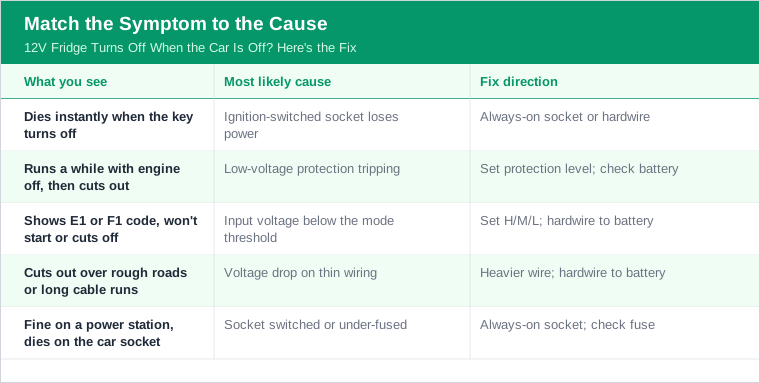
The exact behavior tells you whether it is the socket or the protection cutoff. Line it up before rewiring anything.
| What you see | Most likely cause | Fix direction |
|---|---|---|
| Dies instantly when the key turns off | Ignition-switched socket loses power | Always-on socket or hardwire |
| Runs a while with engine off, then cuts out | Low-voltage protection tripping | Set protection level; check battery |
| Shows E1 or F1 code, won't start or cuts off | Input voltage below the mode threshold | Set H/M/L; hardwire to battery |
| Cuts out over rough roads or long cable runs | Voltage drop on thin wiring | Heavier wire; hardwire to battery |
| Fine on a power station, dies on the car socket | Socket switched or under-fused | Always-on socket; check fuse |
The key distinction is timing. A fridge that dies the exact instant the key turns off is a switched-socket problem, because the power was cut, not the fridge. A fridge that keeps running for a while with the engine off and then quits is a protection-cutoff problem, because the battery voltage fell to the fridge's low-voltage threshold.
Those two point at different fixes. The switched socket needs a different power source, an always-on socket or a hardwired connection. The protection cutoff needs the right setting for your battery, and often a second battery or power station so the fridge is not draining your starter battery to the cutoff in the first place.
The Number One Cause: An Ignition-Switched Socket
If the fridge dies the moment the key turns off, the socket is switched, and this is the most common version of the whole problem. If a 12V fridge only runs while the ignition is on, the most common cause is that it is plugged into an ignition-switched socket rather than an always-on, constant, or battery socket. The socket does exactly what the carmaker designed it to do: cut power with the key.
Why carmakers switch these sockets is sensible, they do not want an accessory left plugged in to flatten the battery overnight. But it is exactly wrong for a fridge, which needs to keep running with the engine off. The socket is not faulty; it is just the wrong socket for a fridge.
The first thing to check is whether your vehicle has a constant socket somewhere else. Some vehicles have both an ignition-switched socket and a constant, always-on socket, and moving the fridge to the constant socket lets it keep running with the engine off. Test each socket with the key out; the one that still has power is the always-on one, and it may be in the cargo area, the console, or the rear seats.
The catch with an always-on socket is that it lets the fridge run straight off the starter battery with the engine off, which will slowly drain it. That is fine for a few hours but risky overnight, which is why the durable fix pairs a constant power source with the fridge's low-voltage protection set correctly, so the fridge cuts off before it flattens the battery you need to start the car.
How the Low-Voltage Protection Works
The other common cause of a fridge cutting out is its own built-in battery protection, and understanding it prevents a lot of confusion. Many fridges, Alpicool being a common example, have a three-level low-voltage battery-protection function with modes labeled H, M, and L, shown on some models as H3, H2, and H1, with the factory default set to the H, highest, protection level.
Each level cuts the compressor off at a different voltage to protect the battery. On 12V input, the H (H3) mode turns the compressor off at 11.1V and restarts it at 12.4V. The M (H2) mode turns off at 10.1V and restarts at 11.4V. The L (H1) mode turns off at 9.6V and restarts at 10.9V. So the higher the level, the sooner the fridge quits to protect the battery.
This is why a fridge on the default H setting seems to cut out early: it is doing its job, shutting down at 11.1V to leave your starter battery enough charge to crank the engine. On a 24V system the same protection uses higher thresholds, with stages running from 21.3V off and 22.7V on up to 24.3V off and 25.7V on.
The codes tie into this too. An E1 error means the input voltage is too low to start, below the mode's turn-on threshold, such as below 12.4V in H mode, and an F1 code indicates the low-voltage protection has cut the fridge off. So an E1 or F1 accompanying the shutdowns confirms it is the protection, not the socket, doing the cutting, and the fix is the setting plus a healthier power source.
Set the Protection Level for Your Battery
Once you know the protection is cutting the fridge off, the fix is matching the setting to the battery you are running from. The rule is simple: set H when the fridge is connected to the vehicle's starter battery, and set M or L when it is connected to a portable power station, leisure or second battery, or an AC adapter.
The logic follows the risk. On the starter battery, you want the fridge to quit early, at 11.1V in H mode, so it never drains the battery you need to start the car. On a dedicated leisure battery or power station, there is no starting risk, so you can let the fridge run the battery down further, to the M cutoff at 10.1V or the L cutoff at 9.6V, before it protects itself, getting more runtime out of your storage.
Setting the level correctly resolves two opposite complaints at once. If your fridge cuts out too early on a leisure battery that still has charge, it is set to H when it should be M or L. If your fridge is flattening your starter battery, it is set too low, M or L when it should be H. The default H is the safe choice on a starter battery and the frustrating one on a leisure battery.
Note the soft-start setting while you are in the menu. The soft-start, or compressor delay, default is 2 minutes and is adjustable from 0 to 10 minutes, which staggers the compressor restart after power returns. It does not cause the engine-off shutdown, but a long soft-start delay can make a fridge look slow to resume after the protection restarts it, which is worth knowing so you do not mistake it for a fault.
Voltage Drop: The Hidden Cutoff Cause
There is a sneaky version of the protection cutoff that traps people who have set everything correctly: thin wiring. Long or thin cigarette-lighter wiring causes voltage drop that can push the fridge below its low-voltage cutoff and shut it off even when the battery itself is healthy. The battery is fine; the voltage arriving at the fridge is not.
Voltage drop is the loss of voltage along a wire that is too thin or too long for the current it carries. A fridge drawing its running current through a skinny cigarette-lighter cable and a marginal socket connection can see a meaningfully lower voltage at its input than the battery actually holds. If that arriving voltage dips below the mode's cutoff, the protection trips, and the fridge shuts off blaming a low battery that is not actually low.
The tell is a fridge that cuts out over rough roads, on long cable extensions, or when it should have plenty of battery left. Rough roads jostle a marginal socket connection, and long cheap extension cables add resistance, both of which deepen the drop. A fridge that runs fine on a short, thick cable and cuts out on a long thin one is describing voltage drop, not a battery problem.
The startup surge makes wiring size matter even more. Compressor fridges draw a brief startup surge higher than their running current, with mini-fridge startup spikes commonly cited at 10 to 15 amps, so the wiring and fuse must be sized for the surge, not the average. A wire that carries the 1-to-2-amp running current fine can still sag on the surge, tripping the cutoff at the worst moment.
The Permanent Fix: Hardwire to the Battery
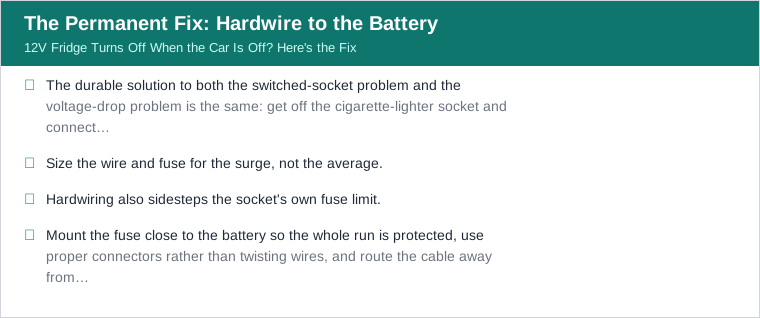
The durable solution to both the switched-socket problem and the voltage-drop problem is the same: get off the cigarette-lighter socket and connect the fridge properly. The recommended permanent fix is to hardwire the fridge to the battery with an inline fuse mounted as close to the battery as possible. That bypasses the switched, thin, fuse-limited socket entirely.
Size the wire and fuse for the surge, not the average. For a hardwire run of about 15 feet, 10 AWG wire is the recommended minimum to carry the current safely and limit voltage drop. An inline fuse around 20A is commonly recommended for a portable fridge to cover the startup surge, though on lighter 12 AWG wire the fuse should be no more than 15A. A proper 12V fridge wiring harness with an inline fuse makes the job clean and safe.
Hardwiring also sidesteps the socket's own fuse limit. Factory cigarette-lighter circuits are commonly fused at only 10A or 15A, which is one reason a fridge on that socket can be starved or trip a blown fuse, and those values vary by vehicle. A dedicated 10 AWG run with its own 20A fuse gives the fridge the clean, surge-capable supply the thin socket circuit cannot.
Mount the fuse close to the battery so the whole run is protected, use proper connectors rather than twisting wires, and route the cable away from heat and sharp edges. Done once, a hardwired fridge stops cutting out over rough roads and stops dying with the ignition, because it is now fed directly from the battery through wiring sized for the job.
Keep It Running Without Draining Your Starter
Hardwiring to the starter battery solves the switched-socket problem, but it introduces the original worry: a fridge running with the engine off can flatten the battery you need to start the car. The right protection level helps, cutting off at 11.1V in H mode, but the better answer for serious camping is to not run the fridge off the starter battery at all.
A dedicated leisure battery is the classic solution. Alternatives to hardwiring the starter battery are a dedicated leisure or second battery isolated by a smart battery isolator or DC-DC charger, or running the fridge from a portable power station, so the fridge keeps running with the engine off without draining the starter battery. The isolator charges the second battery while you drive, then disconnects it so the fridge draws only from the leisure battery when parked.
Sizing that storage is where the fridge's real appetite matters. A daily draw of about 310Wh at 12V is roughly 26Ah per day, and about 610Wh is roughly 51Ah per day, so battery or power-station capacity should be sized against that daily figure. A fridge that sips 310 watt-hours a day in mild weather and 610 in the cold needs a battery big enough to cover a night, and ideally more, without hitting its cutoff.
A power station is the plug-and-play version of the same idea, and it lets you set the fridge's protection to M or L for maximum runtime since there is no starting risk. Whichever route you choose, the goal is the same: a constant power source sized to the fridge's daily draw, so it runs all night with the engine off and never leaves you with a dead starter battery in the morning.
The Fix Sequence, Start to Finish
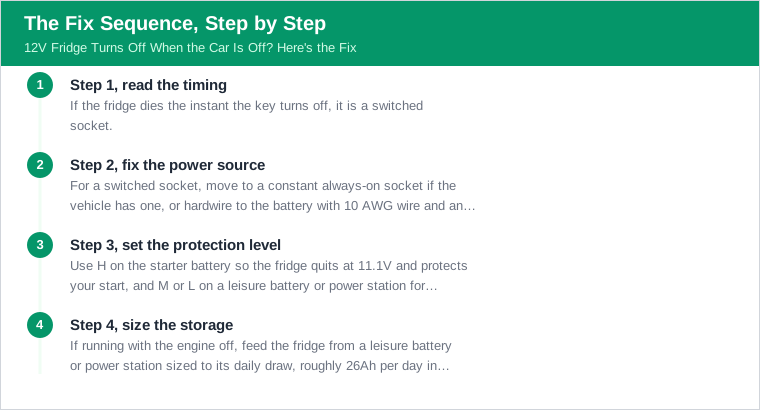
The whole problem resolves in a short order: identify the cause by timing, fix the power source, then set the protection. Follow it top to bottom.
Step 1, read the timing. If the fridge dies the instant the key turns off, it is a switched socket. If it runs a while with the engine off and then cuts out, or shows E1 or F1, it is the low-voltage protection.
Step 2, fix the power source. For a switched socket, move to a constant always-on socket if the vehicle has one, or hardwire to the battery with 10 AWG wire and an inline fuse around 20A mounted near the battery. Hardwiring also fixes voltage drop from thin cigarette-lighter wiring.
Step 3, set the protection level. Use H on the starter battery so the fridge quits at 11.1V and protects your start, and M or L on a leisure battery or power station for more runtime, cutting off at 10.1V or 9.6V.
Step 4, size the storage. If running with the engine off, feed the fridge from a leisure battery or power station sized to its daily draw, roughly 26Ah per day in mild weather and up to 51Ah in the cold, so it runs all night without flattening the starter battery.
The Verdict: Fix the Power, Not the Fridge
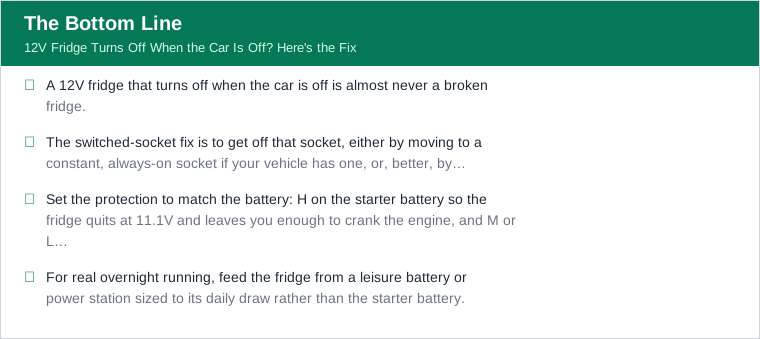
A 12V fridge that turns off when the car is off is almost never a broken fridge. It is being cut off by its power source, and the two causes are easy to tell apart by timing. Dies the instant the key turns off means an ignition-switched socket; runs a while and then quits, or throws an E1 or F1, means the low-voltage protection is doing its job.
The switched-socket fix is to get off that socket, either by moving to a constant, always-on socket if your vehicle has one, or, better, by hardwiring the fridge to the battery with 10 AWG wire and an inline fuse around 20A mounted near the battery. Hardwiring solves the voltage-drop version of the problem too, since thin cigarette-lighter wiring can trip the cutoff even on a healthy battery.
Set the protection to match the battery: H on the starter battery so the fridge quits at 11.1V and leaves you enough to crank the engine, and M or L on a leisure battery or power station for more runtime. An E1 or F1 code alongside the cutouts confirms the protection is the cause and the setting is where to look.
For real overnight running, feed the fridge from a leisure battery or power station sized to its daily draw rather than the starter battery. Do that and a fridge that used to die with the ignition runs quietly through the night with the engine off, exactly as a compressor fridge is meant to, and your car still starts in the morning.