
First, Rule Out Normal Pulldown
Before you diagnose a fault, make sure you are not just looking at a fridge that needs more time. A 12V compressor fridge pulls down slowly by design. A warm box can take several hours to reach setpoint, so a unit that has only been running for thirty minutes and is not cold yet is behaving exactly as it should.
This matters most on day one and after any warm-up. Load a fridge with room-temperature drinks, or open it repeatedly while packing, and the compressor has to fight all that heat back out of the box. That is a long job for a small compressor, and the temperature falls in a gradual curve rather than a quick drop. Judging it after a few minutes is like judging an oven the moment you turn it on.
The honest test is to let it run undisturbed for several hours with the lid closed and then read the internal temperature. If it is trending down, even slowly, the sealed system is working and the rest of this guide is about removing the obstacles slowing it. If, after hours of runtime, the box is no cooler than the cabin, then you have a real problem worth chasing - and the good news is that most of the time the culprit is something outside the compressor entirely. Give it the time first; then diagnose.
The Box Is Fighting the Ambient
A 12V fridge does not cool to a fixed number in a vacuum - it works against the air around it, and hot air makes the job much harder. The typical normal operating ambient range is about 50F (10C) to 109F (43C), and within that band the fridge should reach its setpoint. Push past the top of it and performance falls off a cliff.
In ambient above roughly 90-95F (32-35C), the condenser struggles to shed heat and the box may never reach setpoint. This is the single most common reason a fridge seems to run forever without getting cold in summer. A unit sitting in a closed car, in direct sun, or against a hot bulkhead is trying to dump heat into air that is already hot, and there is nowhere for that heat to go. The compressor runs and runs because it can never catch up.
The fix is to lower the fridge's environment, not just its setpoint. Move it out of direct sun, crack a window or run a fan in a parked vehicle, and keep it away from the engine bay or any warm surface. Even shade and a little airflow around the unit can drop the working ambient enough to let the condenser breathe. If the box finally gets cold once the car cools down in the evening, ambient heat was your answer - the fridge was fine all along, just overwhelmed.
MAX vs ECO: You May Be in the Slow Mode
Many 12V fridges have two running modes, and the wrong one will make a healthy unit look weak. MAX mode runs the compressor harder for the fastest, coldest pulldown; ECO mode limits compressor speed to save power and cools more slowly. If you set the fridge to ECO to protect your battery and then wonder why it is not cold, you have found the answer without opening a single panel.
ECO is a genuinely useful mode once the box is already cold - it sips power to hold temperature. But it is the wrong choice for the initial pulldown, when you need the compressor working at full tilt to drag a warm box down to setpoint. The practical routine is to run MAX until the fridge reaches temperature, then switch to ECO to maintain it efficiently. Starting cold-soak in ECO can add hours to an already slow process.
While you are in the settings, confirm the setpoint itself is where you think it is. The setpoint range on typical models spans about -4F to 68F (-20C to 20C), which is wide enough that a bumped control could leave the fridge targeting 50F when you wanted 38F. A dial knocked in a bouncing cargo area, or a child-lock hiding the real setting, will quietly hold the box warmer than you expect. Check the mode and the number before assuming the hardware is at fault - both are one-button fixes.
Airflow: The Condenser Needs to Breathe
A compressor fridge cools by moving heat out of the box and releasing it through a condenser, and that condenser cannot work if it is smothered. Give the condenser and its fan at least a few inches - about 4 in (10 cm) - of clearance for airflow. Enclosed or against-the-wall installs trap heat and kill cooling, because the fridge ends up recycling its own exhaust.
This trips up a lot of built-in setups. A fridge slid perfectly into a cabinet or a tight drawer looks tidy, but if the vents are pressed against plywood the heat has nowhere to escape. The condenser radiates into a dead pocket of air that only gets hotter, the fan fights a losing battle, and the box stays warm even though everything is technically working. The tidier the install, the more likely it is starving the fridge of air.
The fix is ventilation, not repair. Leave a clear gap around the vent side, and in a cabinet install add a pass-through or a small computer fan to pull hot air out and draw cool air in. Keep the intake and exhaust from short-circuiting into each other. Outdoors, simply not parking the vent side against a wall or a pile of gear is often enough. A fridge that suddenly cools fine once you pull it out into open air was never broken - it was suffocating.
The Voltage Trap: Runs, Then Quits
Here is a failure that masquerades as a dozen others: the compressor tries to start, the voltage sags, and the fridge shuts itself down. 12V compressor fridges are very sensitive to voltage drop. Thin or long wiring causes the compressor to try to start, sense a voltage dip, and shut down immediately - so the box never gets a real chance to cool.
The physics is in the startup. A compressor draws more at the instant it kicks on than while it runs, and that brief startup surge exceeds the running current. Undersized wiring or a weak battery can trip the low-voltage cutoff at compressor start, so the unit clicks on, browns out, and clicks off in a loop. From the outside it looks like short-cycling or a dead compressor; underneath, it is a wiring and voltage problem.
Diagnose it at the plug. The most common offenders are a too-thin cigarette-lighter lead, a long extension of undersized wire, or corroded contacts adding resistance. Wire the fridge with adequately thick cable on as short a run as practical, straight to a healthy battery where possible, and confirm the connections are clean and tight. If a fridge that stalls on a skinny socket lead runs perfectly on a short, fat cable to the battery, voltage drop was the whole story. This is also why a fridge often behaves on shore power but fails in the vehicle - the wiring, not the fridge, changed.
Battery Protection H/M/L Is Cutting You Off
Almost every 12V fridge has a battery-protection setting, and the wrong level will shut the compressor down before the box is cold. Battery protection has three levels - H (High), M (Medium), and L (Low) - with H the factory default. The higher the setting, the sooner the fridge quits to spare the battery.
The exact thresholds are published. On Alpicool H mode, input must be above about 12.4V to start, and the fridge shuts off if voltage falls below about 11.1V. Across the settings, reported cutoffs are roughly 11.8V on H, 11.0V on M, and 9.6V on L - and that L figure is below the safe minimum for a lithium (LFP) battery, so it is only appropriate on a supply you are willing to run down. The rule of thumb: use H when wired to a car or starter battery to protect it, and use M or L when running on AC power or a dedicated house/portable battery.
The trap is a fridge set to H, fed by a battery that sags under load, quitting at 11.8V while you assume the cooling died. Drop it to M or L on an appropriate power source and the compressor stays on long enough to actually chill the box. Separately, the compressor's own control board protects the fridge with a low-voltage cutoff near 10.5V and a high-voltage cutoff near 15.5V; those are hardware limits you cannot adjust, but the H/M/L setting is the one that usually cuts a run short.
The Door Seal and the Overpacked Box
Two mechanical problems make a healthy fridge run nonstop without ever getting cold, and both are easy to miss. The first is the seal. A damaged or dirty door seal lets warm air in, so the compressor runs continuously but the box stays warm. Every gap around the lid is a slow leak of cabin heat straight into the space you are trying to cool, and the compressor simply cannot win against an open door.
Check the seal by feel and by sight. Run a finger around the gasket for cracks, grit, or a spot that has taken a set and no longer springs back. A classic test is to close the lid on a slip of paper - if it pulls out with no drag, the seal is not gripping there. Clean the gasket, work out any warp, and confirm the lid latches square. A seal is cheap next to a compressor, and a leaking one is a far more common cause of a warm box than a failed sealed system.
The second problem is packing. Overpacking with warm items or blocking internal airflow prevents the box from reaching temperature. Cold air has to circulate around the contents, and a box crammed to the lid with room-temperature cans gives the compressor an enormous heat load and no room to move air. Pre-chill what you can, leave space for circulation, and do not treat the fridge as a place to cool a warm case of drinks all at once. Load it cold and it stays cold; load it hot and full and it struggles for hours.
When It's Actually the Sealed System
Only after the outside factors are ruled out is it fair to suspect the fridge itself. If the compressor runs constantly yet the box never cools - with good voltage, clear airflow, a sound seal, MAX mode, and a reasonable ambient - suspect a low refrigerant charge or a failed sealed system. That is the genuine hardware failure, and it is not user-serviceable.
The signature is telling. A sealed-system fault means the compressor hums along drawing power, but there is no cold being produced, because the refrigerant that carries the heat is low or gone. Unlike a wiring problem, it does not short-cycle; unlike an airflow problem, moving the fridge into open cool air changes nothing; unlike a seal problem, a taped-shut lid still will not chill. When every external variable is clean and the box is still no colder than the room after hours, the loop inside has failed.
There is no home fix for this. The sealed refrigeration circuit is charged and brazed at the factory, and recharging it requires specialized equipment most owners do not have. At that point the practical decision is warranty service or replacement, depending on the unit's age and value. The important thing is to arrive here last, not first - because a fridge condemned as a dead compressor is, far more often, a wiring, airflow, seal, or setting problem wearing a convincing disguise.
Power It Right So It Never Sags
Because so many not-cold complaints trace back to voltage, it is worth sizing the power system to keep the fridge happy. Know the loads first. Typical running current is about 4-6A at 12V - a field-tested 35L Alpicool averaged about 5.2A while running - and compressor-on power draw is typically about 45-55W, dropping to an idle/standby draw of only about 2W between cycles. Those are modest numbers, which is exactly why a fridge should not be flattening a healthy supply.
The problem is rarely the average draw and almost always the sag under startup. That brief surge at compressor start is what trips protection on a weak or poorly wired supply, so the goal is a power system stiff enough that the voltage barely dips when the compressor kicks on. For continuous fridge use, target at least about 200Ah of lithium capacity and 300W of solar so the battery never sags to the low-voltage cutoff. With that headroom, the fridge cycles cleanly and the H protection setting never fires prematurely.
If you are running off the starter battery, keep the run short and the wire thick, and consider a plug-in voltage monitor so you can watch the feed sag in real time. Seeing the number drop toward 11.8V at each compressor start tells you instantly whether the shutdowns are a protection setting doing its job on a tired battery, or a genuine cooling fault. Fix the supply and a huge share of not-cold problems simply disappear.
The Verdict: Cold Air Is a Chain, Find the Broken Link
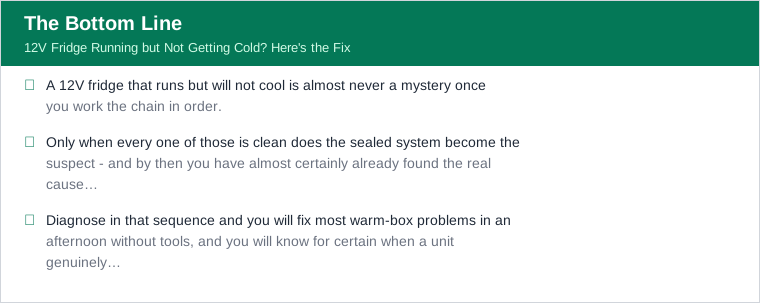
A 12V fridge that runs but will not cool is almost never a mystery once you work the chain in order. Give it several hours to pull down. Get it out of ambient above 90-95F (32-35C) and into some airflow. Put it in MAX mode with the setpoint where you want it. Give the condenser its 4 in (10 cm) of clearance. Confirm the voltage feed is not sagging and the H/M/L protection is matched to your power source. Check the seal and stop overpacking.
Only when every one of those is clean does the sealed system become the suspect - and by then you have almost certainly already found the real cause somewhere earlier in the list. The compressor running is actually good news: it means the electrical side is alive and the fault is usually something removable rather than a dead unit.
Diagnose in that sequence and you will fix most warm-box problems in an afternoon without tools, and you will know for certain when a unit genuinely needs service instead of guessing. Work top to bottom and you rarely reach the bottom, because the cheap fixes sit at the top of the list and the expensive one sits at the very end. That ordering is not an accident - it is the whole point. Cold air is a chain of conditions - time, ambient, airflow, voltage, mode, and seal - and a warm fridge just means one link is broken. Find it, and the cold comes back.